

If you finish a meal feeling dull, rise from pranayama feeling edgy, or reach the evening unable to hold your attention, another purity rule probably won’t solve the problem. You need to notice which fuel is disturbing the flame.
The Dharmic idea of Agni gives you a practical way to do that. Agni transforms food, breath, sensory impressions, and intention into energy, attention, judgement, and action. The aim is not the hottest fire or the strictest routine. It is a steady fire: strong enough to transform what you take in, calm enough to leave the mind clear.
When digestion means more than the stomach

The Bhagavad Gita 15.14 identifies the divine presence within the body as vaisvanara, the digestive fire that assimilates four kinds of food. This places eating inside a sacred relationship. Food is not inert material passing through a machine; it is an offering entering a field of life.
The Chandogya Upanishad traces a related movement from purity of nourishment to clarity of sattva, from clarity to stable remembrance, and from remembrance to the loosening of inner knots. This does not mean that a prescribed menu produces liberation. It means that confused consumption makes sustained remembrance harder, while appropriate nourishment creates better conditions for it.
The panca-kosha teaching helps explain the sequence. The annamaya kosha is sustained by food. The pranamaya kosha concerns vital movement. The manomaya kosha carries thought and sensory response. The vijnanamaya kosha discriminates. The anandamaya kosha points toward a subtler ground of being. These are not isolated compartments. A disturbed meal can unsettle breath; unsettled breath can agitate thought; agitated thought can weaken discrimination.
Audit the four things you consume
Before changing your diet, look at the whole stream of ahara. Use these four questions at the end of an ordinary day:
- Anna, material food: Did your meals leave you comfortably nourished, or heavy, restless, hungry again, and unable to concentrate? Observe the after-effect rather than relying only on a food’s reputation.
- Prana, vital intake: Was your breathing easy and continuous, or did haste, argument, work, and screen use keep it constricted? Breath often reveals disturbance before the mind names it.
- Vishaya, sensory material: Which sounds, images, conversations, and notifications remained active in your mind after they ended? An input that repeatedly produces agitation is not neutral merely because it is digital.
- Bhava, mental attitude: Did you receive the day with gratitude and attention, or consume everything in resentment, fear, greed, and hurry? The same meal enters a different inner environment when the mind is hostile or distracted.
This wider audit prevents a common mistake. You may blame lunch for an afternoon crash while ignoring the argument you replayed through the meal, the shallow breathing at your desk, and the flood of alarming information that followed. Agni has to process the entire burden.
Eat to clarify, not to perform purity
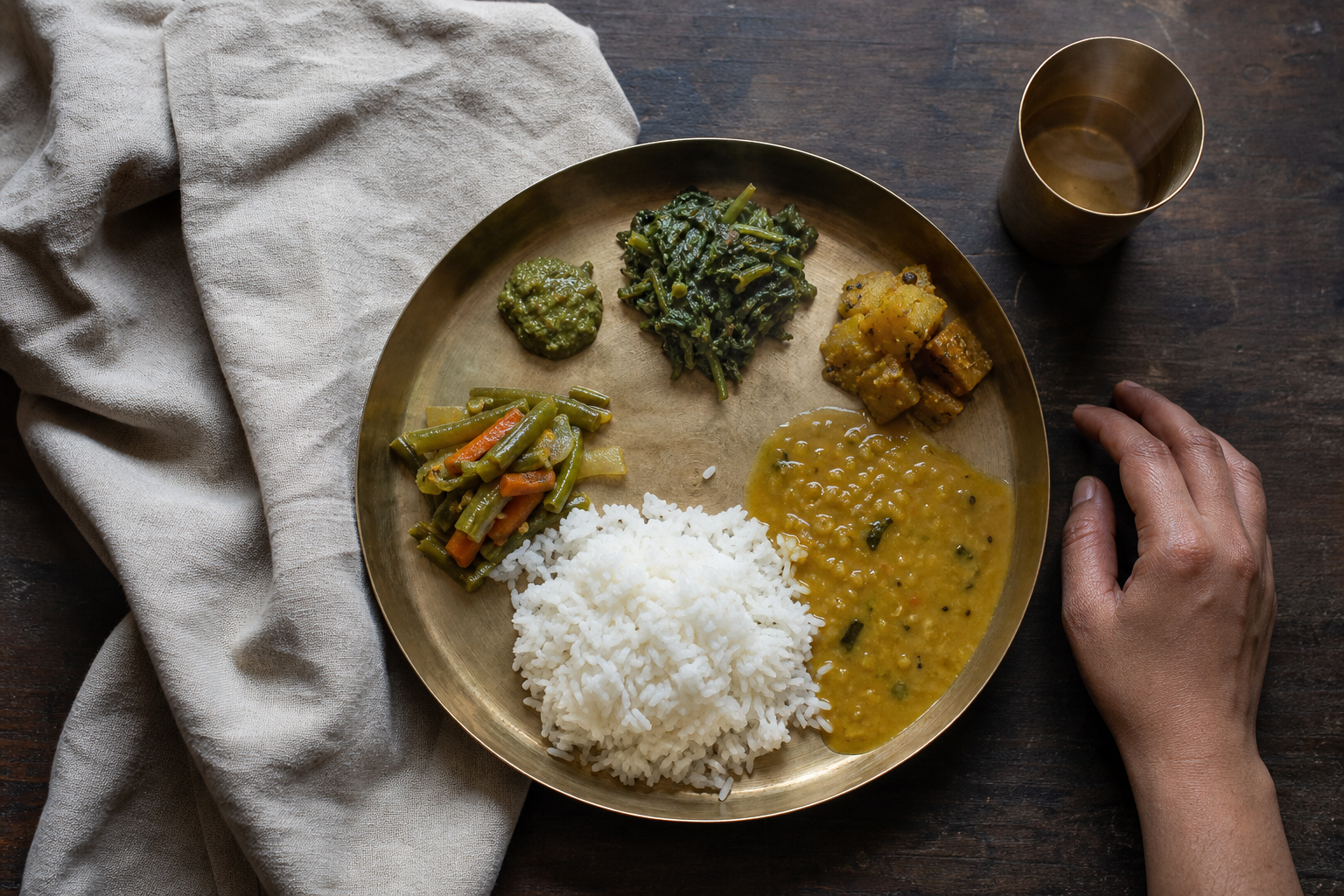
The Bhagavad Gita 17.8-10 describes food through its effects on consciousness. Fresh, light, nourishing food tends toward sattva. Excessively stimulating, intensely spiced, or carelessly over-processed food can feed rajas. Stale, degraded, or negligently prepared food inclines toward tamas. These categories are best used as observations, not as permanent labels stamped on a person or ingredient.
Sattva is not a badge of superiority. A dish does not become spiritually useful merely because it appears on an approved list. Its suitability also depends on freshness, season, preparation, quantity, constitution, health needs, and the state in which you eat it. Purity here means fitness and transparency: nourishment that does its work without unnecessarily clouding perception.
A workable baseline is a predominantly sattvika plate built around seasonal produce, legumes, whole grains, suitable dairy or plant-based fats, and digestive spices used with restraint. Consistent mealtimes matter because a fire tended at an intelligible rhythm is easier to observe than one alternately neglected and overloaded.
A meal practice you can repeat
- Choose a stable setting. Sit down and move the phone out of reach. A device-free meal reduces the number of inputs Agni must handle at once.
- Arrive before eating. Let several natural breaths pass without manipulating them. Offer gratitude to the people, soil, water, plants, animals, and forms of labour that made the meal possible.
- Eat without racing. Chew attentively and notice when taste turns into automatic repetition. The point is not to reach a prescribed chewing count; it is to remain present long enough to detect satisfaction and strain.
- Check the middle of the meal. Ask whether you are still eating from hunger or from momentum, distraction, anxiety, or reluctance to waste what was served.
- Observe the residue. Later, note whether you feel clear, comfortably energised, irritable, sleepy, bloated, or driven toward more stimulation. One reaction proves little; a repeated pattern deserves attention.
Ayurveda distinguishes jatharagni, the primary digestive fire; bhutagni, the transformation associated with elemental qualities; and dhatvagni, the processes by which bodily tissues are nourished. When transformation is incomplete, Ayurveda uses the concept of ama for the residue that obstructs healthy functioning. When nourishment is well assimilated, it supports ojas, associated with stability and resilience, and tejas, associated with brilliance and discernment.
These traditional concepts are useful maps, but they are not excuses for self-diagnosis. Ama should not be treated as the name of an unspecified laboratory toxin, and ojas cannot be reduced to a single device reading. Persistent pain, major appetite changes, unexplained fatigue, or continuing digestive disturbance warrants assessment by a qualified health professional. A spiritual food discipline should support appropriate care, never replace it.
Use breath to steady the flame, not force it

Breath can fan Agni, but more force does not mean more transformation. The useful question is whether a practice leaves you settled, lucid, and available for meditation. If it leaves you overheated, irritable, light-headed, or compulsively energised, the flame has not become more spiritual; it has become less governable.
Yogic anatomy places transformative fire near manipura chakra, the navel centre associated with will, assimilation, and purposeful action. A steady centre appears as warmth joined to discernment. Excess may appear as irritability and overdrive. Depletion may appear as inertia and indecision. These are contemplative signs to observe, not medical diagnoses.
Begin with unforced nadi-shodhana
- Sit in a stable position that allows the abdomen and ribs to move without strain.
- Exhale naturally. Close the right nostril and inhale gently through the left.
- Switch sides and exhale through the right. Inhale through the right, switch again, and exhale through the left.
- Keep the breath quiet, the face relaxed, and the transitions smooth. Do not add retention merely to make the practice feel advanced.
- Finish while the breath still feels easy, then sit quietly and notice the quality of the mind.
This gentle sequence is a better daily foundation than chasing intensity. A short period of asana can first release bodily restlessness; alternate-nostril breathing can then settle pranic activity; meditation can receive the resulting clarity. The order matters because meditation is harder when the body is cramped and the breath is still agitated.
Kumbhaka, bandha, kapalabhati, bhastrika, and forceful agni-sara practices require more care. Retentions and energetic locks alter internal pressure, while vigorous breathing can amplify agitation when it is poorly timed or excessive. Learn advanced methods from a qualified teacher who can observe you directly. If a practice produces pain, marked breathlessness, faintness, or distress, stop. If you have a medical condition or are receiving treatment, discuss substantial breathwork changes with an appropriate clinician as well as a competent teacher.
Do not assume that dullness always calls for stronger breathing. The actual burden may be irregular meals, inadequate rest, unresolved emotion, or sensory excess. Likewise, an already driven mind rarely needs to be whipped into greater intensity. Balanced Agni is measured by usable clarity, not by dramatic sensation.
Treat attention as nourishment
Your eyes and ears keep feeding the mind after the kitchen has closed. A carefully prepared meal cannot by itself produce sattva if it is eaten beside conflict, alarming headlines, rapid video, or an endless stream of comparison. Sensory contact leaves a residue just as food does.
Pratyahara is often translated as withdrawal of the senses, but it need not mean fleeing the world. It means recovering the ability to decide what receives your attention. The senses remain available; they stop dragging the mind from one object to the next.
Build boundaries around predictable moments
- At meals: Keep news, work, and entertainment outside the eating space. Let taste, smell, gratitude, and conversation be enough.
- During the day: Use bounded news windows instead of repeated checking. If an update does not change an action you can take, recognise when information has turned into agitation.
- Between activities: Insert a quiet transition before carrying one task’s emotional residue into the next. A few unforced breaths are often sufficient to reveal what you are carrying.
- In the evening: Replace the final stream of novelty with silence, mantra, kirtana, prayer, or gentle candle-gazing. Choose a practice that gathers attention rather than stimulating it.
Use the after-effect test. Once an input ends, are you more present, more compassionate, and better able to choose? Or are you reactive, numb, scattered, and immediately seeking another input? This test is more reliable than declaring an entire medium pure or impure.
Sauca and aparigraha work together here. Sauca clears what clouds perception. Aparigraha interrupts the urge to keep accumulating objects, information, opinions, and stimulation. Digital restraint is therefore not a rejection of technology. It is an application of an old discipline to a form of consumption that rarely announces itself as consumption.
Turn daily consumption into inner yajna

The Bhagavad Gita 4.24-30 expands yajna beyond an external fire. Breath can be offered into breath, sensory activity into restraint, and knowledge into disciplined awareness. In this interior sacrifice, the offering is not destroyed. It is released from possessiveness and returned to a larger order.
This changes the questions surrounding food. What harm accompanied its procurement? With what state of mind was it prepared? Who was excluded from the table? What was wasted? A meal that flatters a private ideal of purity while depending on greed, humiliation, or careless waste has not completed the ethical work of Agni.
Related Dharmic disciplines sharpen different parts of this inquiry. Buddhism speaks of physical food, sensory contact, intention, and consciousness as forms of nutriment; mindfulness reveals how grasping enters each one. Jain practice makes ahimsa and aparigraha central to choosing, obtaining, and limiting food. Sikh langar turns nourishment into equality and fellowship, while simran and seva direct attention away from greed and ego. These approaches are not interchangeable, but each refuses to separate consumption from the character it forms.
You can bring that ethic into an ordinary kitchen through four decisions:
- Procure with ahimsa: Reduce avoidable harm and refuse to treat convenience as the only value.
- Prepare with attention: Keep the cooking space orderly, handle ingredients with care, and notice the mood being carried into the food.
- Share without hierarchy: Make hospitality and generosity part of nourishment rather than an occasional ornament.
- Conserve without possessiveness: Plan, store, serve, and reuse food responsibly so that abundance does not become waste.
A practical reset for finding your steady flame
Run this as an observation practice over several weeks. Change one major variable at a time so that you can recognise what actually helps.
- Stabilise meal rhythm. Make eating times more consistent before constructing an elaborate list of forbidden ingredients.
- Choose a simple baseline plate. Emphasise fresh seasonal produce, legumes, whole grains, suitable fats, and moderate seasoning. Adapt it to your constitution, convictions, and legitimate health requirements.
- Protect the meal. Put away the device, take several quiet breaths, offer gratitude, and eat attentively.
- Add gentle daily practice. Use comfortable asana, unforced nadi-shodhana, and meditation in that sequence. Leave forceful techniques and retention for properly guided training.
- Set one sensory boundary. Choose the recurring news, social-media, or entertainment habit that leaves the strongest residue and place a clear limit around it.
- Keep a short record. Note appetite, digestion, post-meal energy, focus, emotional reactivity, media exposure, and sleep continuity. Look for repeated relationships rather than judging a single day.
Resting heart rate, heart-rate variability, and sleep continuity can be supplementary observations if you already track them. They are not measures of spiritual purity. Treat trends as prompts for inquiry, not as proof that sattva, ojas, or awakening has been quantified.
Key takeaways
- Inner Agni processes material food, breath, sensory impressions, and mental attitudes; changing only the menu may leave the main disturbance untouched.
- A sattvika choice is one that reliably supports clarity, vitality, restraint, and compassion in context, not one that advertises personal superiority.
- The best breath practice leaves you steadier. Intensity, heat, tingling, and light-headedness are not measures of spiritual progress.
- Pratyahara begins with practical boundaries around meals, news, transitions, and the final sensory inputs of the evening.
- Ahimsa, gratitude, sharing, and conservation determine whether nourishment supports dharma beyond your own body.
Begin with your next meal. Put the phone away, let the breath settle, receive the food as an offering, and notice what remains in body and mind afterward. Repeat what makes clarity more dependable and compassionate action easier. That is how an inner fire becomes a daily discipline.