
You are standing before a Shiva murti. One hand promises fearlessness, another carries fire, a lifted foot points toward release, or a crescent rests above matted locks. You may recognize Shiva without knowing why this particular form was chosen.
The most useful question is not simply, What does Shiva symbolize? Ask instead: What is this form asking me to notice, overcome, protect, or practise? Shaiva iconography becomes intelligible when you read the whole composition – posture, hands, attributes, companions, setting and ritual location – rather than guessing from one familiar feature.
Begin with the grammar, not a symbol dictionary
Shiva’s many forms do not divide him into unrelated deities. They make distinct dimensions of one reality available to human attention. The familiar distinction is between nirguna, reality beyond attributes, and saguna, reality approached through qualities and form. A sacred image does not confine the infinite. It gives your mind, senses and conduct a disciplined way to meet it.
The Shiva Linga is the essential starting point. The Sanskrit word linga means a mark or sign. The form can be read as an axis of the immeasurable linking earth and sky, manifestation and transcendence. Its union with the pitha or yoni expresses the inseparability of consciousness and creative power. Reducing this relationship to an anatomical explanation misses its cosmological and contemplative purpose.
This also explains why the Linga and Shiva’s anthropomorphic forms belong together. The Linga refuses to place a limit around Shiva. A lilamurti, or form of divine play, then shows how that limitless reality acts: teaching, dancing, protecting, testing, absorbing danger or granting release.
These forms follow a technical discipline. Agamic and Shilpa traditions regulate proportion (tala), stance (sthana), hand gesture (mudra), attribute (ayudha) and the conditions of darshana. This grammar appears in traditions associated with the Kamikagama, Suprabhedagama, Mayamata and Manasara, alongside Puranic and Upanishadic teaching. The precision is not decorative fuss. It stabilizes the image so that theology can be recognized, remembered and ritually encountered.
Use this five-part sequence whenever you meet an unfamiliar Shiva image:
- Read the complete silhouette. Is Shiva still, dancing, seated as a teacher, joined with another deity, standing with family, carrying a river, drawing a bow or appearing as a column?
- Examine the hands. Separate gestures from held objects. A hand offering abhaya, fearlessness, does different work from a hand holding the flame of dissolution.
- Notice relationships. A child, spouse, disciple, rival, animal or figure beneath the feet may be essential to the identity and teaching of the form.
- Use architectural placement as evidence. A south-facing teacher and a relief on the western sanctum wall are not interchangeable decorations. Direction and location can disclose the form.
- Translate recognition into practice. After identifying the murti, ask what discipline follows from it: attentive listening, humility, restraint, courage, household responsibility, ecological care or freedom from fear.
Do not identify a murti from one feature alone. The same broad attribute may appear in more than one form, while regional and artistic treatments can vary. A cluster of features is stronger evidence than an isolated object.
Forms that reveal cosmic order and liberating knowledge
Some of Shiva’s best-known forms answer the largest questions: What sustains the cosmos? Why do beings fail to perceive reality? How can knowledge become liberation rather than information?
Nataraja: movement held within perfect order
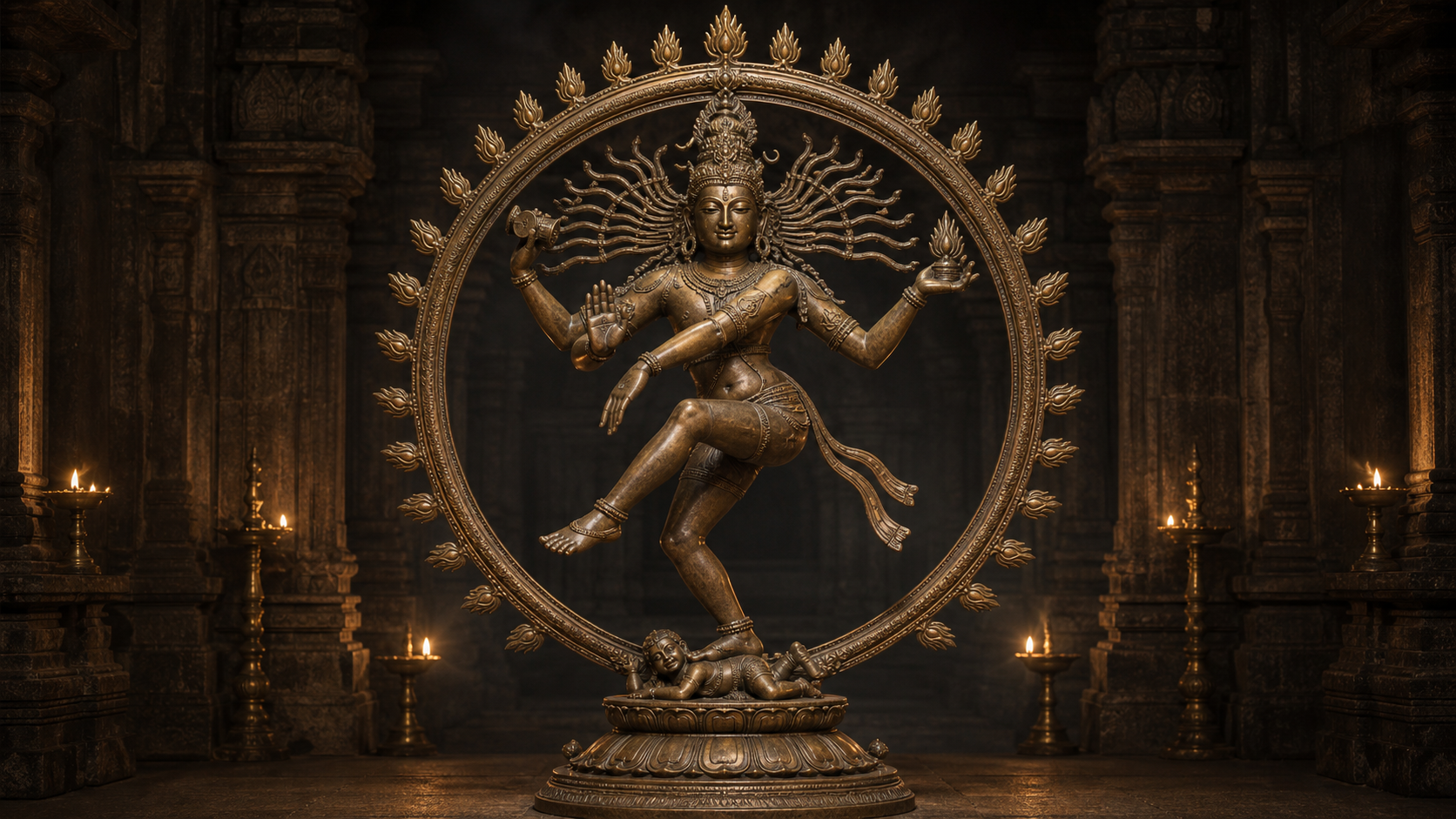
Identify Nataraja by reading the composition as one coordinated event. Shiva dances within the prabhamandala, a circle of flames. The damaru marks the emergence of sound and time. Fire signifies dissolution. The forward right hand offers abhaya, assuring fearlessness. The forward left hand directs attention toward the raised foot, the refuge of release. Beneath the other foot lies Apasmara, the dwarf of forgetfulness.
The image holds the five cosmic acts known as panchakritya: creation, preservation, dissolution, concealment and grace. Do not read only the drum as creation and the flame as destruction. Concealment explains why truth can remain unrecognized; grace explains why release remains possible. Apasmara therefore represents more than a defeated enemy. Forgetfulness must be held down so awareness can remain free.
If you use Nataraja for contemplation, follow the visual sequence. First notice the ring of change. Then notice the poised dancer who is not overwhelmed by it. Find the gesture of fearlessness, and finally the raised foot. The practical teaching is precise: liberation does not require pretending that movement, loss or uncertainty have ceased. It requires finding steadiness and refuge within the cosmic rhythm.
The form also joins temple, performance and spiritual training. The 108 karanas associated with the Natyashastra appear on the gateways at Chidambaram, while Bharatanatyam carries gesture and movement as an embodied discipline. During Arudra Darshan, the dance is not treated as an idea safely contained in the past; it is ritually made present to the community.
Lingodbhava: stop trying to measure the immeasurable
Lingodbhava presents Shiva as an endless column of fire. Brahma and Vishnu search for its limits and discover the limits of their own search. The form is not meant to diminish either deity. It corrects the assumption that the boundless can be mastered by rank, motion or intellectual reach.
In many South Indian temples, look for Lingodbhava on the western wall of the sanctum. This is a useful reminder that circumambulation is also a mode of learning: the temple discloses theology through sequence and direction. Some Kerala traditions also render the theme through ritual kalam drawings, showing that an iconographic teaching need not be confined to permanent stone or metal.
When you encounter Lingodbhava, resist the urge to treat it as merely an origin story for the Linga. Its sharper question is personal: where has your ability to search turned into the pride of believing that everything real must submit to your measurement?
Dakshinamurti: knowledge ripens through silence
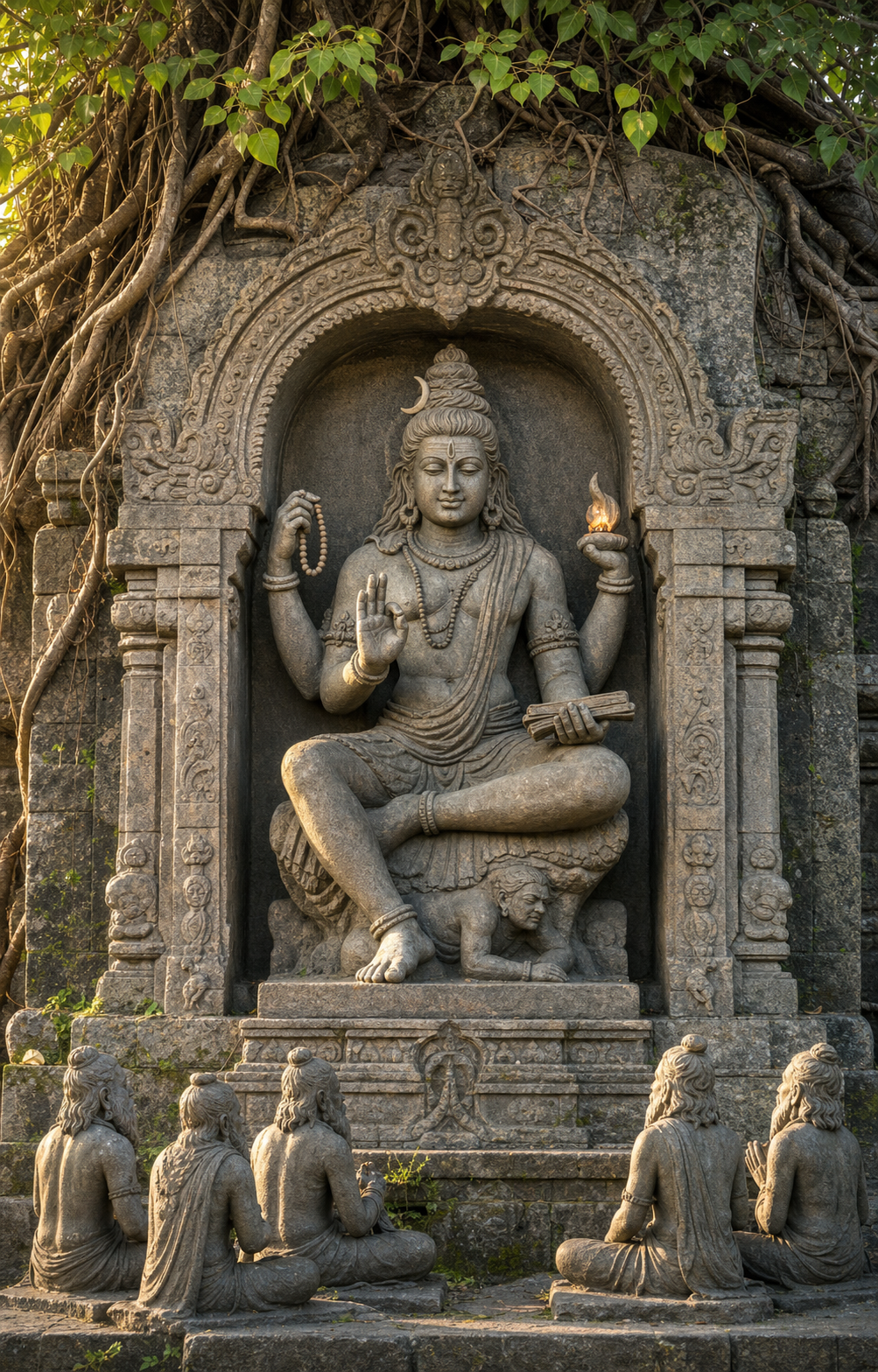
Dakshinamurti is Shiva as the south-facing Guru, seated beneath the banyan with attentive sages. His chinmudra expresses the reunion of individual awareness with the absolute. The disciples matter as much as the teacher: their presence shows that receptivity, steadiness and disciplined listening belong to knowledge.
This form corrects a common mistake in spiritual study. Accumulating explanations is not the same as seeing clearly. The teaching of mauna-vyakhya, instruction through silence, asks you to leave enough interior quiet for knowledge to become direct. Before reading another interpretation of Dakshinamurti, sit with the image without commentary for a few minutes. Observe the posture and gesture before you name them. That pause is not an absence of study; it is part of the method.
The Ashtamurti traditions widen the same insight. One mapping names Shiva through eight epithets – Sharva, Bhava, Rudra, Pasupati, Ugra, Mahadeva, Bhima and Ishana. Another relates Shiva to elemental and celestial order through earth, water, fire, air, space, sun and moon. Do not force these mappings into a hunt for one statue containing every item. Their purpose is to train perception beyond the isolated image: the world of elements, living beings and cosmic time is itself a field in which Shiva is recognized.
Forms that teach relationship, responsibility and restrained power
Ardhanarishvara: unity that does not erase difference
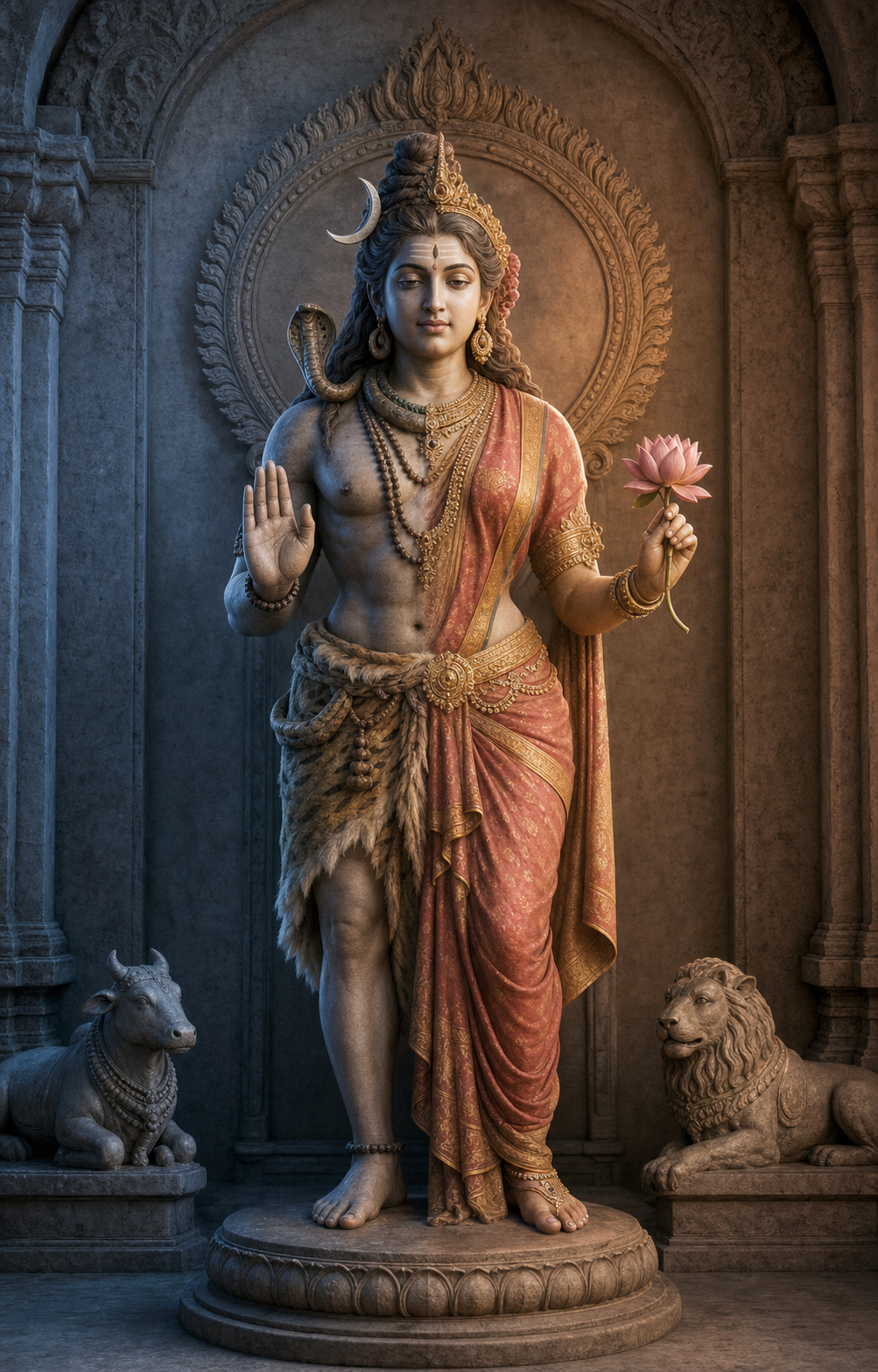
Ardhanarishvara unites Shiva and Parvati in one body. The form represents the indivisibility of consciousness and energy, often expressed philosophically as Purusha and Prakriti. Its unity does not make the two halves indistinguishable. Difference remains visible, but rivalry is overcome.
That distinction matters. Ardhanarishvara is not a vague statement that every difference is unreal or socially irrelevant. It teaches complementarity without domination and wholeness without forced sameness. Use the image to examine a relationship, household or institution: Is one side claiming completeness while depending invisibly on the other? Is difference being turned into hierarchy when it could become reciprocity? The murti asks for balance in conduct, not merely admiration of balance in stone.
Somaskanda: liberation does not require neglecting the household
Somaskanda presents Shiva with Uma and the child Skanda. The family’s composure makes household affection, continuity and responsibility part of sacred life. This is especially important when renunciation is misunderstood as the only serious spiritual path. Somaskanda shows that love and liberation need not be opponents.
In many Tamil sanctums, a Somaskanda panel is placed behind the principal Linga. Read that arrangement as a theological relationship. The unbounded sign of Shiva and the intimate family form occupy one sacred structure. If you are responsible for a household, the practical question is not whether family duty distracts from dharma in the abstract. It is whether care, continuity and ethical responsibility are being performed as dharma.
Gangadhara and Neelakantha: power must be contained before it can serve
Gangadhara is Shiva bearing the Ganga in his matted locks. The river’s tremendous descent is received, moderated and redirected so that power becomes nourishment rather than devastation. The image therefore joins mythic memory with an ethic of water: reverence for a sacred river is incomplete without responsibility for water and the life it sustains.
Neelakantha carries a related teaching. Shiva contains the halahala poison, marked by his blue throat, without allowing its toxicity to spread. Applied carefully, this is an ethic of restraint. Compassion is not passive exposure to harm, and it is not the transmission of whatever you have received. It is the capacity to stop a destructive force from travelling further.
Put these forms together when you hold authority, anger or painful knowledge. Gangadhara asks whether you can channel force toward life. Neelakantha asks whether you can contain toxicity without reproducing it. Neither form glorifies uncontrolled power. Both place responsibility before display.
Chandrasekhara, Pasupati and Harihara: time, kinship and plural belonging
Chandrasekhara, Shiva crowned by the crescent moon, directs attention to cyclical time. The crescent is not simply an ornament for identifying Shiva. It invites equanimity as conditions wax and wane. When circumstances change, the form asks you to distinguish a passing phase from the principles that should remain steady through it.
Pasupati, Lord of beings, extends duty beyond the human community. The title places animals and vulnerable life within a sacred field of kinship. Devotion to Pasupati should therefore become visible in how you treat creatures, habitats and those unable to defend themselves. This point also meets the wider Dharmic commitments to non-harm and service found across Jain, Buddhist and Sikh life.
Harihara joins Shiva and Vishnu in a composite form. It does not demand that their differences disappear, nor does it require one devotional community to defeat another. It establishes unity-in-difference as a sacred possibility. When sectarian loyalty hardens into contempt, Harihara supplies a clear test: devotion that cannot honor another Dharmic path has lost the composure displayed by the deity it claims to defend.
Read Shiva’s fierce forms as disciplines, not spectacles
Fierce iconography is easy to misread because weapons, conflict and terrifying appearance attract attention first. The interpretive mistake is to stop there. Shiva’s fierce forms usually require you to identify what is being defeated, why force becomes necessary and how power remains governed by dharma.
Tripurantaka: aim at the structure of bondage
Tripurantaka is Shiva destroying the three cities with a single arrow. In Shaiva Siddhanta interpretation, those cities correspond to three impurities: anava, the contraction that confines awareness around the ego; karma, the impressions and consequences of action; and maya, misapprehension that obscures reality.
The single arrow makes the image practical. Scattered effort treats symptoms one by one. Concentrated insight strikes the structure that keeps recreating them. When the same conflict returns in different forms, Tripurantaka asks you to look beneath the latest incident. Is egoic contraction controlling the response? Is an old pattern of action repeating itself? Is misperception making the target appear somewhere it is not?
This is courage without cruelty. The form authorizes determined action, but it directs the first battle toward bondage and confusion rather than giving anger a sacred costume.
Kirata-Arjuna: readiness must survive a test of humility
In the Kirata-Arjuna form, Shiva appears as a forest hunter, tests Arjuna and then empowers him with the Pashupatastra. The sequence matters: encounter, test, recognition and only then the granting of power. Arjuna’s status and intention do not exempt him from humility and discernment.
Use this form when you are eager for authority, a weapon, a title or a difficult responsibility. Do not ask only whether you possess the skill to use it. Ask whether your judgment remains sound when the teacher appears outside the form you expected, and whether your discipline can withstand correction. Kirata-Arjuna joins ascetic intensity to worldly duty by insisting that capability be purified before it is enlarged.
Bhairava: the threshold is where vigilance begins
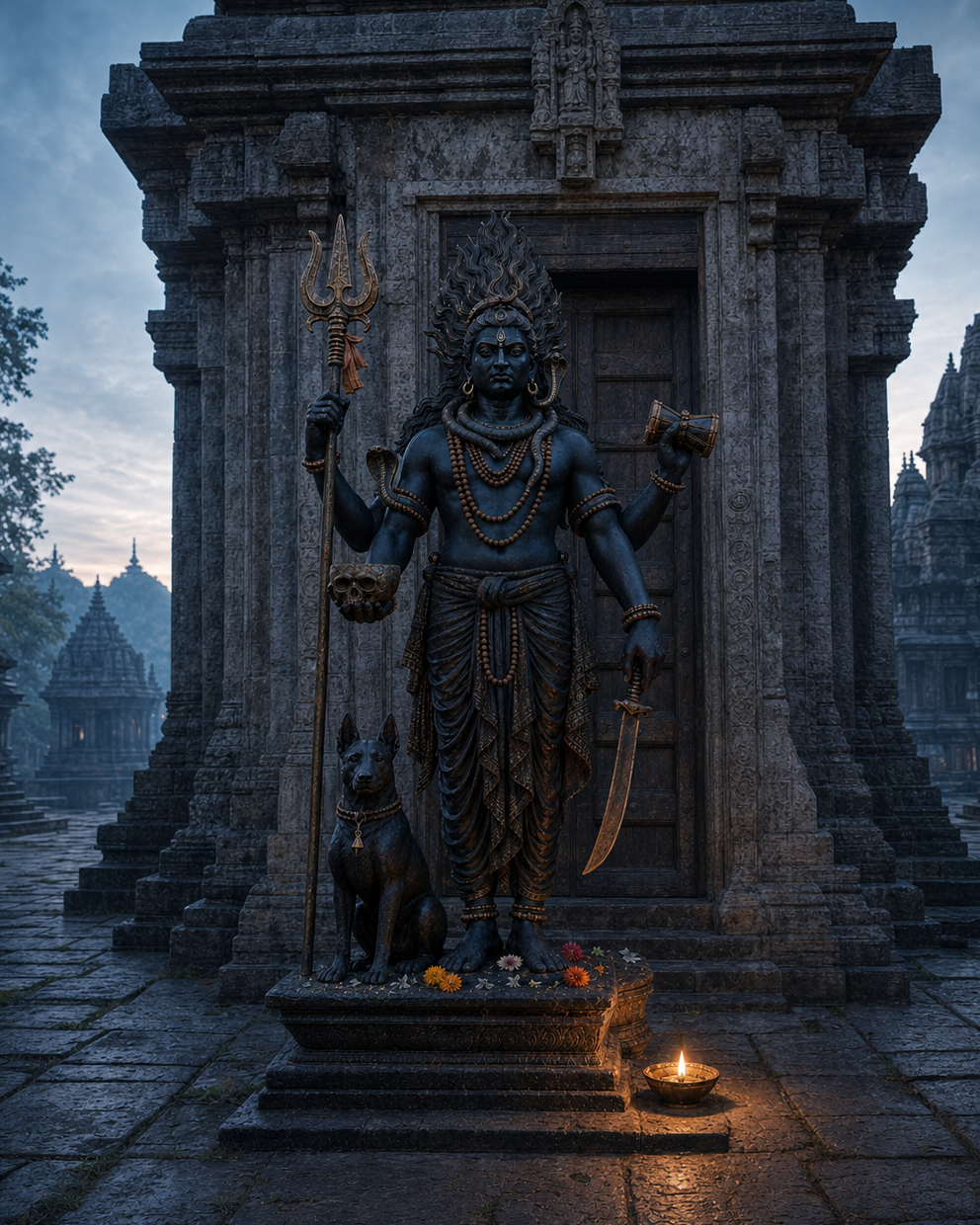
Bhairava is Shiva in an awe-inspiring form associated with thresholds and time, especially as Kala Bhairava. In Kashi and Kathmandu, Bhairava serves as a guardian before whom vows carry gravity. The form makes a hard point: freedom without responsibility decays into negligence.
When you meet Bhairava, notice where the image is situated and what boundary it guards. A threshold is both architectural and ethical. Before entering a sacred space, beginning a vow or taking on an obligation, ask what must be left outside and what discipline must be carried within. Bhairava’s severity is not an invitation to cultivate fear for its own sake. It is a demand that sacred commitments be taken seriously.
Key takeaways for your next temple visit
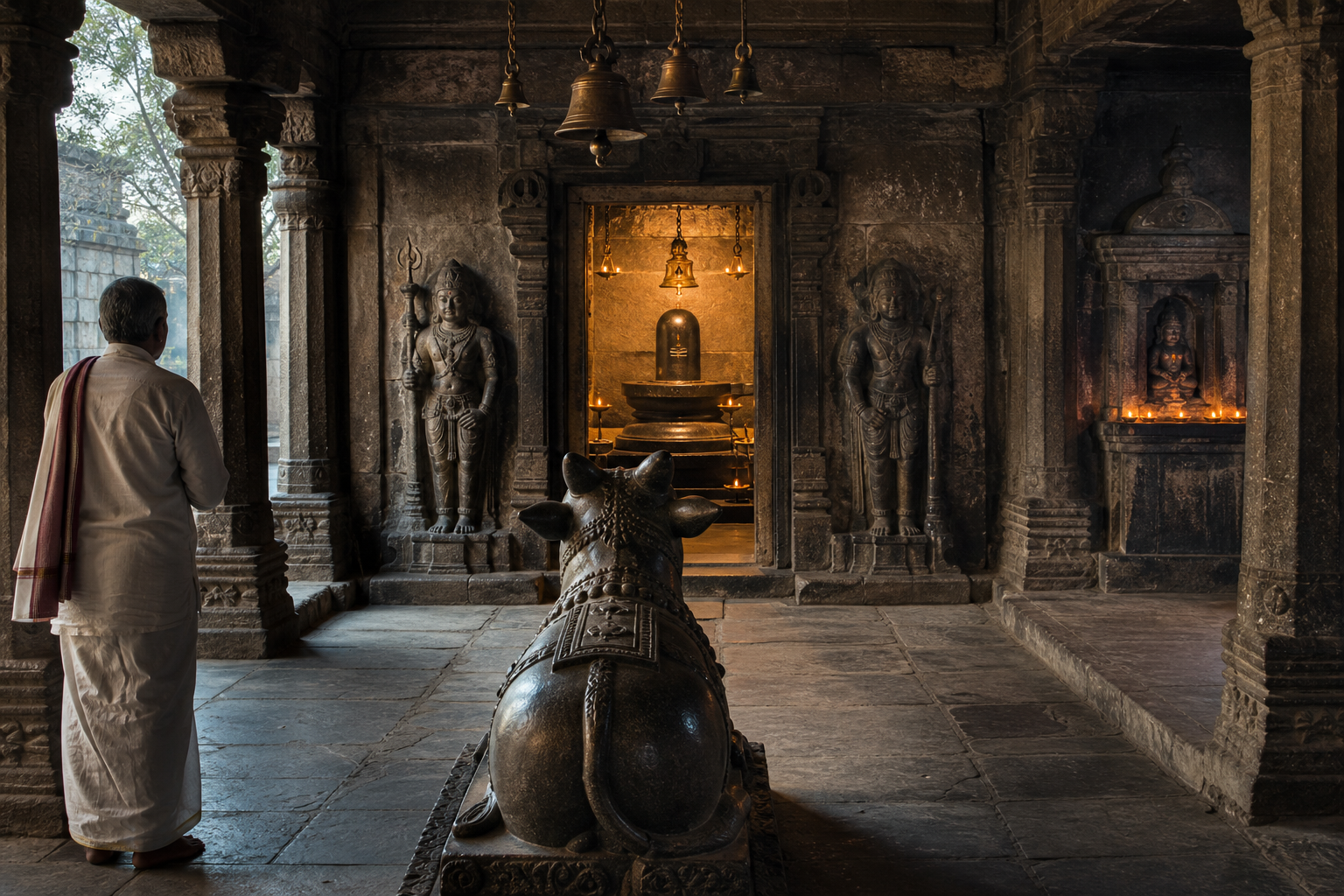
- Identify a cluster, not a single clue. Posture, hands, attributes, relationships, direction and placement work together.
- Begin with the Linga. It is the sign of Shiva’s boundlessness; the narrative forms disclose how that boundless reality acts.
- Read every figure in the composition. Apasmara, sages, Uma, Skanda, Brahma, Vishnu and Arjuna are not background decoration. Their relationships reveal the teaching.
- Let temple architecture assist you. Dakshinamurti’s southern orientation and Lingodbhava’s frequent western placement can help confirm what you are seeing.
- Do not confuse fierceness with permission for aggression. Tripurantaka directs force toward impurity, Kirata tests humility before granting power, and Bhairava binds freedom to vigilance.
- Complete recognition with conduct. A correct name is only the first step. Ask what the form requires of you after darshana.
On your next visit, choose one form and delay looking up its name. Record five observations: posture, hands, held attributes, surrounding figures and location. Then identify the murti and compare its teaching with what you actually noticed. This small discipline turns iconography from memorized trivia into attentive seeing.
Finally, leave with one instruction rather than ten impressions. Nataraja may ask you to remain poised in change. Dakshinamurti may ask for silence. Gangadhara may ask you to channel power responsibly. Bhairava may ask you to honor a boundary. The sacred form has done its work when your seeing becomes a change in conduct.