

You may be wondering whether Rama devotion should begin with a journey, a temple festival, or a disciplined practice at home. You don’t have to choose among them. Ram Navami can establish your intention, ordinary days can test it, and Rameswaram can give it the embodied form of tirtha-yatra.
The sequence matters. A pilgrimage without preparation can become hurried sightseeing, while a festival without follow-through can disappear as soon as the lamps are extinguished. Here is a practical way to connect home worship, digital darshan, ethical vrata, temple pilgrimage, and care for sacred geography as one path of Rama bhakti.
Begin with a sankalpa you can carry beyond one day
Start with a sankalpa, not an itinerary. A useful sankalpa names both a devotional act and the quality you want that act to cultivate. “I want to visit Rameswaram” is a hope. “I will prepare for Rameswaram by practising truthful speech, regular Rama-nama, and service” is a direction.
Keep the commitment narrow enough to survive an ordinary week. You might choose a brief fixed period of nama-japa each day, one regular reading from the Ramayana tradition, or one recurring act of seva. The point isn’t to assemble the largest possible programme. It is to give Rama bhakti a dependable place in your life before emotion, travel, or festival crowds intensify it.
- For daily practice: choose one name or mantra and one regular place. Consistency matters more than adding several chants at once.
- For scriptural listening: select a manageable passage from the Valmiki Ramayana or Ramacharitmanas, or include the Rama Raksha Stotra if it belongs to your family or sampradaya practice. These are also well-established choices for Ram Navami observance.
- For ethical practice: identify one recurring failure of speech, restraint, duty, or service. That is where the example of Maryada Purushottama becomes personal.
- For pilgrimage: decide what you are actually seeking at Rameswaram: darshan, gratitude, repentance, remembrance of Rama’s journey, an ancestral rite, or renewal of a neglected discipline.
If your purpose includes shraddha for ancestors, arrange it through a competent priest or temple contact rather than improvising from online instructions. Rameswaram’s sacred waters are associated with ancestral rites, but the appropriate procedure depends on family tradition and ritual context.
Make Ram Navami an observance, not a broadcast
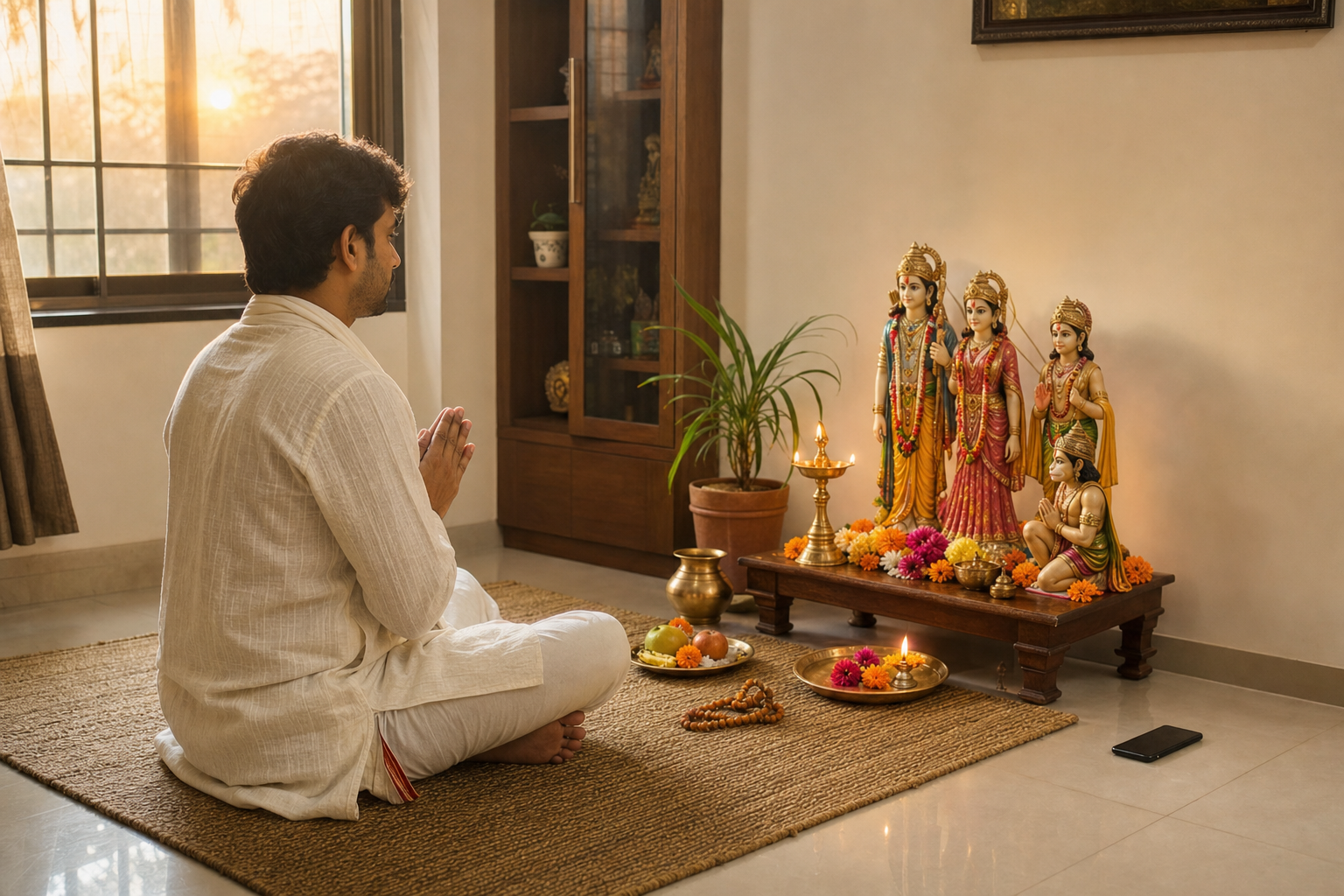
Ram Navami follows sacred time rather than a permanently fixed civil date. The central observance falls on Chaitra Shukla Navami, and Rama-janma worship is associated with Madhyahna when the Navami tithi prevails. Before arranging your household programme, check the Panchang and the schedule of the temple or sampradaya you follow. Don’t copy the previous year’s date or assume that every community will use an identical congregational timetable.
If you are worshipping at home, a simple sequence is enough:
- Clean the worship space and prepare a deepa before the programme begins. Put the phone or computer carrying a stream where it won’t turn the altar into a distracted media setup.
- State your sankalpa plainly. Name the discipline or service that will continue after Ram Navami.
- Read or hear a selected passage concerning Sri Rama. A shorter passage received attentively is better than a long recitation rushed to fit a schedule.
- Offer nama-japa or kirtan. A temple programme may combine the Hare Krishna mahamantra with invocations such as “Sri Ram Jai Ram Jai Jai Ram”; follow the form natural to your lineage and household.
- Prepare a modest naivedya according to your tradition. Fruit, water, panakam, or soaked gram are among the customary possibilities. Bhagavad-Gita 9.26 places the emphasis on devotion in the offering, not its expense or display.
- Join abhishekam, kirtan, discourse, and arati actively if you are using live or recorded darshan. Sing, recite, listen, and bow rather than treating the stream as background content.
- Distribute prasada and perform the act of seva named in your sankalpa.
Digital darshan is especially valuable when distance, mobility, work, or a time-zone difference prevents temple attendance. It can synchronize households with a worshipping community and give diaspora families access to kirtan, recitation, abhishekam, and arati. It does not need to pretend to be physical pilgrimage. Its proper role is to support shravana, remembrance, and participation until an in-person visit becomes possible.
If the live timing is impossible, use the recorded stream deliberately. Set aside a clean period, preserve the devotional atmosphere, and participate as you would during the live event. The important distinction isn’t between live and recorded video; it is between worshipful attention and passive consumption.
Carry Rama’s vrata into speech, restraint, and seva
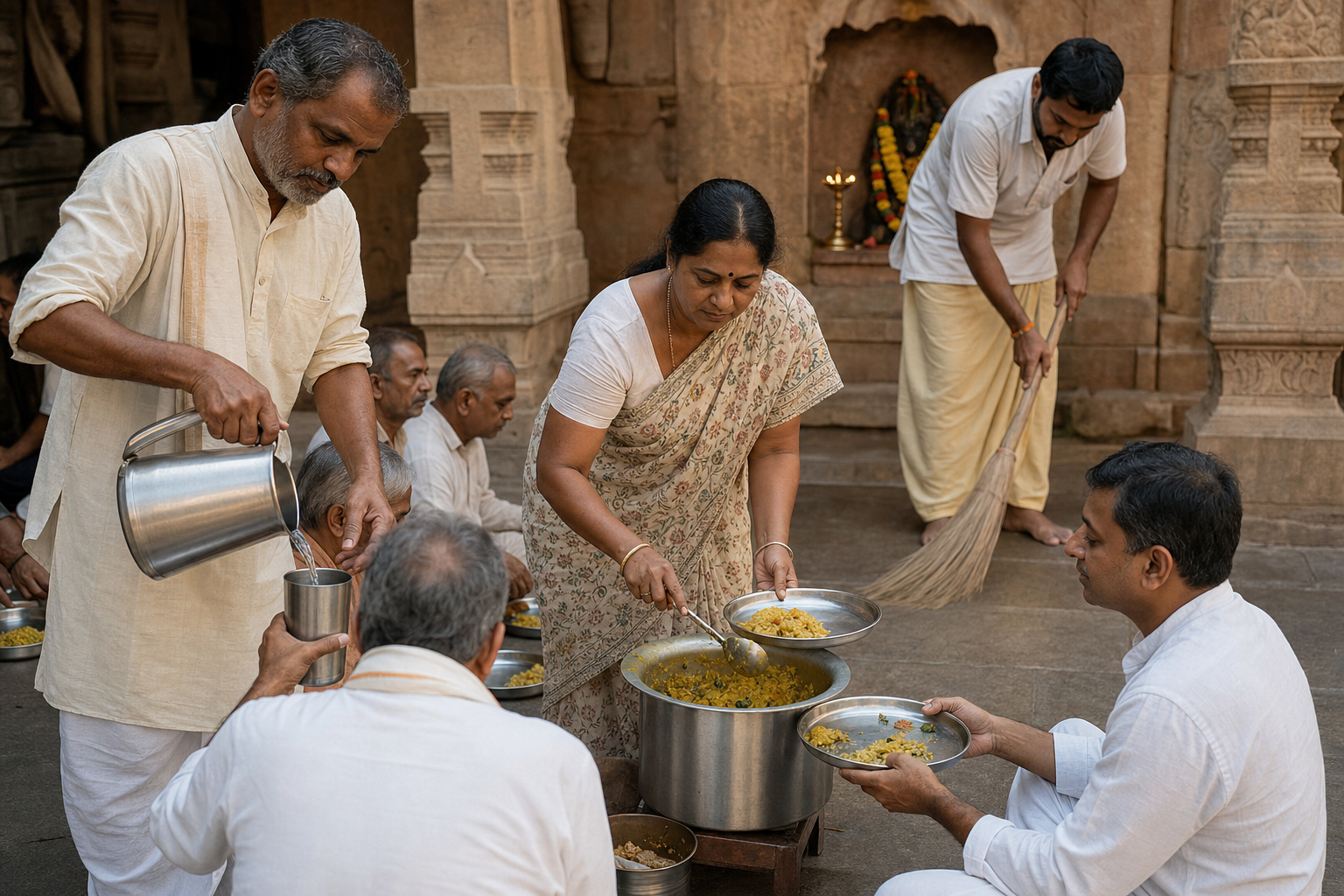
The first serious test of Ram Navami comes after the festival. Rama’s dharma cannot remain confined to alankara, music, and a single sacred date. It has to enter the places where you are tempted to speak carelessly, evade responsibility, humiliate an opponent, or postpone a duty that belongs to you.
Choose a vrata that can be observed in visible behaviour. Truthfulness should not become an excuse for cruelty, so ask whether what you are about to say is true, necessary, and expressed without needless injury. Restraint should not become passivity, so identify the duty you have been avoiding and complete it without demanding recognition. Seva should not remain a sentiment, so give it a recipient, a time, and a form.
- At home: take responsibility for an unglamorous task that normally falls on someone else.
- In the community: support annadana, education, temple service, or an environmental clean-up. These forms of festival-linked service carry sanctity beyond the altar.
- In disagreement: refuse falsehood and distortion even when they would help your side momentarily. Dharma is weakened when devotion is used to excuse adharma.
- In consumption: practise restraint before acquiring another devotional object. A simpler altar with regular worship is more coherent than an expanding collection without attention.
This is also where dharmic kinship can be recognized without flattening distinct traditions. Rama bhakti retains its Vaishnava theological character, while truth, compassion, disciplined conduct, non-injury, restraint, and service resonate with sat and seva in Sikhi, karuna and mindful discipline in Buddhism, and ahimsa and aparigraha in Jainism. Unity does not require sameness. It asks us to recognize shared ethical labour while respecting different scriptures, teachers, and ritual languages.
Review your vrata regularly. If it has become theatrical, reduce its public display. If it has become vague, give it a concrete action. If you fail, resume it without turning the failure into an excuse to abandon the discipline. Pilgrimage preparation is already underway when your conduct begins to change.
Plan Rameswaram around ritual order, not sightseeing order
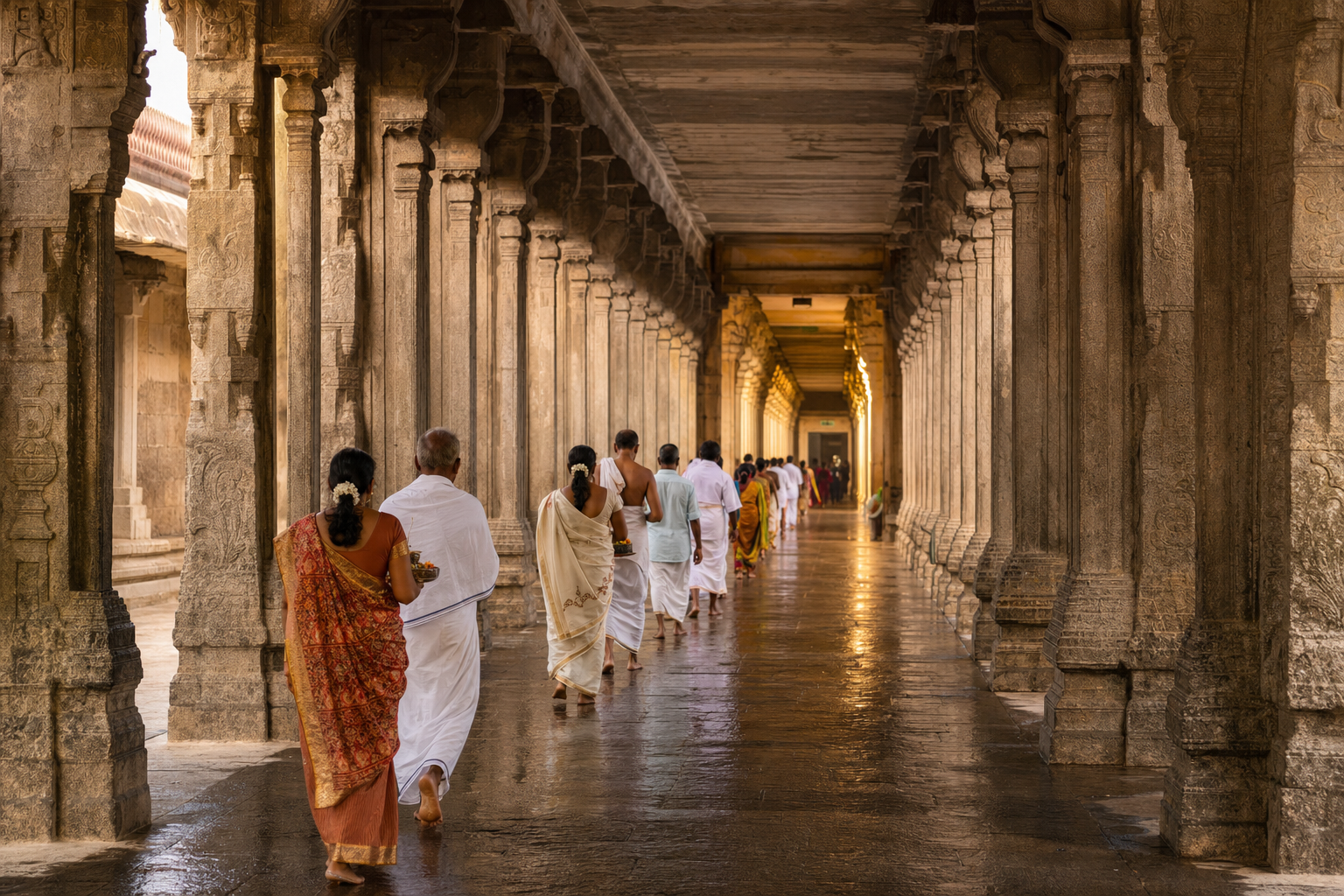
Rameswaram stands at the southern reach of Bharat on the Gulf of Mannar. It is revered within the Char Dham circuit, while Sri Ramanathaswamy Temple is counted among the twelve Jyotirlingas. For a Rama devotee, its importance lies in a distinctive meeting of traditions: Rama is remembered as consecrating a linga before the crossing toward Lanka. Shaiva worship of Ramanathaswamy and Vaishnava remembrance of Rama therefore occupy the same sacred landscape.
Don’t treat the Jyotirlinga as an incidental stop on a Rama-themed tour. Temple worship follows Shaiva Siddhanta Agama, and a pilgrim should enter the local discipline with reverence. Rameswaram’s power is precisely that it resists a narrow sectarian map of dharma.
The traditional core of the visit has a clear progression:
- Begin at Agni Theertham on the Bay of Bengal, using the designated bathing area and following current local safety instructions.
- Proceed through the twenty-two temple wells, or theerthams, according to the temple’s present procedure. Their waters are part of a wider sacred geography of sixty-four theerthams across the island.
- Complete darshan and worship of Sri Ramanathaswamy rather than allowing the water ritual to become the endpoint.
- Walk the great corridors without rushing. The celebrated colonnade extends nearly 4,000 feet and contains more than a thousand granite pillars, giving you room to notice how repetition, proportion, sound, and changing light can steady attention.
- Continue, as time permits, to Gandhamadhana Parvatham, Villondi Theertham, Kothandaramaswamy Temple, and the Dhanushkodi shore facing Setubandha.
For a one-day yatra, protect the morning for Agni Theertham, the temple wells, Jyotirlinga darshan, and an unhurried pradakshina through the corridors. Treat the other locations as secondary. For a two-day visit, keep the temple sequence on the first day and use the second for the wider Rama landscape. This prevents a long drive to Dhanushkodi from forcing you to hurry the central act of worship.
Bring clothing suitable for repeated contact with water and a secure way to protect essential belongings. Observe modest dress, barefoot-entry rules, and photography restrictions. Current queue arrangements, access controls, ritual procedures, and transportation can change, so confirm them with the temple and your accommodation before travel rather than relying on an old itinerary.
Season affects the quality and safety of the yatra. November through March is typically the more temperate period; April through June brings stronger tropical heat, while October and November can bring northeast-monsoon rain and occasional cyclones. Madurai is the nearest major airport hub, with rail and bus routes connecting onward across the Pamban channel. Verify present services before purchasing linked tickets, and leave room for coastal weather to alter the day.
Read the sacred coast carefully, then protect it

Rameswaram becomes more intelligible when each location is allowed to teach something different. Srimad-Bhagavatam 10.79.16-17 remembers Balarama visiting Setubandha, and Caitanya Caritamrta, Madhya-lila 9.199-209 records Sri Caitanya’s journey to Rameswaram. You are entering a route carried not only by the Ramayana tradition, but also by generations of pilgrims who approached the same shore through different currents of bhakti.
At Kothandaramaswamy Temple, the remembered surrender of Vibhishana makes sharanagati concrete. Consider what prevents you from accepting sincere refuge or changing your judgment when someone chooses dharma over inherited allegiance. At Ramanathaswamy, ask whether reverence for your own form of worship has made you incapable of honouring another dharmic sampradaya. In the long corridors, notice whether repetition feels empty or whether it reveals the steadiness that devotion requires.
At Setubandha, avoid forcing sacred memory and coastal science into a careless argument. Rama Setu is remembered in the epic tradition as the causeway prepared for the march to Lanka. The visible chain is also described geographically as a system of sandbars and limestone-coral formations shaped by waves, currents, and sea-level change. A geological description neither performs the work of theology nor settles every historical question raised around the epic. You can honour the tirtha without making a physical formation carry claims it has not independently established.
The same humility should govern your treatment of the coast. The Gulf of Mannar contains coral reefs, mangroves, seagrass meadows, and habitat used by the endangered dugong and many reef species. The biosphere’s protected area includes twenty-one islands. Sacred geography is not an excuse to crowd restricted zones, discard puja materials or plastic, or damage the very ecology through which the tirtha is encountered.
- Use designated bathing places and obey marine no-go zones.
- Avoid single-use plastic and carry your waste back from the shore.
- Do not remove coral or other natural material as a pilgrimage souvenir.
- Choose local services that respect conservation rules and the livelihoods of traditional fishing communities.
- Accept closures and weather restrictions without pressuring boat operators or officials to bypass them. The cyclone that devastated Dhanushkodi in 1964 remains a warning that this sacred coast is also a vulnerable coast.
Key takeaways
- Let Ram Navami establish one sustainable vow; don’t ask festival emotion to carry an entire year of devotion.
- Use the Panchang and your temple’s guidance for the observance window, especially the Navami tithi at Madhyahna.
- Turn live or recorded darshan into worship through recitation, kirtan, offering, and attentive participation.
- At Rameswaram, preserve the ritual progression from sacred bathing to Ramanathaswamy darshan before adding the wider island circuit.
- Receive the Shaiva-Vaishnava confluence as a dharmic strength, not an inconvenience to a narrowly themed journey.
- Protect the reefs, seagrass, shores, and local livelihoods as part of your vrata of ahimsa and seva.
Your next step doesn’t require a ticket. Write one sentence naming the practice you will begin, the quality it is meant to cultivate, and the service through which you will test it. When you eventually stand at Rameswaram, you will arrive not merely with a list of places to see, but with a discipline ready to receive the tirtha.
References
- Dandavats – Awe-Inspiring Rameswaram Pilgrimage: Sri Ramanathaswamy Temple, Rama Setu, Sacred Shores
- Dandavats – Ram Navami 2026 Live Darshan: Profound Rituals and Memories at Sri Sri Krishna Balram Mandir