
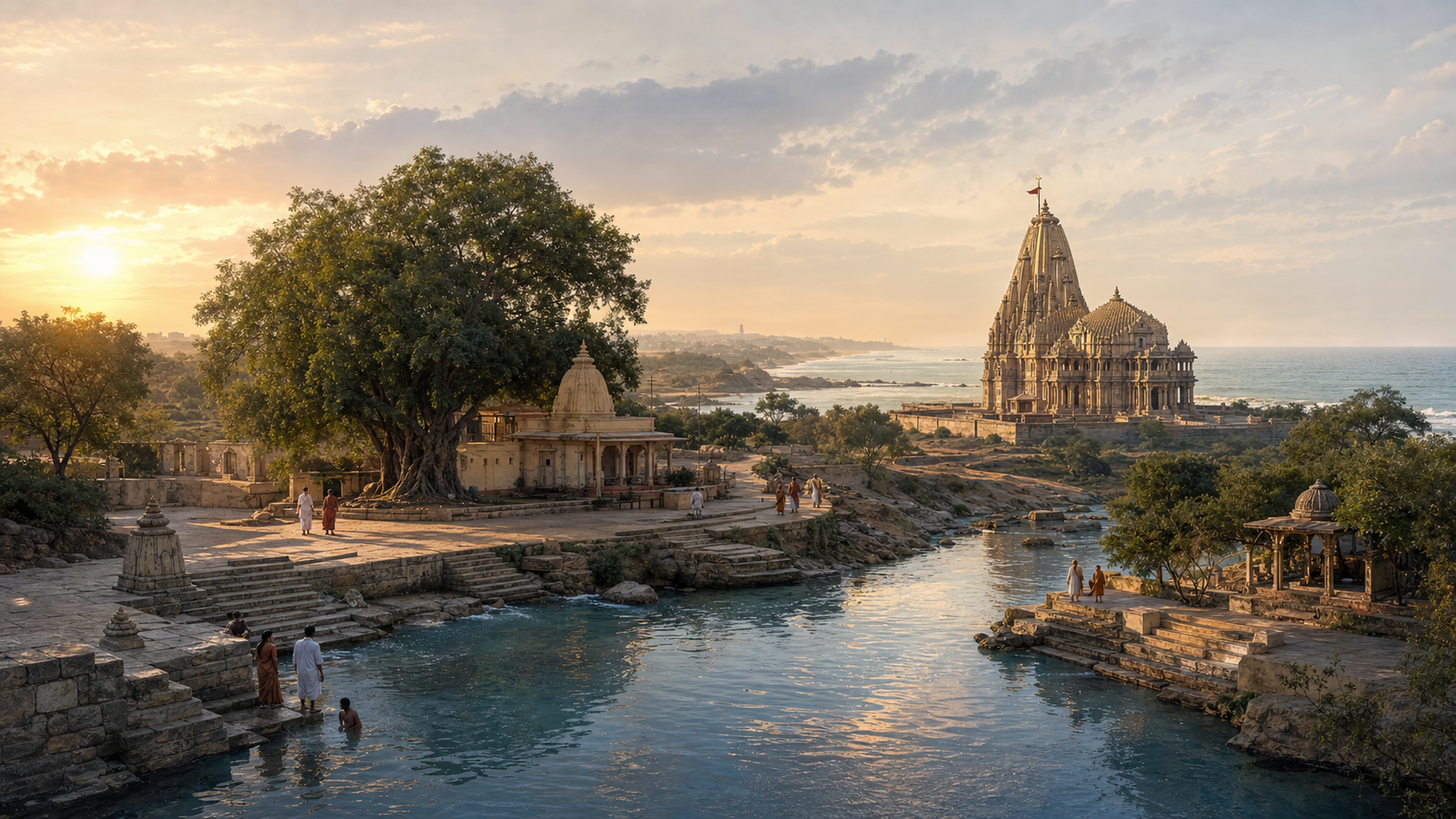
If you are going to Somnath, the most important planning decision is whether you are visiting one temple or entering the wider kshetra. Treating Prabhasa Patan as a quick stop at the jyotirlinga leaves the landscape’s central teaching unread.
The more meaningful route passes through water, error, consequence, relinquishment and renewal. You do not need to perform every available rite, but you should know what the Triveni Sangam, Bhalka Tirtha, Dehotsarg Tirtha and Somnath contribute to that progression. Once you see them as parts of one sacred geography, the pilgrimage becomes more than a collection of darshans.
Key takeaways before you enter the kshetra
- Prabhasa Patan is the wider sacred field; Somnath is its great Shaiva center, not a substitute for the whole kshetra.
- The Triveni joins observable coastal geography with sacred tradition: the Hiran and Kapila are associated with the confluence, while the Sarasvati is traditionally understood to arrive beneath the ground.
- Bhalka and Dehotsarg commemorate different moments. Bhalka remembers Jara’s arrow; Dehotsarg remembers Krishna’s relinquishment of his embodied form.
- The Krishna sites and the Somnath jyotirlinga should be read together without erasing their Vaishnava and Shaiva distinctions.
- A strong pilgrimage has one clear intention, time for stillness between sites, and conduct that protects the water and respects local ritual guidance.
Four places form one contemplative route
Prabhasa Patan lies on the Saurashtra coast near Veraval in Gujarat’s Gir Somnath district. Its name already gives you a way into the landscape. Prabhasa carries the sense of radiance or splendour, while Patan, from a term used for port settlements, recalls its maritime setting. This is a shore shaped by river flow, monsoon variation and the Arabian Sea, not an inland temple complex sealed off from its environment.
A kshetra is more than a point on a map. It is a field in which physical features, remembered events and repeated practices give meaning to one another. At Prabhasa, water supplies the physical threshold, Krishna’s final lila supplies the narrative arc, and pilgrimage supplies the action through which you enter that arc. Keep those three layers together, but do not confuse their kinds of truth. Sacred tradition can affirm a subterranean Sarasvati without turning that affirmation into an unsupported claim about modern hydrological measurement.
Triveni Sangam: begin by learning how to arrive
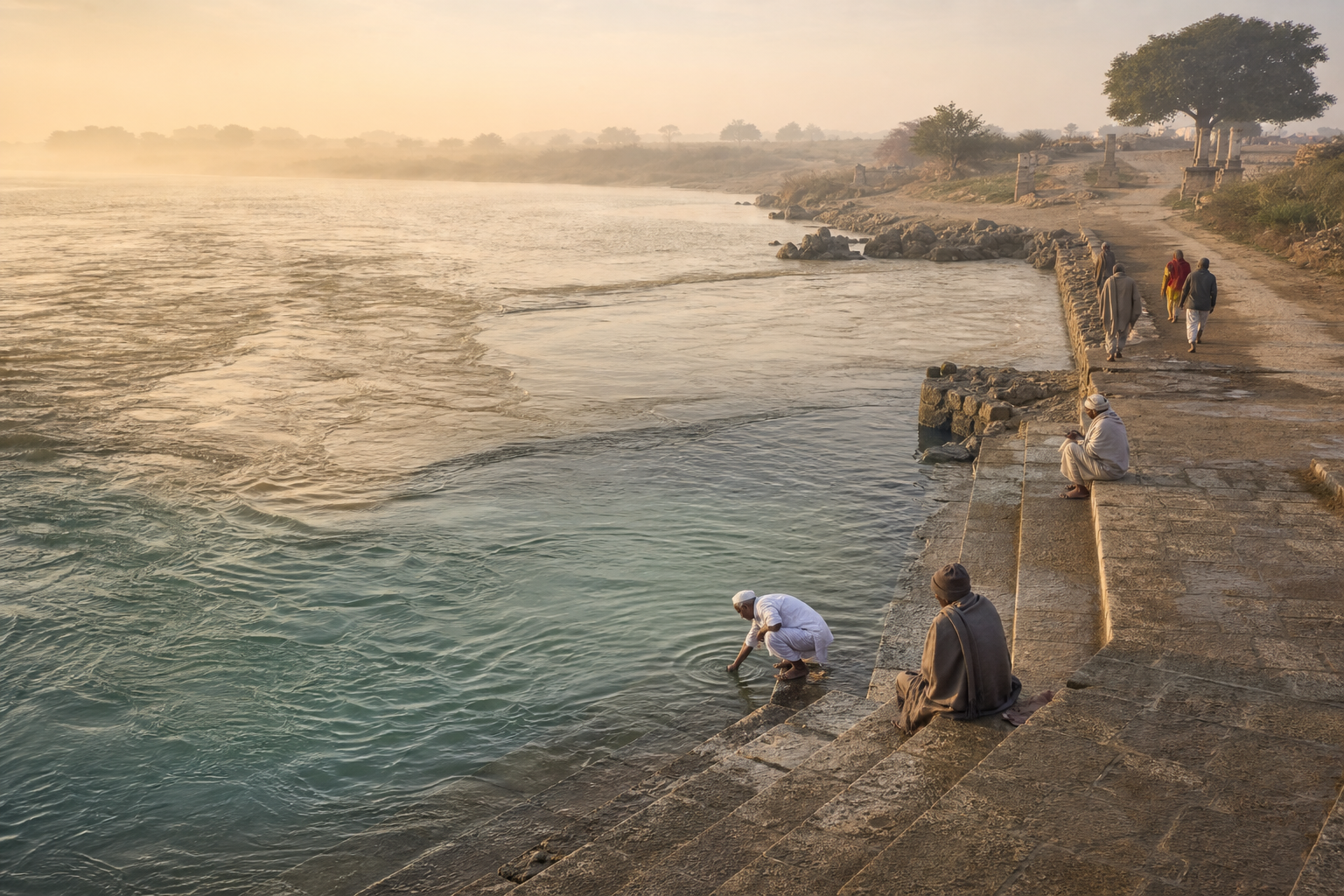
The confluence is revered as the place where the Hiran, Kapila and subterranean Sarasvati meet the Arabian Sea. The third river belongs explicitly to sacred memory and traditional understanding. That distinction does not diminish the sangam. It reveals how Hindu sacred geography can hold visible water, inherited memory and ritual meaning in one place without reducing one to another.
Begin here slowly. Notice the direction of the water, the openness of the coast and the meeting of river and tide before reaching for a camera or starting a recitation. A sangam is not sacred merely because separate streams occupy adjacent channels. It is sacred because place, time and intentional action can converge there. Your first task is therefore attention.
Traditional practice includes dawn snana, tarpana for ancestors and dana. These are not interchangeable gestures. Snana prepares the body and mind; tarpana turns attention toward lineage and obligation; dana extends the pilgrimage beyond private feeling. If you intend to perform a lineage-specific ancestral rite, learn the appropriate procedure from your family tradition or a competent priest rather than improvising it at the water’s edge.
Do not interpret sanctity as permission to enter unsafe water. Tidal and seasonal conditions are part of the confluence’s living geography. Follow boundaries and local instructions, and use a modest or symbolic form of snana when immersion is unsuitable. Ritual seriousness is measured by intention and discipline, not by taking an avoidable risk.
Bhalka Tirtha: confront the distance between intention and consequence
Bhalka remembers the moment when the hunter Jara mistook Krishna’s foot for a deer and released his arrow. It is tempting to compress this into a simple story about a guilty hunter and an innocent victim. That reading is too small for the setting.
The event occurs at the end of a much larger unraveling. Jara acts through misrecognition, yet his error becomes part of a transition already unfolding. Bhalka therefore asks a harder question than who is to blame: what should a dharmic person do when intention, perception and consequence no longer align neatly?
Before moving on, identify one situation in which you have judged only the intention or only the outcome. Hold both together. This is not an invitation to excuse harmful action. It is a discipline of seeing clearly enough to distinguish malice, error, accountability and forgiveness. Bhalka becomes spiritually useful when Jara is neither demonized nor used to make consequence disappear.
Dehotsarg Tirtha: do not confuse departure with defeat
Dehotsarg, near the confluence, marks the place where Krishna is traditionally remembered as relinquishing his physical form. The distinction from Bhalka matters. One site holds the release of the arrow; the other holds the avatara’s departure. If you treat them as duplicate memorials, you lose the movement from mortal vulnerability to transcendence.
Popular devotional memory also connects this phase with final counsel and with the contemplative atmosphere of the Uddhava Gita. Pilgrims often use the setting for silence or recitation from the Bhagavad Gita and Srimad Bhagavatam. Choose one short passage before you arrive. Reading a page attentively is more fitting than racing through a long recitation merely to complete it.
The word dehotsarg directs attention to the relinquishment of the body, not to divine extinction. Within Vaishnava theology, Krishna’s embodied lila closes without making the divine subject to annihilation. Sit with that distinction. The site can then help you contemplate impermanence without treating life as meaningless, and release without confusing it with indifference.
Somnath: carry insight into worship
Somnath gathers the route into Shaiva worship. Here Shiva is venerated as Lord of Soma, the Moon. The sacred account remembers Soma performing penance at Prabhasa after Daksha’s curse and recovering his lost radiance. The moon’s waning and waxing therefore become a disciplined image of decline, penance and renewal.
If you proceed to Somnath after the Krishna sites, do not mentally discard what came before. Carry Bhalka’s confrontation with consequence and Dehotsarg’s meditation on release into darshan. Abhisheka and mantra can then become responses to what the route has disclosed, not isolated religious activities added to a sightseeing schedule.
Krishna’s departure begins with the Yadavas’ collapse

The arrow cannot be understood in isolation. In the Mausala Parva’s final cycle, the Yadavas descend into fratricidal conflict. A cursed iron pestle is ground down and cast into the sea, but reeds arising along the shore eventually become instruments of destruction. The attempted disposal of the object does not dispose of the consequence.
That sequence gives the coastal setting moral force. What is thrown away returns through the landscape. The story is not a formula for explaining every misfortune as punishment, nor should it become one. It is a warning that power, pride and unresolved wrongdoing can move through consequences that their authors no longer control.
Read the remembered events in three movements. First, social order collapses from within; the Yadavas are not simply overcome by an outside enemy. Second, Jara’s misperception shows how limited knowledge can still produce irreversible results. Third, Krishna’s departure places both events within a larger theological horizon. Human action remains consequential even when the divine purpose exceeds human understanding.
This is why Prabhasa should not be approached only as the sad location where Krishna died. In avatara theology, divine descent participates in history without being imprisoned by it. Krishna’s departure closes a form of presence and a cycle of lila. It does not imply that the divine has been extinguished by chance.
You also do not need to force sacred narrative, physical geography and modern historical method into a single category. The Mahabharata and Bhagavata Purana give the kshetra its narrative depth; local remembrance locates that depth in a sequence of tirthas; ritual allows pilgrims to inhabit its ethical questions. Each layer can be taken seriously on its own terms.
Somnath completes the route without erasing its differences
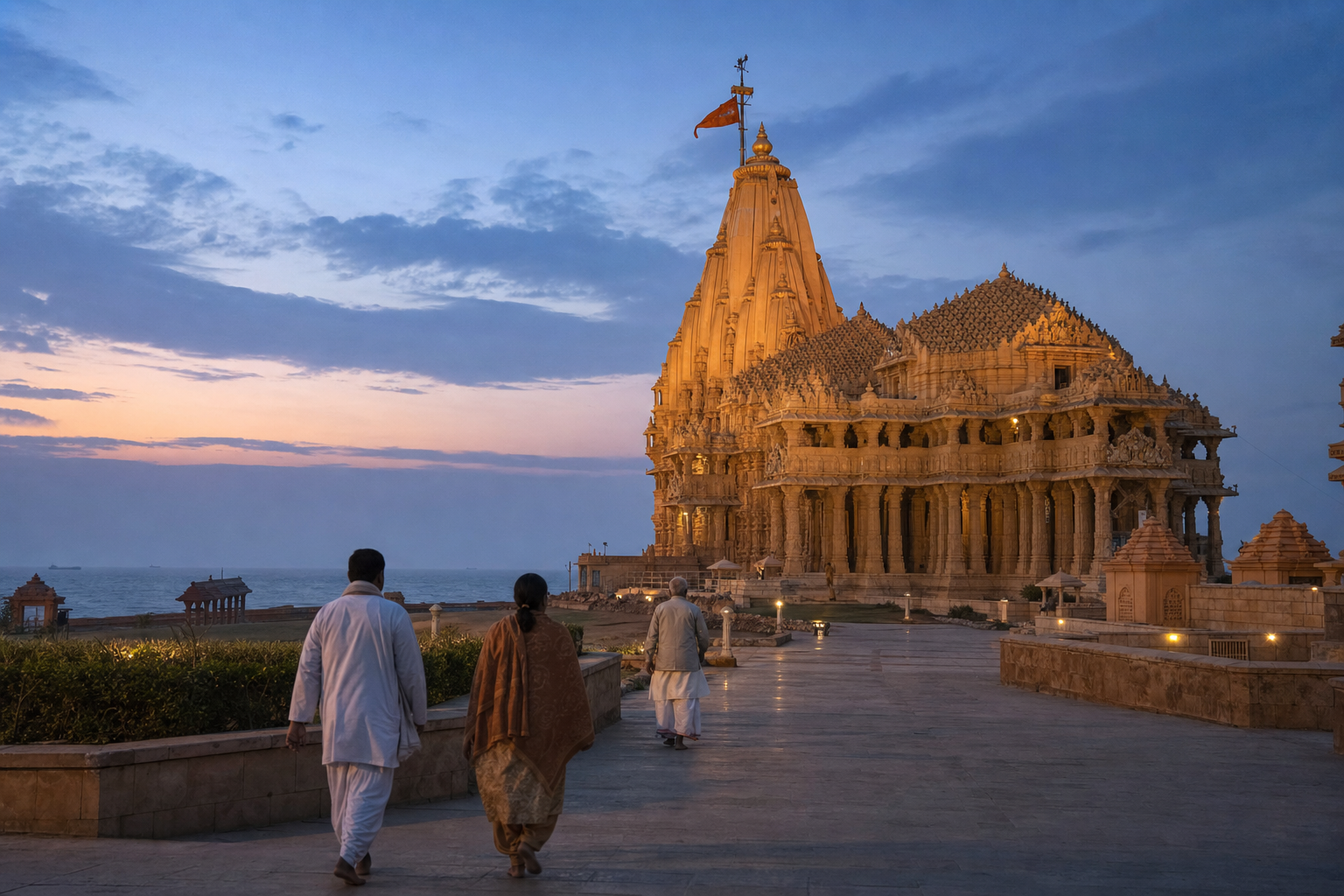
Prabhasa is often praised as a place of unity, but unity here should not mean vagueness. Bhalka and Dehotsarg carry a specifically Krishna-centered memory. Somnath is a jyotirlinga and a center of Shiva worship. The Triveni supports purificatory and ancestral practices used across Hindu sampradayas. Their proximity does not make their theologies identical; it allows them to illuminate one another.
The Vaishnava movement through departure and divine return meets the Shaiva image of radiance recovered through penance. The confluence is therefore not achieved by declaring that every form means exactly the same thing. It emerges through a dharmic capacity to honor difference while recognizing shared disciplines: purification, mantra, self-restraint, remembrance, dana and darshan.
Somnath also carries historical memory. The present temple was reconsecrated in 1951 under the Somnath Trust, with Sardar Vallabhbhai Patel and K. M. Munshi closely associated with its renewal. That date matters, but the temple should not be reduced to a monument of reconstruction. Its strongest answer to destruction is continuing worship.
When you enter, hold together three meanings of radiance: Prabhasa as the radiant place, Soma regaining his lustre, and the jyotirlinga as Shiva’s luminous presence. This makes abhisheka more than the pouring of water over a sacred form. It becomes a disciplined appeal for clarity after diminishment and right action after disorder.
Make the pilgrimage attentive, safe and proportionate
There is no need to imitate every visible practice. A crowded itinerary can become another form of inattention. Use the following sequence as a practical framework, not as a claim that every sampradaya or family must follow one compulsory liturgy.
- Choose one sankalpa. Decide whether your primary purpose is ancestral remembrance, contemplation of Krishna’s departure, Shiva worship, or a connected journey through all three. One clear purpose will organize the day better than an indiscriminate list of rites.
- Learn the distinctions before arriving. Remember the basic map: Triveni is the confluence, Bhalka commemorates the arrow, Dehotsarg commemorates relinquishment of the body, and Somnath centers Shiva as Lord of Soma.
- Prepare one text or mantra. Select a short Bhagavad Gita or Srimad Bhagavatam passage for Dehotsarg, or a familiar Shiva mantra for Somnath. Familiarity supports attention; the pilgrimage is not the best moment to perform a complex recitation you have never learned.
- Seek guidance for specialized rites. Tarpana and other family observances may carry lineage-specific procedures. Clarify them in advance instead of copying another pilgrim whose custom may not be yours.
- Protect the tirtha. Do not leave plastic, food packaging, soap or ritual material in the water. Sacred geography is not honored by offerings that become pollution. Follow on-site directions about water access and the handling of materials.
- Leave unclaimed time between places. The route depends on a change in attention from purification to consequence, then release and renewal. If every pause is consumed by transit, photography or phone calls, the physical journey continues while the pilgrimage stops.
The ritual calendar can also shape your decision. Kartika Purnima, Magha Purnima, Amavasya observances and Maha Shivaratri bring heightened participation. Choose such a date if collective observance is central to your purpose. Do not assume, however, that a famous tithi can supply the attention you have not prepared to bring.
Let dana complete rather than advertise the visit. Give within your means and through a recipient or channel you can regard as responsible. The point is to convert inward reflection into an outward obligation. In the same spirit, treat care for the riverbank and shore as part of pilgrimage discipline, not as a separate environmental concern added afterward.
Before you leave Prabhasa Patan, choose one form of follow-through: a regular period of japa, a properly guided act of ancestral remembrance, a concrete dana commitment, or a habit that reduces harm to sacred waters. The kshetra’s geography has been read well when its sequence continues in your conduct.