
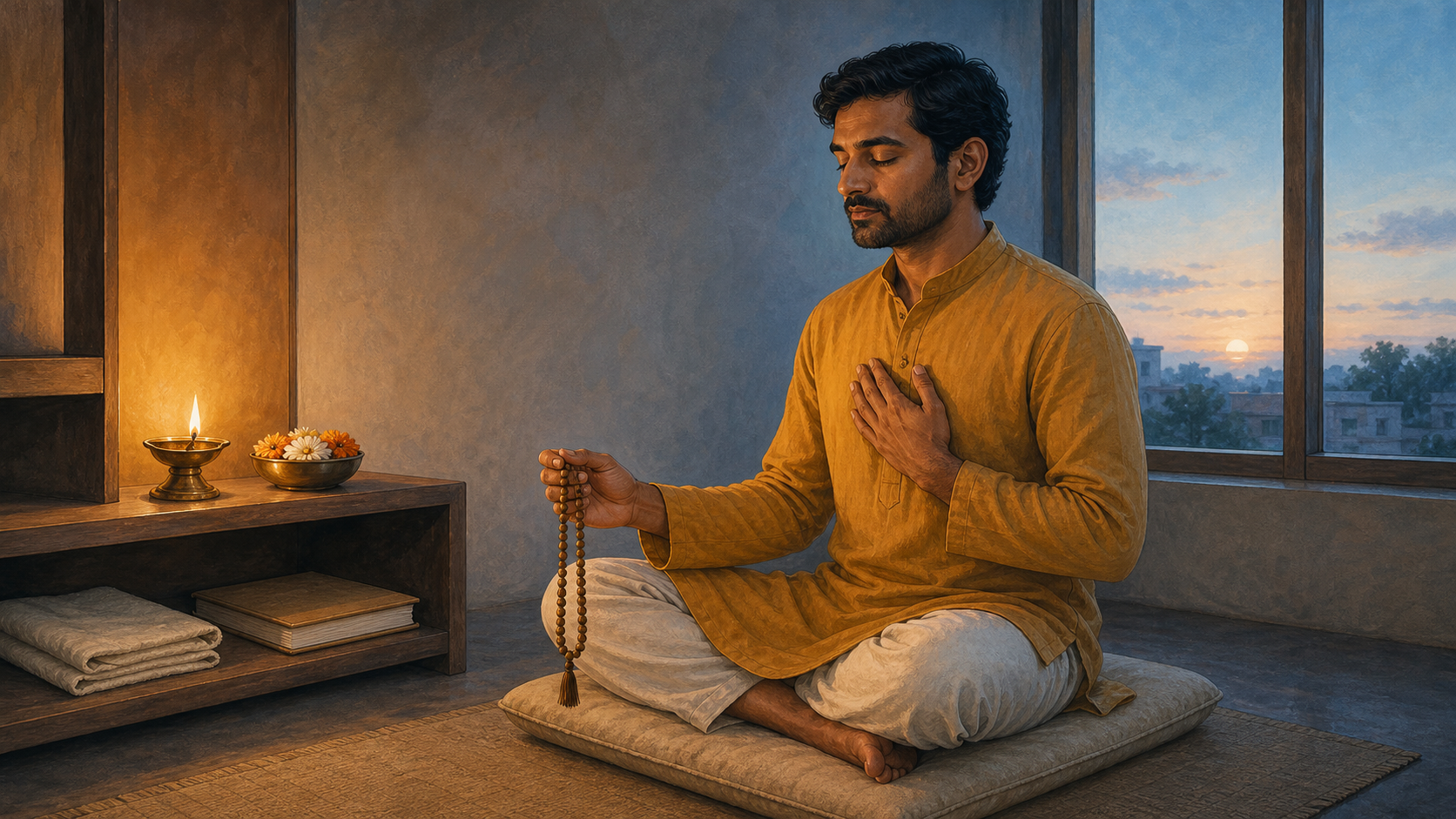
You may already know a mantra, chant, or familiar prayer, yet still wonder what you are supposed to do with your mind while reciting it. Should you ask for a particular result, concentrate on every word, generate devotion, or simply keep repeating until thought becomes quiet?
The way through is not to collect more sacred formulas. It is to give one authentic practice a clear intention, a stable structure, and an ethical consequence. When attention, breath, sound, and intention begin moving together, prayer stops being an occasional appeal and becomes a discipline you can carry into decisions, relationships, grief, and service.
Prayer becomes dependable when it stops being a transaction
There is nothing improper about praying during illness, uncertainty, conflict, or loss. The trouble begins when the entire practice is reduced to a bargain: I will recite this if the Divine gives me that. If the desired event does not occur, faith collapses; if it does occur, craving merely chooses another object.
A more durable prayer asks for alignment before outcome. In a Hindu devotional frame, you may place a need before Ishvara while asking for the clarity and strength to act according to dharma. In contemplative or non-dual practice, prayer can refine the mind so that the witnessing presence is less obscured by agitation and attachment. Buddhist, Jain, and Sikh disciplines use different theological and philosophical languages, but they likewise join inner practice to attention, restraint, compassion, truth, or service. Their differences should be respected rather than compressed into a vague claim that every tradition means exactly the same thing.
Before recitation, turn your concern into a short sankalpa. A useful intention contains three movements:
- Name what is true. Admit the fear, confusion, grief, desire, or fault without exaggerating it and without pretending that you are above it.
- Name the dharmic quality you need. Ask for discernment, courage, patience, truthful speech, non-harm, or the strength to perform a necessary duty.
- Release control of the result. Commit to the right action while acknowledging that consequences are not entirely yours to command.
For a theistic practice, that may become: May I see this situation clearly, act truthfully, and avoid causing needless harm. I offer the result beyond my control. In a non-theistic contemplative practice, the same movement can be framed as a resolve to cultivate clarity and goodwill without grasping at a particular outcome.
This change is especially important when your prayer concerns another person. Instead of asking that someone be controlled, defeated, or made to conform to your preference, ask what truthful and compassionate action is yours. Prayer should make responsibility more visible, not give desire a sacred disguise.
Choose one doorway without flattening the Dharmic traditions
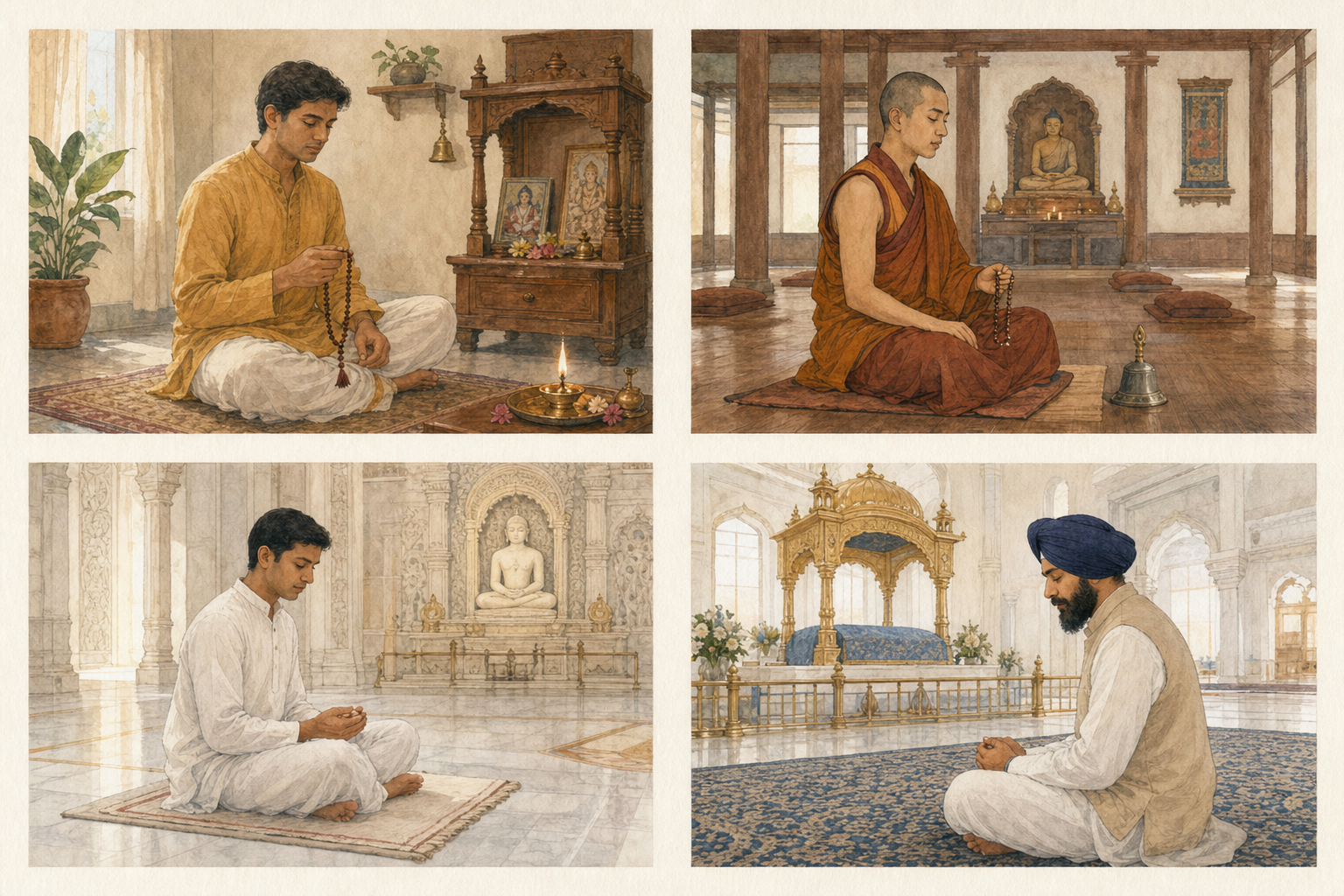
You do not need to sample every method. You need a form whose meaning you can learn, whose discipline you can sustain, and whose ethical demand you are prepared to honour. The Dharmic family offers related disciplines of remembrance and attention, but each tradition gives those disciplines its own grammar.
- In Hindu practice, you might begin with the name or mantra of your Ishta, a stotra, a simple arati, or a prayer followed by silent dhyana. Bhakti, jnana, karma, and raja are different entrances rather than mutually exclusive camps: devotion can soften the heart, inquiry can correct confusion, selfless action can test sincerity, and meditation can steady attention. If a simple offering supports your bhava, a leaf, flower, fruit, or water is enough; Bhagavad Gita 9.26 places the value of the offering in the devotion with which it is made.
- In Buddhist practice, chanting the refuges, reciting a lineage-appropriate mantra such as Om Mani Padme Hum, or cultivating metta can train the mind to extend goodwill without possessiveness. Do not force such practice into the mould of petition to a creator. Let its own discipline of attention, non-grasping, insight, and compassion govern it.
- In Jain practice, the Namokar Mantra can orient attention toward liberated and spiritually accomplished beings rather than toward the fulfilment of a personal wish. Samayik gives that orientation a period of equanimity, while pratikraman turns prayer toward honest review, repentance, restraint, and repair. The decisive question is whether remembrance strengthens ahimsa and self-command.
- In Sikh practice, the Mool Mantar and Naam Simran turn attention toward Ik Onkar and remembrance of Akal Purakh. Kirtan gives this remembrance a communal voice, while seva and truthful living reveal whether Naam has entered conduct. Recitation is not an escape from the world but a way of meeting it with humility and courage.
Use three tests when choosing your form. First, learn its basic meaning rather than treating syllables as a technique for obtaining power. Second, choose something repeatable enough that novelty is not doing all the work. Third, identify the conduct it demands after the session. A prayer you can recite beautifully but refuse to live is not yet an inner practice.
If a mantra or method comes with instructions from a guru, acharya, monastic community, granthi, or established lineage, follow that discipline instead of mixing it casually with incompatible procedures. Pluralism means honouring legitimate paths; it does not require turning sacred forms into interchangeable wellness products.
A repeatable 10-to-15-minute prayer sequence
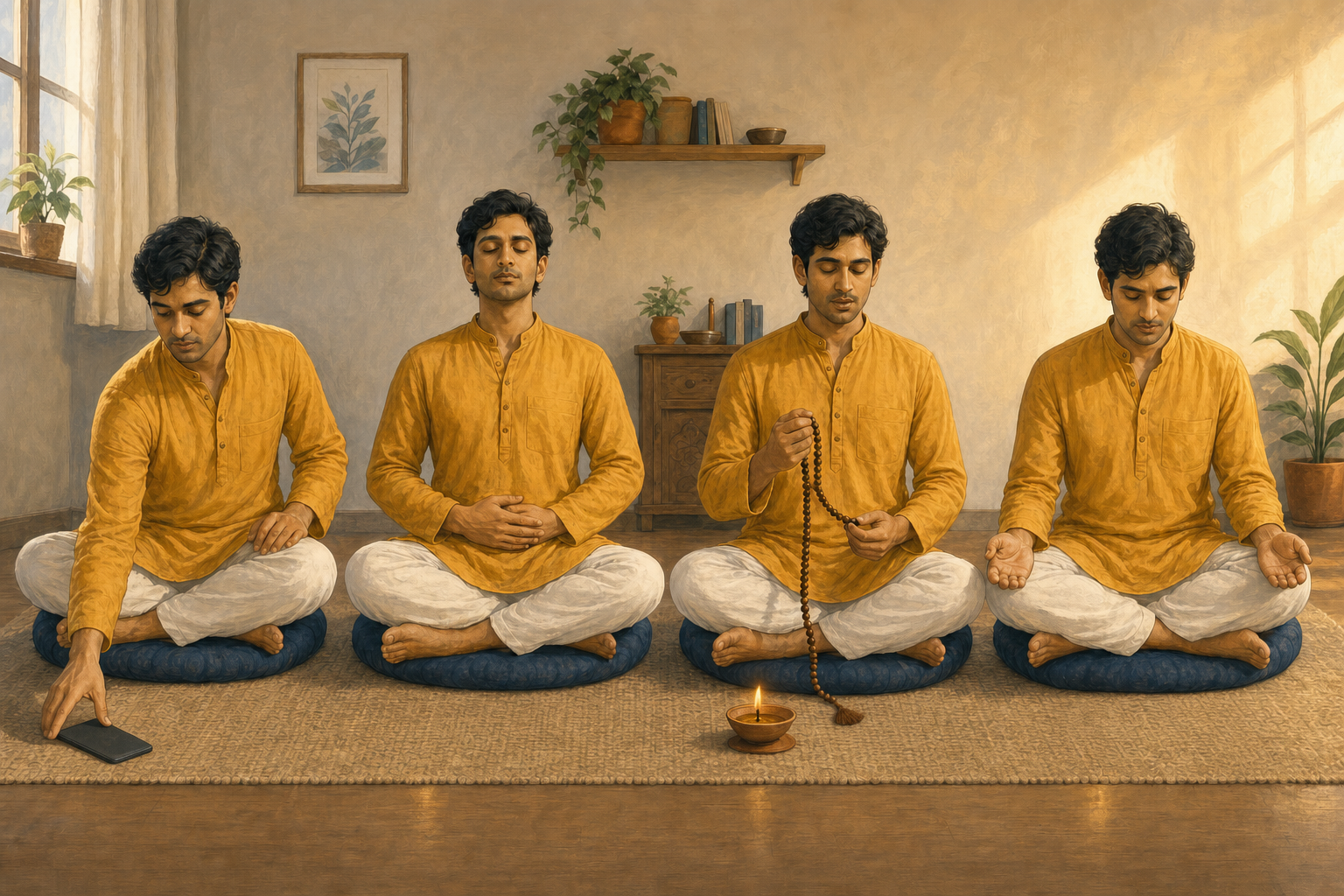
Ten to fifteen minutes twice daily often proves sustainable, especially when breath, recitation, and silence form one continuous practice. If two sessions do not fit your present responsibilities, protect one fixed session before attempting more. A modest discipline maintained steadily will teach you more than an elaborate routine performed only when inspiration appears.
- Prepare one clean place. Reduce avoidable noise and put away the device you are not using as a timer. An elaborate shrine is unnecessary. A murti, image, scripture, lamp, or other traditional support may help, but the purpose is to collect attention rather than decorate distraction.
- State your sankalpa once. Keep it short enough to remember. If you spend most of the session negotiating the wording, the mind has found another way to avoid practice.
- Take a steady seat and settle the breath. Let the spine be comfortably upright and release unnecessary tension in the face, shoulders, and abdomen. Use only a gentle pranayama you already understand; otherwise allow breathing to become quiet naturally. Prayer is not a reason to strain, compete, or force breath retention.
- Begin with sound. Use vachika japa, audible recitation, when the mind is scattered or sleepy. Move to upamshu, a whisper or barely audible repetition, when attention becomes steadier. Use manasika, purely mental repetition, when you can remain clearly present without drifting into fantasy or sleep. Silent repetition is subtler, but it is not automatically better if you are no longer attending.
- Join repetition to meaning. Remember the name, quality, teaching, or reality toward which the words point. For a Hindu practitioner using Om, the Yoga Sutra joins japa to contemplation of its meaning; sound and understanding are meant to support one another. If meaning has disappeared, slow down rather than chasing a count.
- Let sound resolve into silence. After recitation, stop deliberately and sit without manufacturing another experience. Notice the residual cadence of the mantra, the breath, and the state of the mind. Thoughts may continue. Your task is not to attack them but to stop feeding every thought with a second story.
- Close with goodwill and one duty. Extend the benefit beyond yourself, then name one action that follows from the session: make an apology, speak accurately, complete neglected work, refrain from a harmful response, offer seva, or attend patiently to someone in your care.
Choose the length before you begin so that the mood of the moment does not decide when prayer ends. Keep one central recitation rather than cramming several mantras, hymns, breath methods, and visualizations into the same short period. Additional forms can remain part of festival, temple, sangha, gurdwara, family, or longer observance without overcrowding your daily anchor.
Prayer may support calm, emotional regulation, and perspective, but it is not a replacement for medical or psychological care. If you are ill, in severe distress, or unable to function, seek qualified help and let spiritual practice accompany appropriate care rather than displace it.
Read the results in your conduct, then correct the practice

Do not judge a session only by whether it felt peaceful. Pleasant states can come and go, while an uncomfortable prayer may expose an evasion you need to face. The more reliable question is whether practice is producing coherence between thought, speech, and action.
Understand the movement from speech to stillness
The traditional fourfold account of vak offers a useful map. Vaikhari is articulated speech. Madhyama is inward or mental formulation. Pashyanti points to a pre-conceptual seeing in which meaning is not yet divided into ordinary sentences. Para is primordial, unmanifest speech.
Use this map to understand why prayer need not end when audible words stop. Do not turn it into a status ladder or claim an exalted attainment because the mind went blank. Your practical work is simpler: pronounce attentively, recollect inwardly, allow meaning to deepen, and stop interfering when genuine stillness appears.
Adjust for restlessness, heaviness, and mechanical repetition
- When rajas dominates, the mind races ahead of the mantra, rehearses arguments, or keeps changing methods. Return to one recitation, make the breath gentle, and use whispered japa so that attention has a clear thread to follow. Do not interpret every surge of emotion as spiritual instruction.
- When tamas dominates, prayer becomes foggy, slumped, or half-asleep. Sit more upright, practise at a more alert time, and use an audible chant instead of disappearing immediately into mental repetition. Heaviness is a condition to work with, not proof that you are incapable of practice.
- When repetition becomes mechanical, recall the meaning before beginning, slow the cadence, and restore bhava. In devotional practice, remember the presence or quality being invoked. In reflective practice, bring the ethical intention back into view. More repetitions do not repair absent attention.
- When prayer becomes self-accusation, distinguish responsibility from rumination. Admit the wrong, identify the repair, and perform it. Replaying guilt without changing conduct keeps attention centred on the self rather than on dharma.
- When silence becomes destabilizing, return to audible recitation, open your eyes, or end the session. If practice repeatedly intensifies panic, intrusive memories, or loss of ordinary functioning, do not force longer sittings; consult a qualified mental-health professional who can respect your spiritual commitments.
Use the five sheaths as a practical self-audit
Pancha-kosha viveka can help you notice where a practice is becoming integrated. Treat the sheaths as a contemplative framework, not as a medical diagnostic tool:
- Annamaya, the physical sheath: Can your body remain steady without needless strain? If pain or posture consumes the session, change the seat rather than turning discomfort into a test of devotion.
- Pranamaya, the vital sheath: Does the breath gradually become less erratic? If you finish breathless or tense, simplify the preparation and stop forcing the technique.
- Manomaya, the mental-emotional sheath: Can you notice fear, anger, or desire without immediately obeying it? The goal is not emotional numbness but freedom from automatic reaction.
- Vijnanamaya, the discerning sheath: Is the next right action becoming clearer? Prayer should strengthen buddhi, including the ability to question a desire that has learned to use religious language.
- Anandamaya, the bliss-associated or causal sheath: Is there a quieter contentment that does not depend entirely on obtaining the requested outcome? Do not chase a pleasant sensation; notice whether grasping has loosened.
Yoga traditions may also describe movement through sushumna or associate compassion and peace with anahata. Such language can guide contemplation, but it should not be presented as a substitute for medical anatomy or as a claim that every bodily sensation is a mystical event.
Make ethical change the decisive test
A practice is not maturing if it makes you more contemptuous, evasive, or convinced of your superiority. Bhakti without responsibility can become sentiment. Meditation without yama and niyama can become self-absorption. Chanting without seva can become performance. Repentance without repair can become another ritual of the ego.
Periodically ask questions that can be answered by conduct rather than mood:
- Did prayer help me speak more truthfully when concealment would have been easier?
- Did I reduce an avoidable harm in thought, speech, consumption, or action?
- Did I complete a duty instead of using spirituality to postpone it?
- Did I repair a wrong rather than merely ask to feel forgiven?
- Did remembrance make room for service, generosity, or patient attention?
- Can I accept an unwanted result without abandoning dharma?
This is where the shared values of the Dharmic traditions become concrete. Ahimsa, truthfulness, restraint, compassion, equanimity, seva, devotion, and discernment are not decorative ideals placed around prayer. They are how inner practice becomes visible in the world.
Key takeaways
- Begin by asking for alignment, discernment, and right action rather than treating prayer as a bargain for one desired outcome.
- Choose a form rooted in your own tradition or lineage, learn what it means, and resist mixing sacred practices merely for novelty.
- Build a stable sequence: prepare the place, state a sankalpa, settle the breath, recite attentively, rest in silence, and conclude with one duty.
- Use audible, whispered, or mental japa according to the actual condition of your attention, not according to a hierarchy you want to claim.
- Correct rajas with simplicity and a clear rhythm; correct tamas with posture, alert timing, and audible sound; correct mechanical practice by restoring meaning and bhava.
- Judge the fruit of prayer by greater truthfulness, non-harm, discernment, equanimity, and service, not by unusual sensations or fulfilled wishes alone.
At your next session, choose one form you can practise faithfully, write one sentence of sankalpa, and protect ten to fifteen minutes for it. When you rise, perform the smallest concrete action that your prayer has made clear. That action is where remembrance begins to become a way of life.