
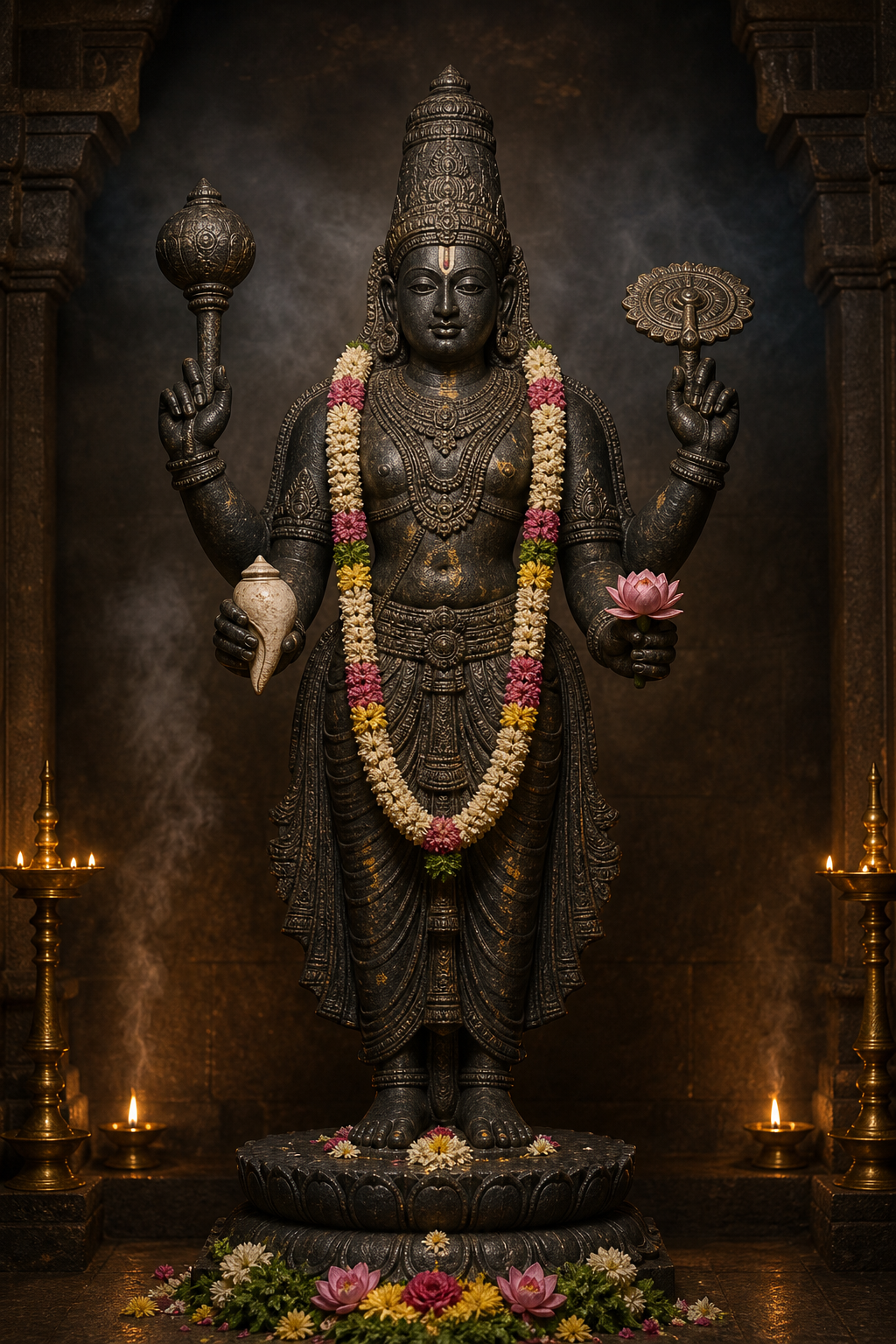
If a temple caption identifies a four-armed Vishnu murti as Upendra, you may wonder why it does not resemble the small-bodied Vamana familiar from narrative images. The caption is not necessarily mistaken. Upendra brings together two registers: the recognizable four-armed form of Bhagavan Vishnu and the theological identity associated with Vamana.
Once you know what to inspect, the murti becomes easier to identify and more rewarding to contemplate. The important details are the four attributes, the side on which each one appears, and the relationship between outward humility and dharmic sovereignty.
Key takeaways
- Upendra is a four-armed form of Vishnu associated with Vamana, not a separate deity competing with Vamana.
- The murti carries the gada, shankha, Sudarshana Chakra and padma. Their placement matters because Vishnu’s distinguished forms can share the same attributes.
- In the Upendra arrangement described here, the gada and shankha are in the deity’s right hands; the chakra and padma are in the deity’s left hands.
- The deity’s right is the viewer’s left when you face a frontal murti. Reversing those viewpoints is a common identification error.
- The symbols can be contemplated as strength, awakening, dharmic order and purity, but their meanings should not be reduced to a rigid one-word code.
How to identify Upendra without guessing
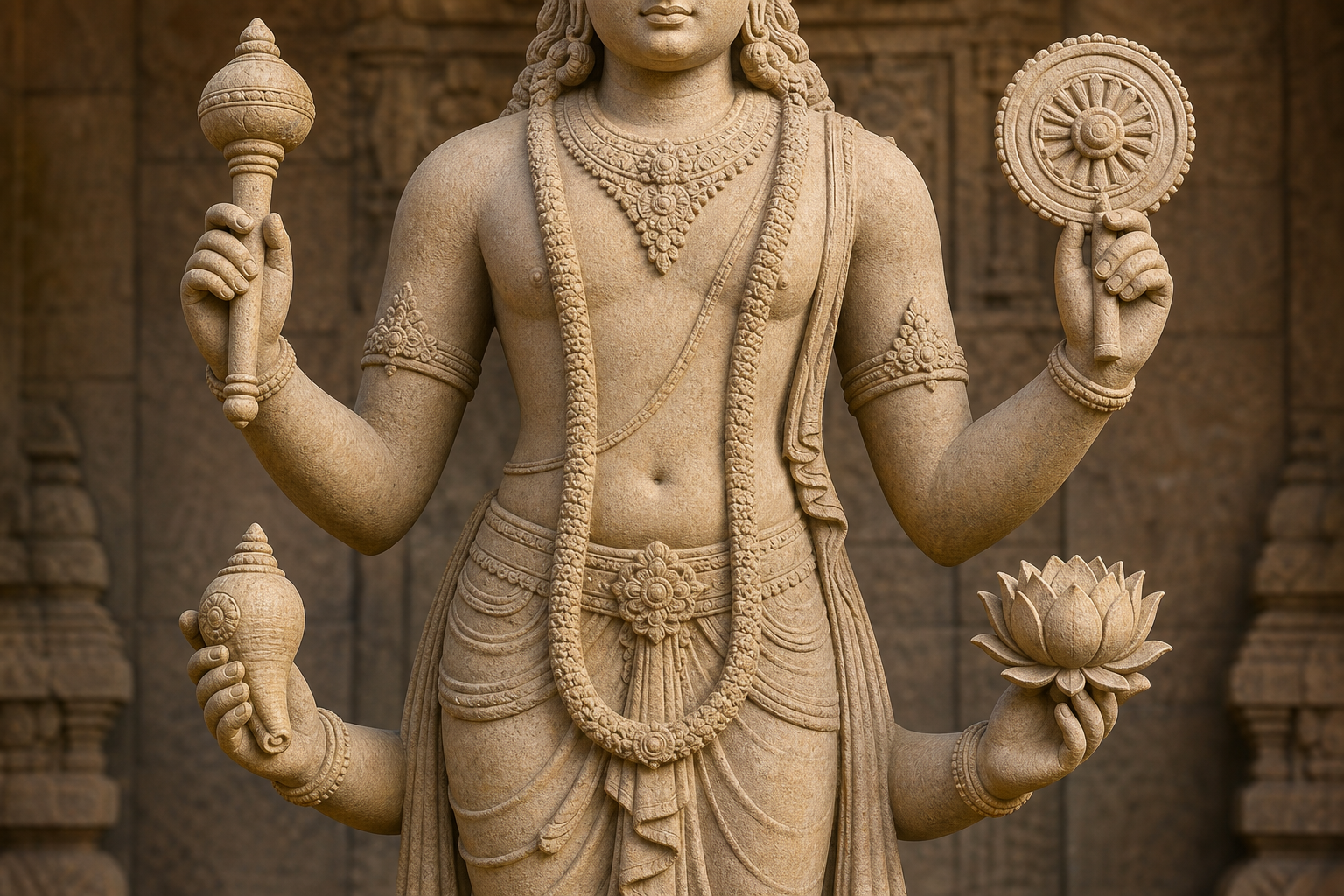
Temple iconography recognizes twenty-four distinguished forms of Vishnu in which the arrangement of the principal attributes helps establish the identity. The same conch, discus, mace and lotus recur across the group. Finding all four therefore tells you that you are looking at this shared Vishnu vocabulary; it does not, by itself, prove that the form is Upendra.
For Upendra, the useful first-pass marker is the lateral grouping: the gada and shankha belong to his right hands, while the Sudarshana Chakra and padma belong to his left hands. Use the deity’s body as the reference. In a frontal image, his right side appears on your left.
- Confirm that the figure has four arms and the general visual identity of Vishnu.
- Locate all four attributes: gada, shankha, chakra and padma. Do not identify a damaged object merely by its approximate outline.
- Separate the deity’s right hands from his left hands. Mentally reverse your own viewpoint before recording the arrangement.
- Check whether the gada and shankha are on the deity’s right and the chakra and lotus on his left.
- Use the inscription, temple tradition or catalogue entry to confirm the name, especially when an attribute is broken, concealed or heavily stylized.
Side assignments alone do not establish which object occupies the upper or lower hand. That distinction matters when the twenty-four forms are classified by exact placement. If you are cataloguing a sculpture, commissioning a murti or checking an image for ritual use, do not manufacture a vertical order from an unclear photograph. Record what is visible, mark the identification as probable when necessary, and consult the relevant temple authority, acharya, sthapati or iconographic manual for the precise convention being followed.
The four emblems form a grammar of dharmic sovereignty
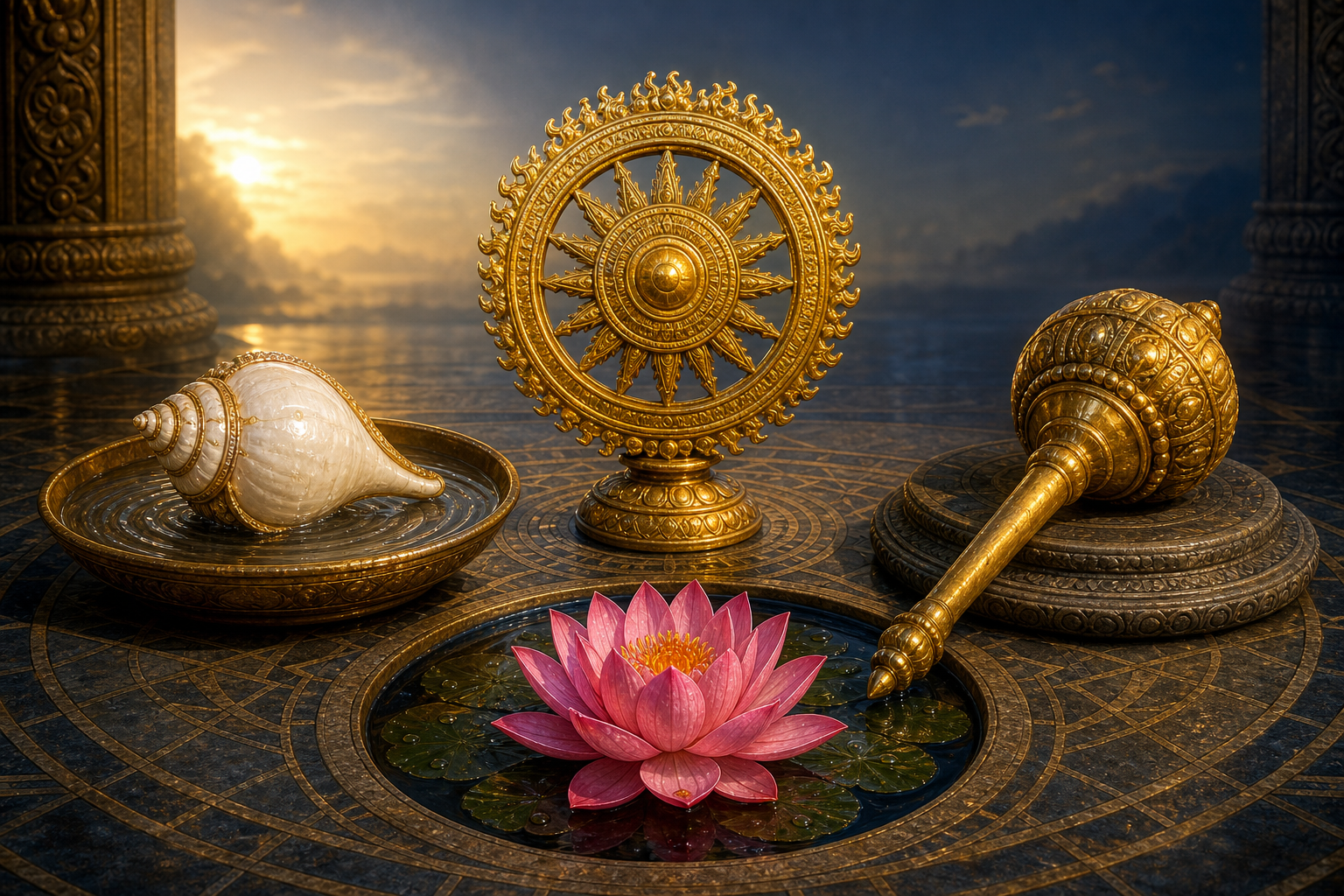
The attributes are not decorative accessories. Each one contributes to a coordinated vision of divine rule. Their common devotional meanings give you a practical starting point for darshan, even though individual sampradayas and iconographic traditions may develop those meanings differently.
| Attribute | What you see | A useful contemplative meaning |
|---|---|---|
| Shankha | A conch with a flared opening | Sacred sound, awakening and the call to dharma |
| Sudarshana Chakra | A wheel or circular discus | Dharmic order, clear discernment and protective power |
| Gada | A mace with a shaft and heavy head | Strength, discipline and the authority needed to uphold dharma |
| Padma | An open or budding lotus | Purity, spiritual unfolding and inward freedom |
Read the four together rather than treating them as independent labels. The shankha calls; the gada gives firmness to that call. The chakra establishes order; the lotus keeps order directed toward purity rather than domination. Strength without a dharmic summons can become mere force. A summons without strength can remain empty speech. Order without inner purity becomes cold control, while purity without discernment may never enter effective action.
This is a contemplative synthesis, not a claim that every school assigns an identical definition to every emblem. The disciplined approach is to begin with the shared symbolic vocabulary and then learn how your own sampradaya, temple or teacher reads it. Iconography should deepen tradition-specific understanding, not replace it with a generic symbol dictionary.
Why the Vamana connection changes the meaning
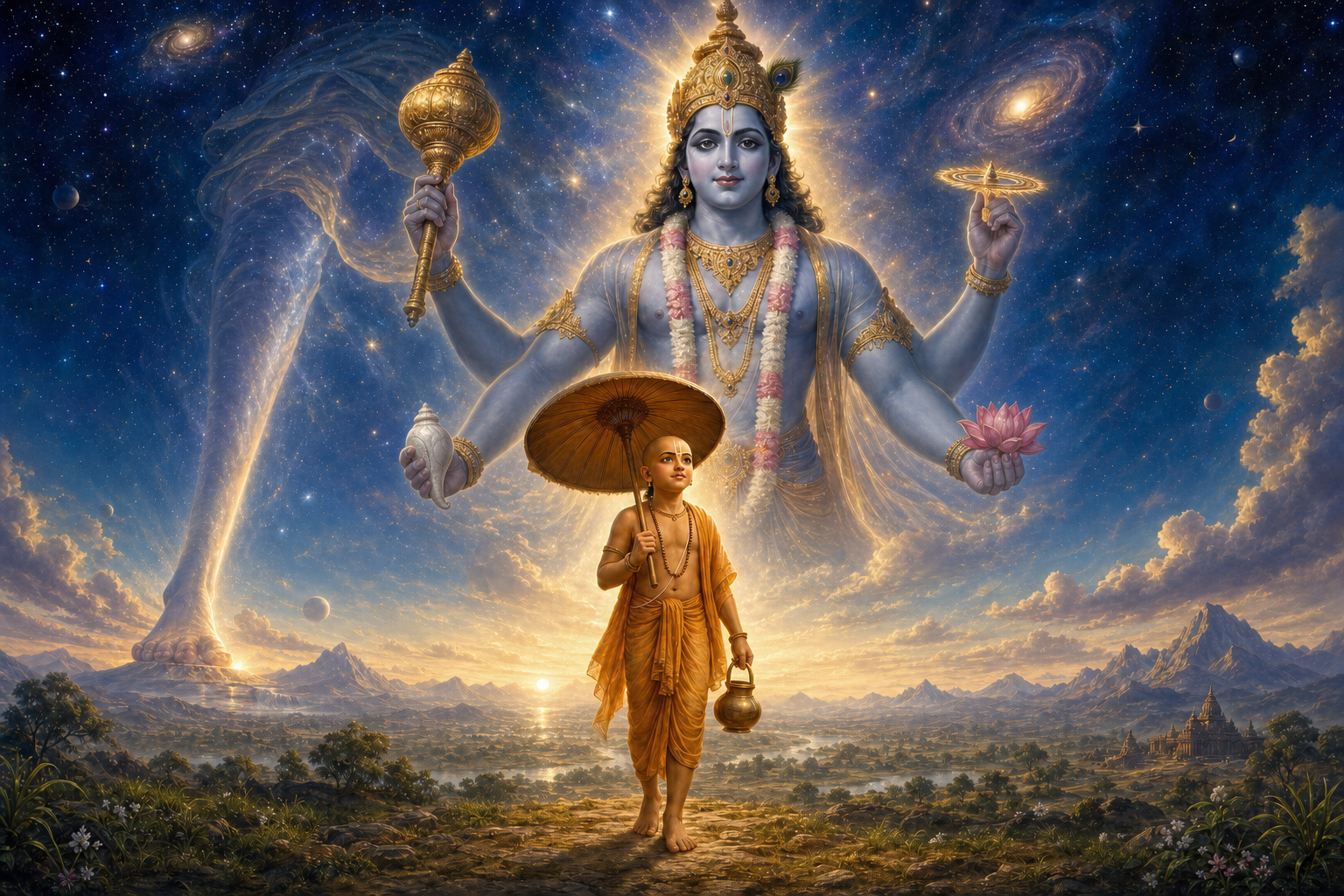
The name Upendra identifies Vishnu in relation to Indra: Upendra is associated with Vamana and described as Indra’s brother. His divine function is connected with helping the devas maintain dharma on earth. The relational name therefore tells you what the form does, not merely what it looks like.
Do not read that relationship as a reduction of Vishnu’s stature. The symbolism deliberately holds apparent smallness and cosmic authority together. Vamana’s dwarf form does not signify diminished divinity. It shows that dharmic power need not advertise itself through physical enormity. The sovereign capacity remains present even when the chosen appearance is modest.
Two opposite mistakes follow from missing this point. One is to separate Upendra and Vamana so sharply that their theological connection disappears. The other is to assume that every image called Upendra must reproduce the narrative appearance of a dwarf. A four-armed Upendra murti can express Vishnu’s enduring divine identity, while the name and context carry the Vamana relationship.
This distinction is especially useful in temples, museums and image catalogues. When you encounter the label Upendra, ask what the label is identifying: a theological name of Vishnu, a member of the twenty-four-form iconographic system, or a narrative representation of Vamana. These layers are related, but they are not always visually interchangeable.
Move from recognition to darshan
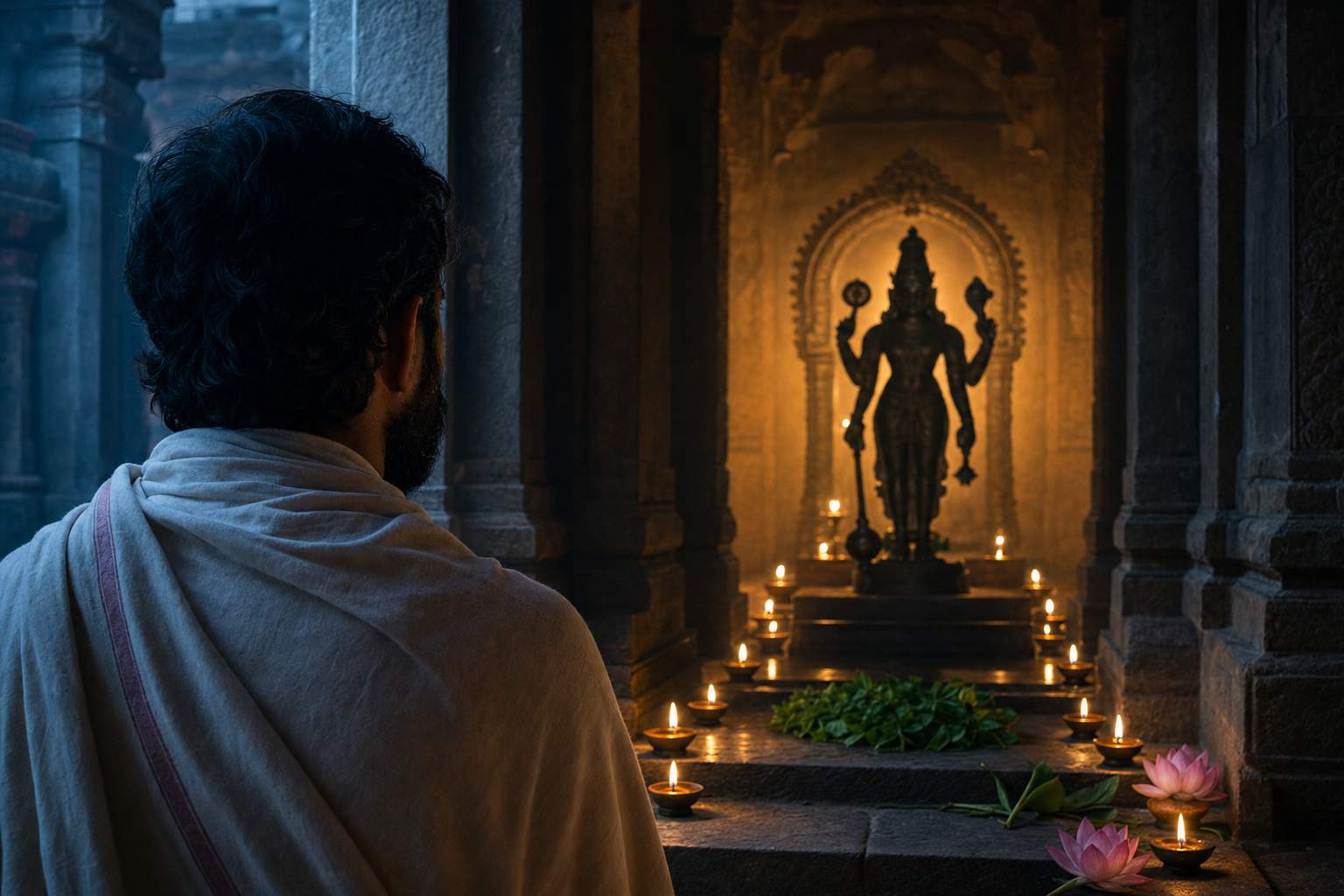
Correct identification is valuable, but it is only the beginning. You can use the iconographic details to give your attention a clear sequence instead of letting your eyes move casually across the murti.
- Name the four attributes you can actually see. If one is damaged or hidden, acknowledge the uncertainty rather than filling it in mentally.
- Pause at the shankha and gada. Ask whether your words are aligned with dharma and whether your actions have enough discipline to support them.
- Pause at the chakra and padma. Ask whether your pursuit of order remains joined to clarity, purity and freedom from egoistic display.
- Remember the Vamana association. Let the contrast between a modest appearance and sovereign responsibility correct the habit of confusing loudness with strength.
- Choose one concrete expression of dharma for the day: a truthful sentence, a restrained response, a duty completed properly or power exercised without humiliation.
This emphasis on conduct is already present in the devotional portrayal of the form. Upendra is described as dwelling in the tongue of devotees who follow dharma. The image therefore directs attention back to speech. A devotee cannot praise dharma before the murti and then treat falsehood, cruelty or reckless language as spiritually irrelevant.
Plantain and coconut are named as offerings associated with this form. If you worship Upendra at home, use them where that practice agrees with your family or sampradaya tradition; where an established temple procedure differs, follow the temple’s procedure. The offering is a gesture of devotion, not a substitute for attention, disciplined speech and dharmic conduct.
The devotional promise attached to Upendra worship is liberation from rebirth and worldly suffering. That promise should not be reduced to a mechanical exchange in which an object is offered and a result is demanded. The murti gathers sound, strength, order, purity, humility and responsibility into one field of attention. Worship becomes coherent when those same qualities begin to shape the worshipper.
The next time you encounter a four-armed Vishnu image, take thirty seconds before accepting or rejecting its label. Identify the four emblems, reverse your viewing perspective correctly, check the side grouping and note any uncertainty about the upper and lower hands. Then let the icon do more than answer a classification question: use it to align one word and one action with dharma.