
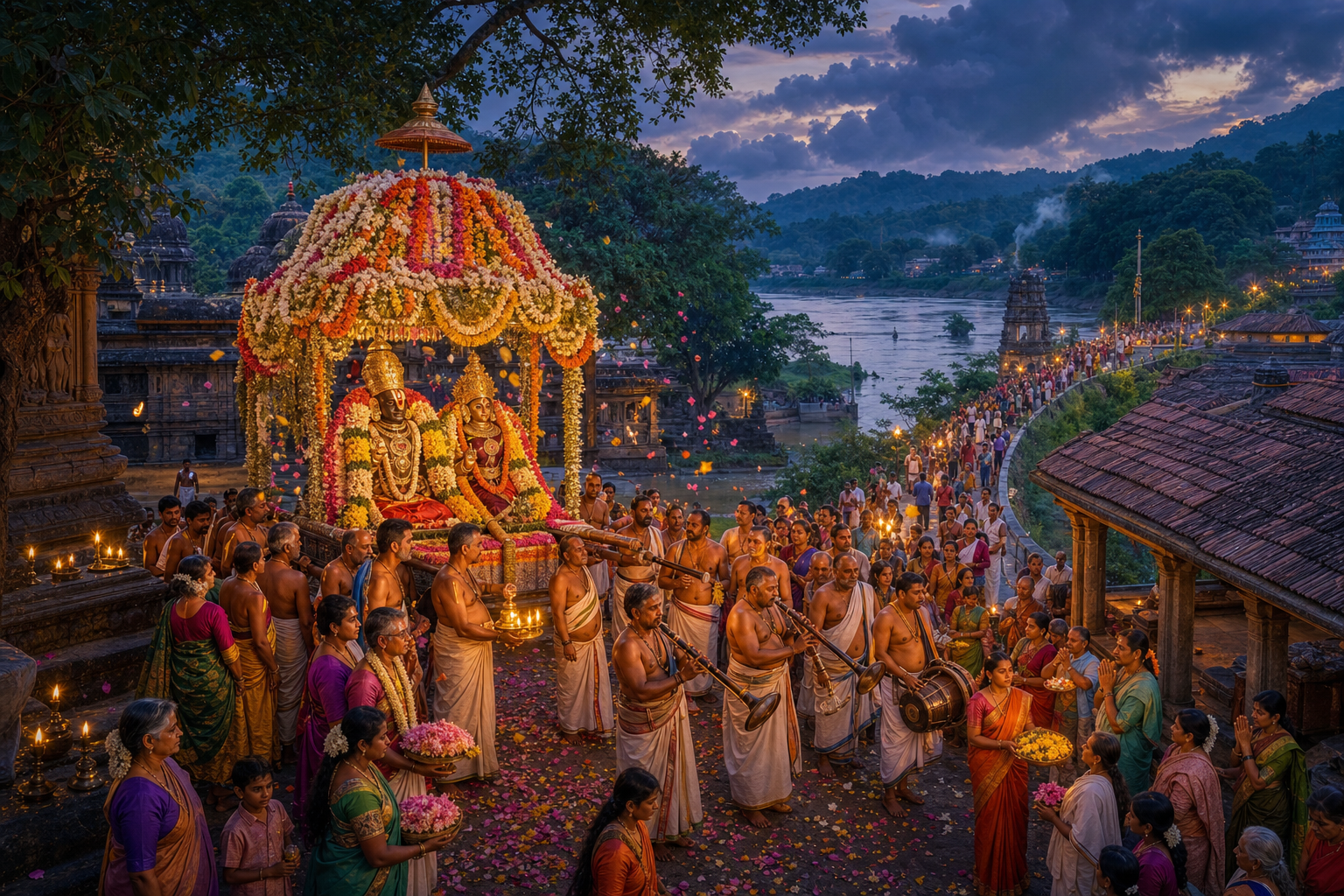
If you have watched a divine wedding procession and wondered whether you were seeing theology, theatre, or local custom, begin with a better question: what relationship is this marriage creating between the deity, the place, and the people gathered there?
That question changes how you approach a pilgrimage. It helps you see why Kukke Subramanya is remembered as a kalyana kshetra, why Sambalpur becomes an extended ritual family during Sitalsasthi, and why neither tradition can be separated from its river, season, architecture, music, or inherited community roles.
A divine marriage makes a claim about the place
A sthala purana is more than a legend associated with a temple. It is a sacred account of why the Divine is encountered at this particular location. Mountains, rivers, caves, shrines, trees, procession routes, and even regional building forms become part of the theological vocabulary.
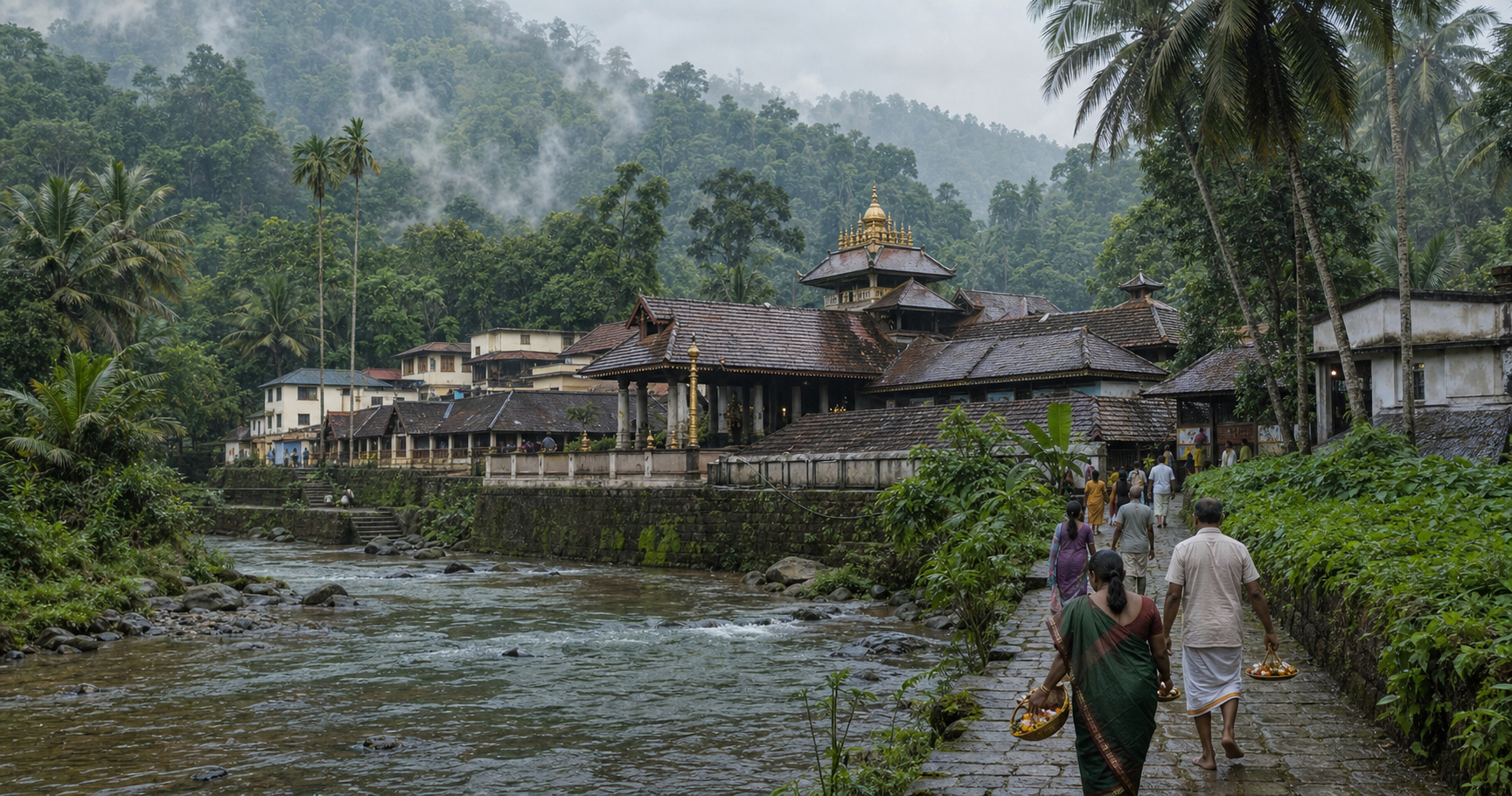
Kukke Subramanya demonstrates this place-making power with unusual clarity. The temple stands in Tulu Nadu at the foot of Kumara Parvatha, beside the Kumara Dhara, within the rain-rich Western Ghats. Its local sacred memory brings Subramanya, also known as Skanda, Kartikeya, or Kumara Swamy, to the river valley with Ganapathi in connection with the defeat of Tarakasura. The remembered marriage of Subramanya and Devasena then establishes the valley as a kalyana kshetra, a field sanctified by divine marriage.
The marriage is only one layer of the location’s identity. Vasuki and Shesha are believed to have taken refuge beneath Subramanya there, seeking protection from Garuda. The association of the sanctum with Vasuki, the anthill imagery of the Adi Subramanya shrine, and the nearby Bila-dvara cave draw the pilgrim’s attention downward, toward shelter, hidden life, and the deity’s guardianship of the nagas. Even the regional explanation of the name Kukke, associated with a basket that protected the anthill, preserves the theme of safeguarding a vulnerable sacred presence.
Local tellings can differ over an episode’s exact setting, including the precise place assigned to Devasena’s marriage. That variation is not an invitation to treat every detail as interchangeable. It tells you to distinguish the stable theological center from the regional form through which a community remembers it. At Kukke, that center is Subramanya as victorious restorer of dharma, divine bridegroom, and protector of the nagas.
When you enter a sacred place shaped by such memory, do not look only at the main murti. Read the landscape in this order:
- Identify the natural feature that prepares the encounter: a river, hill, grove, cave, or spring.
- Notice the subsidiary shrine or symbol that preserves a second strand of the sacred history.
- Watch how pilgrims move between water, threshold, circumambulatory space, and sanctum.
- Ask which part of the built environment answers the local climate as well as ritual need.
At Kukke, the traditional bath in the Kumara Dhara before darshana connects purification in the river with worship in the temple. The sloping tiled roofs and timber elements answer the heavy monsoon, while the compact sanctum, prakara, dhvaja-stambha, and deepa-stambha establish a ritual axis. Architecture is doing two jobs at once: protecting worship from the weather and giving sacred order to movement.
The wedding gives visible form to theology
A divine wedding is easy to mistake for a celestial version of a human social event. The relationship runs in the other direction too: human marriage rites become a language through which communities contemplate cosmic order, complementary powers, disciplined commitment, fertility, protection, and continuity.
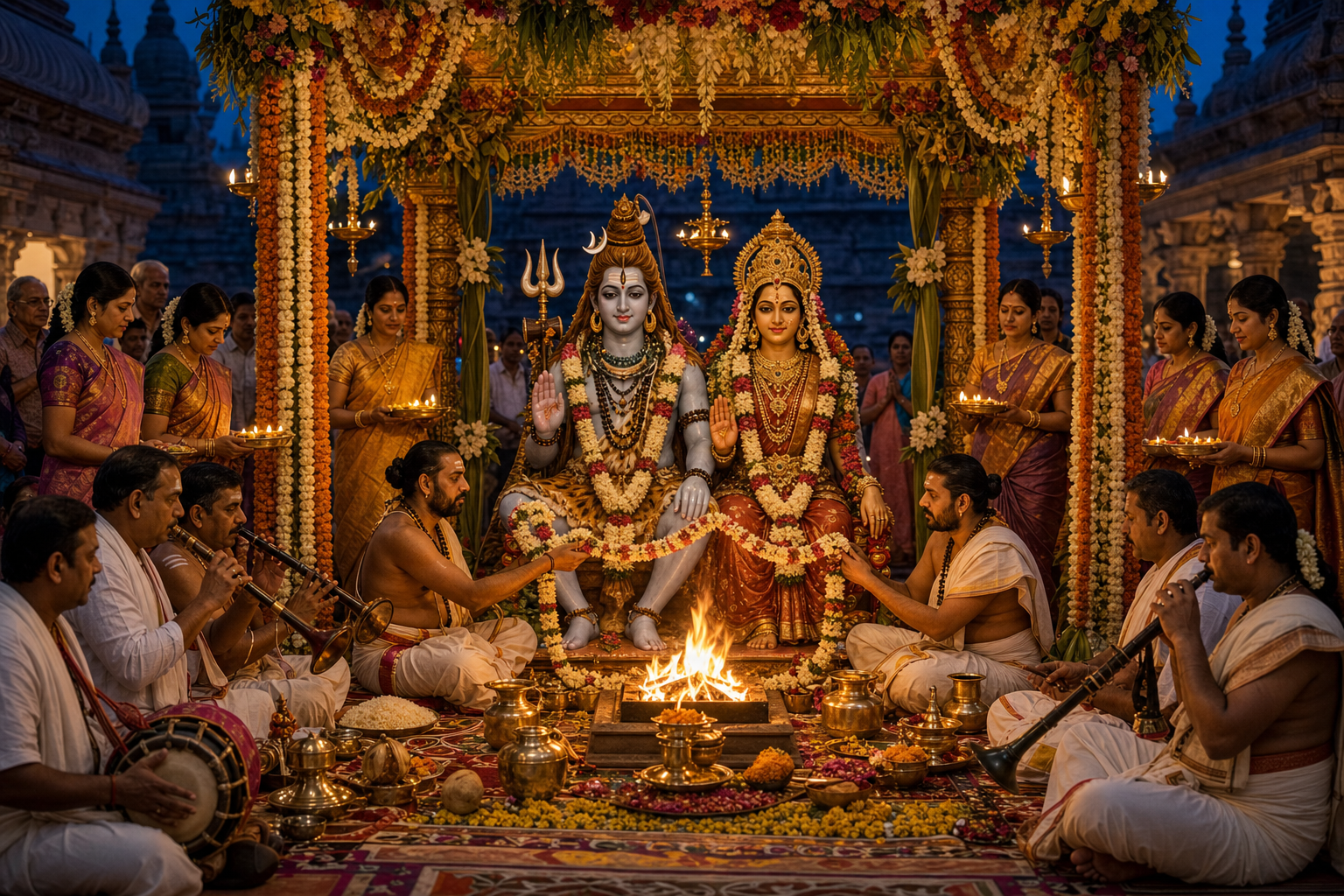
Sitalsasthi in Sambalpur ceremonially unites Shiva and Parvati. The union expresses the complementarity of Shiva and Shakti, often understood as consciousness and dynamic energy. Its affinity with the Ardhanarishvara vision is important: unity does not require the disappearance of distinction. The divine couple allows oneness to appear through relationship.
The sequence of the public celebration makes that principle visible. Engagement and invitation precede the groom’s procession. Shiva’s barajatra moves through the city with conches, nishan drums, and Sambalpuri rhythms before reaching the wedding mandapa. There, rites including kanyadana, panigrahana, laja homa, and saptapadi solemnize the union. The subsequent return procession presents the now-wedded couple to the wider community through the streets and markets of Sambalpur.
If the Sanskrit ritual names are unfamiliar, follow the verbs rather than trying to memorize every term:
- The community prepares and invites, showing that a sacred union requires willing participation.
- The groom journeys, turning the procession route into ritual space.
- The families receive one another, placing relationship before private possession.
- Hands are joined and offerings are made into fire, giving public and sacred form to commitment.
- Steps are taken together, presenting union as a path rather than a single dramatic moment.
- The couple returns among the people, carrying the blessing of the mandapa into civic life.
This sequence gives you a practical way to watch. Do not judge the event only by the largest chariot, loudest ensemble, or most elaborate decoration. Ask what stage of the relationship is unfolding and who has accepted responsibility for it. Once you can identify invitation, arrival, union, and return, the celebration stops looking like an undifferentiated crowd.
Kukke’s Subramanya-Devasena memory gives a different emphasis. The divine bridegroom is also a warrior-sage whose victory restores order and whose protection shelters the nagas. The peacock vahana, vel, naga imagery, and marriage motif therefore belong to one ethical field: power must be disciplined by knowledge, victory must restore dharma, and authority must protect life seeking refuge.
Regional heritage survives because people receive real duties
Heritage becomes fragile when a community is reduced to an audience. It becomes durable when people inherit defined responsibilities, learn them from someone they know, and perform them at a time and place that matter.
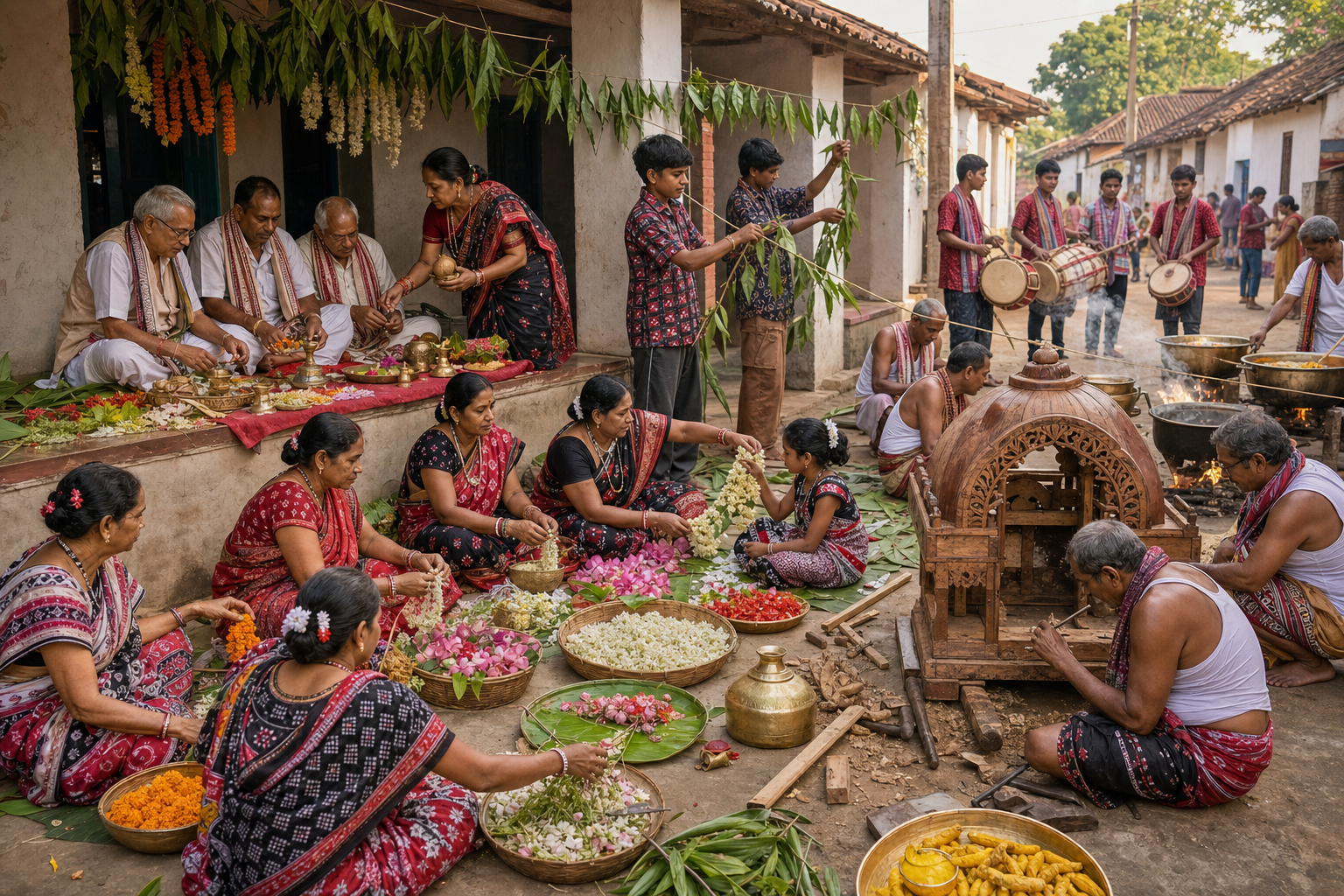
Sitalsasthi has endured in Sambalpur for more than four centuries because the wedding is not confined to priests inside a temple. Local households become the adoptive parents of Parvati or represent Shiva’s side. They accept responsibilities connected with engagement, invitation, hospitality, and kanyadana. Neighborhoods, or paras, organize routes, mandapas, gateways, music, volunteer work, and the reception of the divine couple. The result is a city-wide system of ritual kinship, not merely a large public performance.
The adoptive-parent institution is especially instructive. The honor is communal rather than a display of private status, and participation is not restricted to the wealthiest family. Costs can be supported through shared contributions and gifts in kind. Sacred prestige is tied to service, obligation, and consent.
This structure also protects forms of knowledge that written schedules cannot preserve by themselves. A drummer knows when a procession changes pace. A hereditary sevayat knows how one stage hands responsibility to the next. A household knows how invitations are extended. An artisan knows the regional textile, ornament, and gateway vocabulary. A volunteer knows where elders can stand without blocking ritual movement. Each role carries a different part of the festival’s memory.
If you are documenting a regional tradition for your family, temple, or community, record its chain of responsibility rather than collecting photographs alone:
- Name the role, the person or household entrusted with it, and the moment when the duty begins.
- Record the regional term alongside a plain-language explanation instead of replacing it with a generic label.
- Identify who teaches the role and how a successor is recognized.
- Separate the indispensable ritual act from decoration that may change with budget or fashion.
- Document musicians, weavers, cooks, craftspeople, route stewards, and volunteers as bearers of heritage, not as background labor.
- Preserve the route and sequence. A list of ceremonies without their spatial order loses much of the tradition’s meaning.
This method also prevents a common mistake in cultural preservation: freezing one year’s presentation and declaring it the only authentic form. A living tradition can change its lighting, crowd controls, or temporary structures while retaining its inherited ritual grammar. The test is whether responsibility, sequence, sacred boundaries, and regional vocabulary remain intelligible.
Season and ecology belong inside the ritual
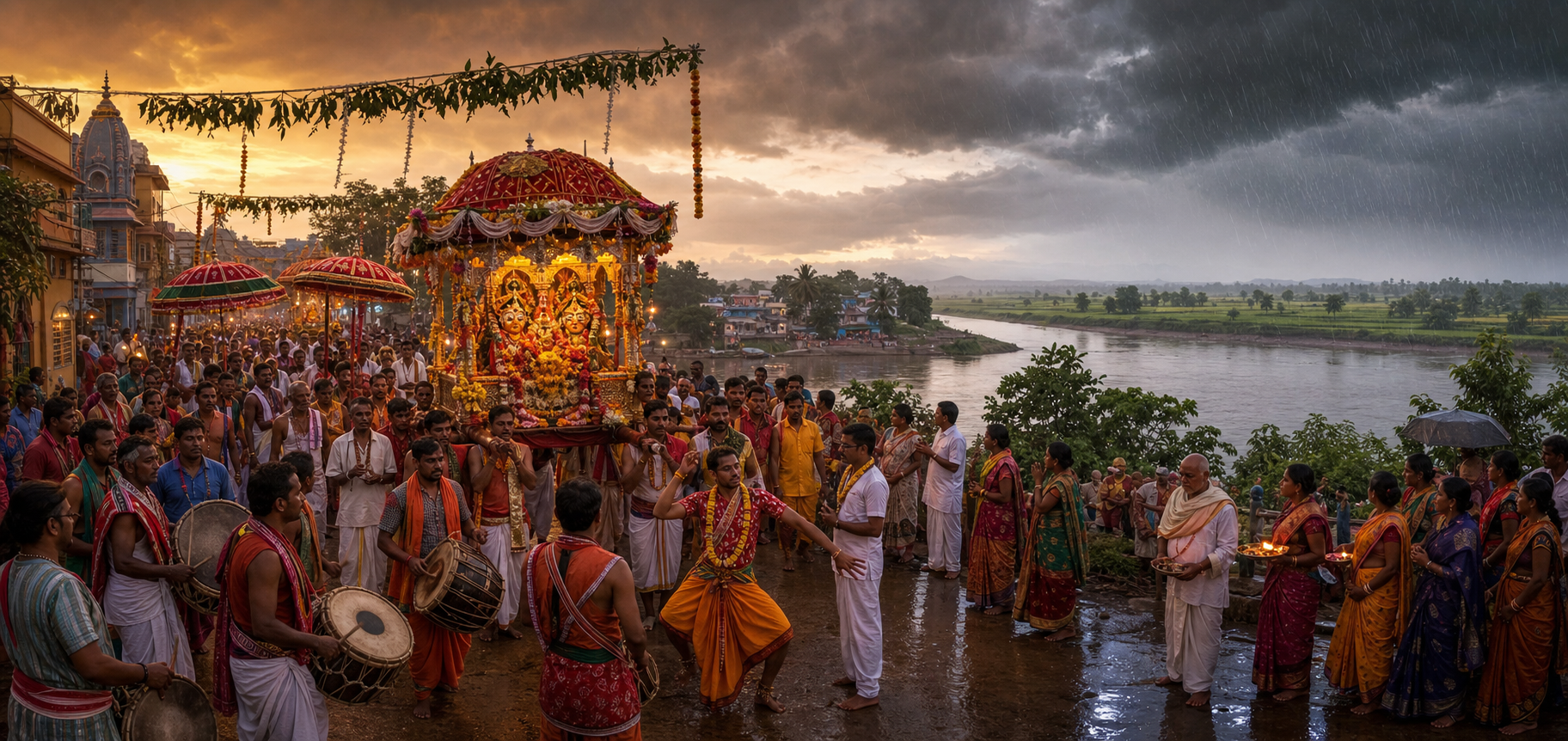
Divine marriage traditions do not occur against a neutral backdrop. Their calendars and symbols often make the condition of the land part of the community’s prayer.
Sitalsasthi falls on Jyeshtha Shukla Shashthi, near the transition from intense summer heat toward the monsoon. Its cooling symbolism, including the joyful sprinkling of water during public celebration, expresses relief from heat and hope for life-giving rain. The festival’s seasonal meaning is therefore not an optional explanation added after the wedding. It is carried in the date, bodily experience, public gesture, and anticipation of changing weather.
Kukke’s ecological grammar is different because it rises from a river valley and rainforest environment. Naga reverence connects Subramanya’s guardianship with serpents, anthills, riparian habitats, and the evergreen canopy of the Western Ghats. The river bath, subterranean symbolism, monsoon-responsive temple form, and restrictions appropriate to a sacred forest landscape all reinforce the same lesson: reverence for the deity cannot be cleanly separated from conduct toward the deity’s place.
This is where sacred ecology becomes an obligation rather than a slogan. If you bathe in a tirtha but leave plastic on its bank, photograph an anthill while trampling the life around it, or treat a pilgrimage trail as an adventure venue without sacred restraint, your behavior contradicts the grammar of the place. Carry reusable water containers where local rules permit, keep offerings and packaging out of waterways, remain on established paths, and follow temple or volunteer instructions around protected areas.
Serpent guardianship also opens a careful inter-Dharmic conversation. Mucalinda shelters the Buddha in Buddhist memory, while Dharanendra protects Parshvanatha in Jain tradition. The Sikh aspiration of Sarbat da bhala directs concern toward the well-being of all. These traditions should not be collapsed into one doctrine, but their distinct images can train a shared ethical attention: spiritual strength is revealed in protection, restraint, and concern for life beyond the human self.
When explaining a festival to a child or first-time visitor, connect one ritual gesture to one condition of the place. Explain the water sprinkling through heat and monsoon expectation. Explain naga worship through refuge and habitat. Explain the tiled roof through rainfall. Concrete connections are easier to remember than a claim that everything merely symbolizes nature.
Key takeaways for respectful participation
- Learn the local sacred account before you arrive. You need not master every variant, but you should know which divine union is remembered, why the location matters, and which natural features belong to its identity.
- Confirm the actual ritual schedule. Lunar tithis can span portions of adjoining civil dates, Sitalsasthi routes differ by neighborhood, and temple procedures can change. Use current temple, Panji, or local administrative information rather than assuming that one published time applies everywhere.
- Follow the sequence, not just the spectacle. Identify preparation, invitation, procession, marriage, and return. This reveals what the community is doing and helps you avoid obstructing a crucial transition for a photograph.
- Distinguish public space from sacred access. A street procession invites broad viewing, but a mandapa, sanctum, ritual corridor, or priestly working area may not. Respect barricades and instructions even when others press forward.
- Arrive before the route becomes dense. Early arrival makes it easier to find a lawful viewing place, keep passages open, and avoid pushing near the mandapa. In hot and humid conditions, wear modest light clothing, carry permitted water, and account for elders and children before crowds thicken.
- Do not treat a parihara rite as a tourist add-on. Kukke’s Sarpa Samskara and Ashlesha Bali involve sankalpa, prescribed procedures, dietary or vrata observances, registration, and temple scheduling. If you intend to undertake one, obtain the current protocol directly and approach it as a religious commitment, not a guaranteed transaction for a desired outcome.
- Support the people who carry the tradition. Fair purchases from regional artisans, respect for performers, cooperation with volunteers, and restraint with disposable packaging contribute more than another close-up video.
- Let regional difference remain visible. Shiva-Parvati’s city-wide wedding in Sambalpur and Subramanya-Devasena’s sacred geography at Kukke participate in a wider Hindu kalyana tradition without becoming replicas of one another.
Before your next temple journey or festival visit, write down four things: the divine relationship being celebrated, the feature of the land that carries its memory, the people entrusted with its continuity, and the conduct the place asks of you. You will arrive as more than a spectator, and you will leave with something more durable than a record of the crowd.
References
- DharmaRenaissance Blog – Timeless Sthala Purana of Kukke Subramanya: Legends, Rituals, and Sacred Ecology of Western Ghats
- DharmaRenaissance Blog – Sitalsasthi 2026: Sambalpur’s grand Shiva-Parvati wedding and Odisha’s living heritage