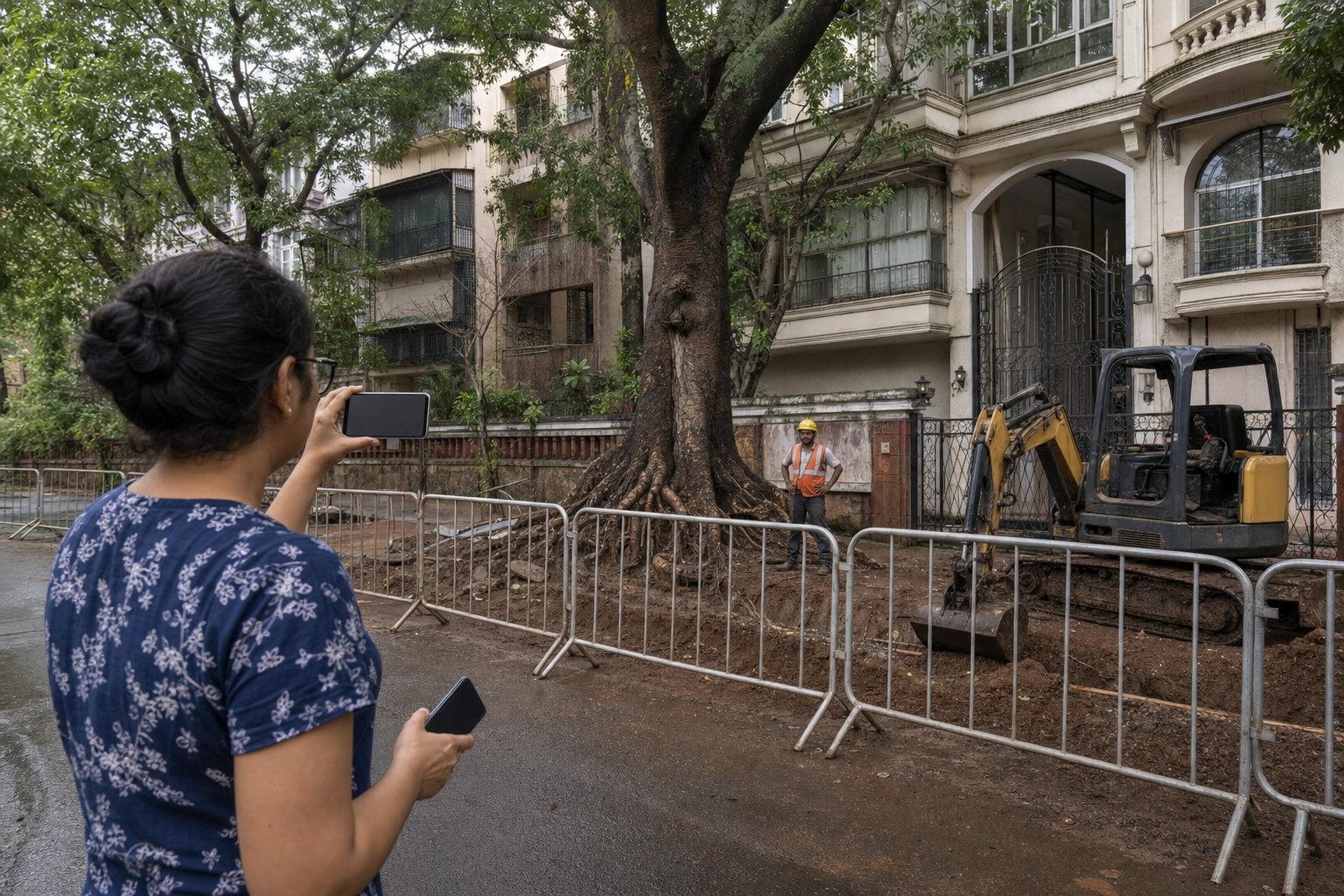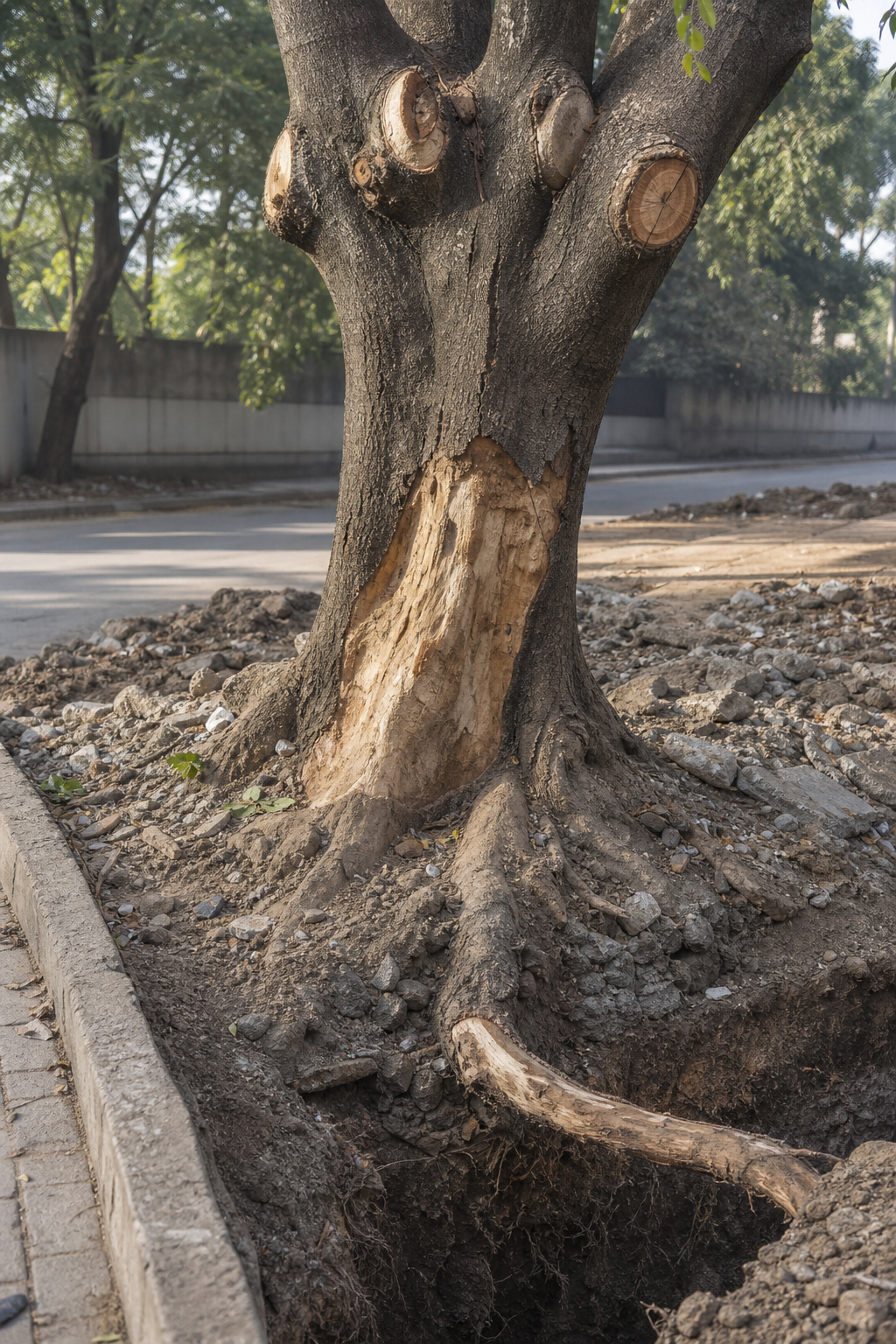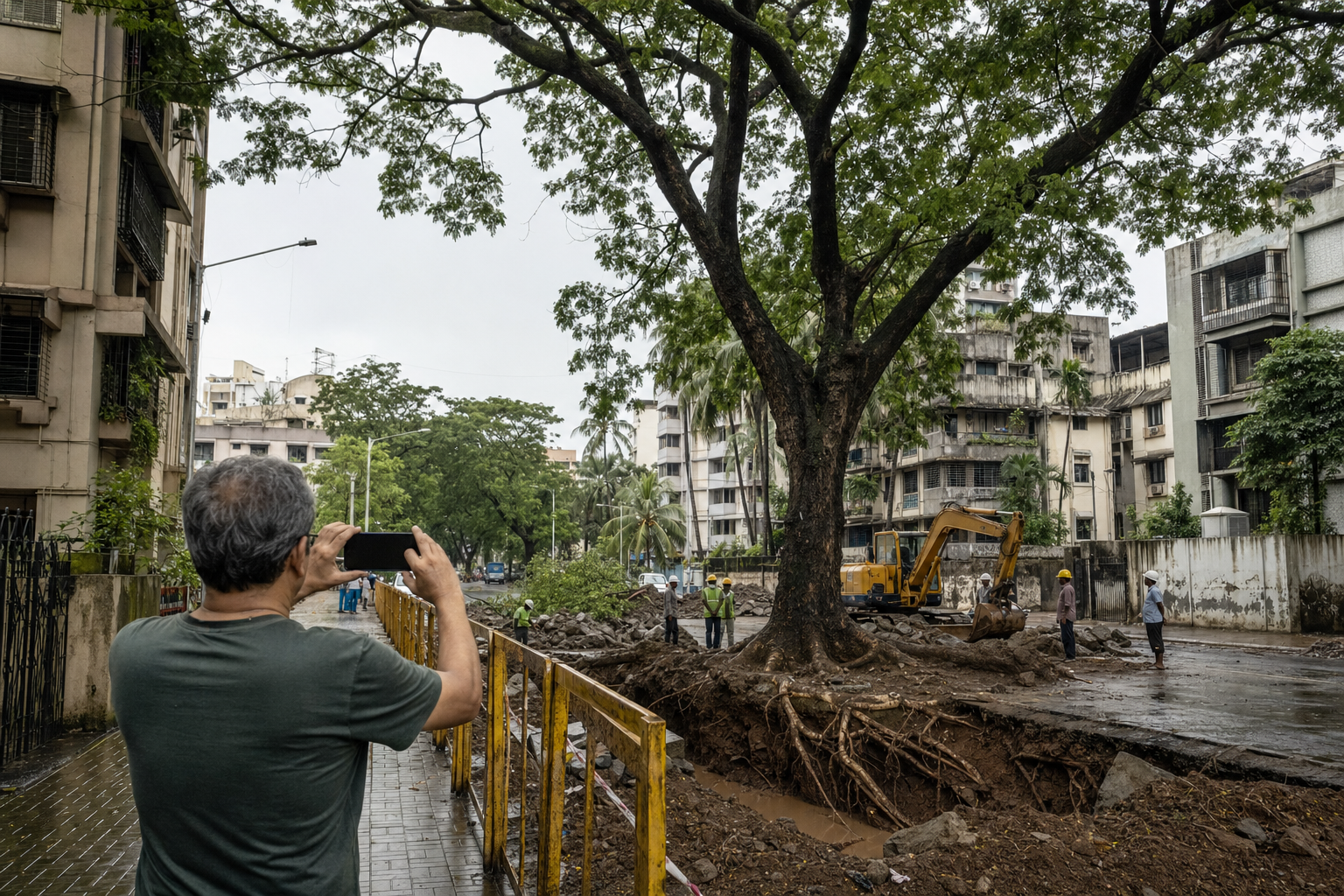
You see a trench cut beside a mature tree, fresh bark wounds on the trunk, or an entire crown reduced to stubs. The contractor calls it routine work. You want to know whether it was authorised, whether the tree can still be saved, and how to get more than a complaint number.
Your first useful move is not an argument at the barricade. It is a precise record that lets the BMC Tree Authority, ward officials, police, an arborist, or a tribunal connect a responsible agency to a specific act of damage. That record can support an inspection, a stop-work direction, restoration, penalties, or investigation. Here is how to build it.
Recognise tree damage before the evidence disappears
Not every cut branch proves an offence. A hazardous limb may require carefully planned pruning, and some public works may receive permission to transplant or remove a tree. The real questions are whether permission exists, whether the approved method is being followed, and whether the work protects as much of the living tree as reasonably possible.
Roots deserve as much attention as the visible crown. A tree can remain green after serious underground injury, so the consequence may emerge long after the excavator has left. Root severance, soil compaction, bark stripping and indiscriminate canopy lopping can weaken a tree, create entry points for decay and increase structural risk during storms.
- Look for fresh trenching close to the trunk, especially where large roots have been cut, crushed or exposed.
- Record excavators, parked vehicles, stored materials or concrete equipment operating over the likely rooting area.
- Notice fresh gouges, stripped bark or impact wounds on the trunk and major branches.
- Distinguish selective pruning from topping. A properly pruned crown retains a functional structure; topping or indiscriminate lopping leaves large stubs and removes substantial live canopy without an evident arboricultural purpose.
- Check whether soil, paving material or construction waste has been piled around the trunk. A buried root collar is not a harmless finishing detail.
- Photograph any displayed permission, tree number, project signboard, contractor name or work-order information.
If a tree or branch appears ready to fall, treat it first as a public-safety hazard. Keep people away, do not stand beneath the crown to obtain a better photograph, and report the danger through the relevant emergency or ward channel. Evidence matters, but it is not worth entering an active work zone or approaching unstable timber.
Do not accept a few replacement saplings as proof that the loss has been repaired. A mature tree already moderates heat, intercepts rainwater, filters particulates, stores carbon, reduces noise and provides established habitat. Young planting may be necessary compensation, but it does not reproduce those services immediately. Prevention should therefore remain the first objective.
Build an evidence record an official can act on
A photograph of a cut root can generate concern. A dated sequence connecting that root to a location, project and machine can generate a case. Your job is to preserve observable facts without making criminal conclusions that only the competent authorities can determine.
- Record the exact location. Include the road, nearest building or junction, a map pin or geotag, and the municipal ward if you know it. Do not guess the ward or tree number.
- Start with context. Take a wide image showing the tree and work site, a second image showing the relationship between the trench or machinery and the trunk, and close images of each wound, cut root or damaged limb.
- Capture the whole tree. Photograph the base, trunk and crown from safe public positions. A close-up alone may not establish which tree was affected or how much canopy was removed.
- Identify the work. Record the project signboard, public agency, contractor and subcontractor shown at the site. Focus on organisational responsibility rather than naming individual labourers unless an authorised investigator asks for identification.
- Write a contemporaneous note. State the date and time, what activity you observed, what equipment was present, whether protective fencing existed, and how conditions changed. Separate what you saw from what someone told you.
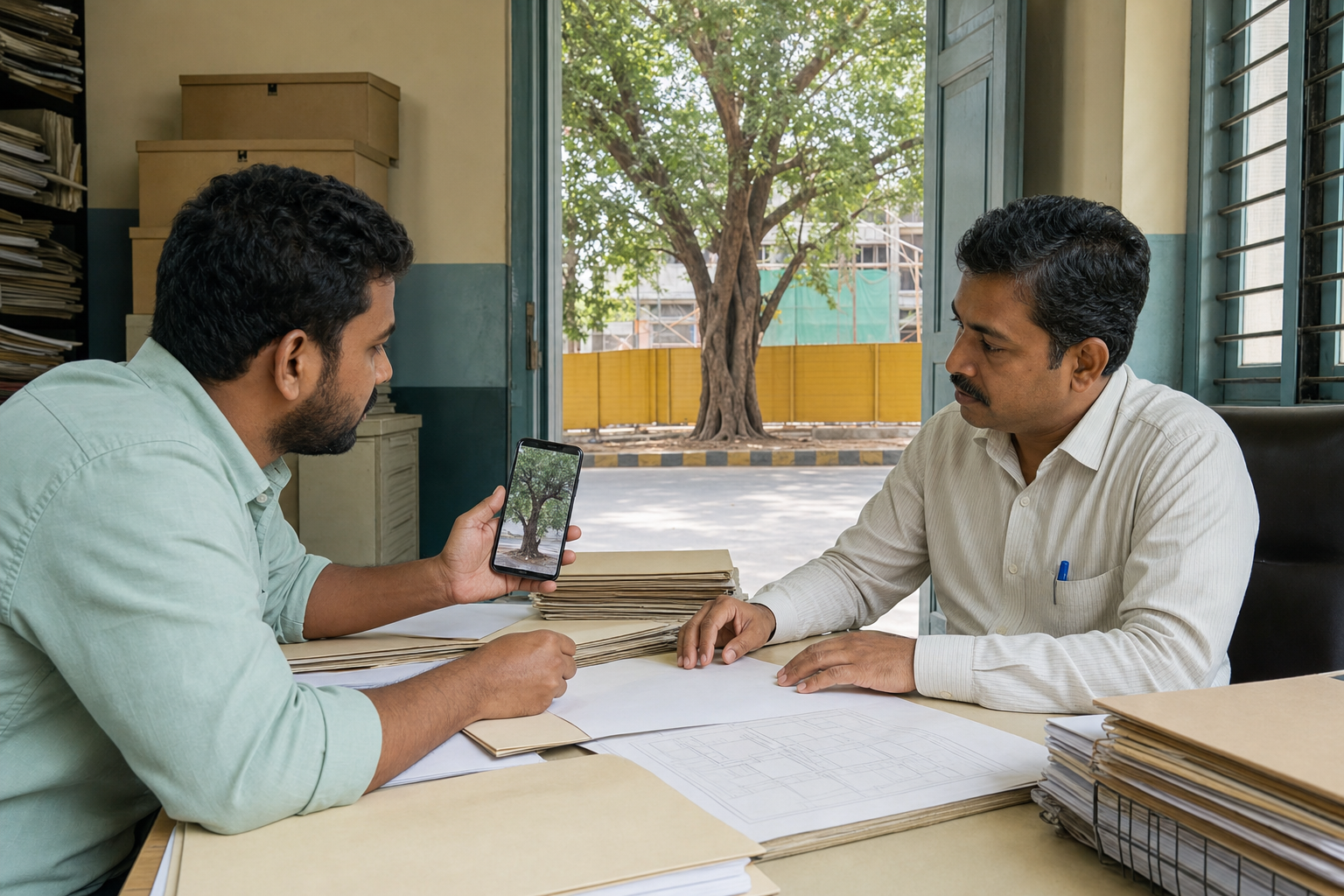
- Preserve the originals. Keep the original photographs and videos with their metadata, make backup copies, and maintain a chronology of complaint numbers, acknowledgements, calls, inspections and replies.
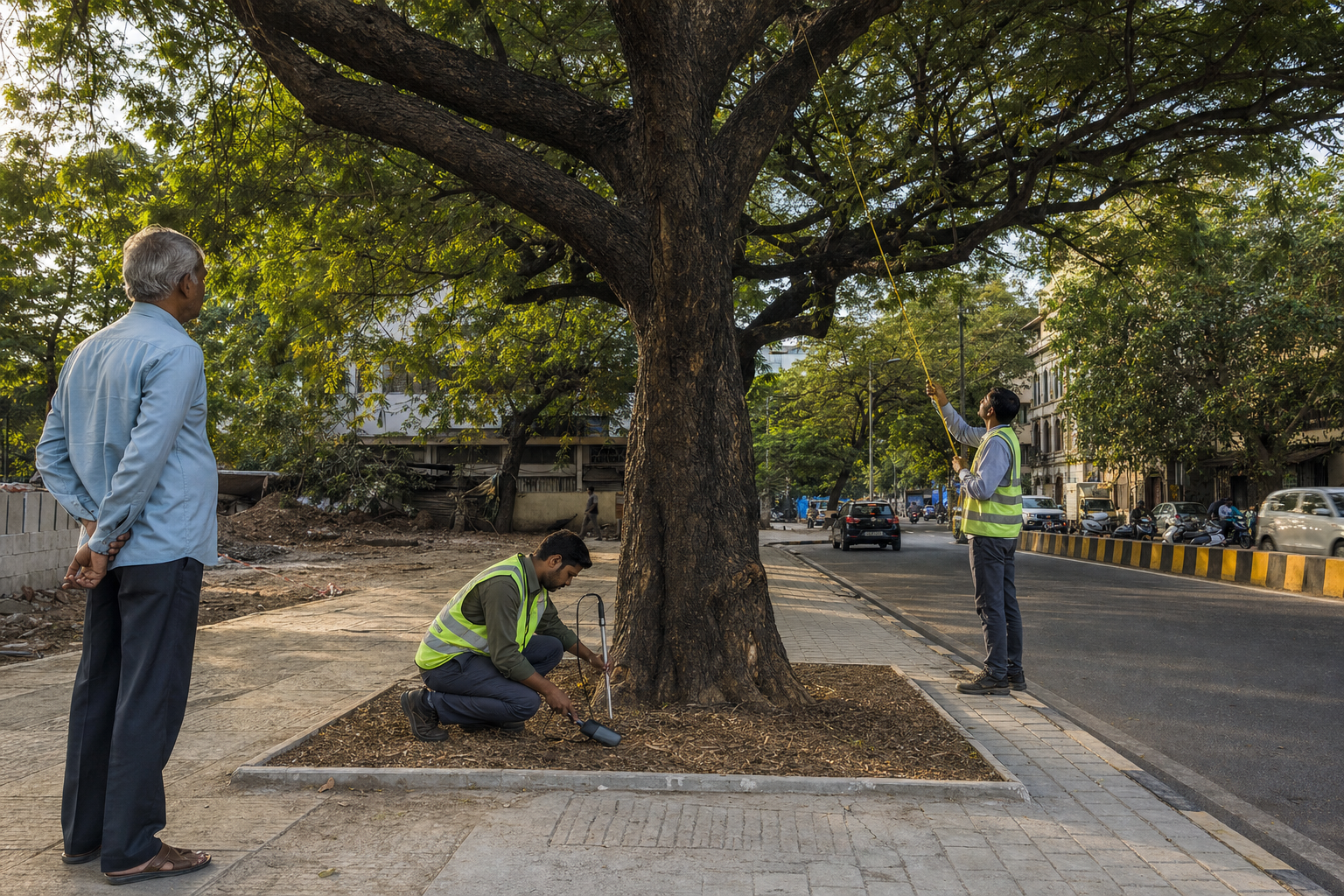
- Request a joint inspection. Ask the Tree Authority or ward office to record trunk diameter, canopy spread, root and bark damage, structural implications and the risk of delayed decline. Where the damage is serious, ask for assessment by a qualified arborist.
Use neutral language. “Two exposed roots beside the eastern side of the trunk appeared freshly severed during trenching” is useful. “The contractor has murdered the tree” assigns motive, overstates what a photograph proves and makes the complaint easier to dismiss as polemic.
If you began documenting after the damage occurred, say so. Do not label a current image as a pre-work baseline. Instead, look for legitimate earlier material such as dated photographs from residents, building records or public imagery, preserve its provenance, and let an expert explain what comparison it supports.
Ask BMC for a remedy, not merely an acknowledgement
The Maharashtra (Urban Areas) Protection and Preservation of Trees Act, 1975 establishes the Tree Authority, restricts felling and transplantation without permission, provides for compensatory planting and prescribes consequences for contraventions. National Green Tribunal directions can add restoration, environmental compensation, monitoring and accountability requirements in matters that come before it. The order applicable to one project should not be assumed to govern every other project, so obtain the actual permission and project conditions.
Send a written complaint to the relevant BMC ward and Tree Authority channel, retain the acknowledgement, and make the requested action explicit. A concise opening can read: “I request an urgent inspection of suspected tree damage at [exact location]. On [date and time], I observed [specific activity and visible condition]. Please confirm whether the work is authorised, preserve the site evidence, assess the tree and direct immediate protection or restoration where required.”
- Ask for the permission covering pruning, transplantation, felling or work within the tree’s rooting area, including its conditions and validity.
- Ask whether the project submitted a pre-construction tree inventory, health and risk assessment, Tree Protection Plan and arborist-approved method statement.
- Request an urgent stop-work or protective direction if ongoing activity is likely to cause additional damage. Explain the immediate act that needs to stop rather than demanding suspension of an entire project without a factual basis.
- Request a site inspection, written condition assessment and directions for root care, soil decompaction, mulching, structural pruning or other expert-led restoration appropriate to the actual injury.
- Ask the authority to identify the project proponent, contractor and officer responsible for supervision.
- Request a reasoned decision on enforcement, including any notice, penalty, restoration-cost recovery, permission suspension or contractual action considered.
- Ask for the complaint number, inspecting officer’s designation and a copy of the inspection report.
Use the Right to Information Act, 2005 when permissions or inspection records are not being disclosed through the complaint process. Request identifiable records rather than asking broad questions about motives. Useful requests include copies of the tree survey, species-wise inventory, permission, approved method statement, Tree Protection Plan, site-inspection notes, contractor notices, penalty orders, transplantation records and survival audits. Also ask which officer or department holds each record if responsibility is disputed.
Administrative and criminal routes serve different purposes. A Tree Authority inspection or stop-work direction can prevent further injury and require remedial care. An FIR may be warranted where the evidence indicates an offence involving unauthorised felling, transplantation, serious damage or damage to public property. Submit the factual record and request investigation; do not try to select charges or promise that an FIR will lead to prosecution. The applicable offence depends on the facts, ownership, permission record and law in force.
If police or civic officials do not act on a serious, well-documented complaint, preserve the refusal or absence of response. A lawyer practising in environmental or criminal law can advise whether the facts justify approaching a magistrate or the National Green Tribunal. Those proceedings carry procedural and cost consequences, so use project-specific legal advice rather than treating a general citizen workflow as a substitute.
Judge the project by protection and survival, not planting photographs
A credible tree-protection programme begins before machinery arrives. It identifies every affected tree, records its condition and decides whether it will be retained, pruned, transplanted or removed. The decision should be supported by evidence, permission and a method that contractors can follow in the field.
| Work stage | What responsible practice looks like | What you can ask to see |
|---|---|---|
| Before mobilisation | Trees are surveyed, assessed and incorporated into a Tree Protection Plan. | Species-wise inventory, condition photographs, risk assessment, approved permission and method statement. |
| During ordinary construction | The rooting area is fenced and kept free of excavation, traffic, material storage and avoidable soil compaction. | Protection layout, site photographs, inspection logs and the contractor’s environmental management requirements. |
| When root-zone access is unavoidable | Low-impact techniques and arborist supervision replace uncontrolled machine excavation. | Approval for hand digging, air-spading, bridging mats, root pruning or another site-specific method, plus the supervising arborist’s record. |
| After construction | Damaged soil and roots receive science-led care, and retained trees are checked for delayed decline or instability. | Completion inspection, remedial-care plan, geotagged condition record and follow-up audit. |
| After transplantation or compensatory planting | Survival, maintenance and replacement obligations continue beyond the planting ceremony. | Locations, species, maintenance responsibility and survival results after one, two and three years. |
A commonly referenced planning principle sets a Root Protection Area radius at roughly 10 to 12 times the trunk diameter measured at breast height, adjusted for species, condition and site constraints. Mumbai’s narrow pavements and congested utility corridors may prevent an ideal circle, but lack of space is not permission to abandon protection. The project should maximise the protected area and use load-distribution mats, geotextiles, low-impact equipment or supervised excavation where access cannot be avoided.
Compensatory planting also requires careful reading. Tribunal or project directions may require three to five saplings for one affected tree, but that range is not a universal ratio to apply without checking the controlling permission or order. More importantly, a planting count proves almost nothing about ecological recovery unless the locations are suitable, maintenance responsibility is assigned and survival is independently checked over multiple years.
This is why the dispute around BMC’s Vruksha Sanjeevani campaign matters. Surajya Abhiyan has argued that ceremonial tree care cannot substitute for FIRs, penalties and enforcement against damaging contractors. The decisive test is not whether a campaign distributes treatments or produces photographs. It is whether established trees remain protected at work sites and whether violations produce timely, visible consequences.
You can apply the same test to civic procurement. Ask whether tender conditions prohibit machine entry and material storage in protected root areas, require arborist supervision, impose damages for non-compliance, recover restoration costs, link performance security to survival, and permit blacklisting for repeated violations. When those conditions are absent, tree protection depends too heavily on goodwill after a contract has already been awarded.
Public reporting should measure outcomes: trees retained in place, compliance with root-protection areas, complaints resolved, penalties recovered, restoration completed and transplant survival after one, two and three years. A dashboard showing only saplings planted can conceal simultaneous damage to mature canopy.
Key takeaways
- Document location, date, project identity and the relationship between construction activity and the damaged tree.
- Photograph roots, trunk and crown; underground injury may be serious even while leaves remain green.
- Describe observations, not motives, and preserve original files, metadata and a complaint chronology.
- Ask for the actual permission, tree survey, protection plan, method statement, inspection and named supervisory responsibility.
- Request a specific remedy: immediate protection, expert assessment, restoration, enforcement and a reasoned written response.
- Use RTI for existing records, and obtain legal advice before pursuing tribunal or magisterial proceedings.
- Judge civic performance by mature trees protected and long-term survival, not by plantation totals or campaign photographs.
A Dharmic civic ethic should make our tree protection exacting, not merely sentimental. Reverence without responsibility leaves the roots exposed. If you see damage, create the dated baseline now, file a remedy-focused complaint, and keep the record alive until the authority either acts or explains its decision in writing.