
A ruler says national honour demands force. A movement calls its struggle dharmic. A commentator invokes Rāma or Kṛṣṇa to settle the argument. You may agree with the cause and still wonder whether righteousness is being used as a discipline or merely as a label.
The useful question is not, “Whose side claims dharma?” It is, “What does dharma require from that side before, during, and after conflict?” The Ramayana and Mahabharata give you a demanding way to answer. They test whether power submits to law, whether diplomacy seeks an adequate peace, whether force remains bounded, and whether victory is followed by repair.
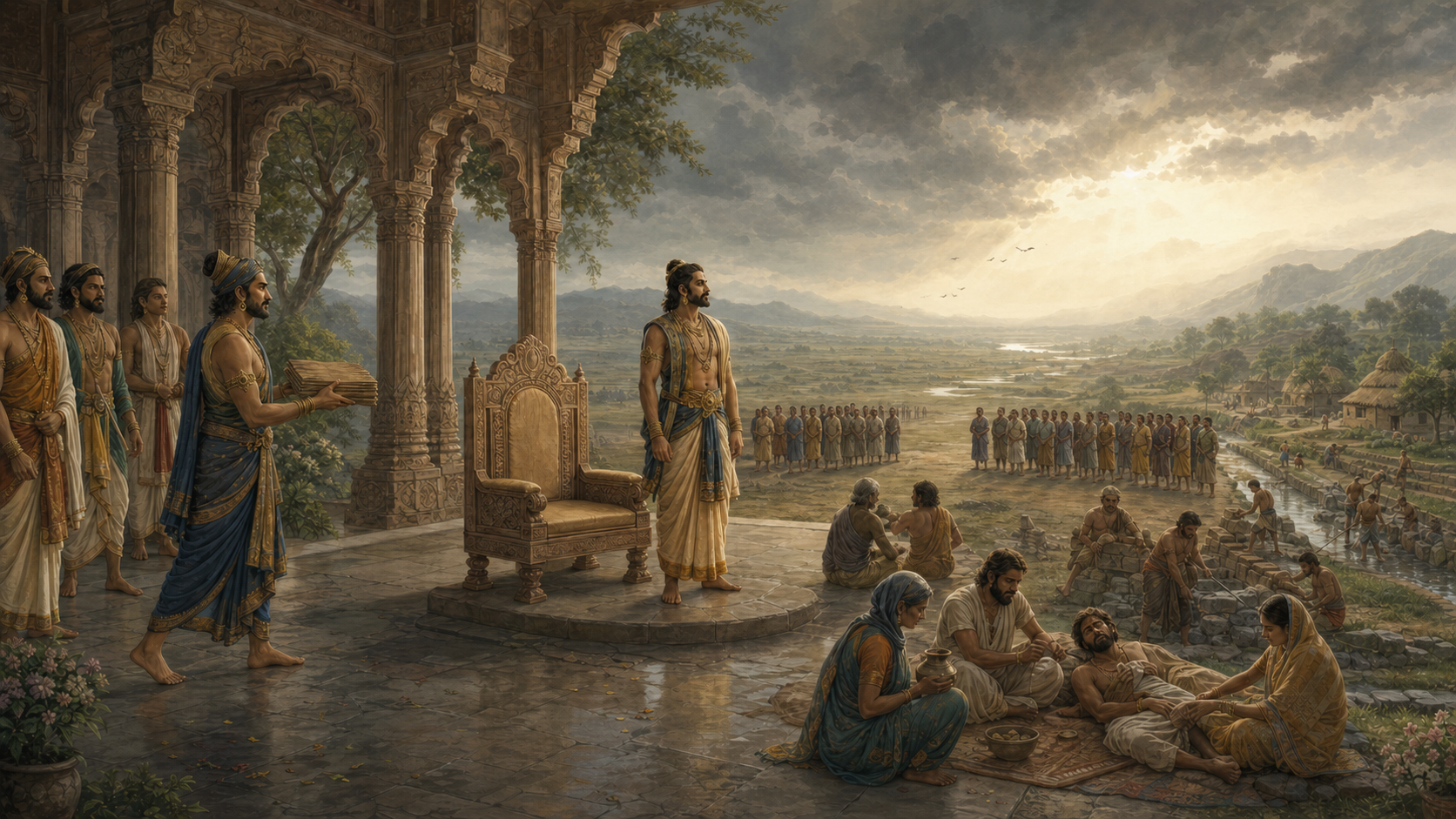
A dharmic ruler is bound before anyone else
Dharma cannot be reduced to personal virtue or political success. It aligns character, social obligation, institutional continuity, and a larger moral order. That is why a leader’s sincerity is never enough. The harder test is whether that leader accepts duties that obstruct personal preference.
Rāma accepts exile to uphold his father’s vow and preserve trust in the crown. The immediate result is painful, but the institutional principle is precise: a ruler cannot demand obedience to norms while discarding those norms whenever they become costly to him.
This does not mean every inherited command, family promise, or established procedure is righteous. The Mahabharata supplies the necessary warning. A gambling hall displaces lawful succession while Dhṛtarāṣṭra’s attachment and the hesitation of respected guardians allow private vice to become public catastrophe. Formal procedure can serve adharma when justice, protection, and truthful counsel have already been compromised.
You can therefore examine a claim of dharmic rule with four questions:
- Does the ruler accept the same law when it limits his own family, party, allies, or ambitions?
- Are decisions explained through stable principles, or are principles invented after the desired decision has been made?
- Can advisers deliver unwelcome facts without losing access, office, or safety?
- Do institutions protect the weak when protection is inconvenient, or only when it produces political credit?
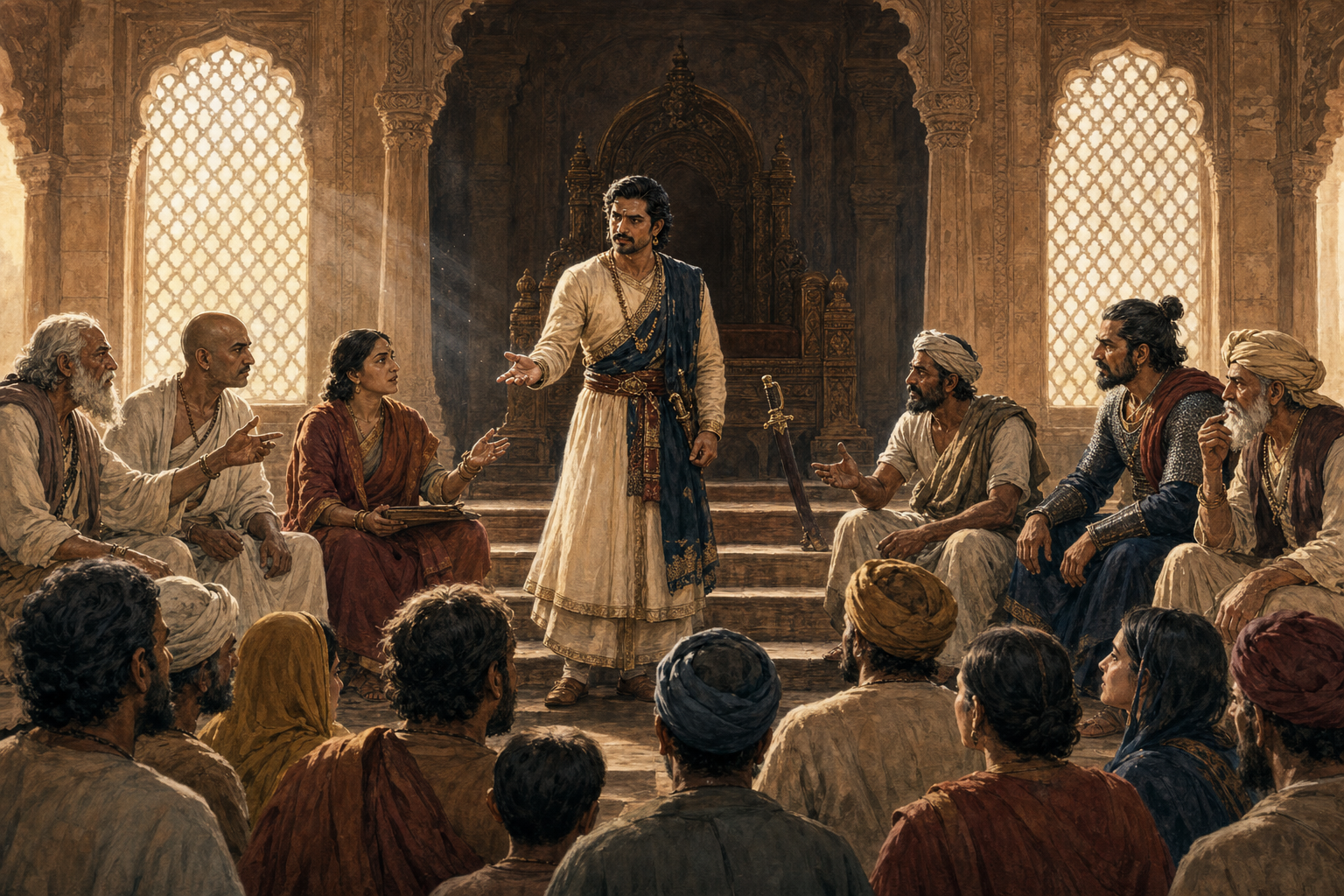
The third question matters because counsel is part of legitimate authority, not a decorative ritual. Vidura warns against arrogance in the Kuru court. Tārā offers political prudence, while Mandodarī remonstrates against a ruinous course in Laṅkā. The Ramayana repeatedly gives ethical insight to people outside the ruler’s preferred circle. A court that hears only agreement has already disabled one of its safeguards against adharma.
This also corrects a lazy use of Rāma-rājya. It is not merely a strong ruler, a prosperous capital, or a population united behind authority. Its governing benchmark includes predictable restraint, accessible justice, protection across occupations and communities, responsible use of revenue, and stewardship of the conditions that sustain life. The ruler is a trustee of order, not its owner.
The Sītā-agni episode, along with disputes surrounding Uttara Kāṇḍa, cannot responsibly be turned into a simple administrative formula. It exposes the terrible collision between compassion for an individual and a ruler’s concern for public legitimacy. Different interpretations do not erase the cost. If someone cites the episode to justify sacrificing a person for public optics, ask what evidence, fair process, and remedy protect that person. Public confidence is a fact a ruler must address; it is not automatically identical with dharma.
Real diplomacy seeks the smallest peace that protects justice
Diplomacy in the epics is neither timidity nor a ceremony performed before an inevitable war. It is a sequence of intelligence, counsel, communication, alliance-building, and calibrated pressure. Its purpose is to correct the wrong without paying the human cost of battle.
After Sītā’s abduction, the path to Laṅkā proceeds through search, reconnaissance, Hanumān’s work as dūta, and an alliance with Sugrīva before force is used. The objective remains intelligible throughout: Sītā must be restored. The demand is connected to the original wrong rather than expanded into an unlimited claim to domination.
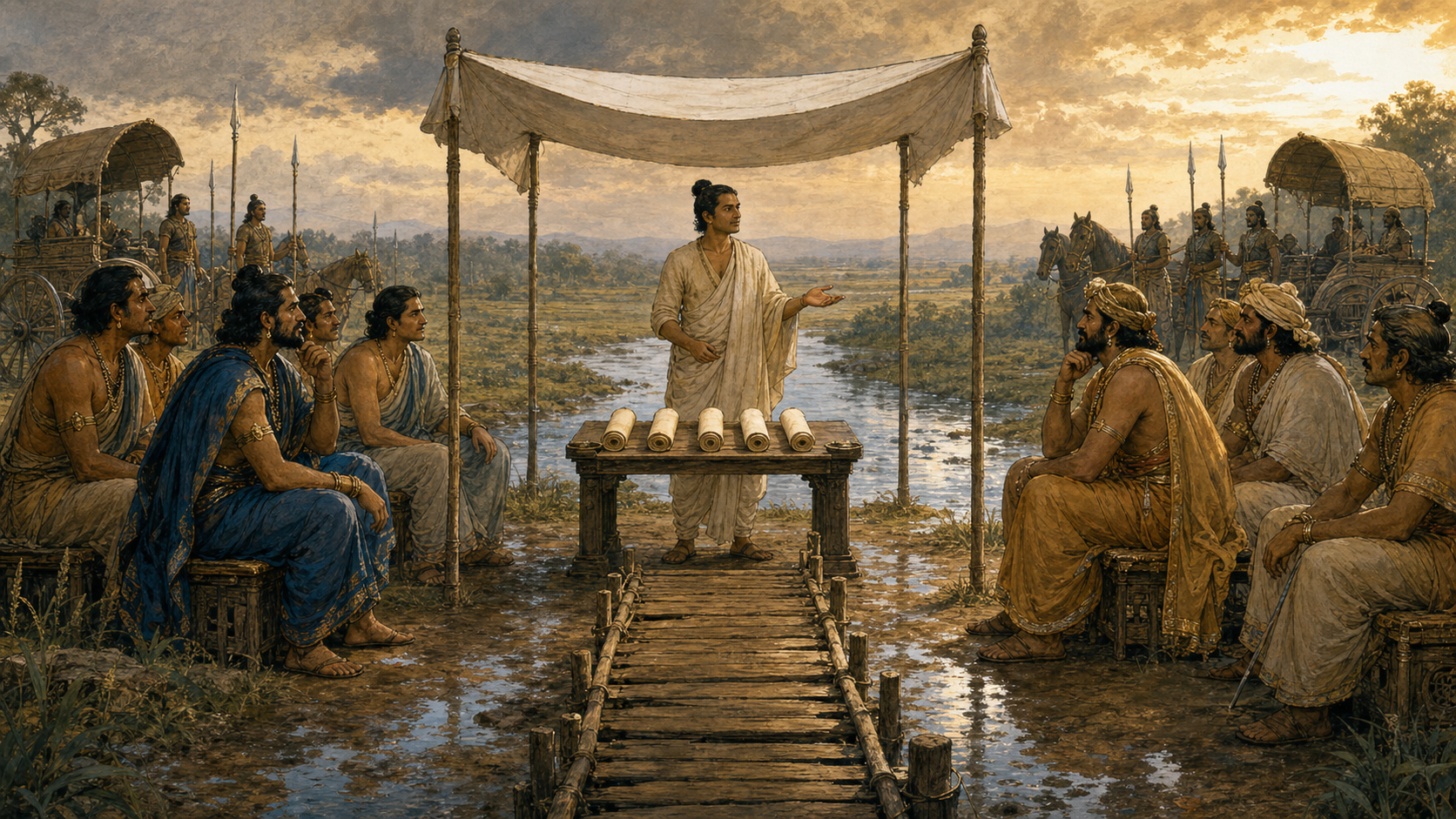
The Mahabharata sharpens this discipline in Udyoga Parva. Kṛṣṇa’s embassy carries the reduced demand for five villages, and Duryodhana refuses even that path to peace. The request matters because it separates the minimum required settlement from prestige. War becomes harder to excuse when a sufficient remedy remains available, and harder to avoid when every sufficient remedy is rejected.
Before accepting that force is a last resort, build a diplomatic ledger. It should answer these questions:
- What precise wrong must be stopped or repaired?
- What is the least expansive settlement that would protect the violated right?
- Was a credible envoy given a genuine channel to communicate that settlement?
- Did the other side receive a clear opportunity to comply, refuse, or propose an adequate alternative?
- Were allies chosen for their commitment to the just objective, or merely for their usefulness against a common enemy?
- Is the threshold for escalation stated in advance, or moved whenever peace becomes possible?
This ledger distinguishes negotiation from appeasement. A proposal that leaves the underlying abuse intact is not an adequate peace. But a maximal demand that cannot distinguish justice from pride is not disciplined statecraft either. The Dharmic aim is not agreement at any price; it is a settlement proportionate to the wrong.
Vibhīṣaṇa adds another diplomatic lesson. He is accepted when he chooses dharma over loyalty to lineage. That choice does not make prudence unnecessary, but it prevents collective guilt from becoming policy. A just coalition must leave a door open for conscientious defection, surrender, and realignment. If the opponent’s people are told that no change of conduct can ever restore their standing, they are given little reason to abandon adharma.
When you hear that diplomacy has been “exhausted,” do not measure exhaustion by the number of speeches, meetings, or threats. Ask whether an adequate offer existed, whether it was clearly conveyed, and whether refusal can be shown. Repetition is not diplomacy if no practicable path to compliance was ever placed on the table.
Dharma-yuddha carries two burdens of proof
A war can have a just cause and still be fought unjustly. It can also follow careful rules while serving an unjust objective. Dharmic reasoning therefore imposes two separate burdens: justification for entering the conflict and restraint in the conduct of conflict.
This structure is consistent with a wider Dharmic preference for preventing harm. Jain ahiṃsā presses toward radical non-harm, Buddhist Right Intention and Right Action bind conduct to compassion, and the Sikh sant-sipāhī ideal places saintliness before the warrior’s defensive duty. These traditions do not erase their differences, but they do deny the ruler an easy passage from moral conviction to violence. Force is an exception whose ethical burden grows with the harm it is likely to cause.
Before war, test the proposed action against six conditions:
- Just cause: Is force answering a grave wrong rather than wounded prestige, appetite for territory, or manufactured fear?
- Legitimate authority: Who may decide, and what law, institution, or accountable office gives that person the right to expose others to war?
- Right intention: Is the purpose to restore order and protect people, or to punish, humiliate, enrich, or annihilate?
- Last resort: Have non-violent remedies with a real chance of correcting the wrong been attempted?
- Reasonable prospect: Is there a credible path to the stated objective, or are lives being spent on a gesture?
- Proportionality: Is the expected protection commensurate with the destruction that the chosen action may produce?
These conditions are cumulative. A righteous intention cannot repair illegitimate authority. Prior diplomacy cannot make a disproportionate campaign acceptable. A plausible victory cannot transform conquest into protection. If advocates answer one question loudly while evading the others, the ethical case remains incomplete.
Arjuna’s crisis in the Bhagavad Gītā makes intention especially difficult to counterfeit. He sees teachers and kin across the field and recoils from the act before him. Kṛṣṇa’s response concerns disciplined action without hatred, possessiveness, or attachment to personal reward. It is not a permission slip for anyone who can attach sacred vocabulary to combat. The warrior must first confront fear, grief, duty, motive, and consequence.
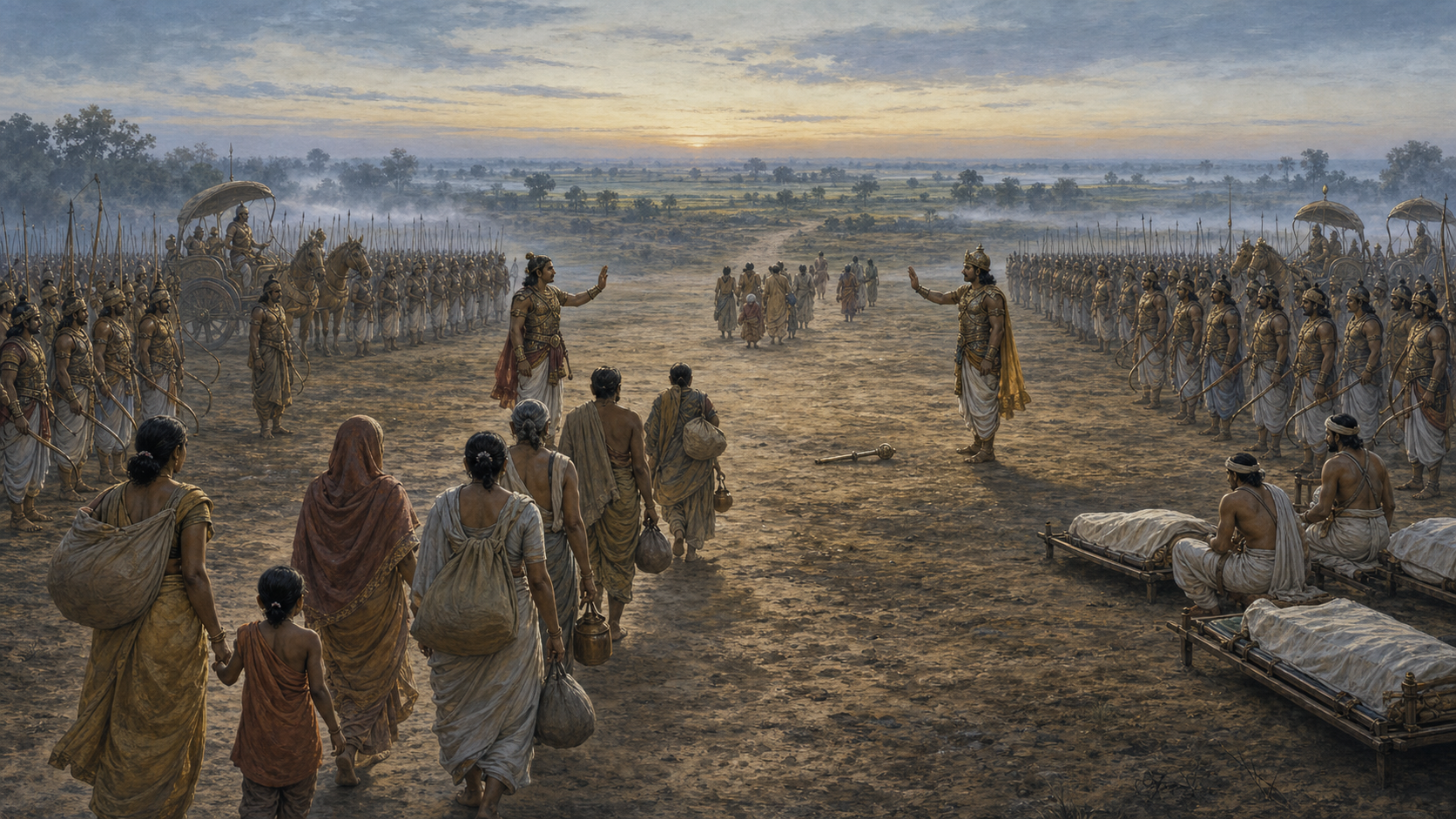
Once fighting begins, the second burden takes over. Within the Mahabharata’s moral order, battle stops at dusk, opponents are meant to be comparably matched, and the unarmed, wounded, surrendered, and non-combatant are protected. These rules make a crucial point: necessity does not suspend moral status. A person does not become an unlimited target merely because conflict exists.
That principle produces practical restraints:
- Distinguish those participating in the fight from those who are not.
- Spare a person who is wounded, disarmed, sleeping, or genuinely surrendering.
- Use no more force than the legitimate objective requires.
- Do not turn exceptional weapons or tactics into ordinary tools merely because they confer an advantage.
- Preserve a path for mercy, defection, and the restoration of order.
The narratives mark violations rather than hiding them. Abhimanyu is surrounded and killed after fair-combat rules collapse, while Aśvatthāman’s night assault on sleeping soldiers is condemned in Sauptika Parva. Tactical success does not cleanse either act. The means become part of the moral outcome.
The Ramayana applies the same restraint through a different set of scenes. The restoration of Sītā is demanded before the war in Laṅkā, mercy remains available to those who lay down arms, and Vibhīṣaṇa is received after breaking with Rāvaṇa. The enemy population is not treated as a single, permanently guilty mass.
Nor does alignment with the righteous side end moral scrutiny. The manner of Vāli’s killing remains open to serious ethical audit even when Rāma’s defence invokes justice for Sugrīva. That ambiguity is valuable. It prevents the conclusion that a just objective automatically sanctifies every chosen method.
Use three quick tests whenever a wartime act is defended as necessary:
- The same-rule test: Would you accept the stated rule if your opponent used it under equivalent conditions?
- The necessity test: What less harmful option was unavailable, and who verified that it was unavailable?
- The mercy test: What happens when a person surrenders, defects, becomes wounded, or no longer poses the relevant threat?
If the defence fails the same-rule test, it is probably partisanship. If it fails the necessity test, convenience is being mistaken for compulsion. If it fails the mercy test, the objective may have shifted from protection to vengeance.
Victory is judged by what the ruler repairs
Winning does not prove that a war was dharmic. The victor can inherit a field of graves, broken families, damaged livelihoods, and institutions trained to obey emergency power. Rule after conflict is therefore not an epilogue to dharma-yuddha. It is part of the original moral case for undertaking it.
After eighteen days at Kurukṣetra, Strī Parva centres the grief of women, Gāndhārī’s anguish reaches the victors, and Yudhiṣṭhira initially recoils from the throne he has won. The silence after battle denies the audience an uncomplicated triumph. Political success has to answer to human loss.
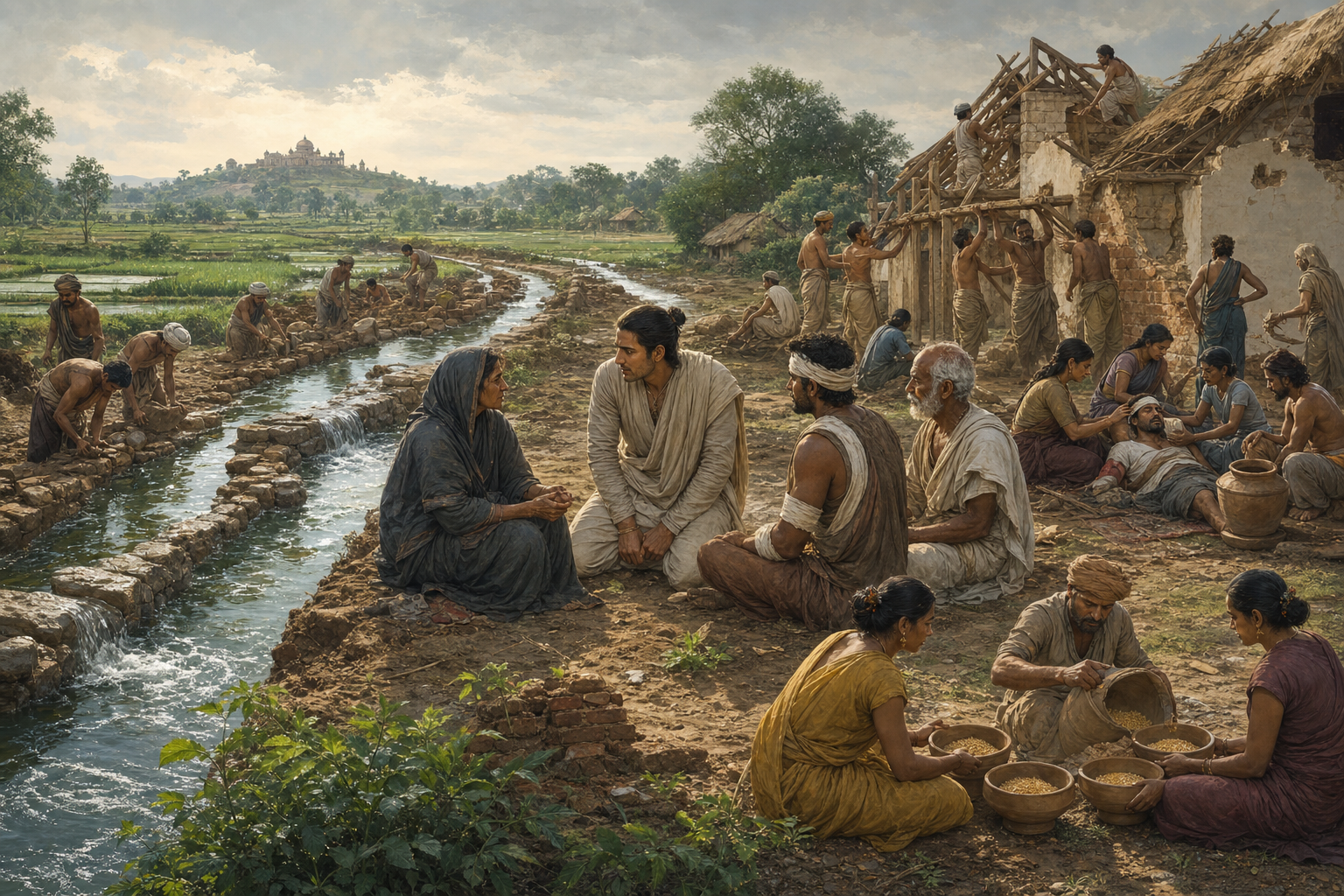
The answer begins in governance. Śānti Parva and Anuśāsana Parva turn toward rājadharma: lighter taxation in distress, protection of agriculture and artisans, impartial courts, resistance to corruption, support for roads, water and granaries, cultivation of learning, and security that does not militarize the whole society. Widows, orphans, labourers, and people deprived of land are not peripheral beneficiaries. Their condition is evidence of whether order is actually being restored.
A credible post-conflict programme should therefore proceed in this order:
- Acknowledge the dead, injured, displaced, and bereaved instead of using victory language to hide them.
- Restore water, food security, roads, agriculture, artisan livelihoods, and the ordinary systems on which civilian life depends.
- Reduce public burdens during distress rather than financing recovery by extracting most heavily from those already damaged.
- Return disputes to impartial justice and prevent wartime loyalty from becoming immunity for corruption.
- Keep security sufficient to prevent renewed predation but bounded enough that emergency rule does not become normal government.
- Make room for surrender, repentance, reconciliation, and the return of those who genuinely abandon adharma.
This is where Rāma-rājya becomes a usable benchmark rather than nostalgic decoration. Its order is sustained through predictable institutions, attention to varied communities, protection of livelihoods, administrative restraint, and care for the natural foundations of welfare. It describes continuous maintenance, not a ruler’s claim to have achieved perfection once and for all.
When a leader announces victory, look past the ceremony to the first governing priorities. Who receives protection first? Whose losses are counted? Which temporary powers are retained? Are taxes and public resources directed toward repair? Are former enemies offered a lawful place after they cease the wrong? The answers reveal whether the campaign sought restored order or merely transferred dominance.
Key takeaways
- Dharma binds the ruler first. A leader who exempts himself, his family, or his allies from stable rules has failed the opening test.
- Diplomacy must offer an adequate and intelligible path to peace. Meetings alone do not establish that peaceful remedies were exhausted.
- A just cause is necessary but insufficient. Authority, intention, last resort, reasonable prospect, and proportionality must also be examined.
- Conduct during war remains morally regulated. Non-combatants, the wounded, the disarmed, and those who surrender retain protection.
- Righteous aims do not purify wrongful means. A side invoking dharma must permit scrutiny of its own disputed acts.
- Victory creates duties toward the bereaved, vulnerable, and economically damaged. Repair is part of justice, not charity added later.
The next time sacred language is used to defend power, write down the claimed wrong, the minimum just remedy, the peaceful steps attempted, the limits on force, and the promised work of repair. If any line is left blank, do not let the word “dharma” fill it.
References
- DharmaRenaissance Blog — Ramayana’s Powerful Blueprint: Dharma vs. Disorder and the Quest for Just Leadership
- DharmaRenaissance Blog — Kurukshetra’s Hollow Victory: Mahabharata’s Stark Warning Against Meaningless War