
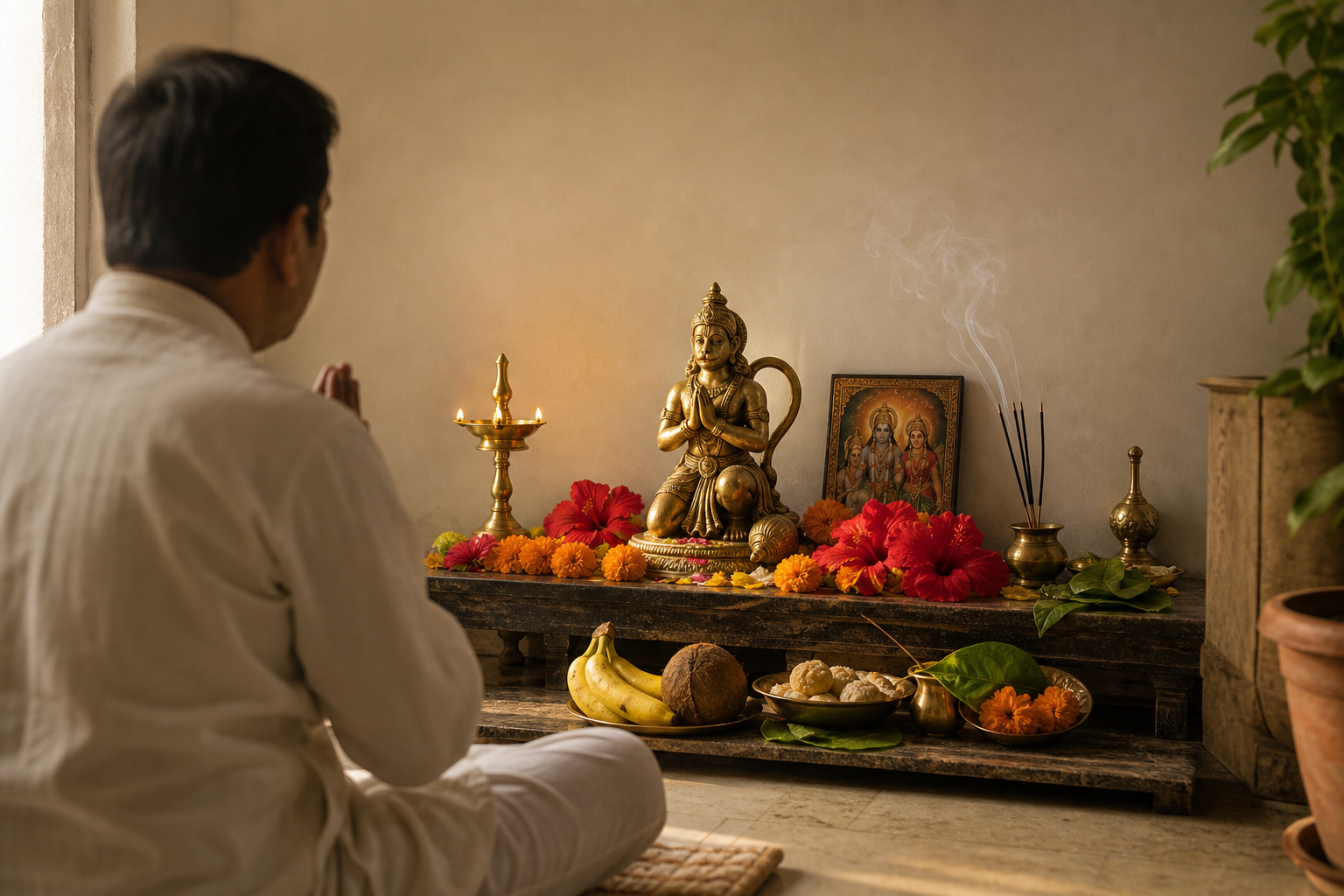
If you are unsure whether to observe Hanuman Jayanti on April 1 or April 2 in 2026, settle that question before planning the fast or buying puja materials. The Purnima tithi crosses two civil dates, but the correct observance for you depends on your location, Panchang, sampradaya and temple tradition.
Once the date is fixed, the worship itself need not be complicated. You can perform a dignified five-offering puja at home, undertake a fuller abhisheka and archana, or concentrate on Hanuman Chalisa, Rama-nama and seva. Choose a form you can carry out attentively and safely.
Confirm whether your observance is on April 1 or April 2
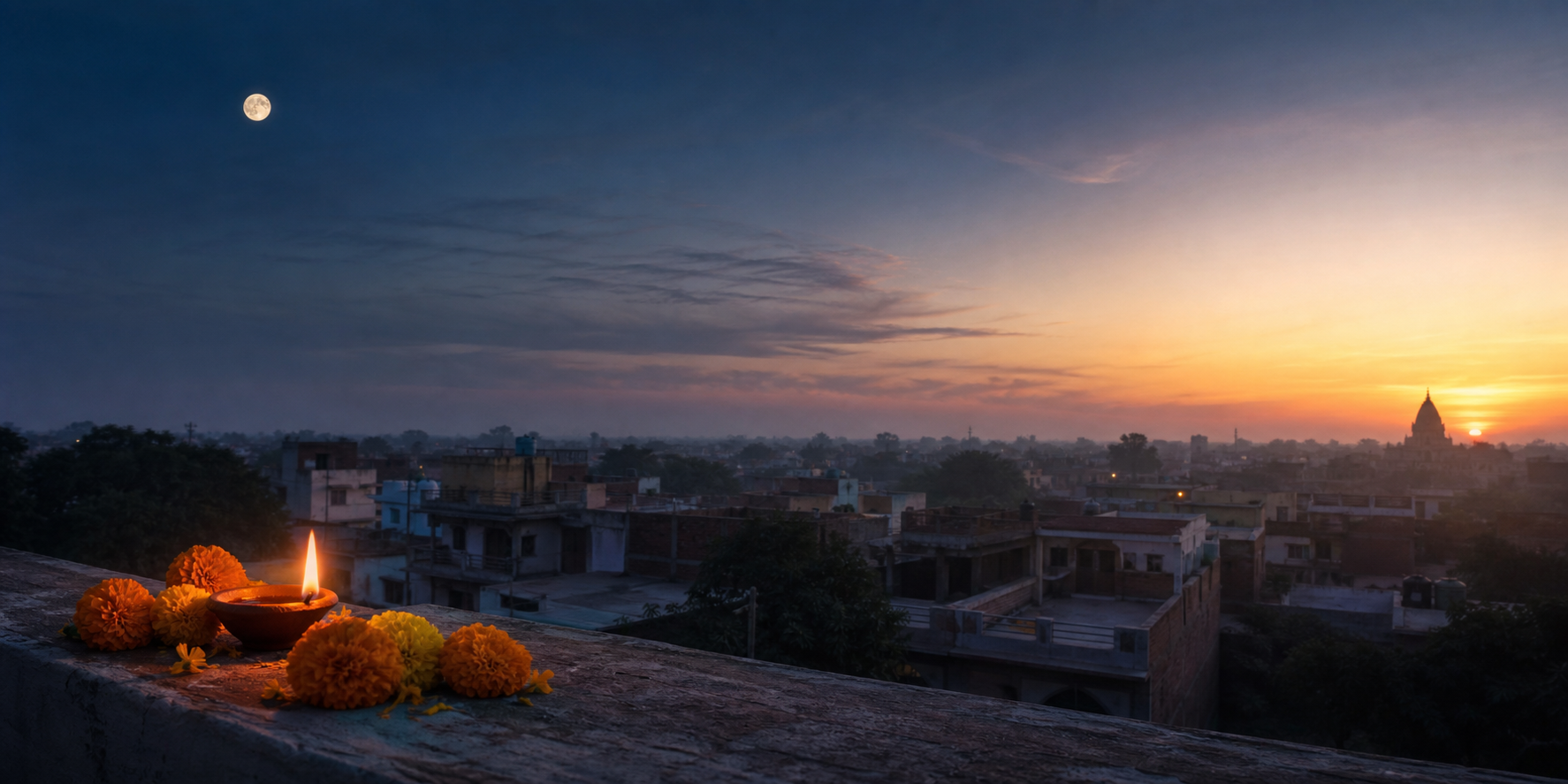
For traditions that celebrate Hanuman Jayanti on Chaitra Purnima, the festival falls across April 1-2, 2026, in many Indian locations. This is not a choice between two competing birthdays. A tithi is a lunar division rather than a midnight-to-midnight civil date, so Purnima can begin on one date and remain in effect on the next.
Many Smarta Panchangs apply the udaya-vyapini rule: the principal observance is held on the civil date when Purnima prevails at local sunrise. Some Vaishnava and regional traditions instead consider which date contains the greater part of the tithi or the relevant moonrise. Purnimanta and Amanta month-reckoning can also change the month name used locally without changing the underlying lunar tithi.
- Check a city-specific Panchang. Do not rely on a calendar prepared for another city or country. Look for the beginning and ending of Chaitra Purnima in your location and whether it prevails at sunrise.
- Identify your family’s rule. If your household follows a particular matha, guru-parampara or regional Panchang, continue with that established practice.
- Check the nearest temple’s announcement. This matters when you want to join abhishekam, parayana, kirtan or annadanam. Community worship should follow the temple’s declared date even if another calendar displays the adjacent civil date.
- Use local time outside Bharat. A timetable stated in IST does not automatically determine the festival date in Toronto, London, Singapore or another diaspora location.
If the Panchang is difficult to interpret, ask the temple one precise question: “On which local date does our tradition perform the main Chaitra Purnima Hanuman Jayanti puja?” That will produce a more useful answer than asking whether the festival is “on the first or the second.”
Regional distinctions should not be erased in pursuit of a single pan-Indian date. Much of North India, Maharashtra and several communities in Karnataka, Andhra Pradesh and Telangana use Chaitra Purnima. Tamil traditions commonly celebrate Hanumath Jayanthi during Margazhi under Moola Nakshatra. If that is your inherited observance, the April date need not replace it.
Andhra Pradesh and Telangana also have traditions of a 41-day Hanuman Deeksha beginning around Chaitra Purnima and culminating with Hanumath Vijayotsavam on Vaishakha Krishna Dashami. Anyone entering that discipline should obtain the precise starting date, niyamas and concluding schedule from the participating temple rather than calculating the end date by simply adding 41 civil days.
Choose a vrat that strengthens attention rather than harming the body
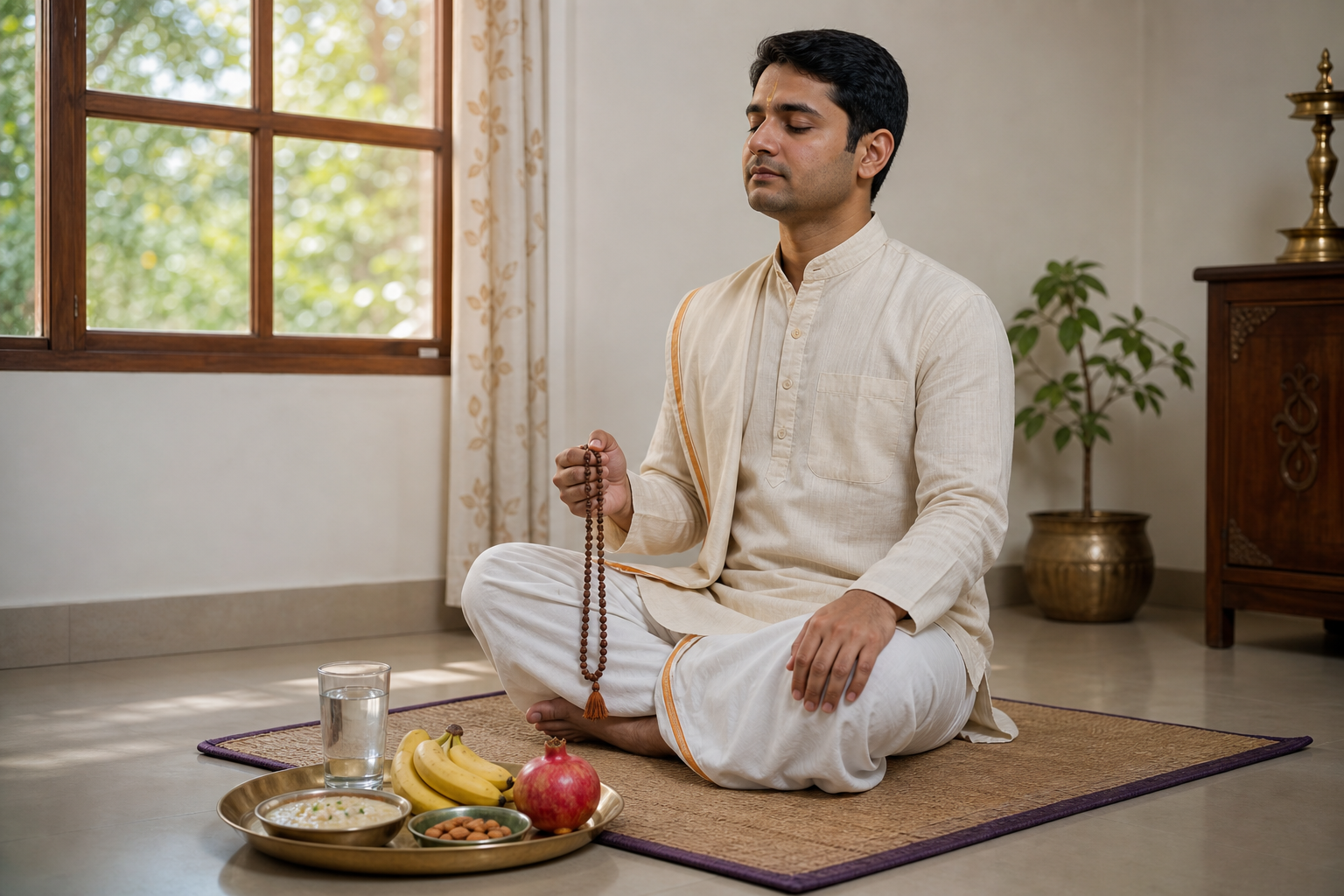
Hanuman vrat is a discipline, not a contest in deprivation. Its practical purpose is to reduce distraction and bring your conduct into line with Hanuman’s courage, restraint, clarity and service to Sri Rama. Choose the form that suits your health, family custom and actual capacity.
- Nirjala: a waterless fast, followed only where it is customary and medically safe. Do not attempt it when illness, heat, medication or another health need makes fluid restriction unsafe.
- Phalahara: water, fruit, milk or other foods permitted by your family tradition. This preserves the discipline without turning thirst or weakness into the day’s central experience.
- Satvik ekabhukta: one simple vegetarian meal, commonly prepared without onion or garlic according to household niyama.
- Manasa-vrat: for someone unable to restrict food, keep a deliberate discipline of truthfulness, restrained speech, reduced entertainment, Rama-nama, japa and seva.
If fasting conflicts with a medical requirement, take water and necessary nourishment and follow the advice of the clinician who knows your situation. Worship is not improved by ignoring medication or creating a preventable health emergency. You can redirect the discipline toward speech, consumption, attention and service.
Begin the vrata with a clear sankalpa. State your location, the local date and Chaitra Purnima, then resolve to worship Sri Hanuman for purification of conduct, steadiness in dharma, strength in service and the welfare of all beings. A short promise you understand is better than a long formula recited without attention.
Parana may be performed after the principal puja and aarti or on the following morning, depending on local custom. Begin with water and a little prasada, then take a light satvik meal. If you are attending a temple, confirm its parana practice before the fast begins so that you are not improvising when tired.
Set up only the puja you can complete with care
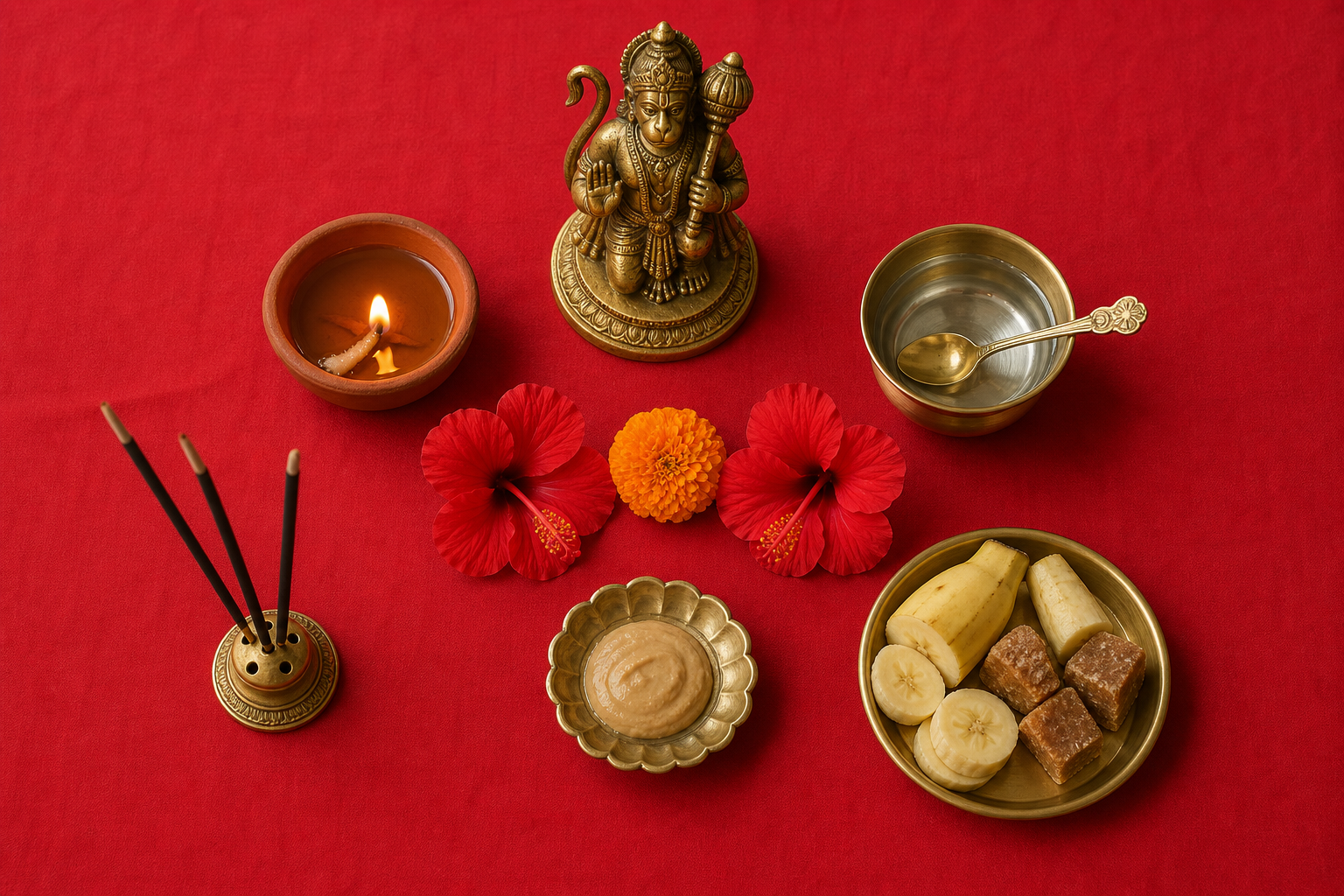
Clean the worship area and bathe before beginning. Place a clean murti or image of Sri Hanuman on a stable altar covered with a fresh red, orange or kesariya cloth, traditionally oriented toward the east or north. If Sri Rama and Sita are worshipped alongside Hanuman, arrange them respectfully at the same altar; tulsi may be offered to Sri Rama according to your custom.
For a simple puja, gather the murti or image, a stable lamp, incense, water, tilak, akshata, flowers and one satvik naivedya. A fuller household puja can add a kalasha, panchamrita, a dedicated bathing vessel, sandal paste, vastra, yajnopavita where customary, sindoor, jasmine or sesame oil, a garland, betel leaves and nuts, camphor, a bell and a japa mala.
Appropriate naivedya includes bananas or other fruit, boondi laddoo, jaggery with roasted chana and clean water. The number of items is not a measure of devotion. One fresh offering prepared cleanly is preferable to a crowded altar of things you cannot handle reverently.
A concise Panchopachara puja
This is a sound choice for a beginner, a small household or anyone with limited time. It also works when a full abhisheka is unsuitable for the murti or worship space.
- Sit quietly, remember your guru and invoke Sri Ganesha with Om Gam Ganapataye Namah.
- State your sankalpa in plain language and mentally invite Sri Hanuman to accept the worship.
- Light the lamp and incense. Offer tilak or sandal paste, flowers and akshata.
- Offer fruit, boondi laddoo or gur-chana with clean water as naivedya.
- Chant Om Hanumate Namah, recite Hanuman Chalisa with attention and remember Sri Rama.
- Perform aarti, offer flowers, ask forgiveness for errors, bow and distribute the prasada.
Do not dismiss this as an inferior puja. The essential movement is already present: purification, intention, invocation, offering, remembrance, gratitude and the sharing of prasada.
A fuller household puja with abhisheka
Use this sequence when you know that the murti can safely receive liquids and you have enough time to keep the altar orderly. Keep towels and all vessels within reach before lighting the lamp.
- Purify yourself and the space. Perform achamana according to your practice, sprinkle the articles with clean water and take a few steady breaths. Invoke Sri Ganesha and offer guru-vandana.
- Install the kalasha if using one. Fill it with clean water and arrange mango leaves and a coconut where customary. In a brief household rite the kalasha is optional, so its absence should not stop the puja.
- Make the sankalpa. Name the place, local date and Chaitra Purnima. Resolve to perform Hanuman Jayanti puja and vrat for steadiness, removal of inner obstacles, strength in service and collective well-being.
- Perform dhyana and avahana. Contemplate Hanuman as Anjaneya, Vayuputra, Kesari-Nandan and Sri Ramaduta. A traditional remembrance begins Manojavam maruta-tulya-vegam and culminates in taking refuge in Sri Rama’s messenger. Follow it with Om Hanumate Namah.
- Offer snana or abhisheka. Bathe a suitable stone or metal murti gently with clean water, then panchamrita and finally pure water. Continue soft mantra-japa instead of rushing through the pouring. For a painted, wooden or otherwise water-sensitive image, use symbolic drops or omit the bath entirely.
- Dry and adorn the murti. Pat it dry with a dedicated clean cloth. Offer sandal paste or tilak, fresh vastra and yajnopavita if customary. Apply only a modest amount of sindoor mixed with jasmine or sesame oil when this belongs to your tradition and is safe for the murti’s surface.
- Offer the upacharas. The fuller sequence may include asana, padya, arghya, achamaniya, gandha, akshata, pushpa, dhupa, deepa, naivedya and tambula. If you do not know the complete mantras, offer each item slowly with Om Hanumate Namah.
- Perform archana and japa. Recite the 108 names when you can do so accurately, or repeat Om Hanumate Namah 11, 21 or 108 times. The Hanuman Gayatri may also be used: Om Anjaneyaya Vidmahe Vayuputraya Dhimahi Tanno Hanumat Prachodayat.
- Offer naivedya. Present the food and water silently before moving them. Mentally dedicate a portion to Sri Rama, keeping Hanuman’s identity as Rama-bhakta at the center of the rite.
- Undertake parayana. Recite Hanuman Chalisa, read Sundara Kanda, or use the stotra transmitted in your family or region. Select a manageable body of recitation before beginning.
- Conclude the worship. Perform aarti with a ghee lamp or camphor, followed by pushpanjali, pranam, pradakshina where space allows and kshama-prarthana for omissions. Complete visarjana according to your household tradition, then distribute prasada.
A narrow muhurta should not create panic. The Purnima tithi and your lineage’s date rule come first. Brahma Muhurta can be used for japa and dhyana, morning is commonly chosen for the main household puja while Purnima remains in effect, and evening can be reserved for family aarti. Abhijit Muhurta may support a brief archana when locally appropriate, but it does not replace verification of the festival date.
Keep the physical risks simple and visible. Place lamps on a level, heat-resistant surface, keep cloth and garlands away from the flame, supervise children and never leave camphor burning unattended. A homam requires suitable space, fire precautions, local compliance and competent ritual guidance. When those conditions are absent, a til-oil lamp, ghee-lamp aarti or additional japa is the responsible alternative.
Let recitation lead to Rama-bhakti and practical seva
The chanting is not an ornament added after the “real” ritual. It is where attention is trained. Hanuman embodies strength guided by intelligence, intelligence governed by humility and humility expressed through service to Sri Rama. A long recital performed mechanically misses that integration.
- If you are new: recite Hanuman Chalisa once, clearly and without multitasking. Read the meaning in the language you understand if the words have become automatic.
- If mantra-japa is your practice: choose 11, 21 or 108 repetitions of Om Hanumate Namah before you begin. Maintain the count with a mala rather than interrupting the prayer to check a device.
- If you have a longer quiet period: read all or selected portions of Sundara Kanda, keeping the narrative connection between Hanuman’s courage and his service to Rama in view.
- If your lineage has a regional text: use Sankat Mochan Hanuman Ashtak, Maruti Stotra, Anjaneya Dandakam, Hanuman Ashtottara or another inherited recitation. Bajrang Baan is best approached according to sampradaya guidance rather than treated as a generic formula.
- If the family is worshipping together: give children one meaningful role, such as placing flowers, joining the aarti or retelling an episode from Sundara Kanda. Participation teaches more than asking them to remain silent beside an unfamiliar ritual.
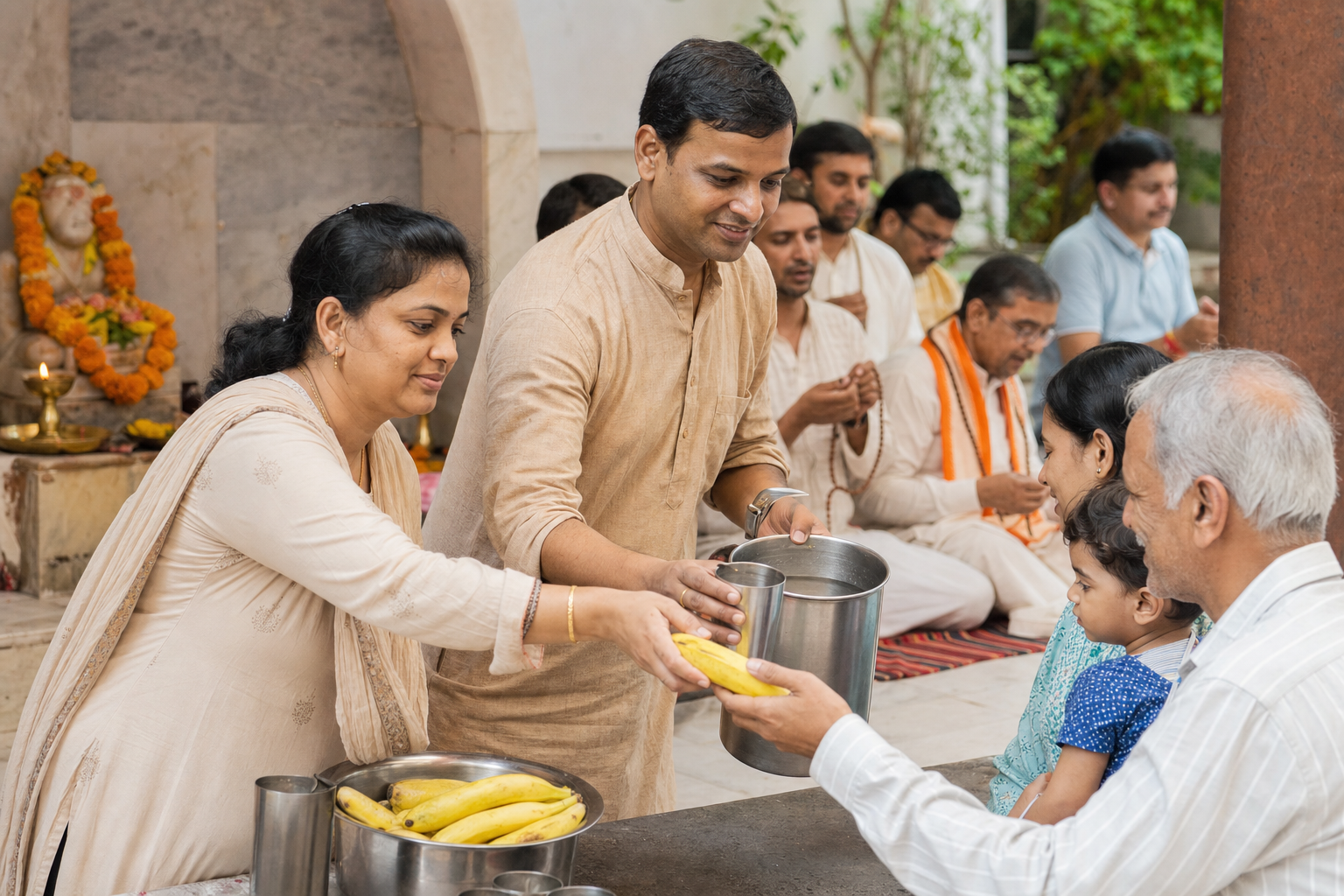
Then take the worship beyond the altar. Annadanam, sharing prasada, vastra-dana, helping someone facing difficulty or volunteering for a community task all give the day’s devotion a practical form. Choose one act you can actually complete. Hanuman’s seva is precise and responsive; an undefined intention to “help later” is too easy to forget.
Ahimsa should govern offerings made outside the home as well. Avoid plastic decorations and synthetic colors where practical, dispose of flowers respectfully and use natural worship materials in moderate quantities. If animals are fed, offer only suitable, unsalted food in a safe setting and do not create crowding or dependence. Feeding monkeys carelessly is not a substitute for informed kindness.
This union of disciplined worship and compassionate action also makes Hanuman Jayanti intelligible across the wider dharmic family. Seva, karuna, tapas, restraint and courage are honored in different forms within Hindu, Sikh, Buddhist and Jain traditions. The point is not to flatten their distinct teachings, but to notice a shared ethical demand: spiritual strength must reduce suffering and support dharma.
Key takeaways for Hanuman Jayanti 2026
- Chaitra Purnima spans April 1-2, 2026, in many locations; use a local Panchang, family tradition and temple schedule to select the date.
- Do not replace a distinct regional observance, including the Tamil Margazhi-Moola tradition, with a generic pan-Indian calendar date.
- Choose nirjala, phalahara, ekabhukta or manasa-vrat according to health and tradition. Medical needs take precedence over food or water restriction.
- A brief puja with lamp, incense, tilak, flowers, naivedya, Hanuman Chalisa and aarti is sufficient when performed attentively.
- Perform liquid abhisheka only on a murti whose material can safely receive it; use symbolic drops or omit it for a water-sensitive image.
- Complete the observance with prasada, an orderly parana and one specific act of seva.
Before fixing your schedule, save the local Panchang entry and the temple announcement in the same place. Then decide on one vrat, one level of puja, one recitation and one act of seva. That small piece of preparation will let you spend Hanuman Jayanti remembering Sri Rama and serving with steadiness instead of managing last-minute uncertainty.
References
- DharmaRenaissance Blog – Hanuman Jayanti 2026: Powerful Puja Vidhi & Vrat Guide with Mantras and Timings
- DharmaRenaissance Blog – Hanuman Jayanti 2026 (Chaitra Purnima): Definitive Guide to Date, Muhurat, Puja Vidhi & Hanumath Vijayotsavam
- DharmaRenaissance Blog – Hanuman Jayanti 2026 Puja Vidhi: Authoritative Step-by-Step Vrat, Muhurta, Mantras, Aarti