
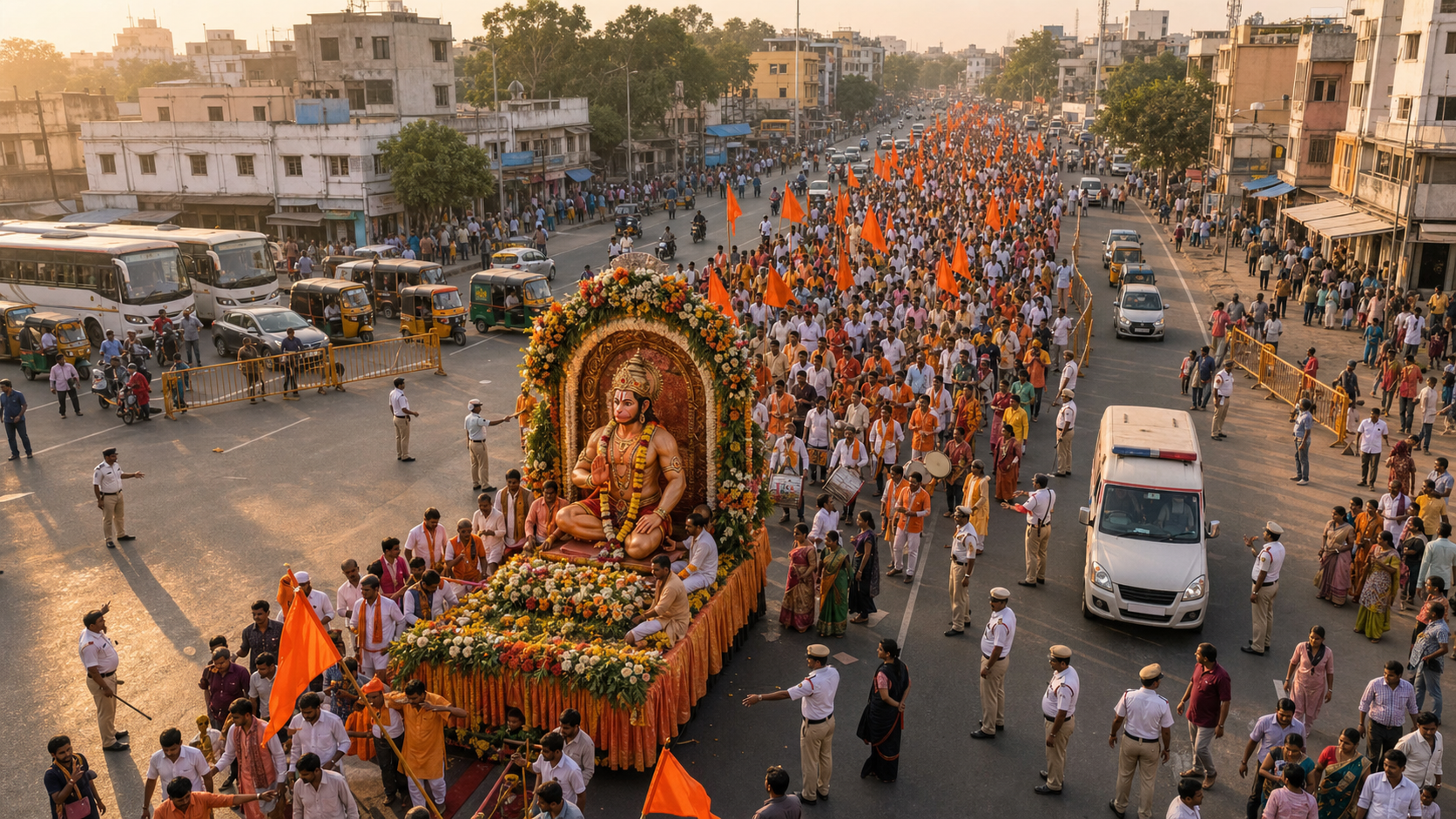
If you are trying to reach the Hyderabad Hanuman Jayanti Shobha Yatra, cross the city while it is moving, or keep a home or business accessible along its path, a static route map will not answer your most important question: what will be open when you arrive?
Hyderabad manages the procession as a moving corridor. Junctions can be restricted when the yatra approaches and released after it passes. The 2026 observance was set for 2 April 2026, but its map and timing should not be reused as a live advisory for another date. What remains useful is the planning method: follow the junction sequence, keep a transport alternative, and make the last part of your journey on foot.
Key takeaways
- Treat the published route as a sequence of affected junctions, not a minute-by-minute timetable.
- Check Hyderabad Traffic Police bulletins before leaving and again before entering the central corridor; conditions can change as the procession advances.
- Use Metro Rail or MMTS for the long part of the trip, then walk from outside the active corridor.
- If you must drive across Hyderabad, allow extra time and use a perimeter route where practical instead of repeatedly approaching barricaded junctions.
- Do not park on the procession road, its feeder lanes, or near an intersection. These spaces may be needed for crowd control and emergency access.
- Families should choose one rendezvous point and put a contact number on each child’s wristband before entering the crowd.
Read the route as a moving corridor, not a fixed closure
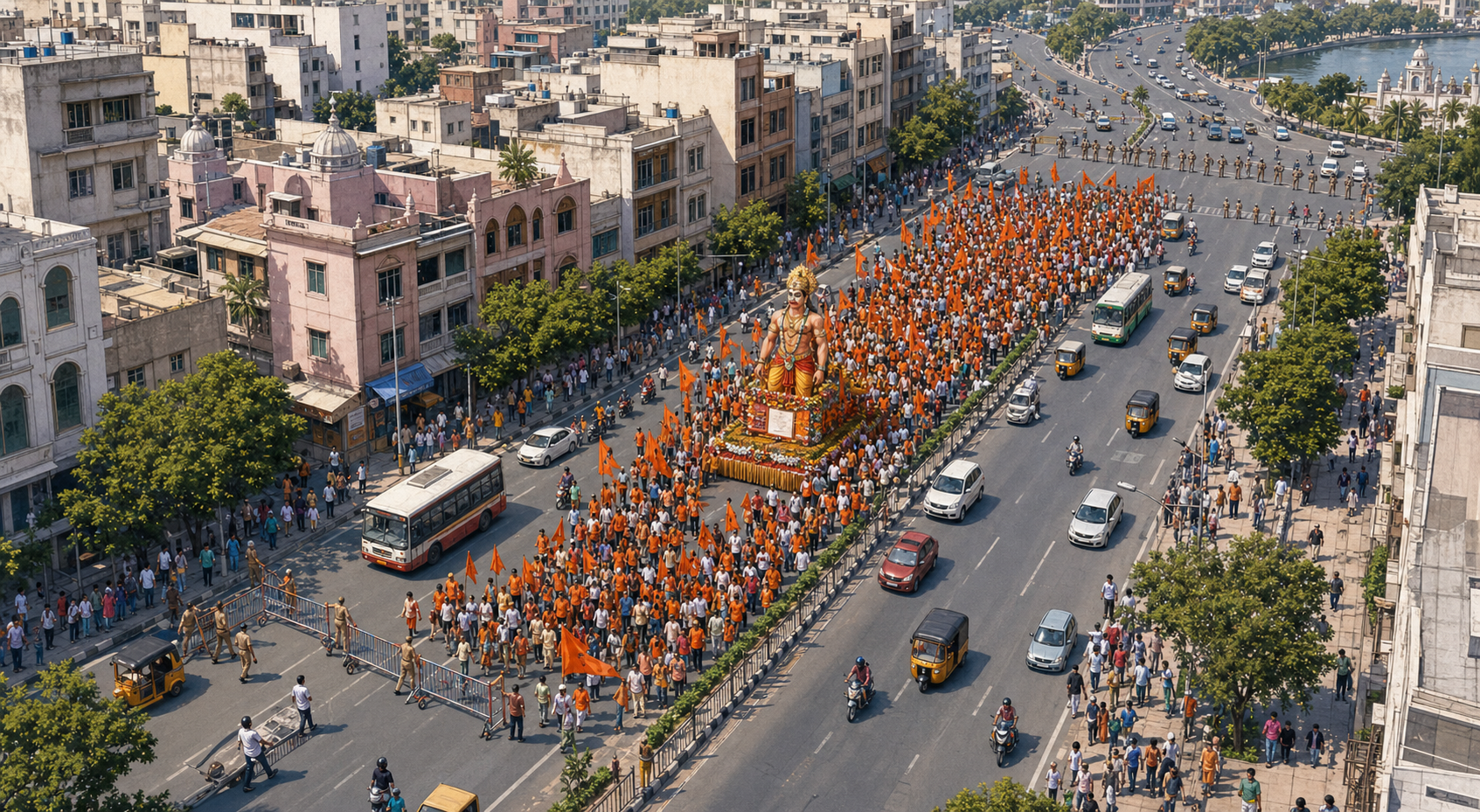
A Shobha Yatra does not move like an ordinary vehicle convoy. Lead banners, bhajan groups, dhol-tasha troupes, tableaux, cultural performers, pedestrians, and volunteer marshals all travel at different rhythms. Forward movement may average only 3 to 4 kilometres per hour, and that figure does not include longer pauses at temple entrances, narrow market stretches, congregation points, performances, or major intersections.
This is why a time printed beside the origin does not produce a reliable arrival time for every later junction. A procession can be moving steadily in one segment while a downstream junction remains open. It can then pause, compress, and cause several feeder roads to be gated together. Once the relevant units pass and pedestrian spillover is controlled, traffic may be released again.
Official planning commonly identifies origin temples, the main corridor, secondary links, congregation or pause points, and dispersal routes. Multiple local yatras may also operate at the same time. A consolidated city view may appear shortly before the event, but junction-level restrictions remain responsive to actual movement. A shared screenshot can therefore help you understand direction without telling you whether a particular road is open now.
When the official route is released, turn it into a usable journey plan:
- Find the origin, destination, and major junctions in their stated order.
- Mark the junction nearest your destination, plus the junction immediately before it in the procession sequence. This tells you which movement may affect you first.
- Choose an approach that reaches the area from the side rather than following the procession road itself.
- Identify a Metro, MMTS, or other public-transport point outside the rolling corridor.
- Save one alternative route that does not rejoin the same affected arterial at the next junction.
- Check the live police bulletin immediately before departure. If you have already started, check again before the final approach.
Do not attempt to defeat a closure by turning into smaller feeder streets. Those streets may be carrying pedestrians, gated to meter inflow, or preserving an ambulance path. A parallel walking approach outside the barricades is usually more predictable than searching for an unguarded vehicle entrance.
Choose the journey by role, not by habit
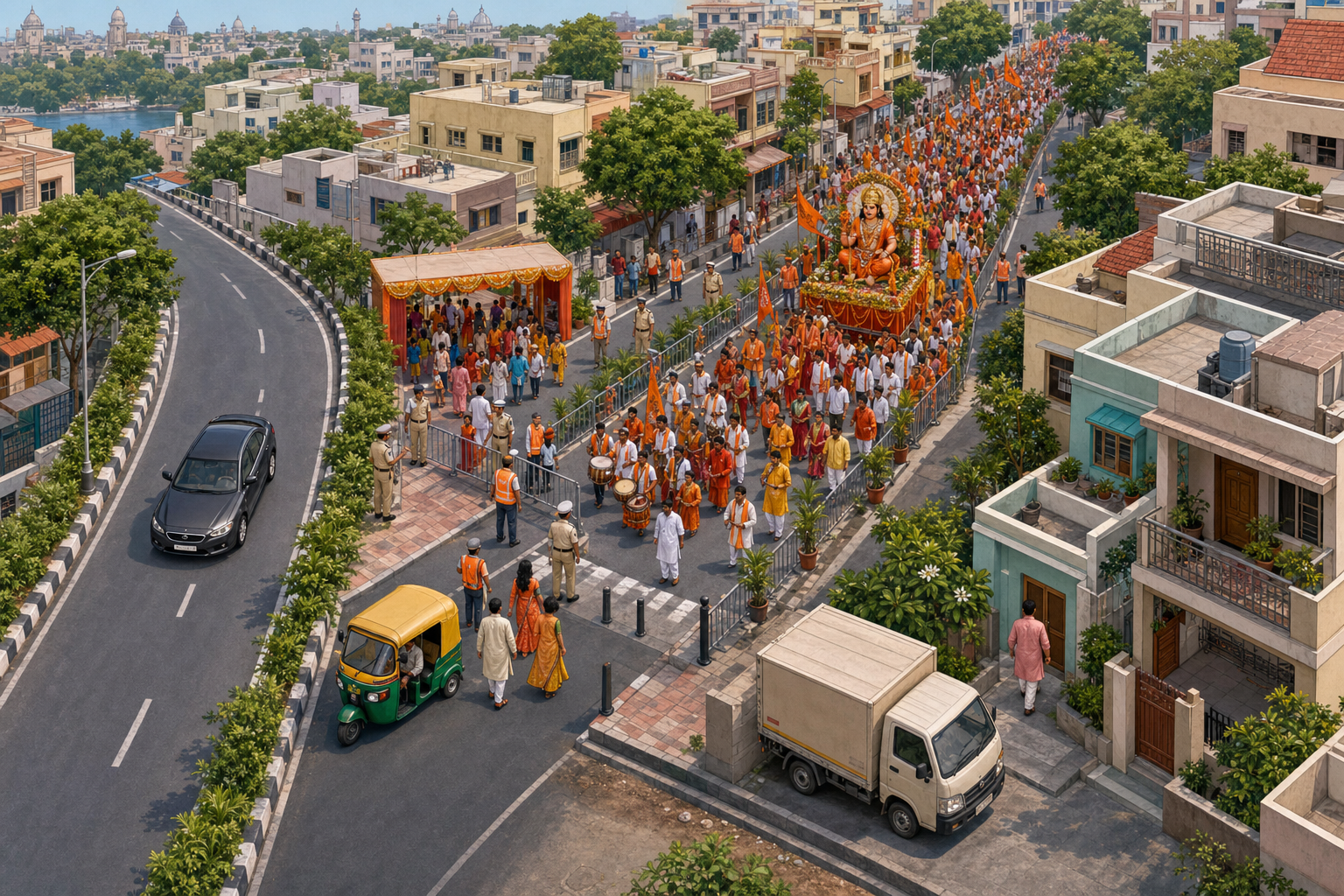
If you are attending the yatra
Build the trip around public transport and walking. Hyderabad Metro Rail’s Miyapur-LB Nagar, Nagole-Raidurg, and JBS Parade Grounds-MGBS corridors provide cross-city alternatives to roads exposed to rolling restrictions. Ameerpet and MGBS are useful interchange points, while MMTS can provide another way to avoid congested surface corridors. Any additional event-day services or changed operating times should be confirmed on the morning of travel rather than assumed.
Select your alighting point outside the active procession corridor. The shortest road distance is not always the best last mile: a slightly longer walk from the clear side of the route can be faster than arriving at a station or stop whose exit faces a dense congregation point. Follow barricades and use marked pedestrian crossings even when the destination is visible across the road.
If you use a taxi or rideshare, arrange the drop-off and return pickup at a designated dispersal point. Do not choose an intersection approach, temple gate, or hospital frontage simply because it appears closer on the app. A vehicle waiting there can obstruct turning traffic, pedestrians, or emergency movement, and your driver may be unable to reach the pin once a rolling closure begins.
If you are crossing the city by car
For a long cross-city trip, a perimeter route such as the Outer Ring Road may be more dependable where practical. Within the core city, leave additional time and expect a route suggested by navigation software to become unavailable at the next junction. Repeatedly rerouting through adjacent streets often brings you back to another feeder gate serving the same procession segment.
Never plan to park on the route and move the car later. No-parking and tow-away controls may cover both the procession road and feeder lanes so that an emergency shoulder remains clear. Use an off-corridor parking location and walk. At barricades, do not make a U-turn across opposing traffic or move a barrier; wait for instructions or take the directed diversion.
If you operate deliveries or staff travel
Complete essential deliveries before the procession reaches your commercial area. Individual mandals may have different start times, while larger crowds can develop around midday and near dusk, so a single citywide delivery window is not dependable. Schedule against the junction affecting your premises, not only the yatra’s origin time.
Combine deliveries where possible, send drivers the designated unloading point in advance, and avoid promising narrow arrival slots during procession movement. Staff who can use Metro Rail or MMTS should do so. If a business must maintain urgent access, coordinate locally before the event rather than negotiating at a barricade after the crowd arrives.
Join safely without losing the devotional experience
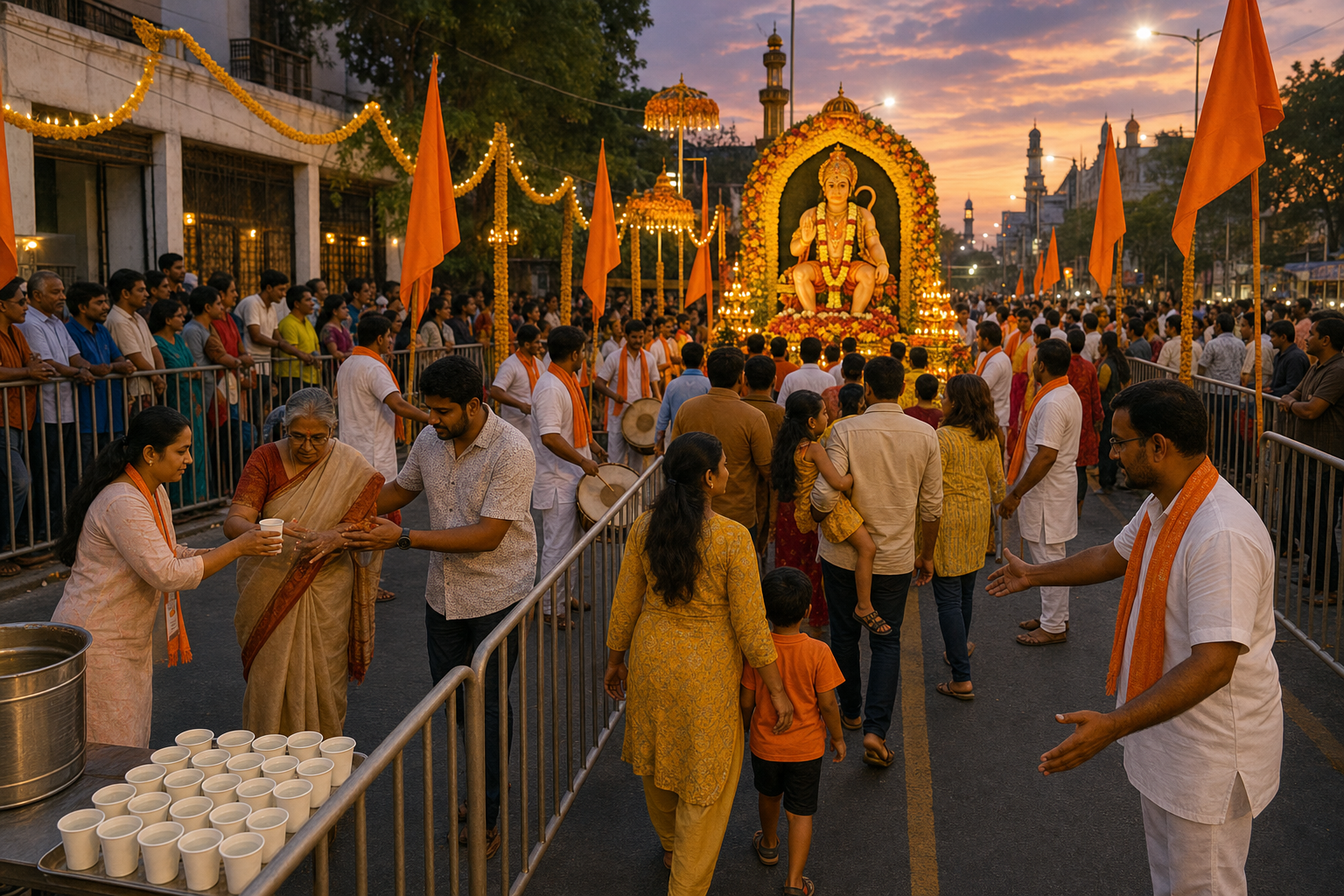
Hanuman Jayanti honours bhakti, seva, courage, and steadfast dharma. In a large public yatra, those values become practical disciplines: walk predictably, listen to marshals, leave working space around tableaux, and notice when someone nearby needs help.
Prepare for heat and sustained walking
Early April in Hyderabad can be hot and dry. Carry drinking water, a cap, and any essential medication. Light cotton clothing and closed footwear are more suitable for a long walk than ceremonial clothing or footwear that restricts movement. A small first-aid kit and glucose or oral rehydration sachets can be useful, but they are not substitutes for an aid post when someone becomes unwell.
Use shade during pauses rather than remaining beside a stationary tableau in direct sun. Dizziness or cramps are reasons to stop, rest, hydrate, and seek medical assistance if symptoms continue. On arrival, note the nearest water counter, first-aid point, police position, and lost-and-found desk instead of trying to locate them only after a problem develops.
Keep children, elders, and vulnerable participants accounted for
Give every child a wrist tag carrying a responsible adult’s name and mobile number. Agree on one unmistakable rendezvous point outside the densest part of the route, and tell children to approach uniformed police personnel or designated volunteers if separated. Avoid instructions such as “meet near the temple” when several entrances or shrines could fit that description.
Families with toddlers may prefer a shaded viewing point near an origin or congregation node instead of walking the entire route. Dhol-tasha and band units can be loud, so simple ear protection may help young children. Keep prams, stools, and bags out of marshal lanes and vehicle turning space.
If an elder or a person with a disability needs barrier-free access, contact the local organizer in advance and ask specifically about a kerb-free approach, accessible toilet, shaded holding area, rest point, and safe exit. These facilities are recommended for large yatras but should not be presumed at every node. A participant with medical needs should carry required medicine and a short note describing the relevant condition or assistance needed.
Move with the procession, then leave in stages
Stay along the left edge where volunteers direct pedestrian movement, and keep clear of vehicles carrying deities. Do not step between a tableau and its marshals to take a photograph. In dense areas, put away tripods and selfie sticks; the extra reach can obstruct people who cannot see the equipment behind them.
When leaving, use a cross-street running away from the procession corridor rather than walking along it in search of a vehicle. Waiting a few minutes after the last tableau can reduce conflict with the final pedestrian wave, but cross only when marshals reopen the route. Use Metro Rail or MMTS for the longer trip home, and keep the family together until you reach the agreed transport point.
For an immediate threat, serious medical need, or hazardous crowd condition, call the all-in-one emergency number 112 and give the nearest named junction or landmark. A precise location is more useful than saying only that you are somewhere on the yatra route.
Prepare homes, shops, and the corridor before the crowd arrives
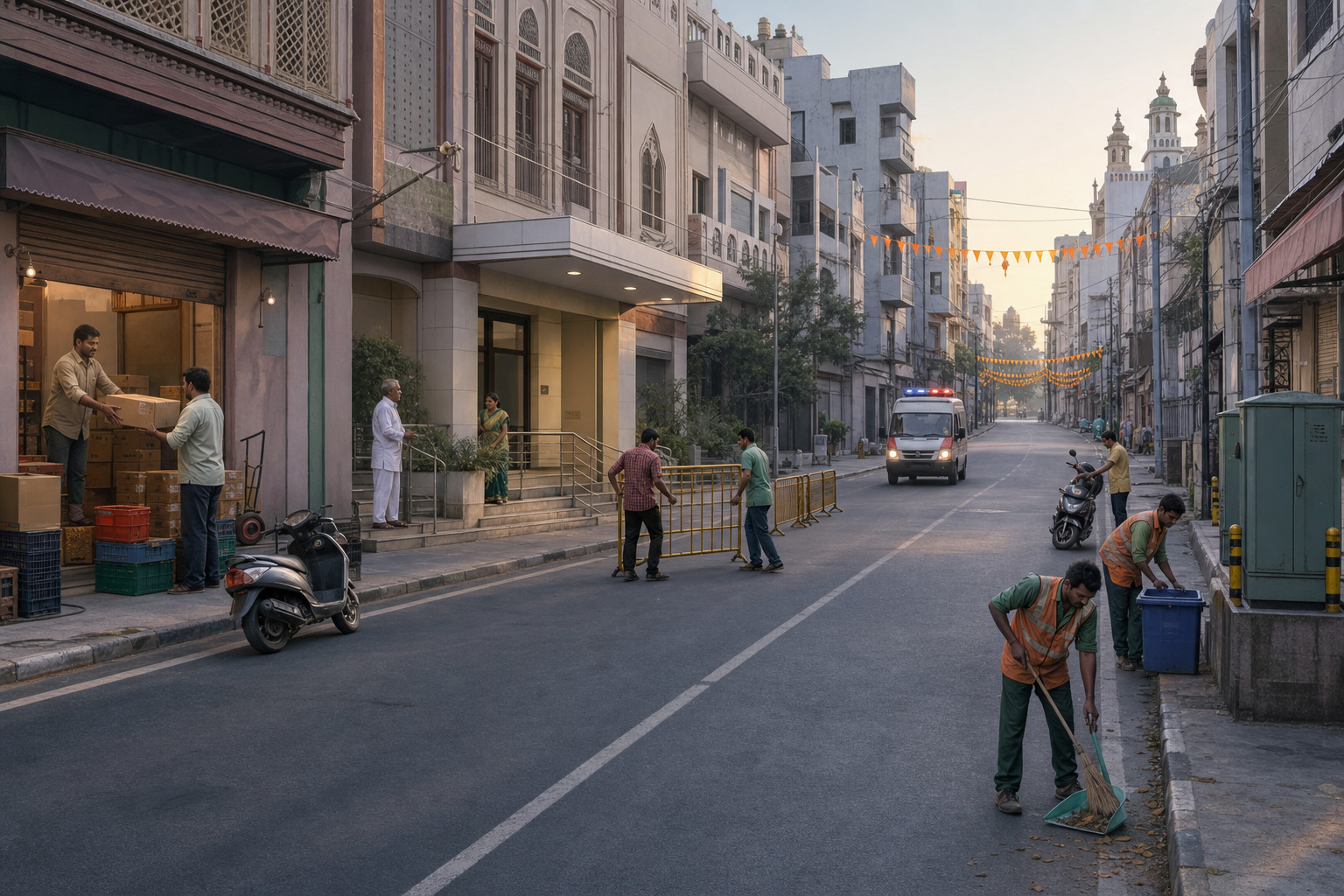
If your property faces a likely procession road, the most useful work happens before barricades appear. Move private vehicles to an off-street location the night before. A car that is legally parked on an ordinary day may still obstruct pedestrian space or emergency access once temporary controls begin.
- Reschedule deliveries and waste collection outside the expected procession window.
- Move bins behind the storefront or property line so the footway remains usable.
- Secure movable signs, display stands, cables, and decorations that project into the pedestrian path.
- Keep gates, building entrances, kerb ramps, and hospital approaches unobstructed.
- Tell staff and residents where the nearest permitted crossing and public-transport point are located.
- Share police updates with a time stamp; do not circulate an old route image as though it were live.
Sound should be moderated near hospitals and in residential pockets. Drone use over a crowd requires prior police and aviation clearance; participation in a public religious event does not remove that requirement. Large poles, pyrotechnics, and laser lights may face safety checks, so organizers should resolve permissions and restrictions before assembly rather than presenting equipment at the route entrance.
Seva also includes leaving the street fit for the neighbourhood that hosted the celebration. Carry a refillable bottle where practical, avoid unnecessary single-use plastic, and place flowers or organic offerings only at designated collection points. If local volunteers organize a cleanup, join them without stepping into traffic lanes that have not yet reopened.
The evening before your next Hyderabad Hanuman Jayanti yatra, make three decisions: where you will enter, where you will reunite if separated, and how you will leave without depending on the procession road. On the day itself, replace every saved screenshot with the latest official junction update. That small discipline preserves both the serenity of darshan and the civic order that allows a large Shobha Yatra to move through Hyderabad safely.
References
- Hindu Pad – Hyderabad Hanuman Jayanti 2026 Shobha Yatra: Comprehensive Route Map, Diversions, and Safety Guide
- DharmaRenaissance Blog – Hyderabad Hanuman Jayanti 2026 Shobha Yatra: Route Map, Traffic Diversions, Timings & Safety Guide