
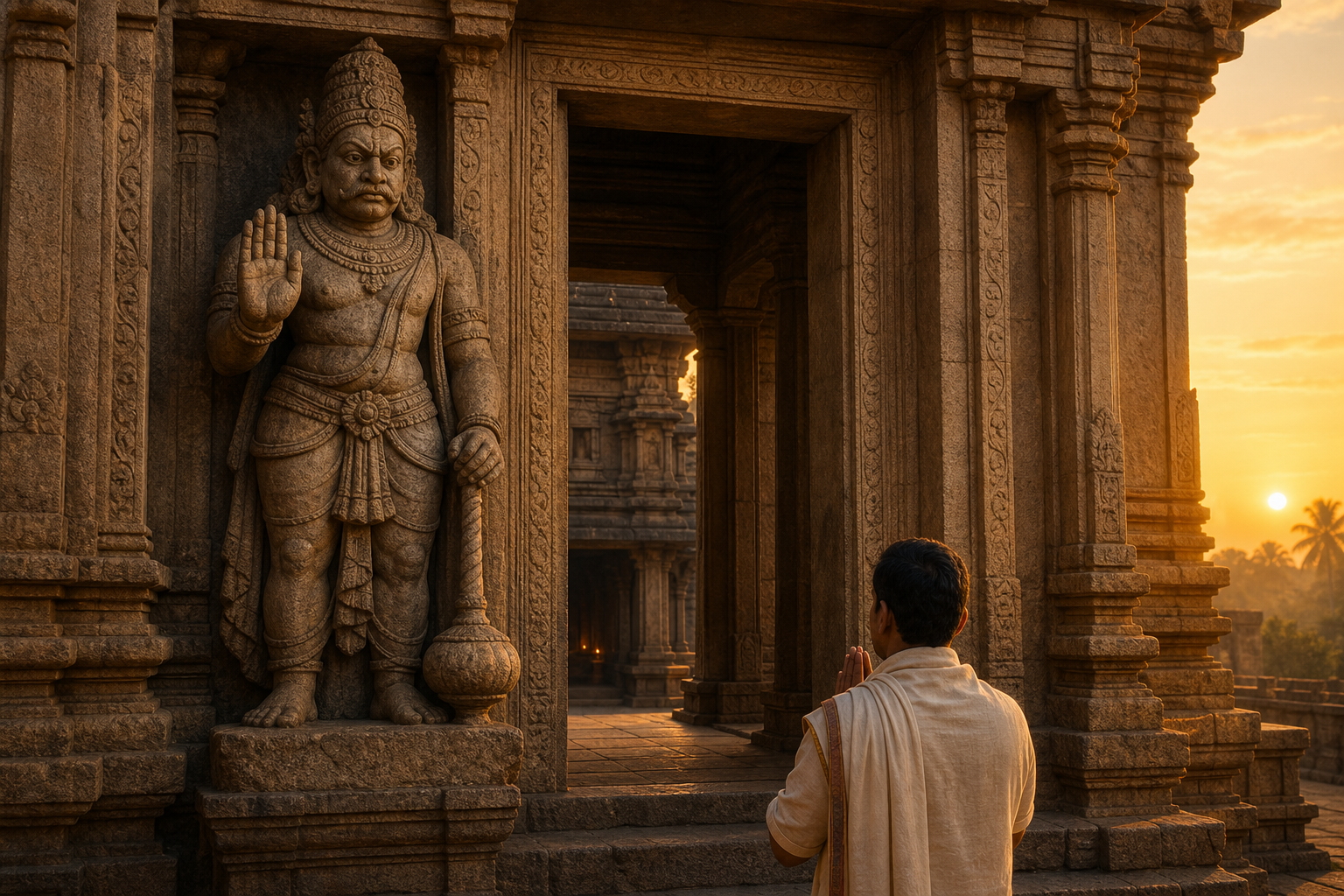
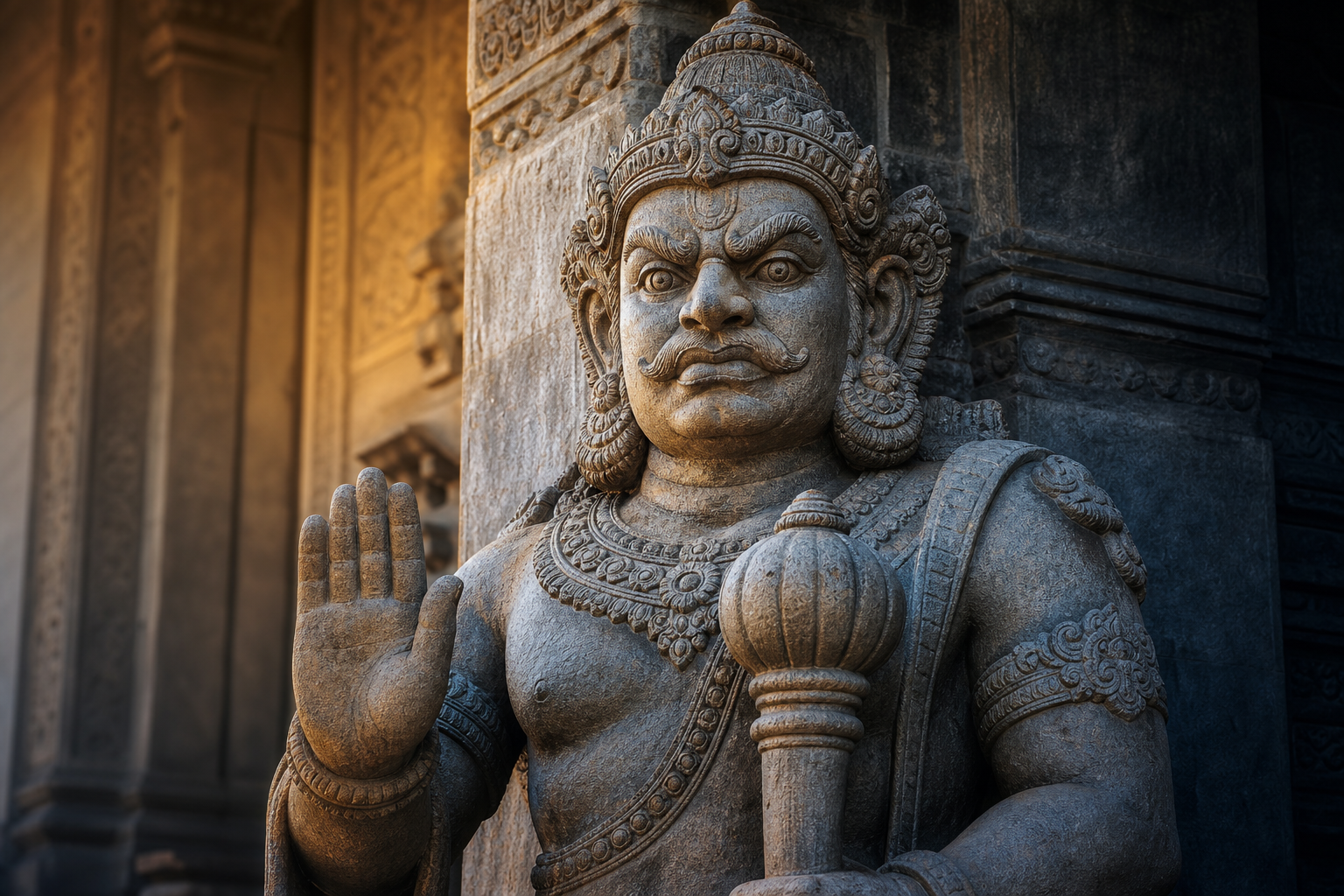
You are approaching a Vaishnava temple through its eastern entrance when a fierce stone guardian arrests your attention. He may carry a mace or sword, bare small canines, or raise a hand that seems to say: stop, compose yourself, and enter properly. Is this Chanda, and why does Vishnu’s sanctuary need such an intimidating presence at its threshold?
In several regional Vaishnava traditions, Chanda is identified as the guardian of the eastern gate. His severity is neither uncontrolled anger nor demonic aggression. It is disciplined protective force placed in Bhagavan’s service. The identification is not universal, however. To recognize Chanda responsibly, you must read the gate’s direction, the guardian’s companion, the iconographic details, and the temple’s own tradition together.
Key takeaways
- Chanda is a fierce dvarapala associated with the eastern entrance in several Vishnu and Narasimha kshetras, especially in parts of southern Bharat, but not every eastern Vaishnava guardian bears his name.
- The east signifies emergence, illumination, dawn, and an auspicious beginning. Chanda’s position there turns physical entry into a moral and devotional transition.
- A robust body, commanding gaze, restrained canines, mace, sword, or warning gesture can support the identification, but appearance alone is not conclusive.
- Local traditions may pair Chanda with Prachanda. Inscriptions, plaques, temple guides, festival recitations, and the archaka-parampara are stronger evidence for a name than a visitor’s visual guess.
- Chanda should not automatically be equated with Jaya or Vijaya. Vaishnava traditions can preserve a widely known Puranic archetype and a regional guardian name without treating them as competing claims.
- For the devotee, the practical lesson is simple: leave agitation at the boundary, steady your intention, acknowledge the guardians, and cross into the sacred precinct attentively.
How to identify Chanda without forcing the name
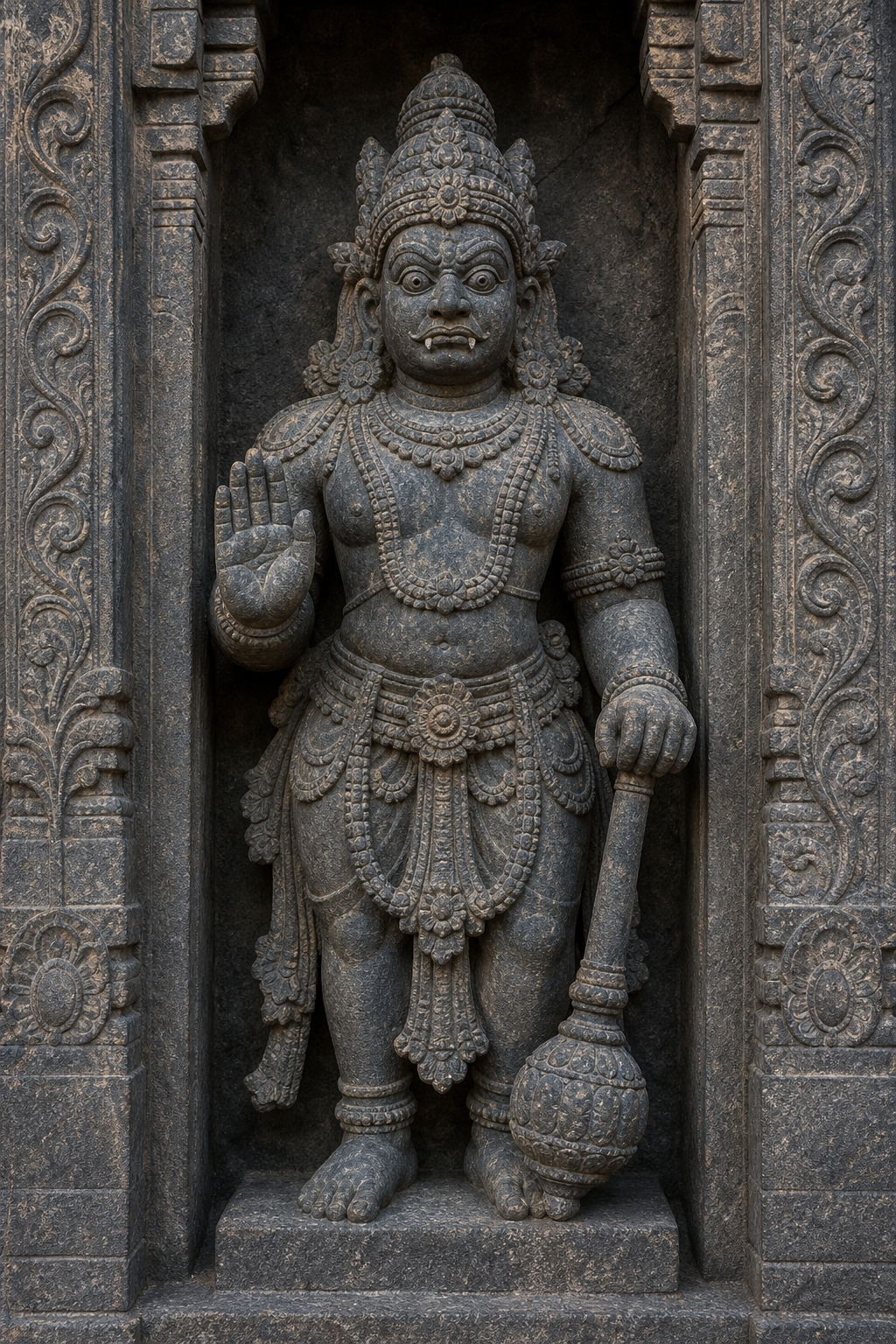
The most common error is to see any muscular figure beside a Vishnu temple door and call him Chanda. Dvarapalas share an iconographic language, while their names vary across Agamic lists, regions, periods, and individual temple traditions. Identification therefore requires several clues, not one dramatic feature.
First establish which threshold you are looking at
Confirm that the entrance actually faces east. A temple’s busiest modern access point may be a side entrance rather than its principal ceremonial gate. Your left or right as you approach is also not a reliable directional marker. Use the temple plan, signage, the position of the main axis, or local guidance. If you are standing at a northern, southern, or western doorway, the mere presence of a fierce guardian does not make him Chanda.
Also note the architectural layer. A temple may lead you through an outer prakara, a gopura, the mahadvara, the zone of the dvajasthambha and balipeetha, and eventually the antarala before the garbhagriha. Guardians can mark more than one of these boundaries. The figure at an outer gate and the figures nearest the sanctum need not have the same names or ritual assignment.
Then read the guardian as part of a pair
Do not isolate one sculpture from the doorway it protects. Examine both flanking figures. Local priestly traditions often pair Chanda with Prachanda, whose name intensifies the same vocabulary of fierce protection. This pairing is especially intelligible at shrines where Narasimha’s ugra dimension is prominent: the guardians form a controlled perimeter around divine power that destroys adharma while sheltering the bhakta.
A pair does not guarantee those names. It simply gives you a better question to ask: does this kshetra identify the eastern guardians as Chanda and Prachanda? That phrasing respects the temple’s living tradition instead of imposing a label learned elsewhere.
Use attributes as clues, not as a nameplate
Chanda may appear broad-shouldered and powerfully built, with an emphatic gaze and a stance that visually blocks careless passage. Slightly protruding canines can signal deterrence without turning the figure into an asura. A gada expresses strength held in readiness; a khadga suggests the power to sever or repel what violates the sacred boundary. An open or raised palm may function as a restraining warning rather than a welcoming gesture.
Look for Vaishnava affiliation as well. Depending on the period and workshop, the carving may include a tilaka cue, vanamala-like ornament, or conch and chakra motifs. These details help establish that you are seeing a guardian within Vishnu’s sacred order. They still do not prove the personal name Chanda.
Style can further complicate recognition. Chola and Vijayanagara dvarapalas often emphasize muscular volume and a forceful stance. Hoysala sculptors may surround the same protective presence with elaborate jewelry, patterned garments, and dense ornamental carving. Nayaka examples can become more theatrical, using twisting posture and intensely expressive eyes. The visual mood changes, but the guardian’s threshold function remains. Do not mistake a dynastic style for a separate theological role.
Let the temple supply the final identification
Check for an inscription, a modern name plaque, an authorized temple guide, or names used during festival recitation. If none is visible, ask an archaka or a knowledgeable temple functionary. Oral transmission matters in temple culture, particularly where an older inscription is absent, damaged, inaccessible, or never supplied the individual name.
If the local name cannot be verified, the accurate description is an eastern Vaishnava dvarapala. That is not an evasive answer. It preserves what the image clearly communicates while leaving uncertain nomenclature uncertain.
Why Vishnu’s eastern doorway needs a fierce guardian
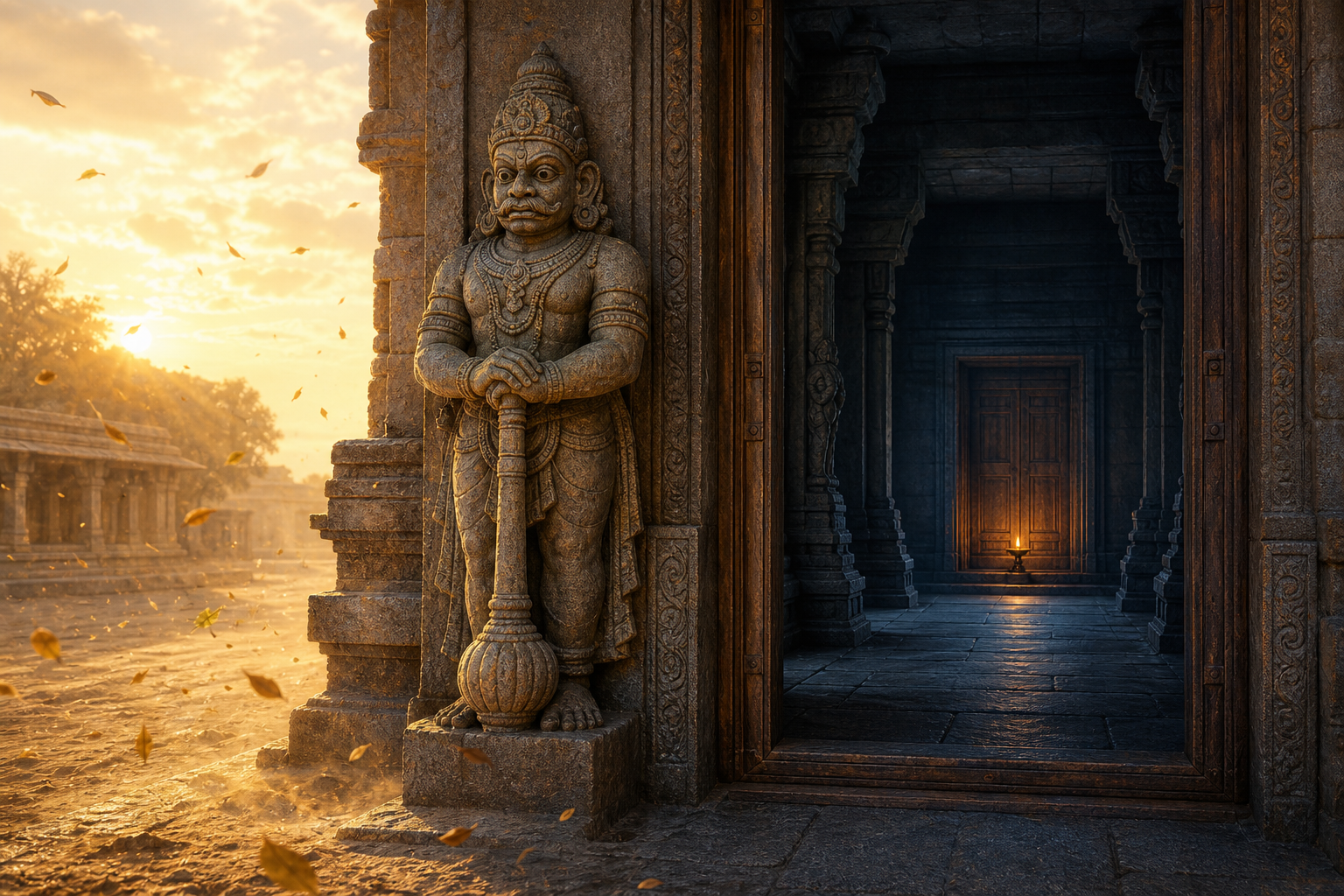
The eastern placement is not an arbitrary architectural convenience. In Indic spatial thought, the east belongs to sunrise, emergence, illumination, and a rightly begun undertaking. Many Vaishnava temples privilege an eastern axis for ceremonial entry, first darshan, and processional movement. When Chanda stands on that axis, his function is joined to the promise of dawn: the devotee moves toward light, but must first become fit for the movement.
The Sanskrit caṇḍa conveys fierceness, impetuosity, or an unyielding quality. It should not be confused with chandas, the term associated with Vedic meter. At a temple gate, Chanda’s fierceness is best understood as intensity brought under dharmic discipline. He is not displaying anger for its own sake. He embodies kshatra converted into seva.
This distinction changes how you read the image. A threatening figure would make sacred space feel hostile. A protective figure makes undisturbed worship possible. Chanda’s gaze is directed against disorder, malice, ritual disruption, and the undisciplined impulses that a visitor carries inward. His form announces that Bhagavan’s gentleness is not carelessness and that hospitality does not require the sanctuary to abandon its boundary.
Temple architecture teaches through successive crossings. The outer precinct separates the kshetra from ordinary circulation. The main gate gathers the pilgrim onto a sacred axis. The dvajasthambha and balipeetha situate personal worship within a larger cosmic and ritual order. The antarala narrows movement before the garbhagriha. Each threshold removes another degree of distraction. Chanda gives visible form to the first demand of that inward journey: do not carry everything across.
Pancharatra and Vaikhanasa paddhatis, together with architectural traditions represented by works such as the Mayamata and Manasara, place doorway deities within the temple’s consecrated system. Named lists are not identical everywhere, but the underlying logic is stable. Threshold and directional deities guard the ritual perimeter so the sanctum remains ordered for darshan. Chanda is therefore not a decorative warrior added after the theology was complete. His station participates in the theology.
How to approach the eastern gate as a devotee
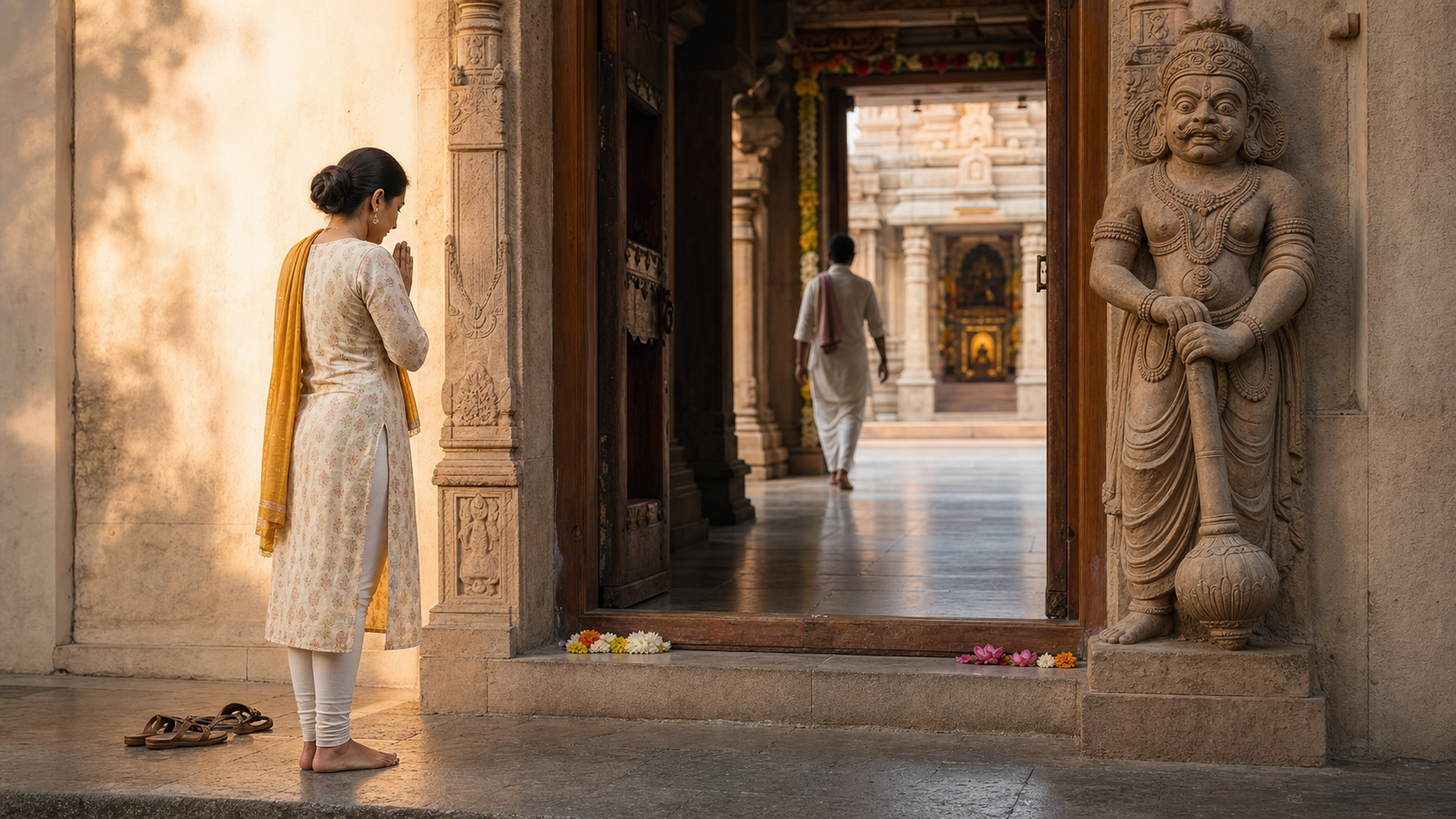
You do not need a private mantra, a dramatic gesture, or certainty about the sculpture’s name to honor the threshold. The most fitting response is attentive conduct. Local temple rules always take priority, especially regarding offerings, touching images, photography, and movement near a ritual doorway.
- Pause before the crossing. Step aside if others are moving through the gate. One quiet breath is enough to mark the difference between arriving at a building and entering a consecrated precinct.
- Acknowledge the whole doorway. Notice both guardians rather than treating one as an isolated art object. A small namaskara or lowered gaze is sufficient where local custom permits it.
- Examine what you are carrying inwardly. Set down agitation, hostile speech, the urge to rush, and the habit of treating darshan as a transaction. Replace them with a clear intention to see, listen, and conduct yourself truthfully.
- Follow the temple’s ritual order. Do not obstruct an archaka, procession, offering, or other devotees in order to inspect the sculpture closely. The guardian belongs to a living sanctuary, not merely to an art-historical display.
- Ask before assigning a name. If knowing whether the figure is Chanda matters to your study or pilgrimage, consult the temple’s own custodians after completing your immediate act of entry.
This courtesy mirrors the larger liturgical pattern. In many temples, priests honor directional and threshold deities as part of daily worship, including movements associated with the balipeetha and entry toward the sanctum. During Brahmotsavams and other utsavas, flowers, lamps, mantras, or formal acknowledgments may accompany the utsava-murti’s passage through a guarded threshold. The exact sequence belongs to the kshetra’s paddhati, but the meaning is readily visible: sacred movement takes place within an order that includes the gatekeepers.
Do not interpret attention to Chanda as worship that competes with Vishnu. A dvarapala’s authority is delegated and devotional. His protection serves Bhagavan, the sanctum, the ritual community, and the approaching devotee. In this respect Chanda resembles the administrative principle represented by Vishvaksena: order itself becomes an expression of service.
What Chanda’s fierceness does – and does not – mean
Chanda is not automatically Jaya or Vijaya
Jaya and Vijaya are the most widely recognized doorkeepers in Puranic accounts of Vaikuntha. That prominence can lead visitors to call every pair of Vaishnava dvarapalas by their names. Local kshetras, however, may preserve additional guardian names, including Chanda and Prachanda, in inscriptions, ritual speech, or archaka-parampara.
You do not have to choose between a Puranic archetype and a regional embodiment. One supplies a widely shared sacred pattern; the other locates protective service within a particular temple’s spatial and ritual life. Treating every pair as Jaya-Vijaya erases regional memory. Treating Chanda as the compulsory name of every eastern guardian makes the opposite mistake. Precision requires room for both canon and locality.
Fierceness is a boundary around compassion
Modern viewers sometimes assume that a compassionate religious space should display only serene forms. Hindu temple language is more exacting. Compassion must be protected from the forces that exploit, distract, or destroy it. Vishnu’s auspicious presence and Chanda’s stern perimeter are therefore complementary. One offers refuge; the other prevents the refuge from becoming spiritually formless.
This is why Chanda need not frighten the sincere devotee. His challenge is directed at what obstructs darshan, including obstruction within the visitor. The raised weapon is not an invitation to imitate aggression. It represents force restrained by dharma and used for protection. The moral test is not whether you can become fierce, but whether your strength can remain governed by service.
The wider Dharmic family preserves comparable thresholds
Other Dharmic traditions use different forms to establish a protected moral field. Buddhist monasteries and shrines can employ guardian yakshas or dharmapalas. Jain temples may place kshetrapalas and attendant yakshas within a sacred geography committed to purity and non-violence. Sikh gurdwaras generally do not use anthropomorphic gate sentinels, yet removing shoes, covering the head, and bowing reverently make entry a disciplined transition rather than an ordinary act.
These are functional parallels, not interchangeable doctrines. Their value lies in the shared recognition that access to sacred space asks something of the person entering it. A boundary can serve openness when it removes conduct that would disturb everyone within. Chanda’s fierce face expresses that principle in a distinctly Vaishnava visual and ritual vocabulary.
At your next eastern gate, resist the urge to rush past the guardians or name them from appearance alone. Establish the direction, read the pair, notice the attributes, and learn the kshetra’s own usage. Then let the threshold do its deeper work: gather your attention, leave disorder outside, and enter Vishnu’s presence with a steadier mind.