

If you are holding an unfamiliar lipstick, skin cream, kajal or hair product, the useful question is not whether the packaging looks expensive. It is whether you can trace the product from the manufacturer to an identifiable Indian importer and then to the seller taking your money.
That check protects more than your wallet. An unlawfully imported cosmetic may have bypassed the controls meant to catch unsafe ingredients, contamination and misleading labels. It can also leave you without a responsible business to approach when something goes wrong.
The real test is traceability, not nationality
A foreign cosmetic is not automatically an illegal cosmetic. Country of origin tells you where a product came from; it does not, by itself, establish whether the importer obtained the required authorization or whether the package complies with Indian rules.
The distinction matters when sellers use the words imported, exclusive or export quality as substitutes for evidence. Imported cosmetics offered in India are subject to the Drugs and Cosmetics Act, 1940 and the Cosmetics Rules, 2020. The Central Drugs Standard Control Organization, working with State regulators, oversees requirements involving import authorization, ingredients, safety and quality.
A second layer concerns what you can see on the retail package. The Legal Metrology (Packaged Commodities) Rules, 2011 require declarations that identify the product, its quantity, its origin and the business responsible for placing it on the Indian market. Safety benchmarks also draw on Bureau of Indian Standards guidance, including IS 4707 schedules dealing with permitted, restricted and prohibited substances.
- Cosmetics regulation asks: Was the imported product authorized, and does it meet applicable ingredient, safety and quality requirements?
- Package regulation asks: Does the consumer receive the required identity, quantity, date, price and origin information?
- Customs and trade law ask: Did the goods enter India through a lawful, properly declared route?
Failure at any one of these layers can make a product unlawful to sell even when the cosmetic itself is genuine. Conversely, unusual packaging or a foreign language does not establish illegality if the Indian-market declarations and import trail are valid.
This is also the right way to interpret the word banned in an enforcement report. In Chhatrapati Sambhajinagar, police seized cosmetics marked Made in Pakistan, valued the goods at Rs 60,000, arrested three people and began tracing the supply chain. The investigation remained necessary because a country label alone does not establish who imported the goods, which permissions existed or which participant knew of a violation.
India withdrew Most-Favoured Nation treatment from Pakistan in February 2019 and sharply increased basic customs duties on goods of Pakistani origin. That makes documentation for such goods especially important, but it does not justify replacing verification with a blanket accusation. The sound consumer standard is simple: treat the declared origin as a fact to verify against the import trail, not as a verdict about the product or seller.
Run this five-part check before you pay
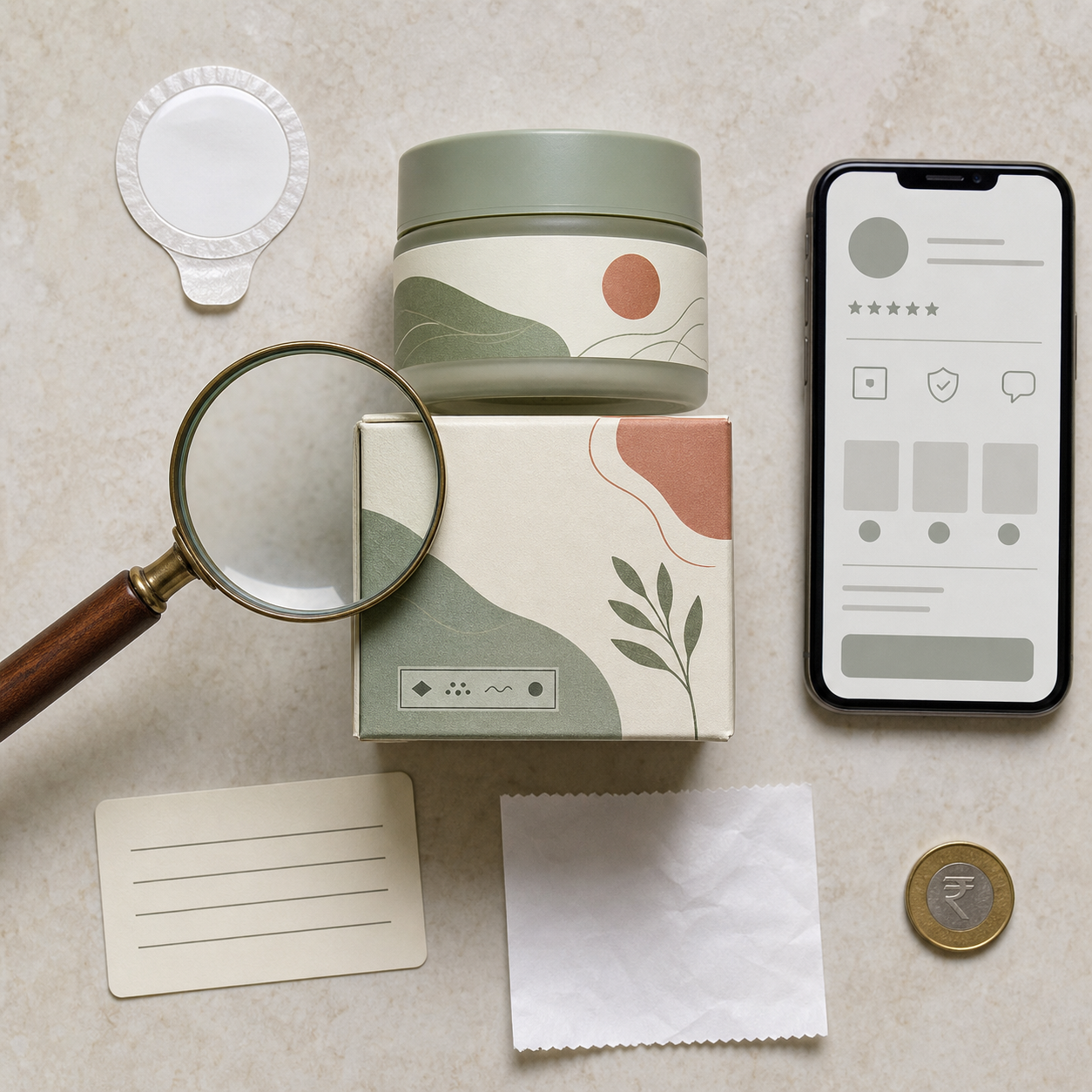
Use the physical package whenever possible. An online photograph may show an export carton, an old design or a stock image rather than the item that will reach you. If the seller cannot show the Indian retail label before purchase, ask for clear images of every side and confirm that an invoice will be issued.
- Find the accountable businesses. Look for the manufacturer’s name and address and, for an imported cosmetic, an identifiable importer with usable contact details. A brand name, social-media handle or marketplace username is not a substitute for a responsible legal entity.
- Read the mandatory retail declarations. Check the country of origin, net quantity, batch number, date of manufacture or use-before date, and maximum retail price. Do not assume a globally familiar brand is exempt from Indian-market declarations.
- Inspect the ingredient information. The ingredient list should be complete and readable. Marketing terms such as natural, herbal or premium do not prove regulatory compliance or chemical safety.
- Demand an invoice that identifies the purchase. The seller’s name, the product and the transaction should be traceable. A cash discount is not worth losing the main record connecting you to the retailer.
- Test the seller’s willingness to document the import. If doubt remains, ask who the authorized importer is and whether the seller or distributor can demonstrate the relevant CDSCO authorization. Public CDSCO resources may help where the information is available, but do not invent a rule that every lawful product must display a particular authorization number on the front label.
An additional Indian-market label or sticker is not automatically suspicious. Importers may need to add declarations for local retail. What matters is whether the information is readable, consistent and traceable. A sticker that conceals the original batch, changes the origin, gives an unverifiable address or appears to have been altered deserves closer scrutiny.
Pause the purchase when you see several of these warning signs:
- No named Indian importer or no usable importer address.
- Missing, contradictory or obscured country-of-origin information.
- No MRP, batch number, net quantity or relevant date.
- An ingredient list that is absent, unreadable or presented only as vague marketing claims.
- A seller who will not issue an invoice or identify the distributor.
- Package details that do not match the seller’s listing, bill or explanation.
- A claim that an imported product does not need Indian retail declarations.
A warning sign is not laboratory proof that the contents are harmful. It is a reason not to expose yourself while the product’s identity remains uncertain. Formal controls exist partly to reduce exposure to prohibited or excessive substances, unsafe preservatives, microbial contamination and heavy metals such as lead or mercury. Cosmetics that bypass the lawful import route create a higher risk because the safety and documentation trail may be missing together.
Your eyes and skin cannot certify a cosmetic. A normal smell, smooth texture or lack of an immediate reaction does not establish ingredient compliance. Home experiments cannot replace regulatory documentation or laboratory testing.
If you already bought or used a suspicious product
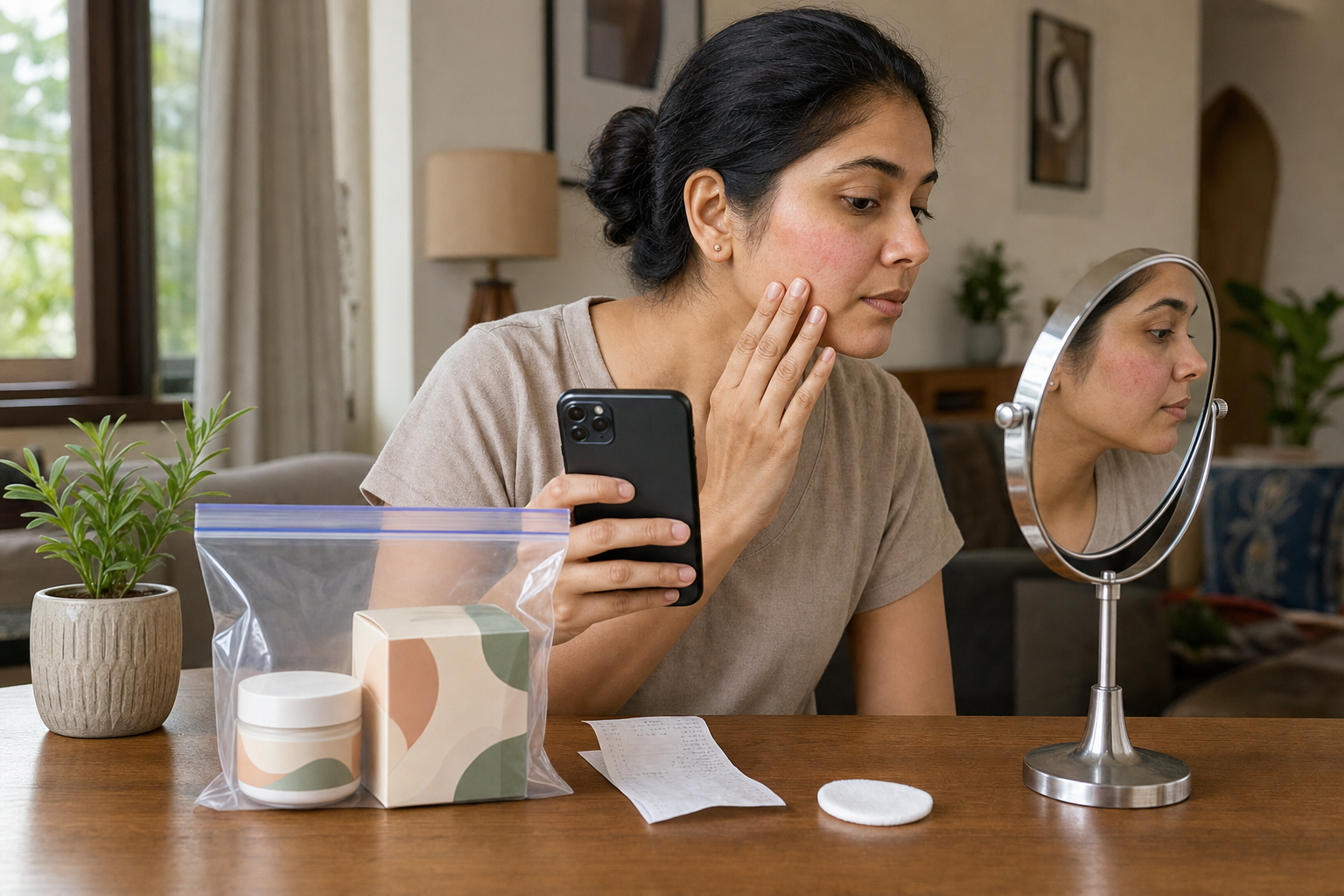
Do not throw away the package in frustration. The container, outer box, batch details and invoice may be the only evidence connecting the product to its seller and supply chain.
- Stop using the product while its identity is unresolved. Do not keep applying it to see whether a reaction happens. If you develop continuing or severe skin symptoms, eye irritation or another concerning reaction, seek qualified medical care. Take the package or clear photographs with you; a retailer cannot diagnose the problem.
- Photograph the evidence. Capture every side of the product, the batch and date markings, the ingredient list, the importer details, the MRP, the seal and any sticker placed over original text. For an online purchase, save the listing, seller identity, order page and claims made at the time of sale.
- Preserve the transaction trail. Keep the invoice, payment record, delivery label and written messages. If the seller never issued an invoice, record that fact and request one in writing.
- Ask the seller for a written resolution. Request the identity of the importer, the distributor’s traceable documentation and a refund where the supplied product does not match the listing or required declarations. A verbal assurance that the item is original does not repair missing records.
- Escalate with a complete evidence packet. Report the listing to the marketplace where applicable and send the product details, seller information and transaction records to the appropriate State drug regulator, CDSCO or consumer-protection channel. Regulators can determine whether customs or other enforcement authorities also need the information.
- Keep the product unless an authority instructs otherwise. Document it before returning or surrendering it. Do not alter the label, empty the container or destroy material that may be needed for testing.
If authorities collect a sample, the chain of custody matters. Laboratories may examine ingredients and microbial limits, while investigators compare labels, permissions, invoices, transport records, communications and payments. Your role is not to prove the entire offence. It is to preserve accurate information so the responsible authority can establish what happened.
Exercise the same restraint in public. A seizure, complaint or arrest is not a conviction, and responsibility may lie at different points in the supply chain. Share evidence with the authorities and describe what you can document. Do not turn an unresolved compliance question into an allegation against an entire nationality, community or every retailer carrying foreign goods.
Retailers and online sellers need a higher standard

A consumer can refuse one doubtful product. A retailer can distribute the same problem to hundreds of households, so checking the outer label at the shop counter is not enough. Procurement records must establish how the goods entered the business and who stands behind them.
- Buy imported cosmetics only from distributors who can demonstrate the relevant CDSCO authorization and provide traceable, GST-compliant invoices.
- Match the invoice, product description, importer, country of origin and batch information. Do not accept an invoice for a generic category when the stock itself cannot be identified.
- Inspect labels against Legal Metrology requirements before placing goods on a shelf or activating an online listing.
- Retain supplier, transport, payment and stock records in a form that allows a batch to be traced rather than reconstructed from memory.
- Recheck suppliers when packaging, routing, importer identity or payment arrangements change. Misdeclared origin, third-country transshipment, fragmented courier parcels and cash-based wholesaling can conceal the actual trail.
- Train frontline staff to pause a sale when declarations are missing instead of improvising an explanation for the customer.
- Quarantine doubtful stock and preserve its records. Obtain regulatory or legal direction before relabelling, returning or destroying goods that may be evidence.
Depending on the facts, non-compliance can engage cosmetics regulation, Legal Metrology requirements, the Customs Act, 1962 and measures under the Foreign Trade (Development and Regulation) Act, 1992. The exact exposure depends on what was imported, how it was declared, what documentation existed and what each participant did. A business facing an enforcement notice should obtain advice from a qualified lawyer rather than relying on a distributor’s reassurance.
This is where consumer protection meets a Dharmic public ethic. Ahimsa is not merely a sentiment when a product touches someone’s skin or eyes; it requires preventing avoidable harm. Integrity in trade requires truthful origin, honest measurement and an accountable seller. Due process requires evidence before condemnation. These duties reinforce one another.
A pro-Bharat marketplace is not one that distrusts everything foreign. It is one in which lawful domestic businesses and responsible importers are not undercut by anonymous grey-market stock, and in which families do not carry the health risk created by someone else’s hidden supply chain.
Key takeaways
- Foreign origin is not proof of illegality; missing authorization, declarations or a lawful import trail is the real issue.
- Before buying, check the importer, country of origin, net quantity, batch, relevant date, MRP, ingredient list and invoice.
- Do not treat attractive packaging, a famous brand name or the word herbal as evidence of safety.
- If a product is suspicious, stop using it, photograph it and preserve the package, invoice, listing and payment record.
- Retailers should verify authorization and batch-level traceability before stock reaches a shelf or online customer.
- Report documented facts and allow regulators and laboratories to determine the violation and responsibility.
Make the label and invoice check part of the purchase, not an investigation you begin after opening the package. If a seller cannot tell you who imported the cosmetic and cannot give you a traceable bill, leave the product where it is. That small refusal protects your household and removes demand from a supply chain that depends on nobody asking questions.