
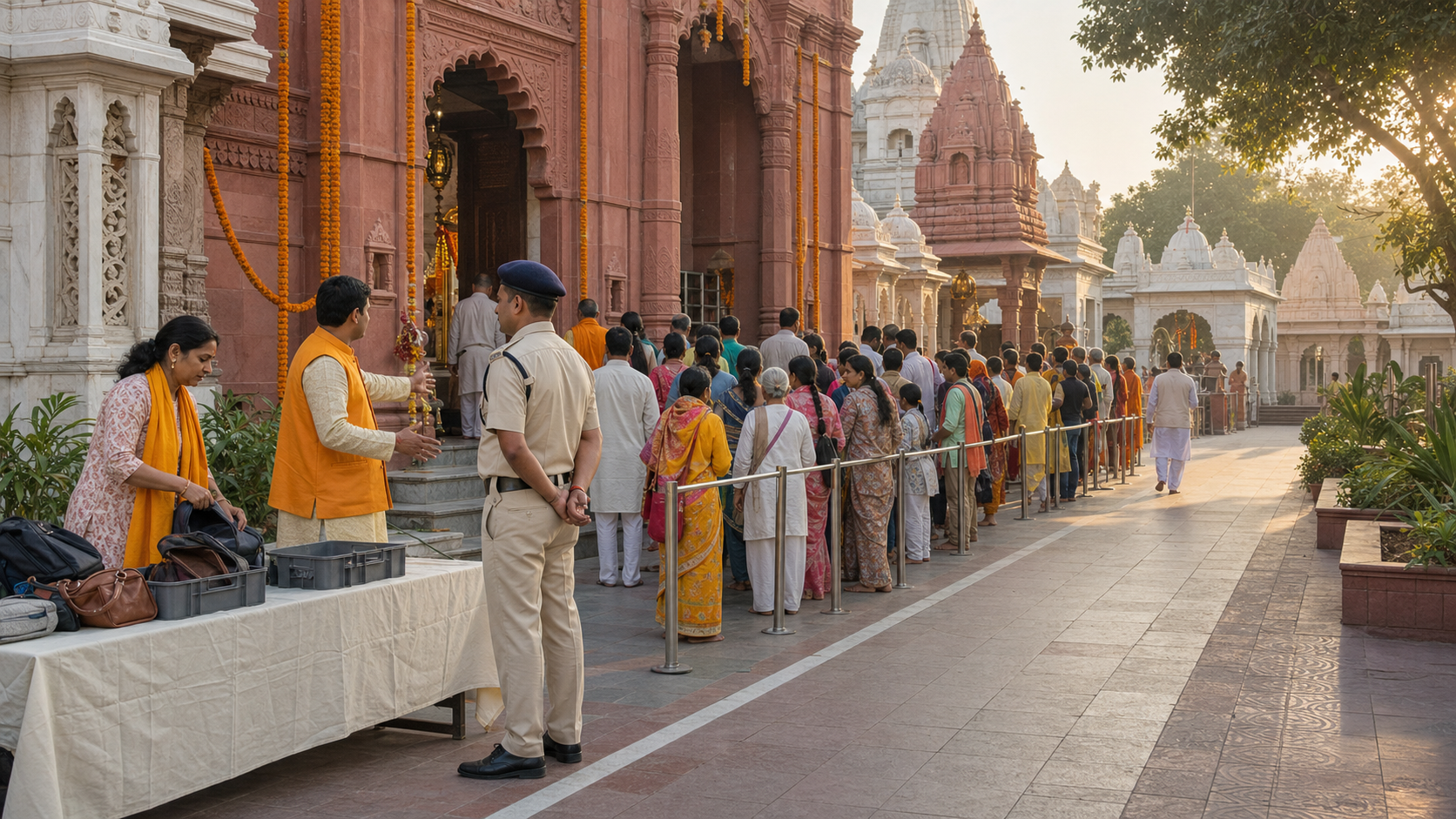
If you are planning darshan at Kalkaji Temple, volunteering at a Delhi mandir, or responsible for security during a crowded festival, the useful question is not whether a frightening headline deserves panic. It is which claims are established, which remain preliminary, and what you can do before the next rush of devotees arrives.
Shabbir Ahmed Lone was arrested near Delhi and was described in early allegations as an LeT-linked handler connected to a Kolkata facilitation node. Kalkaji Temple was reported as a possible target. Those are serious claims, but they have not yet become judicial findings. The right response is calm vigilance: protect the shrine, preserve the distinction between evidence and allegation, and refuse the communal suspicion that terrorist strategy is designed to provoke.
Key takeaways
- Kalkaji Temple has been named in preliminary public accounts, not established in court as the target of a proven conspiracy.
- The suspected Bangladesh-Kolkata-Delhi route matters because a facilitation network can move people, money, documents and instructions without every participant knowing the whole plan.
- You should report observable conduct, such as attempts to enter restricted service areas or repeated questions about guard routines, rather than treating a person’s religion, language, dress or place of origin as evidence.
- Temple committees should prioritise clear entry control, usable exits, trained volunteer roles, police liaison, CCTV coverage at chokepoints and a rehearsed notification plan.
- Call India’s emergency number, 112, when there is an immediate threat. Do not touch an unattended object, confront a suspected person or circulate an unverified accusation online.
What the Delhi threat claim does and does not establish

Four propositions can easily become blurred when a terrorism case moves through headlines and social media. Keep them separate:
- An arrest took place near Delhi.
- Investigators have alleged an association with Lashkar-e-Taiba, a UN-designated terrorist organisation whose command infrastructure has historically been rooted in Pakistan.
- Preliminary accounts describe a facilitation link running through Bangladesh and Kolkata toward Delhi.
- Kalkaji Temple has been mentioned as a possible target in the public domain.
The first proposition does not automatically prove the other three. An arrest may disrupt a plan, but it does not by itself show how advanced that plan was, whether weapons or materials had been obtained, whether reconnaissance had occurred, or whether every suspected participant has been identified. Unless investigators release evidence on those questions, you should not fill the gaps with confident claims.
Nor does a general discussion of vulnerable Delhi shrines create a list of confirmed targets. The Gauri Shankar Temple area, for example, has appeared in broader discussion as the kind of high-footfall location that warrants vigilance. That is not the same as evidence that it was selected by this alleged network. If you share information, retain qualifiers such as “reported,” “alleged” and “possible.” Removing those words changes the claim.
Due process is part of national security, not an obstacle to it. The allegations against Lone must be tested through admissible evidence, lawful remand, access to counsel and judicial scrutiny. A weak or contaminated evidence chain can allow a dangerous participant to escape accountability; an evidence-led process is therefore essential both to convict the guilty and to protect the innocent.
For you, the practical rule is simple: treat the possible threat seriously without treating every circulating detail as settled. Look for official police briefings and concrete developments, such as identified accomplices, recovered evidence, documented reconnaissance or a formal charge. A forwarded image, an unattributed voice note or a message claiming that “all Delhi temples” are threatened does not meet that standard.
Why the suspected facilitation network matters more than one arrest

A terrorist network rarely resembles a single group whose members all meet in one room. A handler may communicate through intermediaries. Recruiters or spotters identify contacts. Logisticians arrange identification documents, SIM cards, lodging or transport. Couriers move cash or other resources. Operators may conduct reconnaissance without meeting the people who financed or directed them. This hub-and-spoke structure limits what any one participant can reveal.
That is why the alleged Bangladesh-Kolkata-Delhi logistics arc deserves attention even before every link is proven. A border-proximate route may offer anonymity, while a large eastern metropolis supplies rail and road connections into northern cities. Dense passenger flows, short-term accommodation, cash transactions and transient communications can conceal ordinary-looking movements.
The location of a suspected node also tells you what an effective investigation must accomplish. Delhi Police, state Anti-Terrorism Squads, central intelligence units and, where appropriate, the National Investigation Agency need to connect activity across jurisdictions. Arresting a suspected operator in Delhi is only one part of the work. Investigators must also identify whoever recruited, financed, housed, transported or remotely directed that person.
Digital evidence is crucial, but a screenshot or isolated contact entry is not enough. Investigators normally preserve devices through forensic imaging, calculate hashes to show that copied data has not changed, extract logs, and correlate communications with call-detail records, cell-site information, IP data and CCTV timelines. Human intelligence then helps confirm or disprove the resulting reconstruction. The evidentiary chain must connect handlers, couriers, financiers, safe houses and reconnaissance activity, not merely attach a dramatic label to one accused person.
When you assess later updates, ask network questions. Was a Kolkata contact identified? Were travel, lodging or financial links corroborated? Did CCTV place anyone at a named shrine? Were devices and accounts connected through more than a confession or an unverified message? Has the alleged role of each person been specified? Those questions are more informative than the number of arrests announced at a press conference.
What you should do at a crowded temple

You do not need to become an amateur investigator. In fact, following, photographing or confronting someone can endanger you, alarm a crowd and interfere with police work. Your role is to notice a specific condition, move to safety when necessary and pass accurate information to people who can act on it.
- Prepare before entering. Carry only what you need so that screening is quick. Identify at least one marked exit, and choose a family regrouping point outside the main pedestrian flow. This is particularly useful when children, older relatives or anyone needing assistance is with you.
- Cooperate with uniform screening. A controlled entry works only when devotees do not bypass it or pressure volunteers to make exceptions. If a gate appears unattended or an exit is blocked, tell a supervisor rather than assuming someone else has noticed.
- Notice conduct, not identity. Relevant indicators can include repeated questions about guard changes, close attention to CCTV mounts or service access, attempts to reach a roof or restricted corridor, or an unattended object placed near a chokepoint. Ordinary photography, unfamiliar clothing, a regional accent or non-participation in worship is not sufficient evidence by itself.
- Report precisely. Tell a police officer, security guard or designated volunteer what you saw, where you saw it, when it happened and, if a person moved away, the direction of travel. Separate what you observed from what you inferred.
- Use 112 for immediate danger. Move away from a suspicious object and keep others from approaching if you can do so without putting yourself at risk. Do not touch, open or relocate it. Do not confront a suspected person.
- Follow crowd instructions during an alert. Walk toward the route indicated by police or trained marshals, keep access open for responders and do not return for footwear, bags or offerings until the area has been cleared.
A good report is narrow: “A bag has been unattended beside the eastern queue barrier for several minutes, and I have informed the marshal.” A poor report turns observation into accusation: “A suspicious outsider planted a bomb.” The second formulation can trigger panic, target an innocent person and contaminate witness accounts.
Apply the same discipline online. Do not publish a stranger’s photograph, name a community, announce an evacuation route as a confirmed target or forward an audio clip merely because it sounds urgent. Save the original message if police request it, record who sent it to you, and rely on verified briefings. Terrorism seeks a second impact through fear and social division; careless forwarding helps deliver it.
How temple management can improve security without closing the shrine
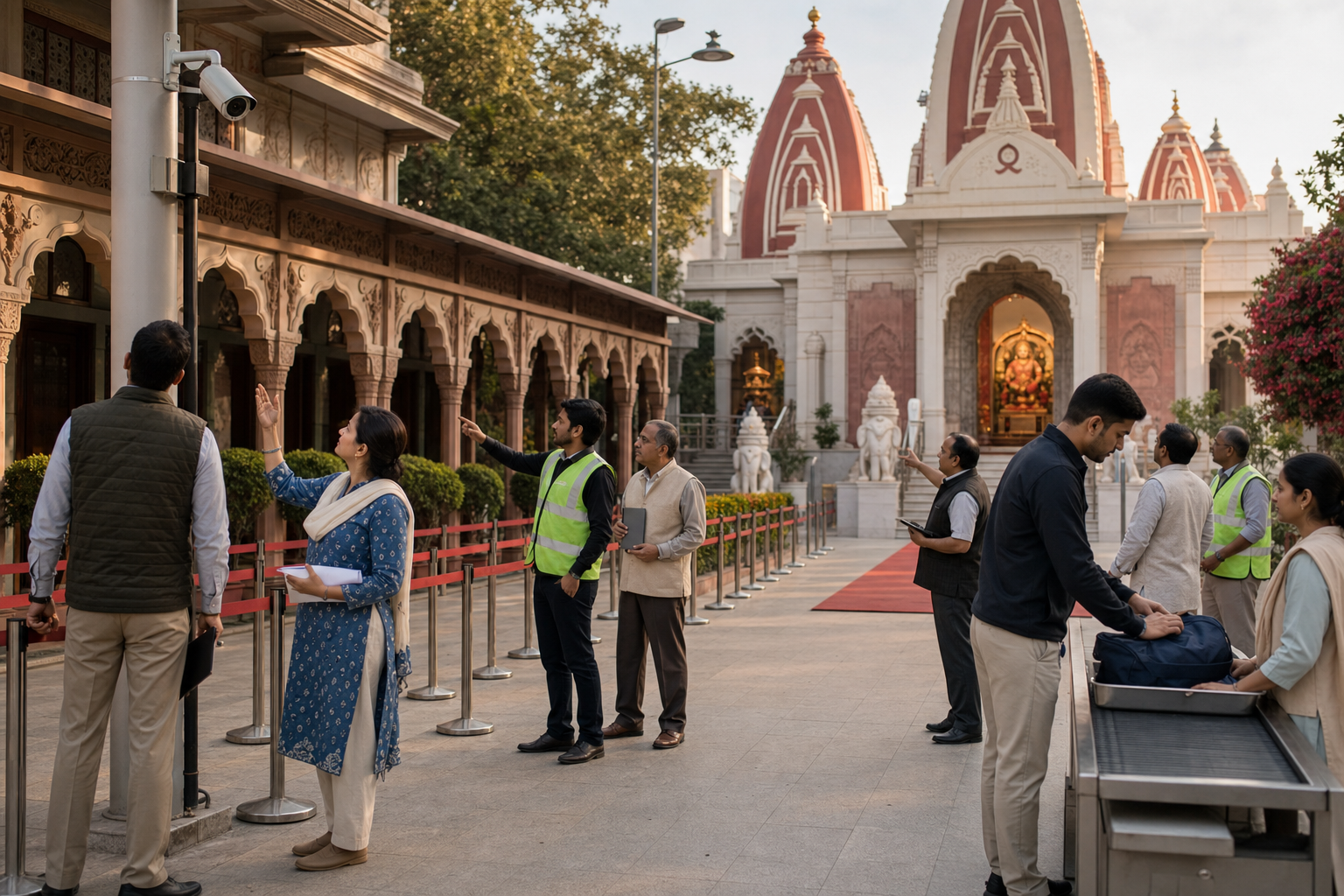
A mandir cannot be protected by making every devotee feel accused. The strongest model is layered and courteous: each measure catches a different kind of failure, while the overall experience remains recognisably one of darshan and seva. The same principle can be adapted by gurudwaras, viharas and Jain derasars.
Before the next high-footfall day
- Name one security lead and at least one alternate. Give local police a current contact sheet. Volunteers should know who can request police support, pause entry or order an evacuation.
- Walk the entire public route. Check perimeter lighting, uncontrolled side entrances, CCTV blind spots, queue chokepoints, roof or service access and whether emergency exits are visible and unobstructed.
- Reduce entry ambiguity. Use a limited number of staffed entrances, courteous bag screening and clear signs. If the layout permits, separate incoming and outgoing pedestrian flows so that a sudden stoppage does not compress both crowds into one gate.
- Assign visible volunteer roles. Reflective vests make marshals easy to find. Separate screening, queue management, first aid and public communication duties so that one volunteer is not trying to perform every task.
- Schedule and record security sweeps. Trained volunteers should check public and service areas before opening and at planned intervals. A simple log should show who checked which area and when, without publishing sensitive patrol details.
- Protect emergency access. Keep exit routes, fire equipment and responder lanes free of vendors, stored footwear and temporary decorations. An exit sign is of little value when the route behind it is blocked.
- Post a discreet reporting channel. Display the security desk location and 112 near entrances. An anonymous tip option can help a devotee report a concern without starting a public confrontation.
- Control temporary access. Maintain a pre-approved list of vendors and service workers during peak periods, issue time-limited credentials where feasible, and restrict roofs, electrical rooms and service corridors to authorised personnel.
CCTV should cover entrances, queue turns, vehicle approaches and other chokepoints rather than merely producing a wide, unusable view of the courtyard. Check whether cameras show the correct time and whether authorised staff can retrieve footage. After an incident, preserve the original recording, note any clock discrepancy and provide it through the police evidence process. Cropping, compressing or forwarding clips through messaging apps can remove context and weaken their evidentiary value.
During festivals and other surge periods
Temporary vehicle barriers can create a pedestrian buffer where the site layout supports one. Handheld metal detectors may be deployed selectively and respectfully. Extra marshals should be placed where queues bend, merge or meet stairs. A visible grievance counter can resolve disputes before frustration turns into pushing or an argument distracts security staff. Police surge support should be arranged in advance rather than requested only after the crowd has exceeded the committee’s capacity.
Screening rules should be written and applied to everyone under the same stated conditions. Volunteers need a clear instruction not to question people about religion, caste, language or region as a substitute for observing conduct. Profiling creates blind spots: it burdens innocent devotees while teaching staff to overlook dangerous behaviour by anyone who appears familiar.
A tabletop exercise is the fastest way to expose a weak plan. Place one realistic scenario before the committee: an unattended object is found near an entry queue at peak time. Ask who calls police, who stops new arrivals, who opens the alternate route, who protects the responder lane, who assists vulnerable devotees, who preserves CCTV and who gives the only authorised public update. If two people believe they own the same task, or nobody owns it, repair the notification tree before conducting a larger drill.
District-level cooperation can make this work easier. Mandirs, gurudwaras, viharas and derasars can develop a shared baseline procedure with local police while retaining the customs of each institution. Joint tabletop exercises spread lessons quickly, and they deny extremists the sectarian fracture they seek.
Your next action can be modest and immediate. If you are a devotee, save 112, use the screened entrance and identify an exit when you arrive. If you manage a shrine, name the police liaison, inspect the exits and put a tabletop exercise on the calendar before the next peak gathering. Open worship and serious protection are not opposing choices; disciplined preparation allows both to endure.