
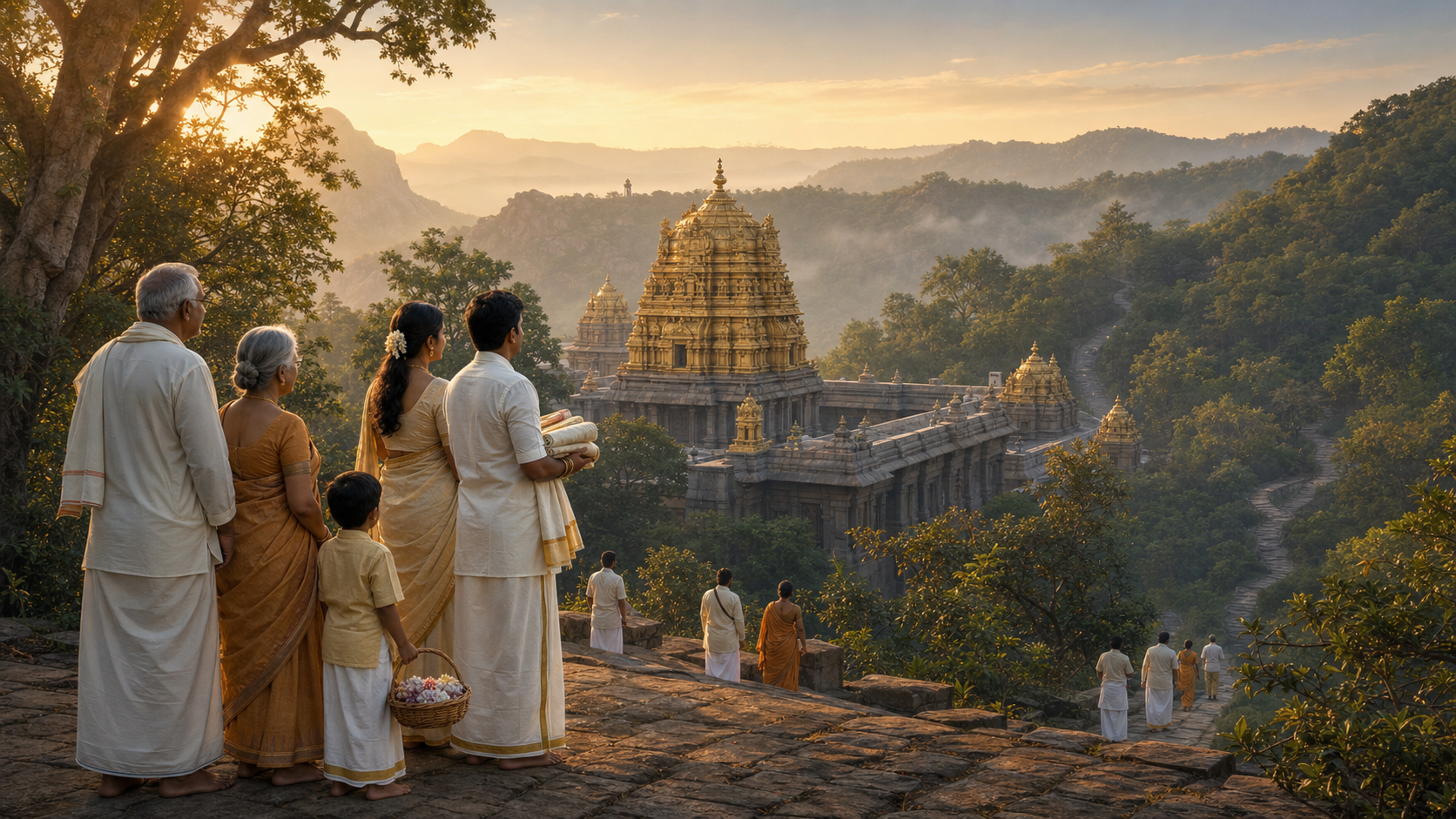
If you are using the April 2026 Tirumala calendar to understand a family observance or prepare for the same festivals in a later cycle, a list of dates is not enough. April 1 called for a choice between temple-centred worship and a demanding theertha pilgrimage; April 13 opened an acharya commemoration; and April 20 brought several observances together on one spiritually dense day.
The useful question is not simply what fell on each date, but what kind of participation each observance required. This calendar will help you match the occasion to your devotional priority, distinguish darshan planning from forest access, and avoid carrying April 2026 dates into another year without checking the relevant tithi, nakshatra, and final TTD programme.
April 2026 at a glance: three dates, three different decisions
Tirumala’s principal April 2026 observances were concentrated on April 1, April 13, and April 20. The concentration makes the month look simple, but each date operated on a different ritual logic.
| Date | Observances | Why a devotee would choose it | Main planning question |
|---|---|---|---|
| April 1, 2026 | Conclusion of Srivari Vasanthotsavams; Tumburu Theertha Mukkoti | Spring-festival worship at the temple or a sacred forest-theertha observance | Is your priority the temple ritual or the theertha journey? |
| April 13, 2026 | Commencement of Sribhashyakara Utsavams | Ramanujacharya remembrance, Veda and Divya Prabandham recitation, and acharya-centred learning | Which parts of the multi-day programme are available during your stay? |
| April 20, 2026 | Akshaya Tritiya; Parashurama Jayanti; Bhrigu Maharshi Varsha Thiru Nakshatram; Srinivasa Dikshitulu Varsha Thiru Nakshatram | Dana, japa, svadhyaya, avatara remembrance, and gratitude to the rishi-acharya lineage | Which one practice will give the crowded ritual calendar a clear personal focus? |
April straddled late Chaitra and the beginning of Vaishakha. Akshaya Tritiya was tied to Vaishakha Shukla Tritiya, while the two Thiru Nakshatram observances followed their respective lunar mansions. That distinction matters whenever you use this calendar as a reference: a civil date, a lunar tithi, and a nakshatra anniversary are related for one year, but they are not permanently interchangeable.
Final temple timings, seva arrangements, queue controls, and forest-access windows could also be refined for operational or safety reasons. The date gave you the devotional framework; an official TTD communication supplied the final practical detail.
April 1 required a choice between two very different pilgrimages
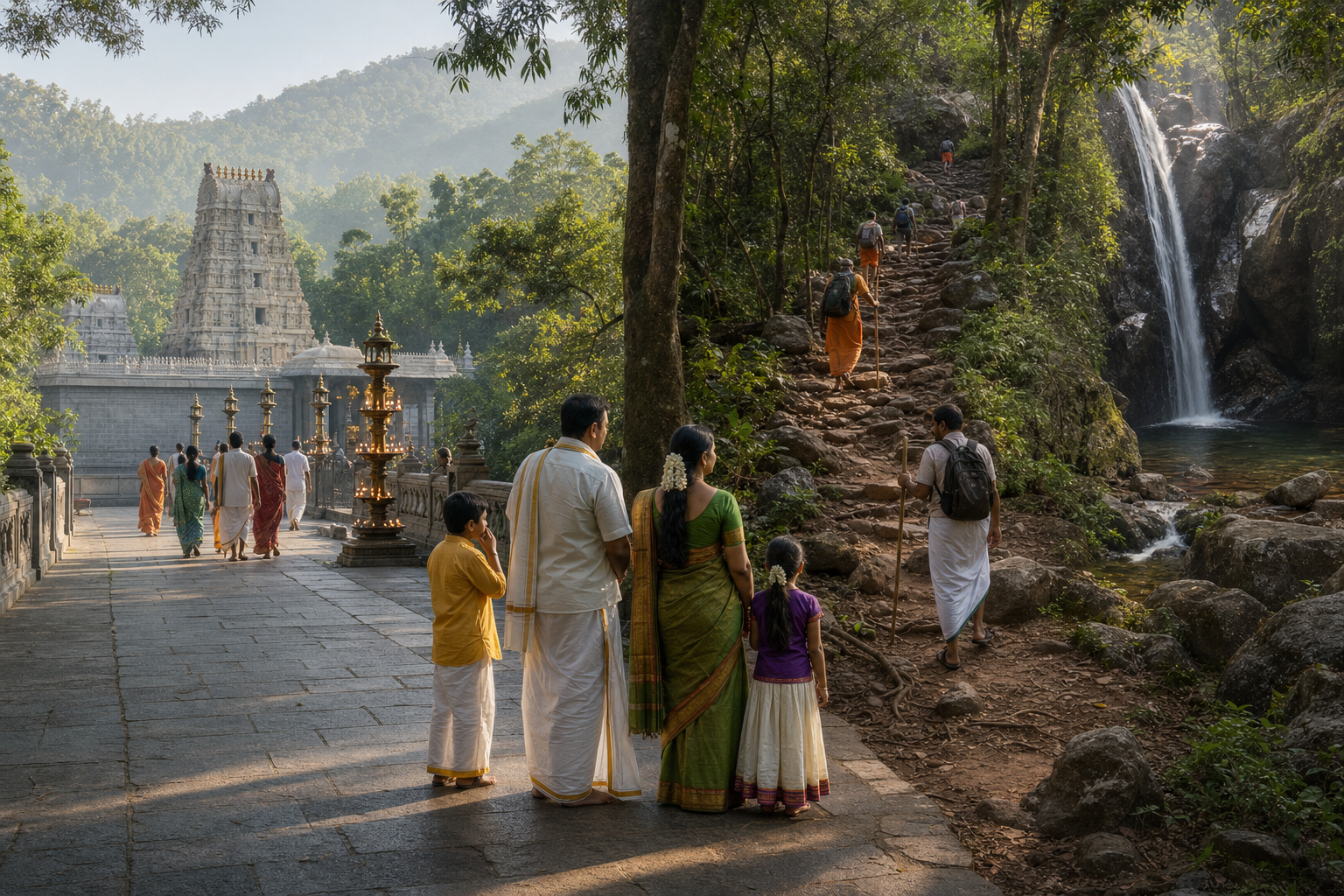
The conclusion of Srivari Vasanthotsavams and Tumburu Theertha Mukkoti shared April 1, but they should not be treated as two adjacent items on a sightseeing schedule. One centred on the ordered liturgy of Sri Venkateswara’s spring festival. The other involved travel through forest terrain to a sacred water body. Their devotional spirit could complement each other, but their physical demands and access arrangements were quite different.
The conclusion of Srivari Vasanthotsavams
Vasanthotsavam marked the seasonal movement into warmer weather through rites of cooling, restoration, and auspicious renewal. Its concluding ritual included Snapana Tirumanjanam, the ceremonial bathing of the utsava-murthis with panchamrita and fragrant substances. Sankalpa and mantra-japa preceded the abhisheka; alankara and deepa offerings completed the movement from ritual bathing to adorned darshan.
This sequence is worth understanding before you enter a busy festival setting. The abhisheka is not an isolated visual event. Sankalpa establishes intention, the mantras order attention, the bathing expresses divine grace and renewal, and the subsequent alankara presents the deities in restored splendour. If Vasanthotsavam is your main reason for visiting, learn that sequence beforehand. You will be better able to follow the rite even when your view is brief or the crowd is moving.
Keep the practical goal equally clear. Verify the day’s festival programme and your darshan arrangement separately, arrive with time for security and queues, and do not let the search for a particular viewing position overwhelm the recitation and worship around you. The meaning of the festival is carried by the full ritual progression, not only by the most visually striking moment.
Tumburu Theertha Mukkoti
Tumburu Theertham, named for the celestial Gandharva Tumburu, lies in the forested Tirumala range. Mukkoti expresses the sacred convergence of innumerable theerthas, giving the day’s snana the character of a serious vrata rather than a recreational outing.
The terrain changes the planning standard. A pilgrim who is prepared for temple queues is not automatically prepared for a forest route. Access windows and safety directions should come from the relevant TTD and forest personnel, and the condition of the route should take precedence over an informal plan or a forwarded message.
- Begin early enough to follow the designated access window without rushing through forest terrain.
- Wear sturdy footwear and carry sufficient drinking water and basic first-aid supplies.
- Remain on marked paths. Keep a cautious distance from wildlife, slippery edges, and unfamiliar parts of the water body.
- Carry no disposable plastic into the forest zone, and take every item of waste back with you.
- Do not introduce soap, detergent, or other cleaning products into the theertham.
- After the snana, leave room for japa or quiet contemplation instead of treating the return journey as the only remaining task.
If you hoped to attend both April 1 observances, the safe assumption was that they were separate logistical commitments until official timings proved otherwise. The calendar alone could not guarantee that a temple programme, regulated queues, forest access, and return travel would fit into one day.
April 13 placed Ramanujacharya’s teaching inside living worship
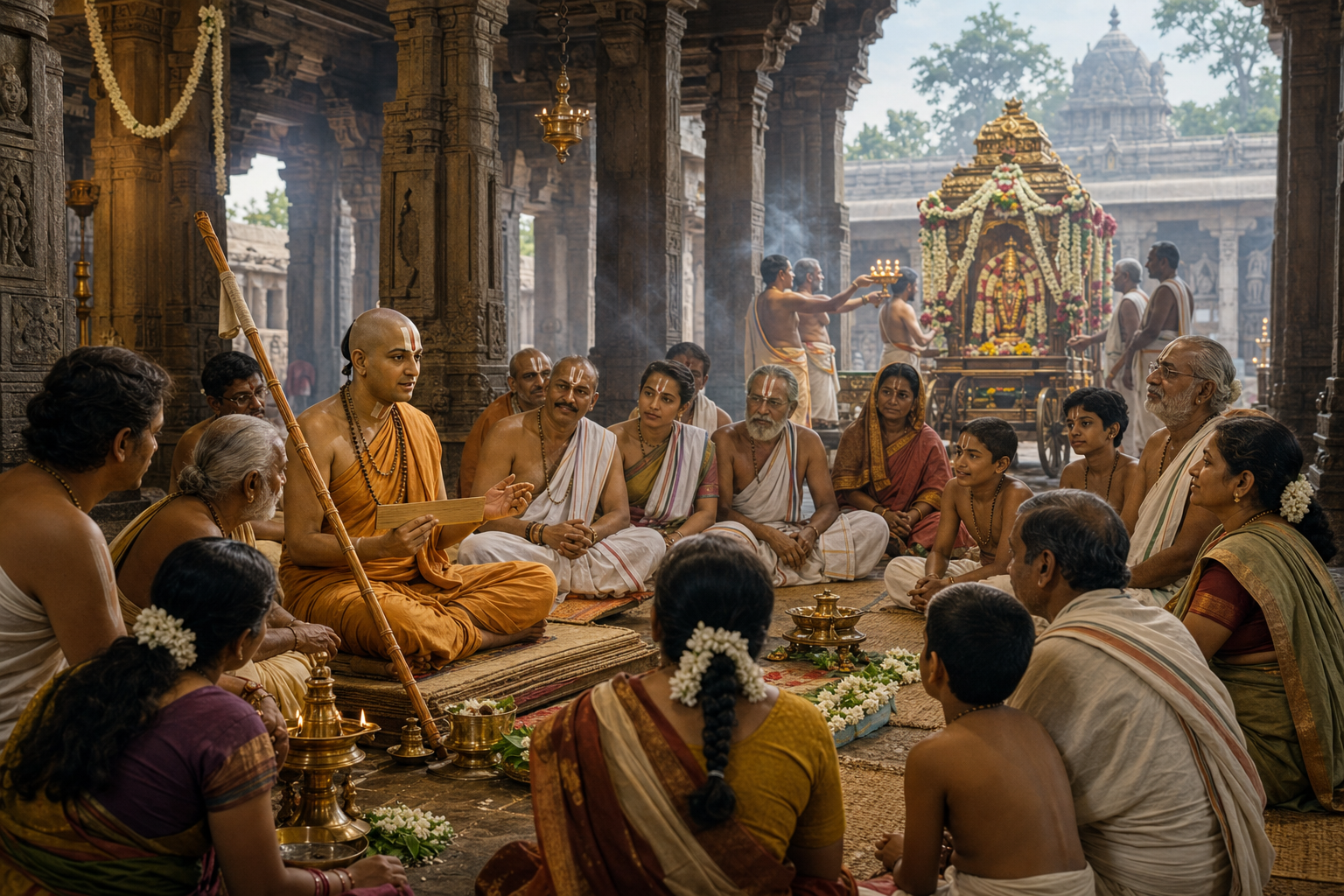
Sribhashyakara Utsavams commenced on April 13 in honour of Sri Ramanujacharya, remembered as Sribhashyakara through his authorship of the Sri-Bhashya. The multi-day observance brought together Veda parayanam, recitation of the Nalayira Divya Prabandham, meditation upon the acharya, and processional honours to his icon.
The central ideas are easier to recognise when you name them before attending. Prapatti is surrender to the Divine rather than reliance on spiritual self-sufficiency. Acharya-sambandham is the living relationship through which teaching, discipline, and sampradaya are transmitted. Vishishtadvaita gives the philosophical framework, but the utsavam shows how that framework becomes recitation, reverence, service, and ordered temple life.
This makes the observance especially suitable for a family that wants more than a brief festival darshan. Children do not need a compressed lecture on the entire philosophy. They need a few anchors that help them notice what is happening and ask an intelligent question.
- Before the visit: explain why Ramanujacharya is called Sribhashyakara and introduce the meanings of prapatti and acharya-sambandham.
- During the observance: listen for the alternation between Vedic and Divya Prabandham recitation, and notice how the acharya receives honour within temple worship.
- After the visit: ask each family member to name one teaching, recitation, or act of discipline worth carrying into household life.
Because April 13 marked the commencement rather than the entire programme, do not assume that every procession or recitation occurred on the opening day. Match your travel dates to the final daily schedule. If your purpose is sustained listening rather than simply witnessing the inauguration, a later session within the utsavam may suit you better, subject to TTD’s confirmed programme.
The observance also corrects a common separation in modern religious life. Philosophy is not confined to a book, and ritual is not empty repetition. At Tirumala, the remembered acharya connects doctrine to liturgy and inherited knowledge to the conduct of a living community.
April 20 united dana, avatara memory, rishi tradition, and guruvandana
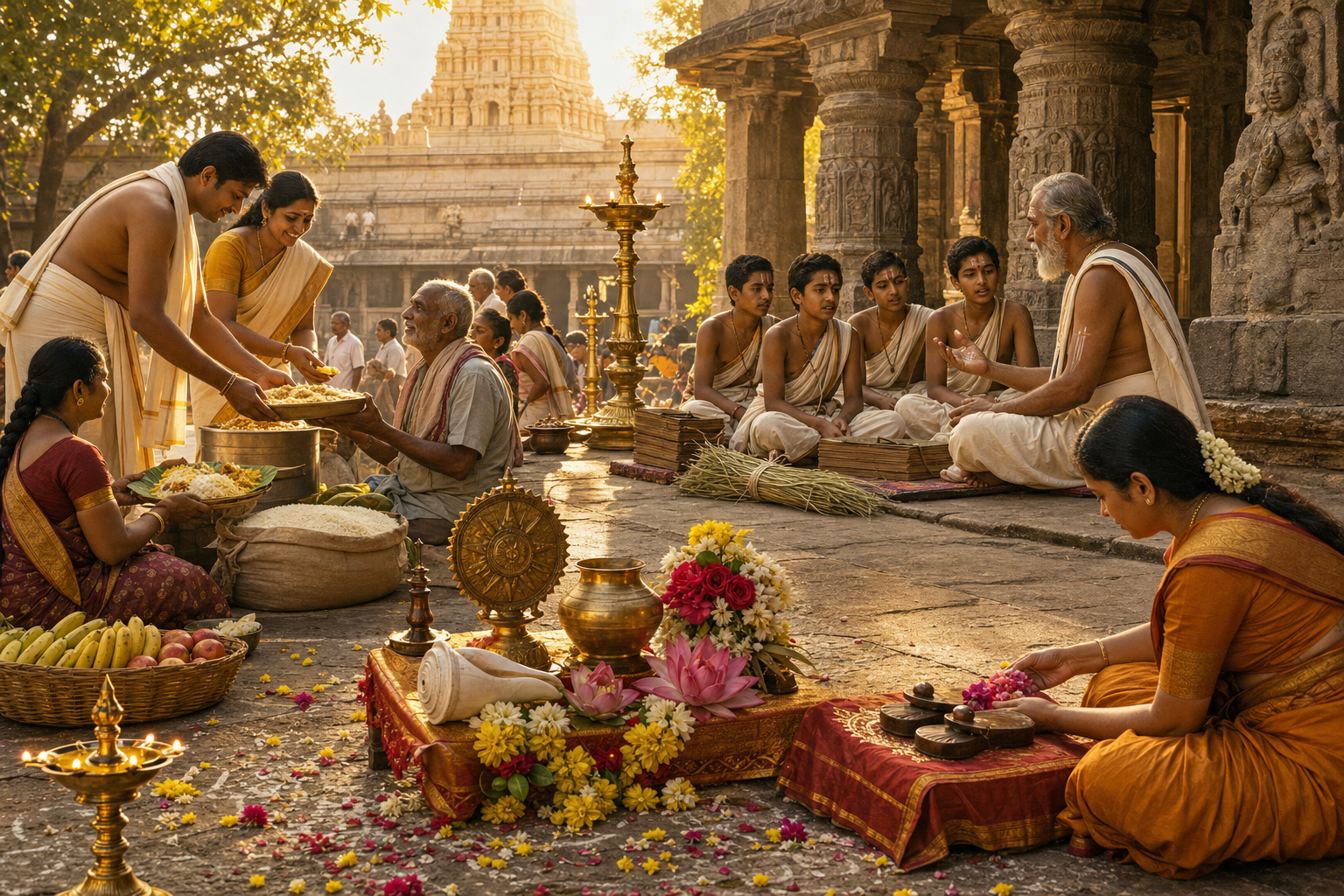
April 20 carried four observances: Akshaya Tritiya, Parashurama Jayanti, Bhrigu Maharshi Varsha Thiru Nakshatram, and Srinivasa Dikshitulu Varsha Thiru Nakshatram. Trying to give each item equal attention could leave the day fragmented. A better approach was to understand the four layers and then choose one concrete discipline around which the others could gather.
Akshaya Tritiya and Parashurama Jayanti
Akshaya Tritiya fell on Vaishakha Shukla Tritiya. Akshaya means inexhaustible or undiminishing, so the day naturally directed attention towards acts whose value should not end with the ritual date: dana, the beginning of a dharmic discipline, and a renewed commitment to svadhyaya.
Parashurama Jayanti on the same tithi honoured Parashurama, the sixth avatara of Vishnu. The corresponding disciplines of restraint, truthfulness, and service keep the commemoration from becoming merely nominal. A simple meal, japamala practice, and well-directed giving offered a practical household form of observance without requiring a display of austerity.
- Set one sankalpa that you can state plainly, such as beginning a regular period of japa or scriptural reading.
- Arrange dana before the day becomes crowded with errands. Annadanam or another form of need-based charity keeps the recipient’s real need at the centre.
- Reserve an undisturbed period for japamala recitation and svadhyaya rather than leaving both to whatever time remains.
- Choose simplicity in food and conduct. Do not confuse severity with sincerity.
The important test comes after the observance. If the sankalpa disappears when the tithi ends, the language of akshaya has remained ceremonial. Choose a practice small enough to sustain and meaningful enough to shape ordinary household conduct.
The two Varsha Thiru Nakshatram remembrances
Bhrigu Maharshi’s annual star-day remembrance directed attention to the rishi-parampara. Rishi-tarpana, mantra recitation, and scriptural study expressed gratitude for revealed and transmitted wisdom. The practical lesson is not that textual learning competes with devotion, but that disciplined study can deepen the intelligence of worship.
Srinivasa Dikshitulu’s Varsha Thiru Nakshatram honoured a revered acharya of the Tirumala tradition and, through him, the service of learned archaka-scholars. Guruvandana here becomes gratitude for knowledge stewardship: sacred learning survives because people memorise, teach, interpret, and preserve the discipline of worship across generations.
The fourfold calendar therefore moved through a coherent chain: Vishnu’s avatara, the Vedic rishi, the learned acharya, and the householder’s own dana and sadhana. You did not need to perform four disconnected observances. You needed to recognise how divine remembrance and human transmission meet in disciplined action.
Build the pilgrimage around your purpose, not just a ticket
The most useful planning decision comes before booking: decide what you want to participate in. A standard darshan visit, an utsavam-centred visit, and a forest-theertha pilgrimage have overlapping geography but different requirements.
- Name the priority. Choose temple liturgy on April 1, Tumburu Theertha Mukkoti, acharya-centred recitation from April 13, or the cluster of April 20 observances. This keeps one delayed activity from consuming the purpose of the entire journey.
- Verify three separate items. Check your darshan arrangement, the day’s festival or seva programme, and any forest-access advisory independently. A date on the religious calendar does not answer every operational question.
- Use authorised TTD channels. Special Entry Darshan required advance planning on high-demand dates. Sarva Darshan generally remained available through regulated queues, but availability did not remove the need for time and patience.
- Build in queue and security time. Early-morning arrival often offered a better balance between crowd intensity and devotional quiet. Do not schedule a tightly timed onward commitment immediately after darshan.
- Prepare for the activity you actually chose. Temple attendance called for modest traditional attire, government-issued identification, respect for designated lines, and restraint in mobile-phone use. The theertha route added footwear, water, first aid, and environmental obligations.
- Plan for companions. An elderly relative, a child, or anyone uncomfortable on uneven terrain changes what is reasonable. Agree on meeting points and priorities before entering a queue or beginning a forest route.
If you cannot be on the hill
Physical attendance is not the only way to let the calendar shape practice. The April 1 theme can become japa and reflection on renewal; the Sribhashyakara period can become a family reading or discussion on prapatti and the role of the acharya; and Akshaya Tritiya can become planned dana, svadhyaya, and a sustainable household sankalpa. Keep the home observance proportionate and clear rather than trying to reproduce temple rites without the corresponding liturgical setting.
Key takeaways
- April 1 combined the conclusion of Srivari Vasanthotsavams with Tumburu Theertha Mukkoti, but temple worship and the forest pilgrimage required separate logistical planning.
- April 13 began the multi-day Sribhashyakara Utsavams, centred on Ramanujacharya, prapatti, acharya-sambandham, and Veda-Prabandham recitation.
- April 20 brought Akshaya Tritiya, Parashurama Jayanti, and two Varsha Thiru Nakshatrams together; one deliberate act of dana, japa, or svadhyaya could provide the day’s practical centre.
- For any later festival cycle, verify the civil date, tithi or nakshatra, final TTD programme, darshan arrangement, and forest advisory instead of copying the April 2026 calendar.
For your next Tirumala pilgrimage, start with one sentence: name the observance you are going for and the practice you want to bring home. Then confirm the current TTD timing and access details around that purpose. A festival visit becomes spiritually useful when the hill’s ritual rhythm continues as steadier conduct after you leave.