
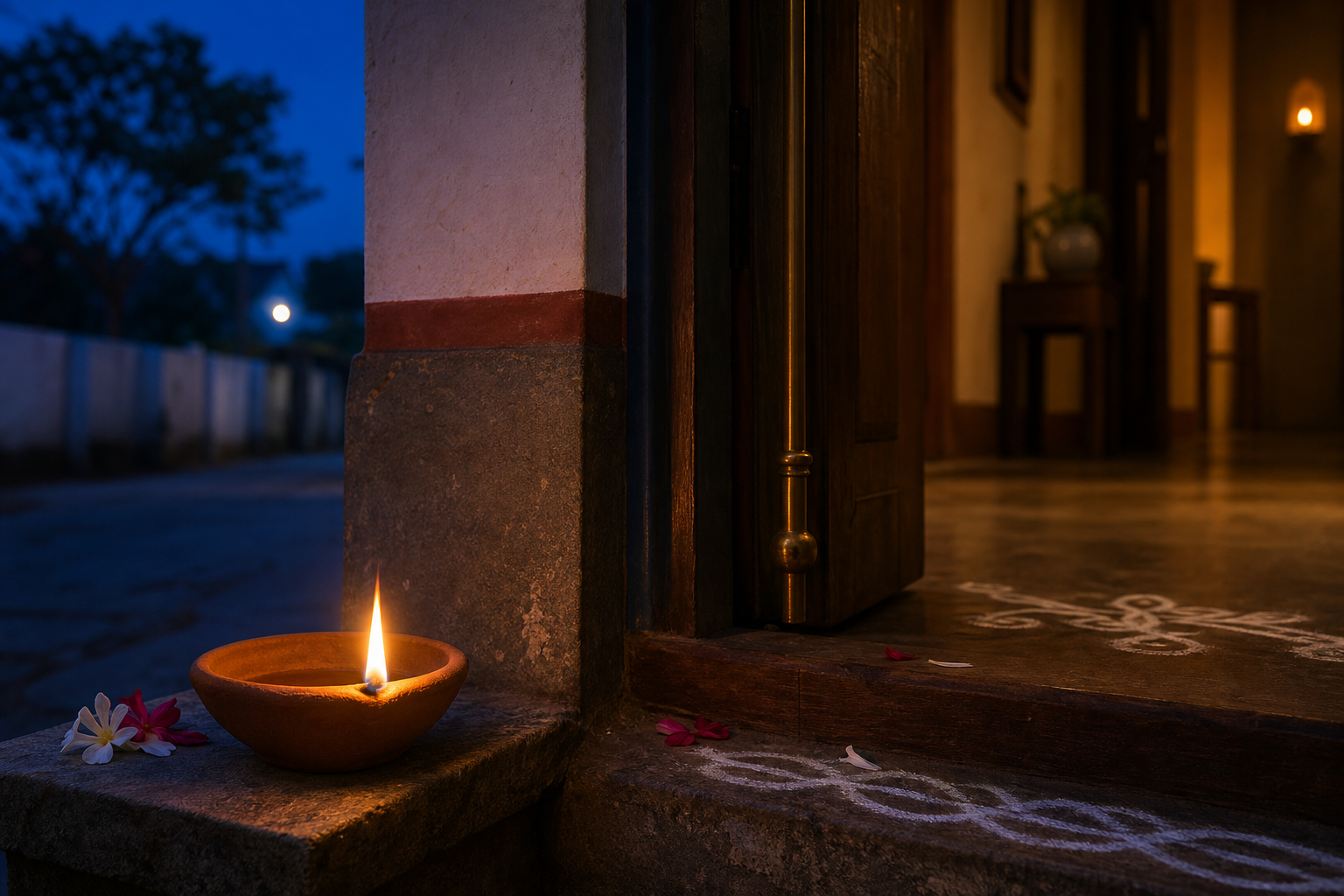
You may have inherited the practice of lighting a diya near the front door without being told why. Or perhaps you want to begin the practice and are wondering whether the oil, direction, time, and placement must all be exactly right.
Begin with the doorway itself. A lamp in the puja space supports inward worship; a lamp at the threshold carries that cultivated clarity into relationship. Its position teaches the central lesson: what is illumined within the home should also brighten the path beyond it.
The doorway makes the lamp a moral symbol
Light commonly represents jnana: knowledge that dispels confusion and permits discernment. The Upanishadic prayer tamaso ma jyotir gamaya, “lead me from darkness to light,” describes more than acquiring information. It points toward an inward movement from obscurity to clear seeing.
The threshold adds a second layer. It is a sandhi, a junction that is neither wholly inside nor wholly outside. You cross it when private life becomes public conduct: when you meet a guest, answer a neighbor, leave for work, welcome a relative, or return carrying the tensions of the wider world. Placing the lamp there makes each crossing an occasion for attention.
This is especially meaningful within grihastha dharma. A householder protects the integrity of the home, but does not treat the home as a sealed refuge from society. The doorway is where affection for one’s own family must widen into hospitality, fair dealing, restraint, and concern for others. The flame shines toward both domains without erasing the boundary between them.
Agni supplies a related moral vocabulary. Agni serves as witness, or agnisakshi, in marriage and solemn vows. A small household lamp is not the same as a consecrated ritual fire, but it recalls the same demand for truthfulness. At the doorway, the light witnesses the difference between values honored in worship and values actually carried into speech and action.
Key takeaways
- The threshold matters because it joins private devotion to public responsibility.
- The inward-facing light signifies clarity, self-restraint, and harmony within the household.
- The outward-facing light signifies welcome, guidance, service, and regard for the wider community.
- Regional details may vary, but cleanliness, steady attention, sincere intention, and physical safety preserve the practice’s core meaning.
Read the two directions of the flame
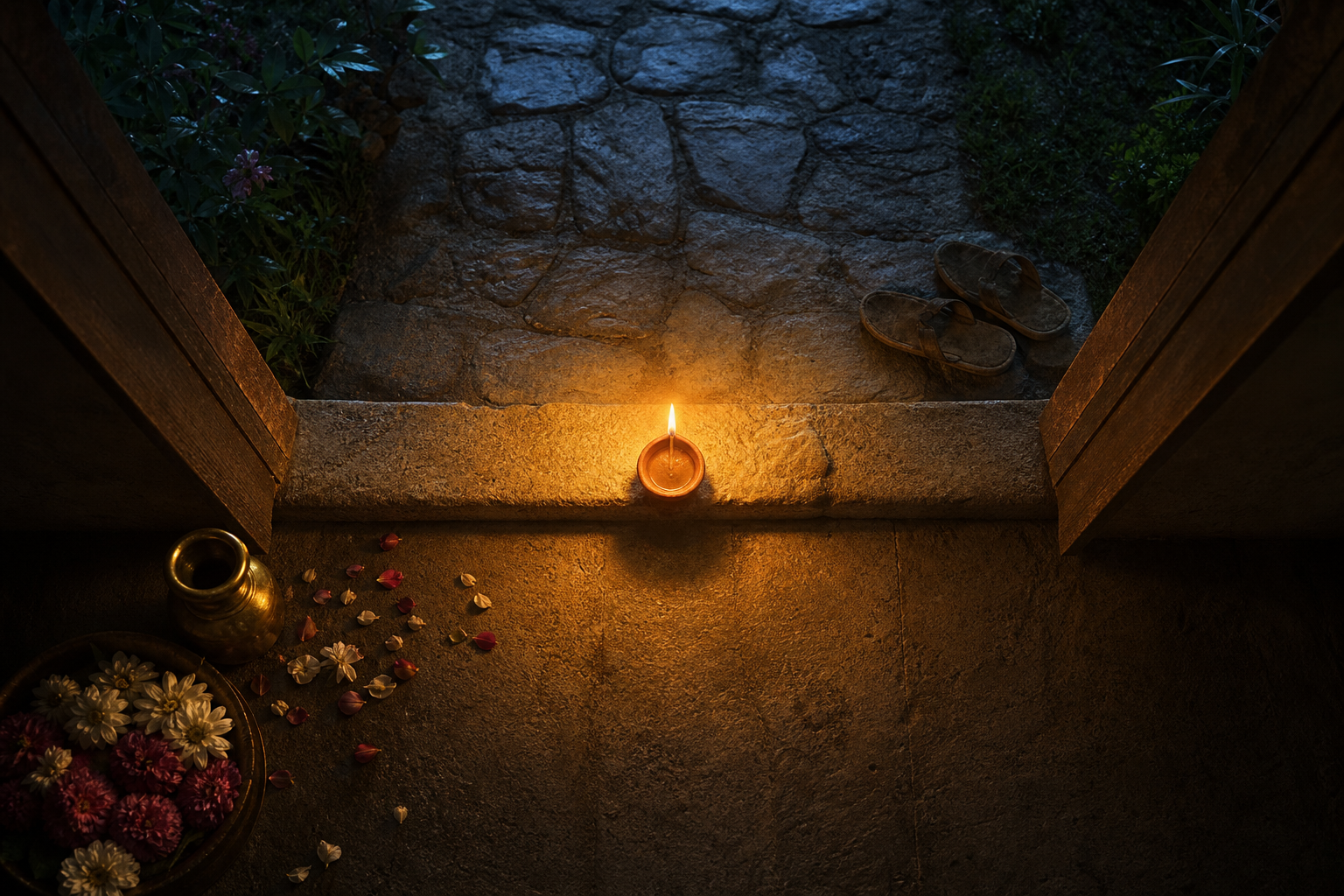
When the light falls inward, let it remind you that household harmony begins with discernment. A devotional act cannot compensate for cutting speech, dishonesty, habitual anger, or neglect. The useful question is not merely, “Did we light the lamp?” It is, “What in this home are we trying to see more clearly?”
When the light falls outward, it turns knowledge into obligation. The Bhagavad Gita’s idea of loka-sangraha concerns action that helps sustain and steady the world. At household scale, that can be modest: greeting a guest without irritation, checking on an elderly neighbor, keeping a shared entrance passable, offering useful counsel, or refusing to carry malicious speech from one home to another.
The practical and spiritual functions once reinforced each other very directly. A lit entrance could guide workers returning after dusk, signal welcome, and make a shared path feel attended. Modern streetlights and apartment corridors may perform much of the physical work now, but they do not replace the ethical question: does your presence make the space around you more trustworthy?
Hospitality here should not be confused with having no boundaries. A threshold is a meeting point precisely because an inside and an outside both exist. Dharmic welcome can be generous while the household remains prudent about privacy, safety, and whom it admits. The lamp expresses goodwill; it does not require indiscriminate access to the home.
The same movement from inward realization to outward responsibility appears across the wider Dharmic family. Buddhist language speaks of dwelling as a lamp unto oneself; Jain Dipavali honors the continuing radiance of Mahavira’s jnana; and Sikh observance around Bandi Chhor Divas connects illumination with release, seva, and social freedom. These are not interchangeable theologies. Their parallel imagery does, however, help you notice a shared civilizational intuition: light becomes complete when insight takes compassionate form.
Keep regional custom distinct from universal meaning
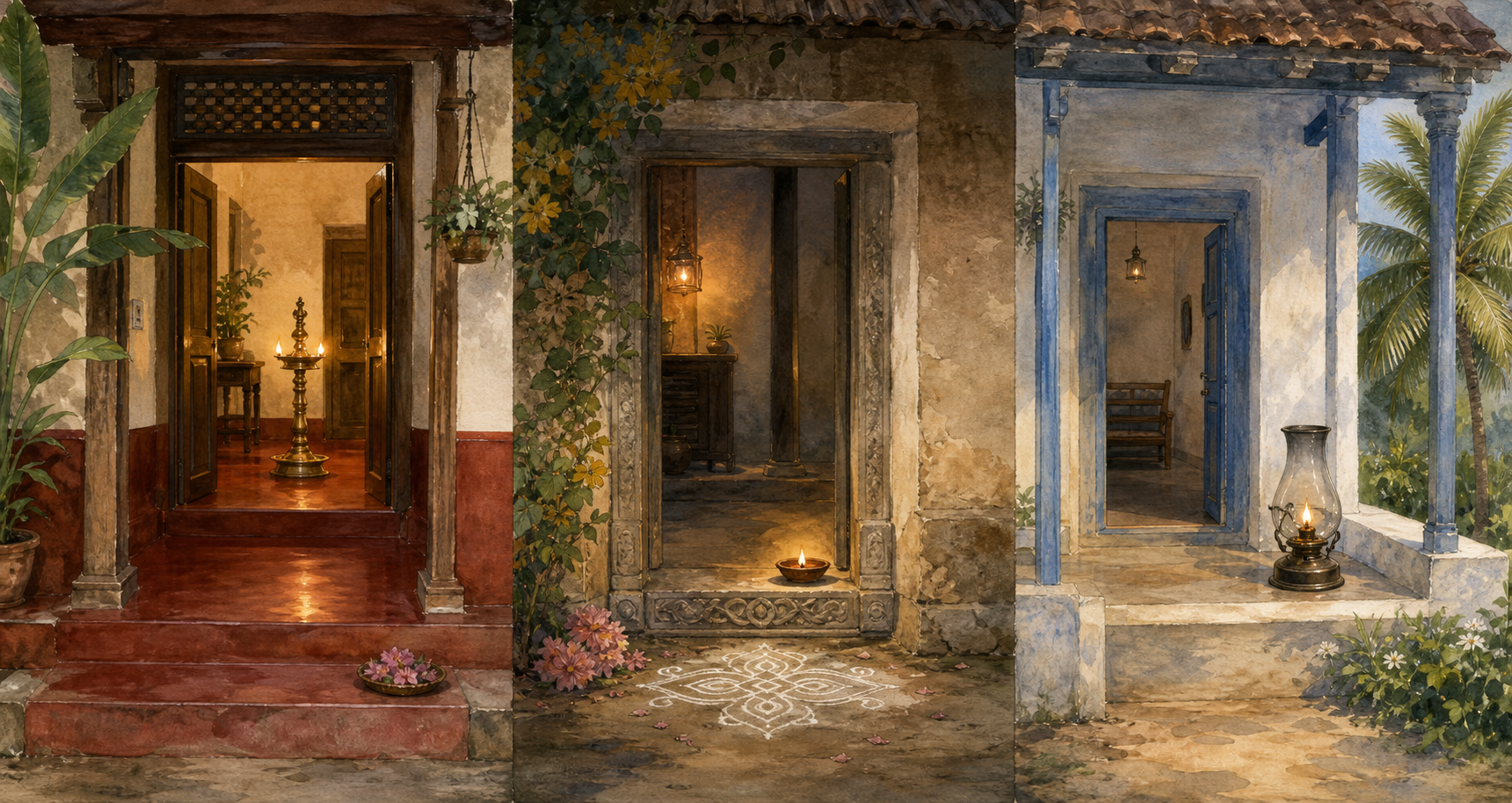
There is no need to flatten India’s household traditions into one supposedly universal procedure. In parts of North India, you may see a small clay diya at dusk. Across the South, an agal vilakku or deepam may stand at the threshold or along a veranda. Coastal, hill, urban, and village households adapt placement to climate, architecture, inherited practice, and the kind of lamp available.
Festival context also changes the immediate emphasis. During Diwali, illuminated entrances participate in a neighborhood-wide celebration of auspiciousness and the triumph of light over darkness. Yam Deep Daan places a doorway lamp within a prayer for family well-being and longevity. During Karthika masam and Karthigai Deepam, lamps at thresholds and courtyards sustain remembrance of divine and inner light beyond a single evening. The vocabulary and observance differ while the inward-and-outward structure remains recognizable.
That distinction helps when advice from relatives, videos, and regional calendars appears contradictory. Ask first whether a detail belongs to your family’s sampradaya, a local festival observance, a vastu preference, or basic fire safety. Do not turn a regional custom into a test of every Hindu household’s correctness.
Some traditions orient a doorway lamp toward the east or north, directions commonly treated as auspicious. That can be a meaningful choice where the architecture permits it, but a lamp should not be balanced precariously or obstruct a walkway for the sake of direction. Your inherited practice deserves priority over a generic online rule, and safe placement deserves priority over both.
Vastu contributes a sound practical principle even when households interpret its directional details differently: keep the entrance clean, unobstructed, and gently illuminated. Rangoli or kolam may frame the lamp and mark the area as cared for. The point is not to treat the doorway as a mechanical switch for prosperity. It is to shape the first and last space you cross each day so that it communicates order, welcome, and attentiveness.
Light a threshold lamp without empty ritualism
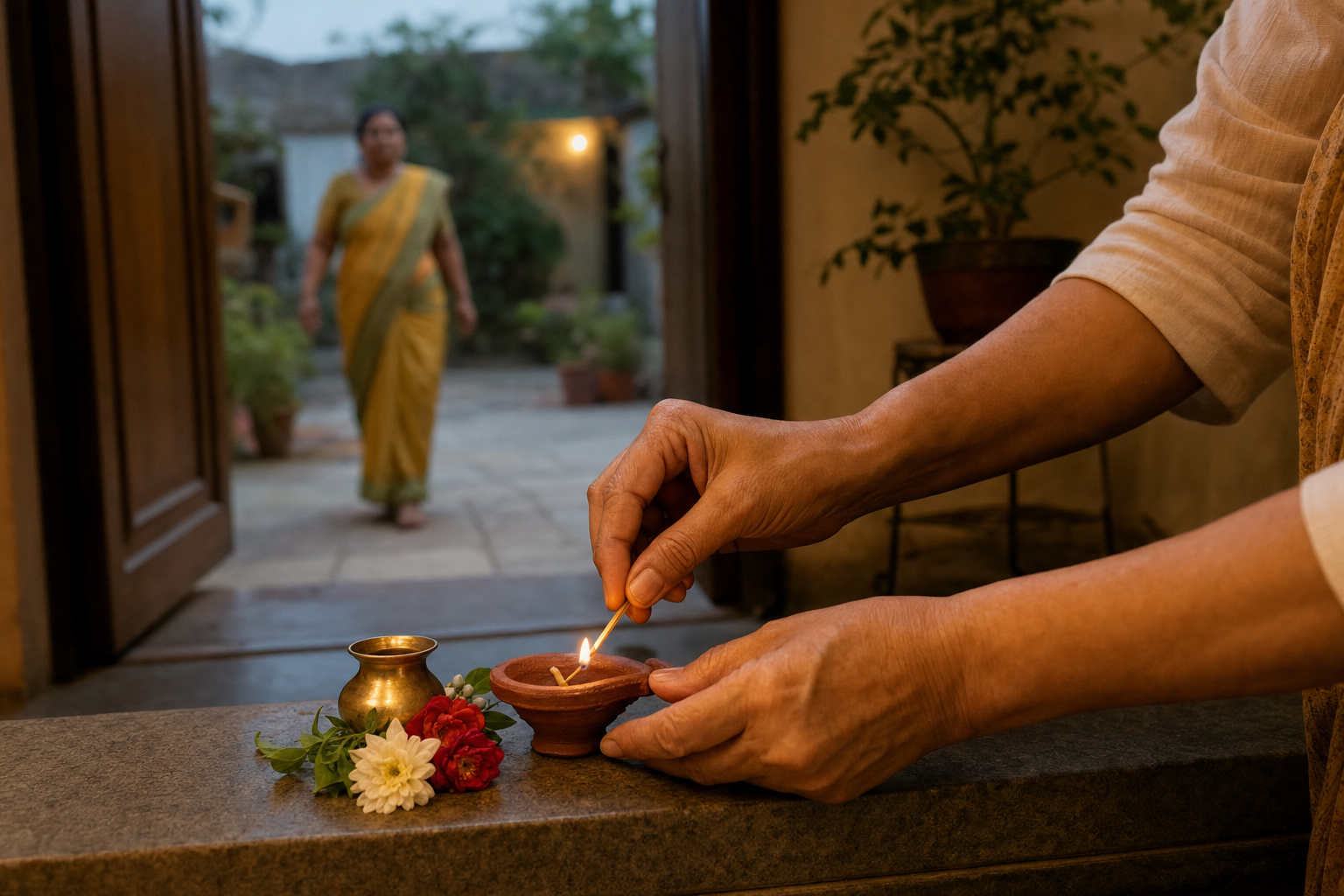
You do not need to manufacture an elaborate ceremony. If your family has a prescribed method, follow it. If you are establishing a simple household practice, the following sequence keeps the symbol, local flexibility, and safety together.
- Choose a clear intention. Before preparing the lamp, name one quality you want to carry across the doorway: clear thought, measured speech, hospitality, courage, or service. A short sankalpa such as “May our understanding become beneficial action” is enough.
- Clean the place. Clear dust, footwear, paper, dried leaves, loose fabric, and other clutter from the immediate area. Select a level surface outside the line of foot traffic. Cleanliness is part of the offering and prevents the symbol of care from becoming a hazard.
- Use a stable lamp and familiar fuel. A clay or metal lamp with a cotton wick is customary. Ghee and sesame oil are both widely used; some traditions associate ghee with sattvic clarity, while regional practice often values sesame oil for a steady flame. Follow household custom rather than declaring one fuel spiritually mandatory. Place the lamp on a stable, non-flammable base.
- Choose a suitable time and position. Dusk naturally expresses the movement from darkness into light. Place the lamp where it can illuminate the entrance and be noticed from both sides, without sitting where someone can kick it, step over it, or catch clothing on it. Shield it from drafts without enclosing it in a way that traps dangerous heat.
- Light it attentively. Pause for the sankalpa instead of treating ignition as the whole rite. Keep children and animals away, maintain distance from curtains and decorations, and never leave an open flame unattended. If an open flame is unsafe or prohibited where you live, a protected or electric light can preserve the practical reminder, although it is not identical to an oil-lamp offering.
- Let the next action complete the ritual. Offer a greeting, speak more carefully, clear a shared path, contact someone who needs help, or correct one unresolved matter inside the home. The symbolic act becomes household dharma when it alters what you do next.
Rangoli, kolam, flowers, and a nearby Tulasi plant can deepen the sense of an auspicious, tended entrance. During Karthika observances, lighting near Tulasi brings reverence for plant life into the practice. Keep every decorative element safely beyond the flame and do not let ornament crowd the path.
Formal trataka, or steady gazing at a flame, is a separate yogic discipline. You do not need to perform it at a busy doorway. A few quiet breaths and a moment of recollection are sufficient. The aim here is to steady intention at the moment of crossing, not to turn an entrance into an unsuitable meditation space.
Use the doorway as a daily test of conduct
A lamp can become empty ritual in two opposite ways. One is to treat it as decoration with no claim on conduct. The other is to treat it as a transaction that guarantees wealth, safety, or spiritual merit regardless of how the household behaves. Neither reading asks enough of the symbol.
When you leave, use the threshold to ask: what am I carrying from this home into the world? The answer may be patience during a difficult meeting, accuracy in work, protection of someone being mistreated, or a refusal to forward an inflammatory claim you have not checked. That is the outward ray of the lamp.
When you return, ask a different question: what should stop at the doorway? You may need to leave behind workplace resentment, the impulse to speak harshly, or the agitation accumulated through constant online argument. This does not mean denying a real problem. It means deciding consciously how to bring it into the home without making everyone else absorb it.
Then look once more beyond the doorway. Is there an obligation outside that private spirituality has allowed you to ignore? A neighbor may need practical help. A younger person may need reliable mentorship. A community discussion may need evidence and restraint rather than another slogan. Contemporary civic and digital spaces are thresholds too: they are places where inner discipline becomes visible to people who may never enter your home.
Do not use the practice to measure another family’s piety. An unlit doorway may reflect apartment rules, disability, travel, finances, children, animals, or a different custom. The proper object of scrutiny is your own crossing: whether the light you honor privately is becoming clarity, hospitality, restraint, and service in the world you share.
Tonight, choose one safe place at the entrance and one quality you want to carry through it. Light the lamp if circumstances permit, name that quality, and complete one action that gives it visible form. The doorway will then become what the symbol asks it to be: a meeting place between inner illumination and lived dharma.