
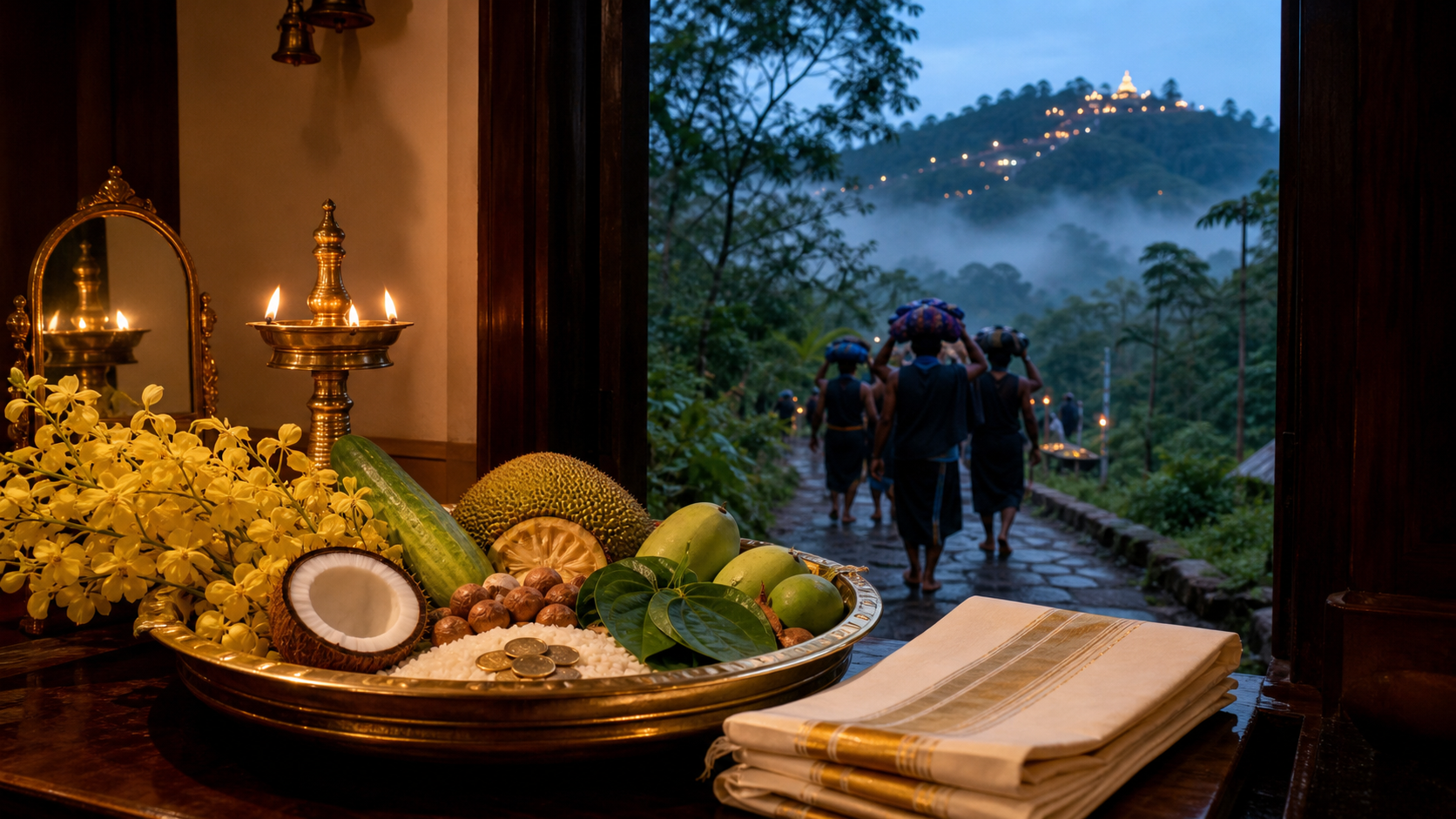
To plan Vishu 2026 well, you need to keep two kinds of sacred time separate. Vishu follows the solar transition into Mesha, while vrata, parana, and Pradosh decisions follow the lunar tithi. Mixing those clocks is what creates most of the confusion around April 14.
If you intend to seek Vishukkani at Sabarimala, there is a second distinction to make: the expected ritual window is not the same as your reporting time. Your journey through Nilakkal, Pamba, the forest ascent, and the queue must be planned backward from the darshan window.
Key takeaways for Vishu 2026
- Vishu falls on Tuesday, April 14, 2026, corresponding to Medam 1 in the Malayalam calendar.
- Sabarimala Vishu Kani Darshanam is expected during a pre-dawn window of approximately 4:00-6:00 a.m. IST. Treat this as provisional until the Travancore Devaswom Board publishes its final ritual and crowd-management schedule.
- Krishna Paksha Dwadashi prevails through most of April 14 in much of India, ending at about 9:05 p.m. IST, when Trayodashi begins.
- If you observed an Ekadashi fast, perform parana after local sunrise while Dwadashi prevails, following the rules of your sampradaya. The late tithi transition leaves a broad daytime opportunity, but your local panchang still governs the precise window.
- For Sabarimala, plan the complete sequence: parking at Nilakkal, regulated transport to Pamba, the 5-km ascent to Sannidhanam, any Virtual-Q requirement, and the festival queue.
- If you are observing at home, arrange the Vishukkani before sleeping on April 13 so it can genuinely be the household’s first auspicious sight on Vishu morning.
Use the solar date for Vishu and the tithi for vows
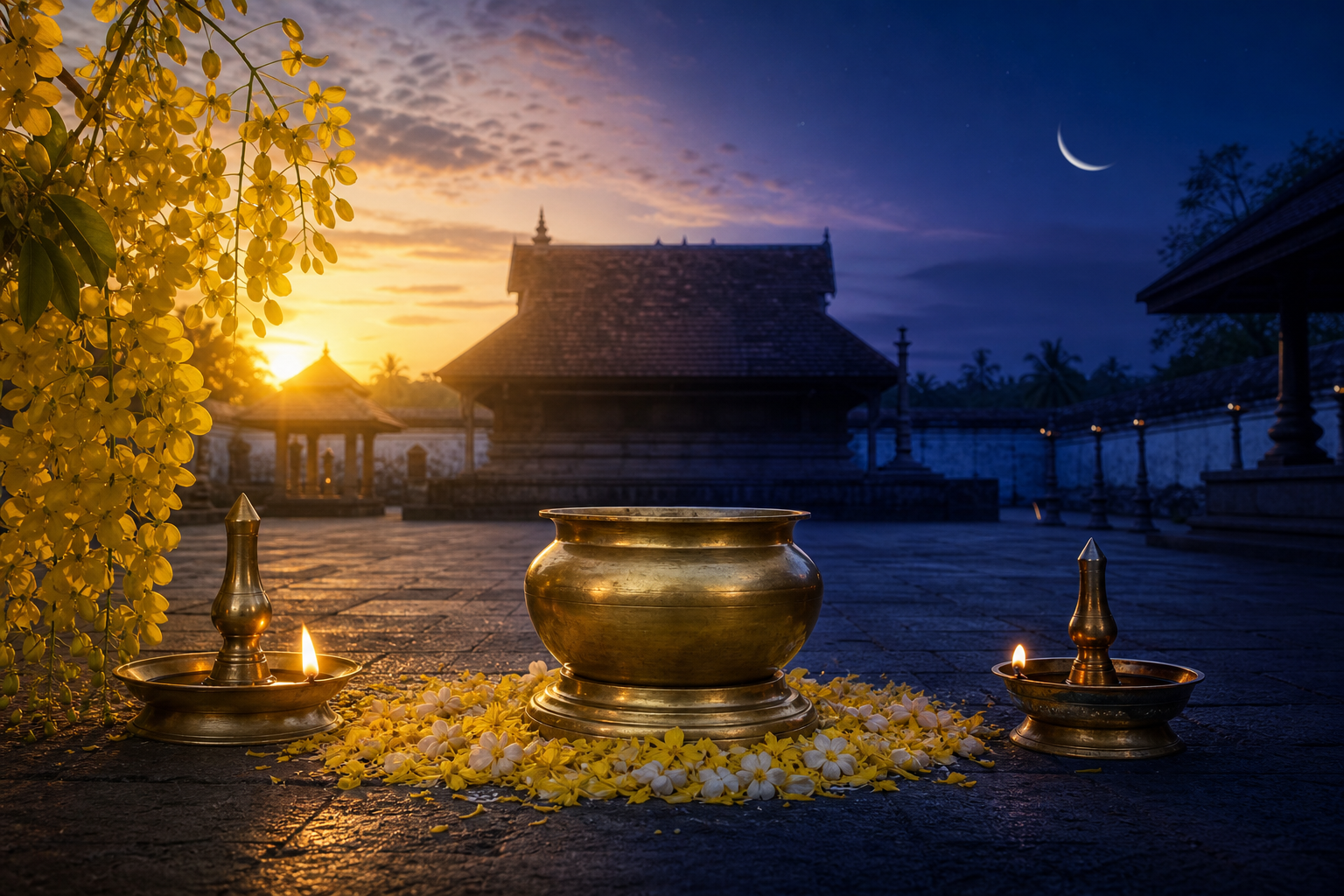
Vishu marks Mesha Sankramana, the Sun’s ingress into sidereal Aries. That solar marker establishes the year-opening observance. Dwadashi and Trayodashi, by contrast, are lunar days calculated from the angular relationship between the Sun and Moon. Vishu does not become a Trayodashi festival merely because Trayodashi begins later that night, and Dwadashi does not postpone the Vishukkani.
This distinction gives you a simple working rule: use the Vishu date and temple schedule for Kani Darshanam, but use the operative tithi for Ekadashi parana, Pradosh, and any tithi-specific sankalpa.
| Time or phase | Panchang or observance | What you should do |
|---|---|---|
| Evening of April 13 | Preparation for the first sight | Arrange the home Vishukkani, or position yourself for the Sabarimala journey according to the final reporting and queue instructions. |
| Approximately 4:00-6:00 a.m. IST on April 14 | Expected Sabarimala Vishu Kani Darshanam window | Use the final temple notification rather than treating this provisional window as a guaranteed appointment. |
| After local sunrise on April 14 | Krishna Paksha Dwadashi | If you observed Ekadashi, complete parana within the valid Dwadashi period and according to your lineage’s rules. |
| Daytime on April 14 | Vishu worship, kaineettam, sadya, and ordinary responsibilities | Use a location-specific panchang only if you need to time a separate new undertaking. |
| About 9:05 p.m. IST in much of India | Dwadashi ends and Trayodashi begins | Do not automatically assign Pradosh to this evening; verify which civil date has Trayodashi during local sunset. |
If you observed Ekadashi
Dwadashi is the customary parana day after Ekadashi. The general pattern is to break the fast after sunrise while Dwadashi is still present, avoiding unsuitable periods and any prohibited part of Dwadashi specified by the tradition you follow. Because Dwadashi continues until approximately 9:05 p.m. IST in much of India, there is no need to rush parana into the pre-dawn Vishukkani period.
Do not let a generic calendar override instructions given by your guru, temple, or Vaishnava sampradaya. Different traditions can apply more specific parana rules even when they agree on the underlying tithi.
If you intend to observe Pradosh
Pradosh is determined by whether Trayodashi touches the local sunset period, not simply by the date on which Trayodashi begins. On April 14, Trayodashi starts only at night in much of India. Many almanacs will therefore place Krishna Pradosh on the following civil date, when Trayodashi actually spans the evening twilight. Check the rule against your location rather than attaching Pradosh to Vishu night by assumption.
If you are timing a separate undertaking
Rahu Kalam, Gulika Kalam, Yamaganda, and Abhijit Muhurat depend on local sunrise, sunset, and solar noon. They are not fixed clock-time labels that can be copied from another city. With a purely illustrative 6:00 a.m. sunrise and 6:00 p.m. sunset, the Tuesday divisions would place Yamaganda around 9:00-10:30 a.m., Gulika around noon-1:30 p.m., and Rahu Kalam around 3:00-4:30 p.m. local solar time. Recalculate them proportionally when daylight differs from that twelve-hour example.
Abhijit Muhurat is centered on the midpoint between local sunrise and sunset and ordinarily spans about 48 minutes, roughly 24 minutes on either side of true solar noon. It can help you time a brief, separate initiation when no other suitable muhurat is available. It should not be used to move a prescribed pre-dawn Kani observance to midday.
Nakshatra and the Moon’s rashi also change with time and location. Check the nakshatra at the actual hour of your sankalpa; a sunrise entry may not describe the sky at an evening ceremony. No responsible calculation should fill in those details merely from the civil date.
Plan backward from Sabarimala Sannidhanam
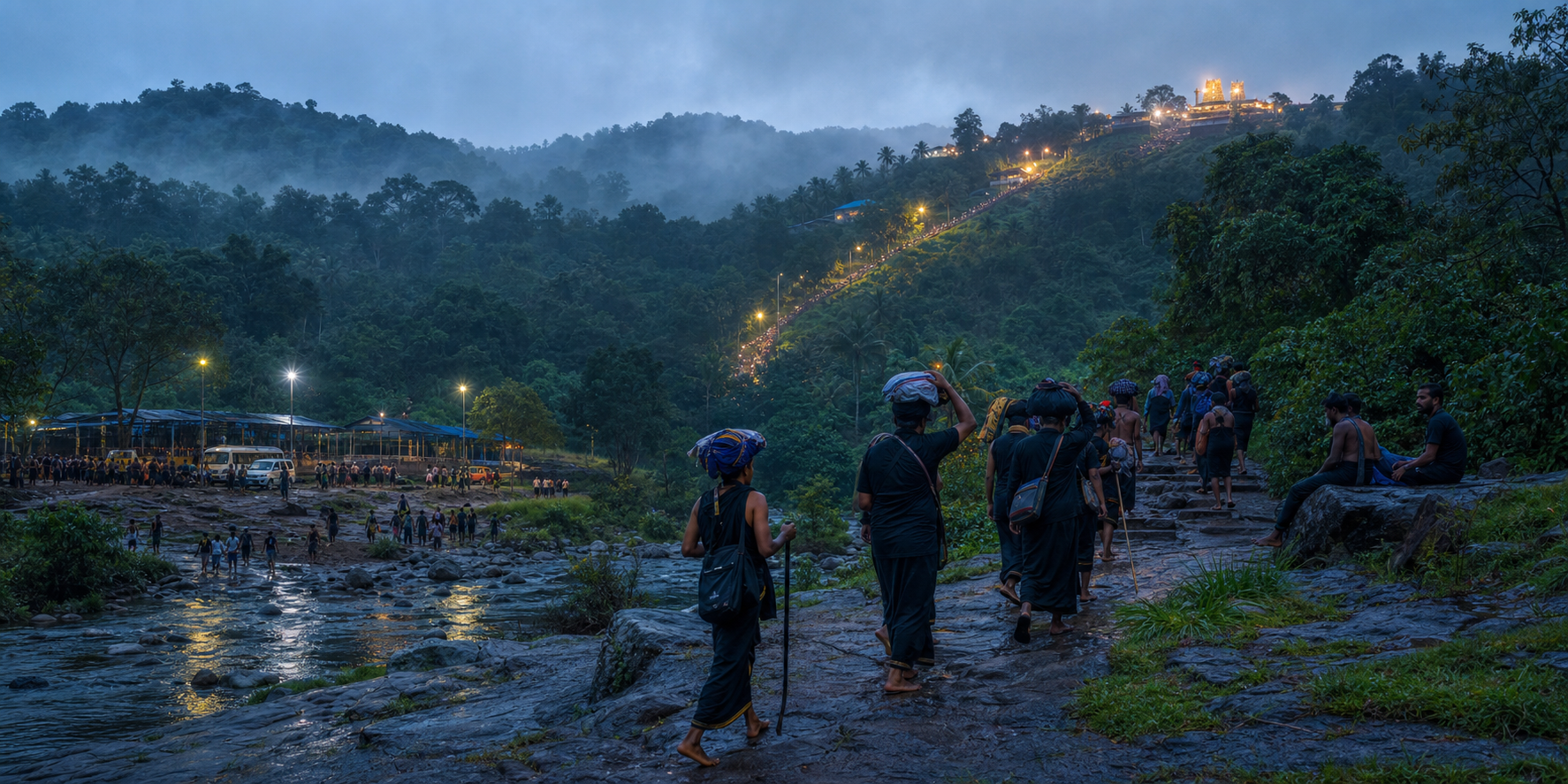
The expected 4:00-6:00 a.m. Kani period is a temple window, not the time to begin your journey from Pamba. The approach includes several controlled stages, and festival attendance can add waiting at each one. Since no reliable journey duration can be inferred without the final operating plan and crowd conditions, build your itinerary around where the authorities require you to report, not around an optimistic walking calculation.
- Confirm the final Vishu opening and Kani timings through the Travancore Devaswom Board’s current official communication. Do not rely on an old screenshot or an expected schedule detached from its date.
- Check whether Virtual-Q or another online darshan arrangement has been activated for the festival period. If registration is required, secure the appropriate slot before committing to transport or accommodation.
- Plan to reach Nilakkal as the vehicle base. Festival traffic is regulated, and private vehicle access should not be assumed beyond the designated arrangements.
- Allow for the regulated KSRTC chain service from Nilakkal to Pamba. Your arrival at Nilakkal is not your arrival at the trailhead.
- From Pamba, account for the 5-km forest ascent to Sannidhanam, entry controls, and the temple queue. A Kani priority may justify reaching the Pamba area the previous evening, provided that arrangement conforms to the final access rules.
- Confirm accommodation instead of assuming that space will remain at Nilakkal or Pamba during Vishu. Limited festival-period availability can undo an otherwise workable pre-dawn plan.
Morning worship may include Nirmalyadarshanam, Usha Pooja, and Seeveli within the temple’s ritual sequence. Neyyabhishekam and prasada such as aravana payasam or appam may also be available according to schedule and stock. If an offering matters to your vrata, check its actual operating window; do not make your entire observance depend on festival-day availability.
Pack for the ascent rather than for a ceremonial photo. Use modest, comfortable clothing appropriate to the hill route, carry minimal luggage, keep water and basic first-aid needs accessible, and comply with current security directions. Sabarimala lies within the sensitive environment of the Periyar Tiger Reserve, so plastic-free rules and waste discipline are part of responsible pilgrimage, not optional tidiness.
At Sabarimala, “first darshan” refers to the sacred opening and encounter with the Kani. It does not mean that you should close your eyes while walking, climbing, or moving through a crowded queue. Follow staff directions and keep full attention on the path until you are safely in the place appointed for darshan.
Set up the home Kani so the first sight is truly intentional
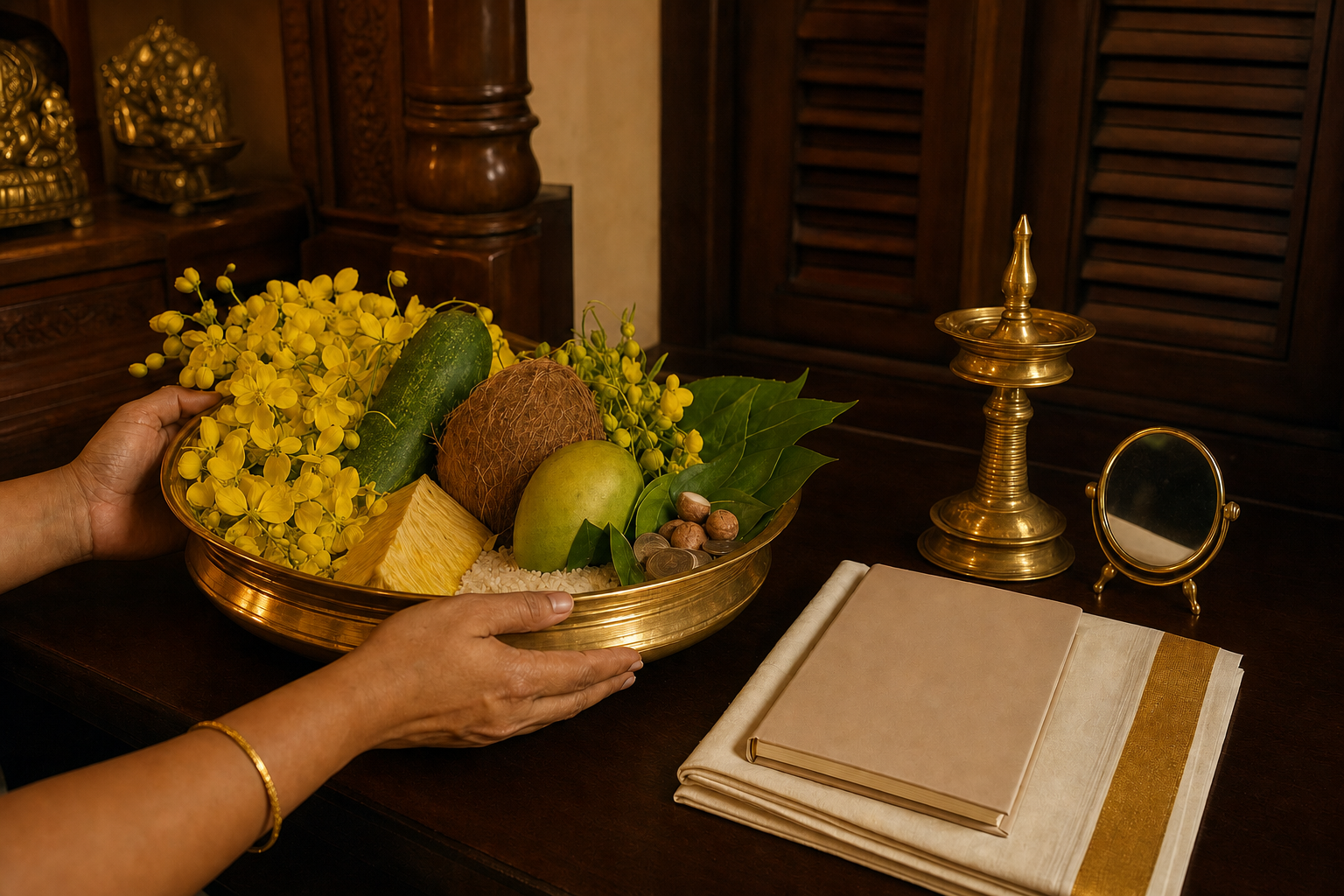
A home Vishukkani works because the household prepares order before waking into the new cycle. If you postpone the arrangement until morning, the family has already begun the day with hurried tasks, screens, and searching. Set everything in place on April 13.
- A clean brass uruli or another vessel used by your household, with rice as the foundation of the arrangement.
- Seasonal fruits and vegetables, a split coconut, and arecanuts.
- Coins or gold representing material sufficiency and the duty to use prosperity well.
- Kani konna, the golden-yellow seasonal blossom closely associated with Vishu.
- An image of the household’s chosen deity. Sri Krishna or Mahavishnu is common in Kerala homes; a family centered on Ayyappa may place Sri Dharma Shastha at the heart of the arrangement.
- A sacred text appropriate to the family’s practice.
- A polished mirror, including a val kannadi or Aranmula mirror where that is the household tradition.
- A nilavilakku placed so its light reveals the full Kani safely.
The symbols should direct conduct, not merely decorate the room. The lamp calls you toward clarity. The mirror turns the first gaze back toward honest self-examination. Grain, fruit, and coins acknowledge abundance together with responsibility. Kani konna places the household within the season rather than outside it.
- Complete the arrangement before the household sleeps on April 13.
- Keep the route to the Kani clear so children and elders can be guided without stumbling.
- Do not leave an open lamp burning unattended overnight. Light it at the appropriate time under adult supervision.
- On waking, keep your eyes gently closed and allow a family member to guide you safely to the Kani.
- Open your eyes before the illuminated arrangement and remain still long enough for the sight to register as worship rather than a photo opportunity.
- Offer prayer and form one concrete dharmic resolve for the year. A useful resolve names conduct you can repeat, such as a daily prayer, weekly seva, disciplined study, or restraint from a known harmful habit.
- Continue with Vishu kaineettam, in which elders give money to younger family members, and gather later for the Vishu sadya according to household custom.
You do not have to choose between temple reverence and domestic continuity. A family member at Sabarimala can seek the Kani of Sri Ayyappa while the household performs its own Kani at home. The two observances share the same discipline of beginning with light, order, gratitude, and responsibility.
Avoid the four planning errors that cause most confusion
- Do not call 9:05 p.m. the “Vishu time.” It is the approximate Dwadashi-to-Trayodashi transition in much of India, not the solar Sankramana time and not the Kani Darshanam window.
- Do not present 4:00-6:00 a.m. as a finally confirmed Sabarimala appointment. It is an expected pre-dawn window subject to the temple authority’s final notification, ritual sequencing, security measures, and crowd management.
- Do not copy another city’s panchang intervals for parana, Rahu Kalam, Abhijit Muhurat, nakshatra, or rashi. Use your location and the time at which the act will actually occur.
- Do not assign Pradosh merely because Trayodashi begins before midnight. The deciding question is whether Trayodashi touches the local Pradosh period around sunset.
These distinctions also help you explain Vishu to younger family members. The mid-April solar threshold resonates with Vaisakhi and with seasonal New Year observances in Sri Lanka and parts of South and Southeast Asia, but each community retains its own ritual language. Shared civilizational timing does not require us to flatten distinct traditions into one festival.
Make your final check on April 13
Before you sleep or depart, write down four verified details: the final temple opening and Kani window, the Virtual-Q or reporting requirement, your Nilakkal-Pamba-Sannidhanam route, and the local panchang entry governing any parana or separate muhurat. Then prepare the Kani or your pilgrim necessities while there is still time to correct an omission.
On Vishu morning, let the discipline continue after darshan. Give way in the queue, protect the forest path, assist those travelling with difficulty, and choose one resolve you can carry beyond Medam 1. That is how the first auspicious sight becomes a year of dharmic action rather than a moment that ends when you turn away.
References
- DharmaRenaissance Blog – April 14, 2026 Panchang: Exact Tithi Timing, Auspicious Muhurat, Nakshatra, and Rashi Guide
- DharmaRenaissance Blog – Vishu Kani Darshanam 2026 at Sabarimala: Auspicious Timings, Rituals, and Travel Insights