
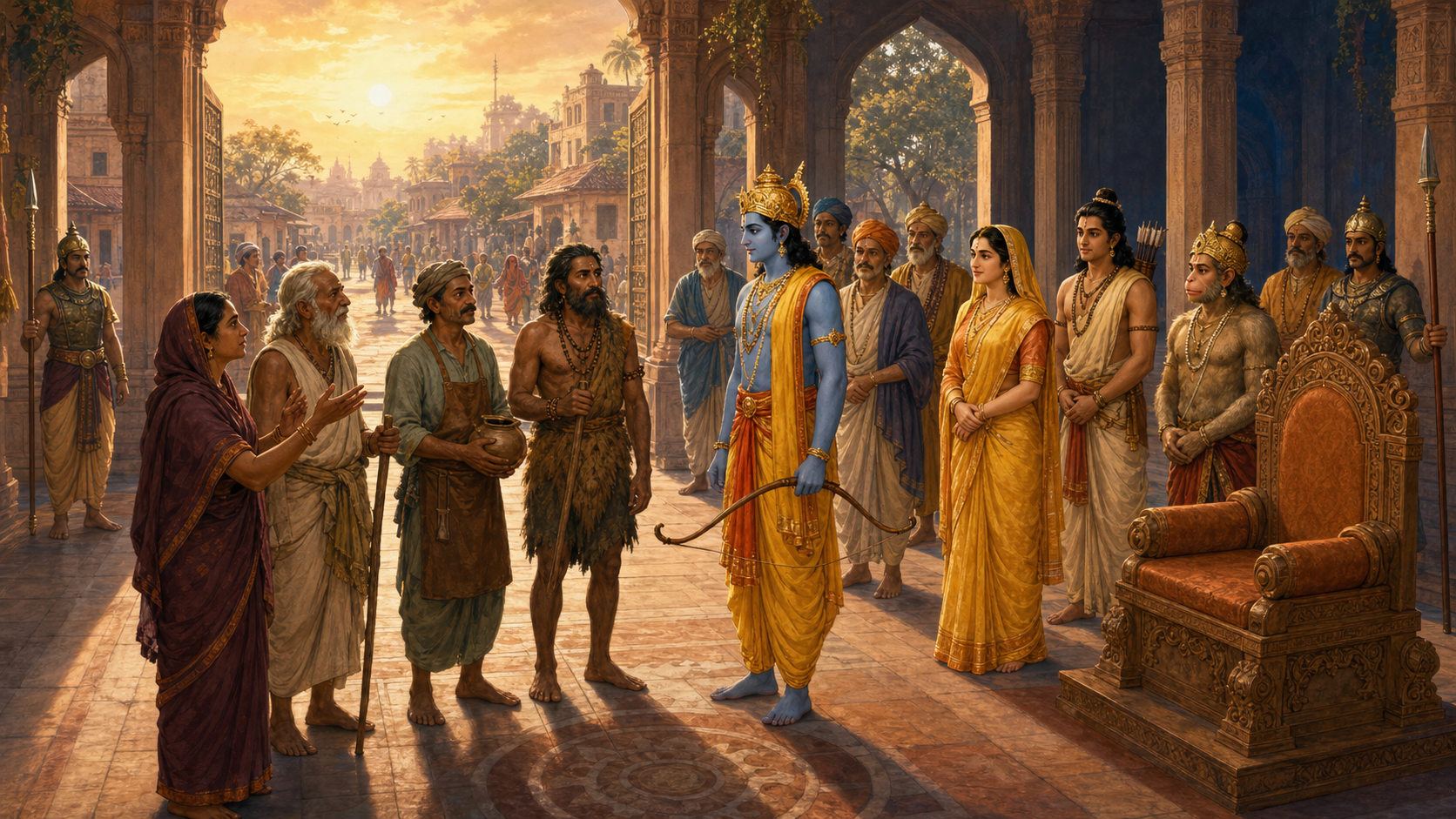
When you hear Rama Rajya invoked in a political speech, community debate, or campaign promise, do not begin by asking how reverently the speaker uses Sri Rama’s name. Ask what the proposed power will do when justice becomes inconvenient.
You can derive a demanding test from the Ramayana: legitimate power accepts binding limits, converts personal virtue into accessible institutions, organizes diverse capabilities, protects the vulnerable, and restrains force even when victory is possible. Those standards help you distinguish Rajadharma from religious branding.
The first test: does power obey limits it did not choose?
Ravana’s failure is not a lack of power. He possesses formidable power but separates it from moral restraint. His carefully framed boon protects him against devas, Gandharvas, Yakshas, and other cosmic orders while leaving humans and vanaras outside its protection. When the time comes to resist him, the devas do not simply cancel the boon. Brahma directs celestial beings to manifest allies capable of acting through the opening Ravana himself left.
That response matters politically. A righteous objective does not make every method righteous. The coalition opposing Ravana works within an existing cosmic commitment instead of discarding it when it becomes inconvenient. Dharma governs the means as well as the desired result.
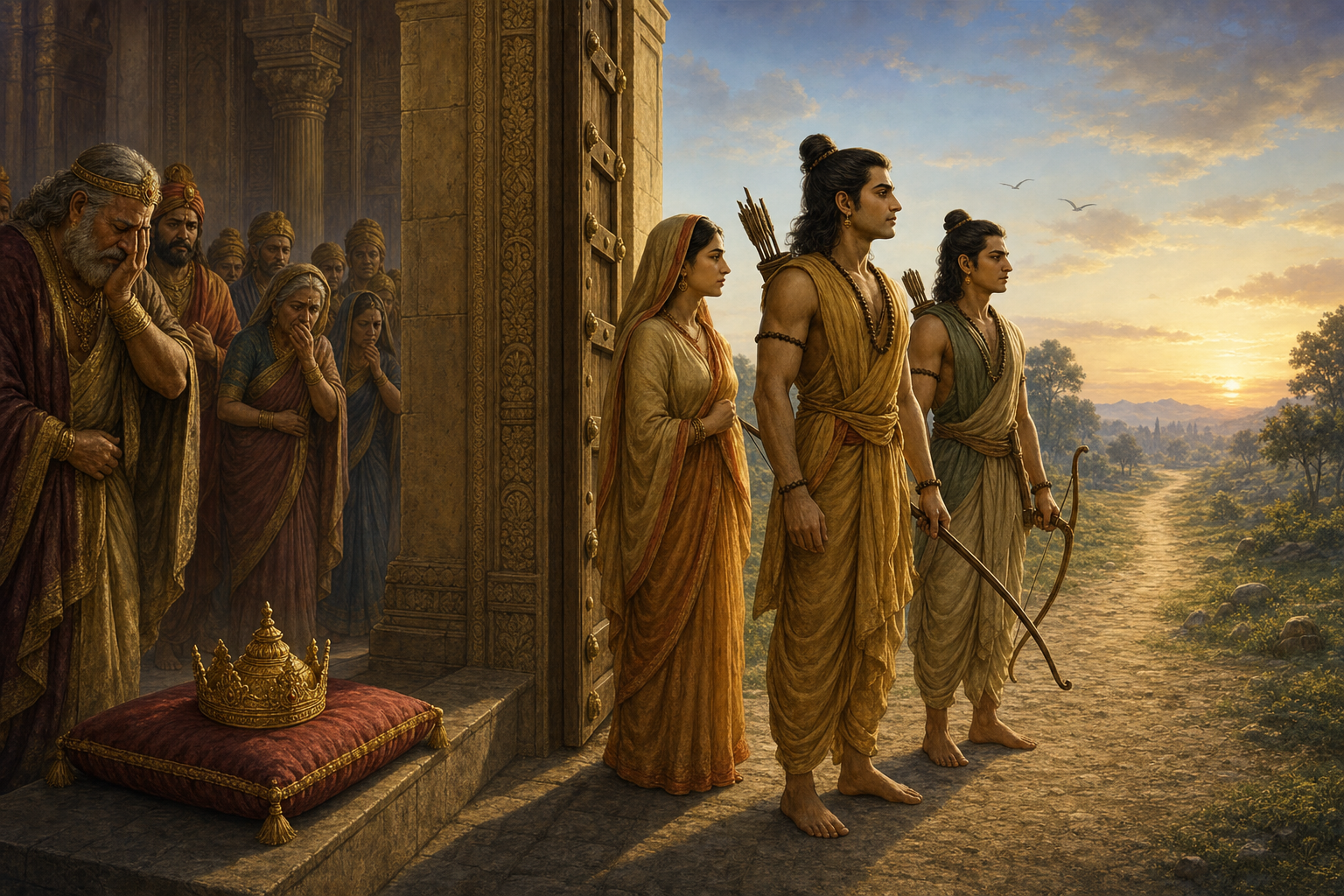
This is the meaning of maryada in public life. Sri Rama is Maryada Purushottama not because he exercises unlimited authority, but because his conduct remains bounded by truth, responsibility, promise, and role. Self-restraint is not weakness added to leadership after the important work is done. It is what separates authority from appetite.
The crisis in Kishkindha makes the same distinction in political terms. Vali’s overreach destabilizes legitimate order. Sugriva’s restoration is connected to a compact with Sri Rama, and that compact creates obligations rather than mere convenience. Assistance must be answered with assistance. A ruler cannot demand loyalty while treating his own promise as optional.
When you evaluate a leader, party, institution, or even a temple committee, look beyond declared intentions. Ask four concrete questions:
- Are the rules known before the decision, or invented after the favored outcome is clear?
- Can the people affected by the decision be heard and receive reasons?
- Does the decision-maker accept the same procedural limits imposed on opponents?
- If an emergency exception is claimed, is its scope narrow, reviewable, and temporary?
A movement may use Dharmic language and still fail every one of these tests. If power exempts itself from its own standards, the language of Rama Rajya is decorative.
Good character must become good institutions
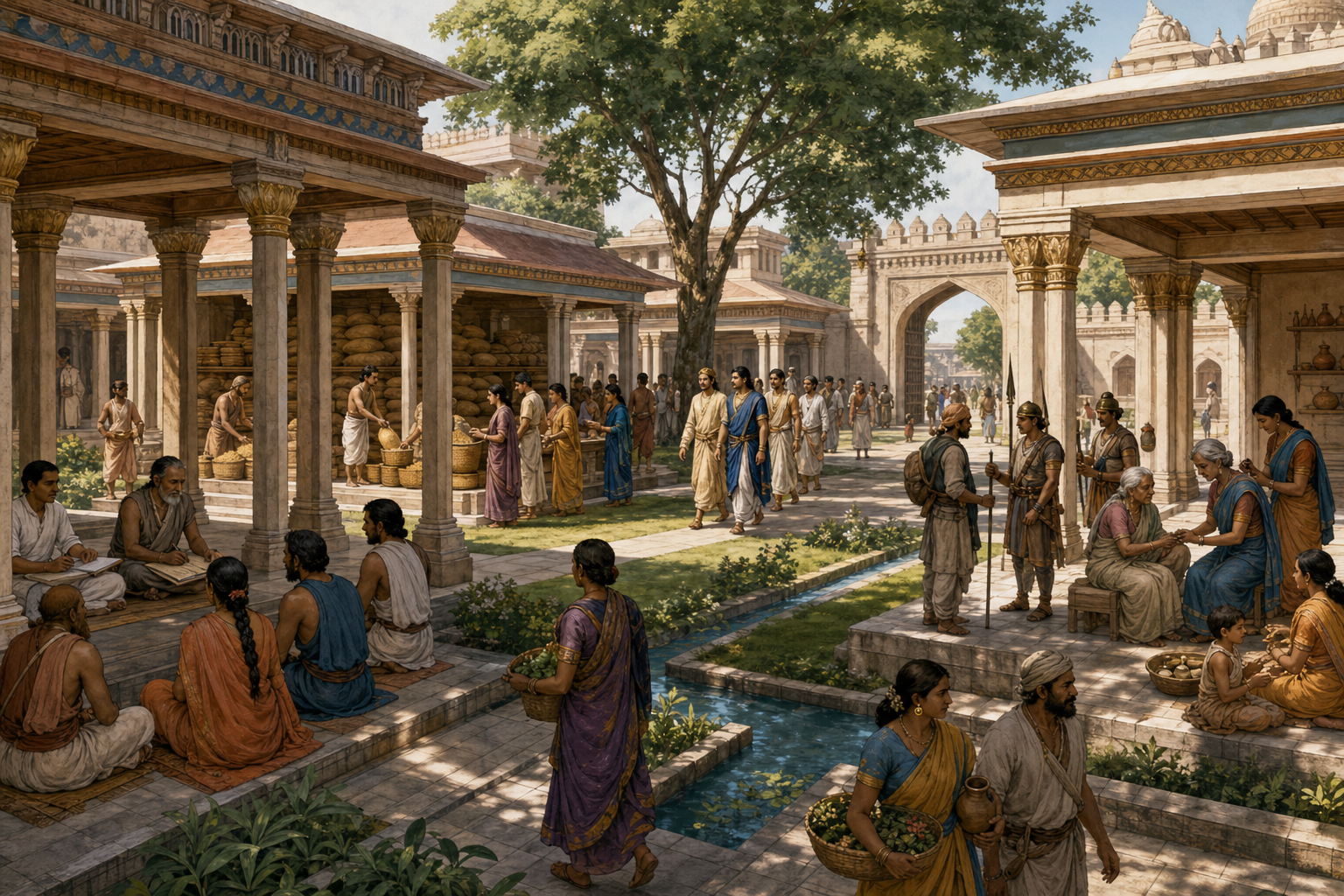
Personal virtue is the entry condition for Dharmic leadership, not a replacement for administration. Citizens cannot depend on a ruler’s mood, private generosity, or reputation for holiness. Justice must become a reliable public path: someone listens, evidence is considered, a decision is explained, and a grievance can be corrected.
Nyaya therefore demands more than severe punishment of wrongdoers. It requires even-handed process, timely adjudication, compassion, and protection against arbitrary treatment. In a modern constitutional setting, judicial independence, legal aid, professional policing, transparent decisions, and accessible grievance redressal are practical ways to carry that responsibility. A government does not prove its commitment to justice by announcing harsher power. It proves it by making fair process available to someone without wealth or influence.
Rama Rajya also refuses the false choice between ethical rule and administrative competence. A ruler may be personally sincere and still govern badly if ministers are unqualified, revenue disappears, local officials cannot act, or welfare never reaches the household for which it was intended. Rajadharma joins character to execution.
| Dharmic standard | Institutional expression | What you should inspect |
|---|---|---|
| Maryada | Published procedures and accountable authority | Can officials explain the rule, the decision, and who reviews it? |
| Nyaya | Independent adjudication, evidence, hearings, and grievance redressal | Can an ordinary person obtain a timely remedy without privileged access? |
| Lokasangraha | Education, healthcare, nutrition, security, and protection of vulnerable people | Are outcomes measured where deprivation is greatest, or only where delivery is easiest? |
| Artha under niti | Fair taxation, predictable compliance, productive public investment, and anti-corruption controls | Are revenue and procurement traceable from collection to public result? |
| Subsidiarity | Capable Gram Sabhas, Panchayati Raj institutions, municipalities, and local administration | Does the local body have authority, information, and resources, or only responsibility without power? |
| Respect for Prakriti | Protection of water, forests, biodiversity, and future generations | Does the decision disclose long-term ecological costs before approval? |
This institutional reading also clarifies what Rama Rajya is not. Dharma-guided government need not mean coercing every citizen into one sect, ritual, or mode of worship. The governing obligation is to protect dignity, uphold fair rules, and allow diverse paths to live without predation. Cultural confidence and pluralism can reinforce one another when the state serves all instead of turning devotion into a loyalty test.
For any policy offered in Rama’s name, insist on both a moral purpose and an administrative chain. Who is responsible? What rule governs the decision? How can a citizen appeal? What outcome will be measured? What happens when an official fails? If those answers are absent, the proposal is an aspiration, not governance.
Dharmic strength is built through capable coalitions
A lonely-hero reading misses one of the Ramayana’s most practical lessons. Sri Rama’s mission requires a coalition. Devas, Gandharvas, Yakshas, Vidyadharas, Kinnaras, and Apsaras contribute to the emergence of the Vanaras and allied forest forces. Cosmic purpose becomes effective only after it is distributed among agents with different strengths.
The leading Vanaras are not interchangeable fighters. Hanuman combines mobility, discernment, devotion, and tireless service. Nala carries Vishwakarma’s design intelligence. Nila is associated with Agni’s dynamic force. Sugriva contributes political leadership and command. Jambavan supplies memory, judgment, and the authority of an elder. Mainda and Dvivida carry associations with healing and rescue through the Ashvins, while Sushena’s connection with Varuna points toward measured order and care. The sena is powerful because its capabilities are differentiated and coordinated.
Jambavan’s intervention with Hanuman is especially useful if you lead people. Hanuman already possesses the needed capacity, but his strength has to be recalled and directed toward a common purpose. Jambavan does not compete with him, perform the leap for him, or offer vague encouragement. He identifies the right person, names the latent capacity, and connects it to the mission.
Before adding another person to a struggling team, ask whether you have overlooked the Hanuman already present. Name the blocked task precisely. List the capabilities it requires. Identify who has demonstrated each capability in another setting. Then give that person a clear mandate, the confidence of the group, and room to act. Encouragement becomes leadership when it restores useful memory and assigns responsibility.
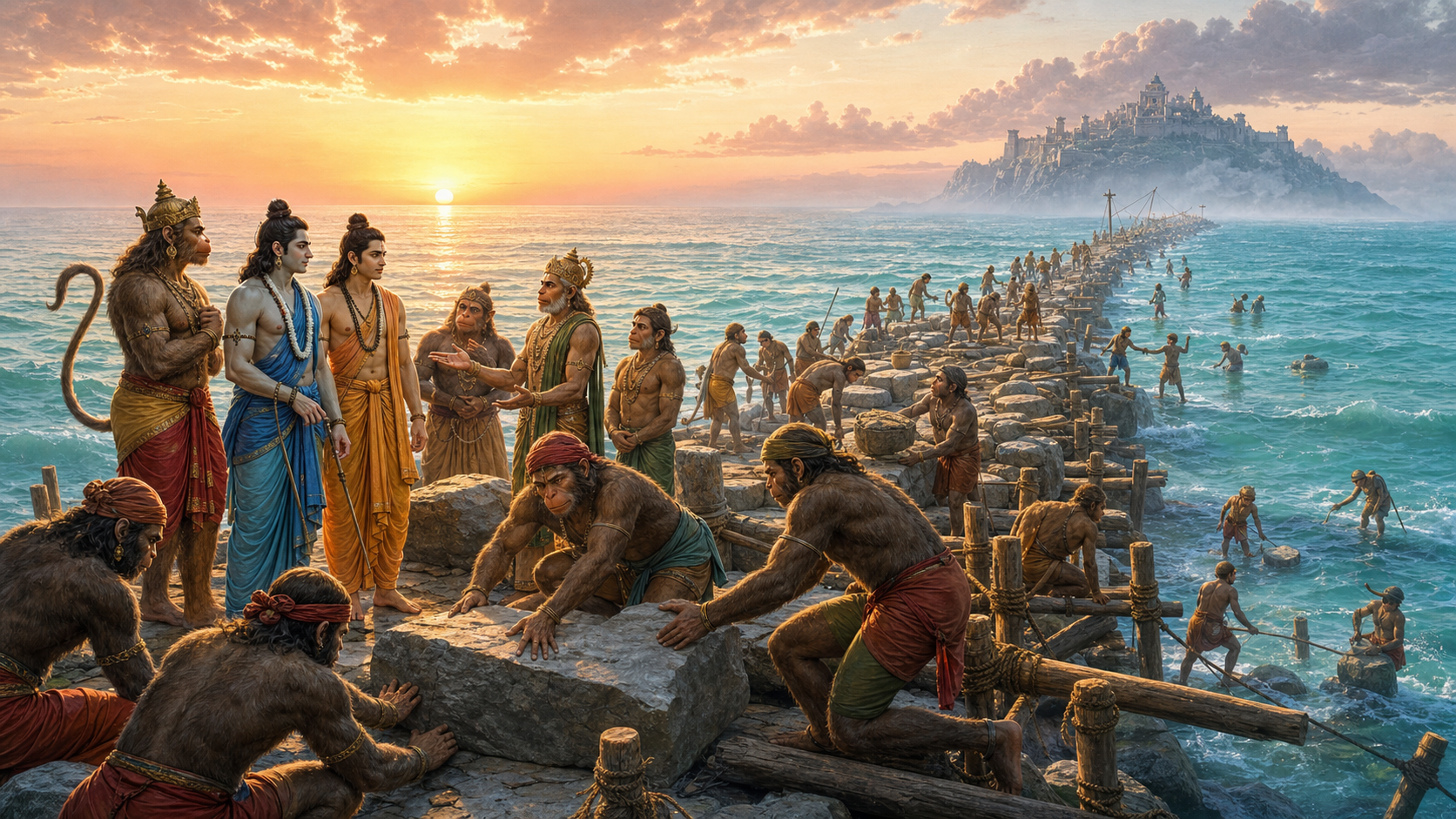
Rama Setu carries the lesson from talent recognition into project execution. Nala and Nila turn an apparently impassable natural barrier into a coordinated operation involving the selection and movement of trees, timber, and boulders, the staging of labor, and the stabilization of successive segments. Sacred-name and floating-stone motifs add devotional meaning in later tellings; the core Valmiki account gives particular attention to design, logistics, teamwork, and sustained construction.
You do not have to choose between devotion and engineering. They answer different needs. Devotion fixes the purpose; engineering makes the purpose traversable. A Dharmic project fails if it has skill without a worthy end, but it also fails if it has a worthy end without sequencing, materials, responsibility, and maintenance.
Use the Setu test on a public project or community initiative:
<!– wp:list {