

You may have encountered Unmatta Bhairava’s fierce face, skull-bowl, weapons, and canine companion and wondered whether Hindu tradition is sanctifying irrational behavior. It is not. The image confronts you with a harder question: what would remain if fear, vanity, and compulsive self-protection stopped governing your choices?
Read carefully, Unmatta Bhairava offers neither an excuse for chaos nor a demand that you imitate a frightening exterior. He gives you a symbolic grammar for recognizing freedom without confusing it with recklessness. That distinction is the key to his theology, his iconography, and any responsible practice connected with him.
Divine madness means freedom from compulsion, not loss of control

Unmatta Bhairava is one of the eight archetypal forms known collectively as the Ashta Bhairavas. As a manifestation of Shiva, he expresses a condition in which ordinary mental and social restraints have lost their ultimate authority. Yet Unmatta does not mean permission for disorder. Its religious force lies in ecstatic overflow: consciousness is no longer cramped by fear, possessiveness, pride, attraction, or aversion.
This is why the English phrase divine madness can mislead you. Ordinary madness may involve confusion, suffering, impaired judgment, or a dangerous loss of agency. The Unmatta state reverses that pattern. It signifies the end of compulsivity rather than the celebration of impulse. What appears wild from outside is inwardly gathered, awake, and answerable to dharma.
The word also resonates with the yogic language of unmanī or unmanā, the condition described as beyond the ordinary discursive mind. The terms should not simply be treated as synonyms, but the resonance helps clarify the image. The mind is not destroyed; its habit of seizing, naming, defending, and appropriating every experience falls quiet. Awareness no longer needs each passing thought to confirm who you are.
Bhairava carries the atmosphere of awe before which fear loses its sovereignty. Unmatta intensifies that encounter. His apparent excess exposes the quieter forms of intoxication that society often rewards: accumulation without sufficiency, performance without sincerity, domination disguised as strength, and constant stimulation mistaken for aliveness. The deity looks outrageous because the habits he unmasks have become ordinary.
There is an important personal boundary here. Unmatta is a theological symbol, not a psychiatric diagnosis. If you or someone near you is experiencing severe distress, harmful impulsivity, or loss of contact with reality, do not romanticize it as spiritual attainment. Seek qualified mental-health care. Ritual observance and contemplative practice are not substitutes for appropriate treatment.
Read the fierce image as a map, not a costume

Unmatta Bhairava may appear dark-hued or tawny-golden, with four or eight arms. Images can include a trident, hourglass drum, sword, skull-bowl, noose, and sometimes a shield. Serpents, skull ornaments, flaring matted hair, an unblinking gaze, and a faintly ecstatic expression complete the visual shock. Not every regional image carries every feature, so begin with what is actually present before reaching for a fixed iconographic chart.
A disciplined interpretation asks what each feature does to your attention. It does not ask how you might reproduce the deity’s transgressive appearance in ordinary life.
| Feature | Theological work | Question for the viewer |
|---|---|---|
| Trishula, the trident | It can signify the collapse of the apparent separation among knower, knowing, and known. | Where are you treating a mental division as ultimate reality? |
| Damaru, the hourglass drum | Its rhythm points beneath verbal thought to consciousness as living dynamism rather than inert emptiness. | Can you notice experience before your commentary takes possession of it? |
| Khadga, the sword | The blade represents decisive discrimination that cuts fixation rather than injuring another being. | Which attachment survives because you keep negotiating with it? |
| Kapala, the skull-bowl | The skull makes mortality and impermanence impossible to hide behind status. | What are you trying to possess as though it could not change? |
| Pasha, the noose | The noose makes bondage visible: desire first promises control and then becomes the thing that controls you. | Which repeated urge has begun to dictate your conduct? |
| Khetaka, the shield | When present, the shield places protection beside cutting force and reminds you that fierceness has a guarding function. | Does your strength protect what is sacred, or merely defend your pride? |
| Serpents and skull ornaments | They bring mortality, danger, and the energies normally pushed to the margins into conscious view. | What becomes less frightening when you stop refusing to look at it? |
| Flaring hair and steady gaze | The wild exterior interrupts habitual perception, while the unwavering gaze conveys collected awareness. | Can intensity coexist with inner stillness in you? |
| The dog | Bhairava’s vehicle is an alert guardian of boundaries and hidden places, expressing loyalty, watchfulness, and liminal protection. | What boundary must you guard if your practice is to remain honest? |
The dog is especially important because it prevents a sentimental reading of transcendence. As kshetrapala, guardian of a sacred precinct, Bhairava does not merely dissolve boundaries. He also protects the boundary between consecrated attention and distraction. His vehicle therefore joins freedom to vigilance. You cannot relinquish inner compulsions by becoming less watchful.
The same principle governs the weapons. Their spiritual meaning is not established by copying violence at the physical level. A sword that fails to cut your own fixation, or a trident invoked to justify hostility, has been read backward. Bhairavic fierceness is protective and transformative. It is not cruelty with sacred decoration.
Place Unmatta within the Ashta Bhairavas without forcing uniformity
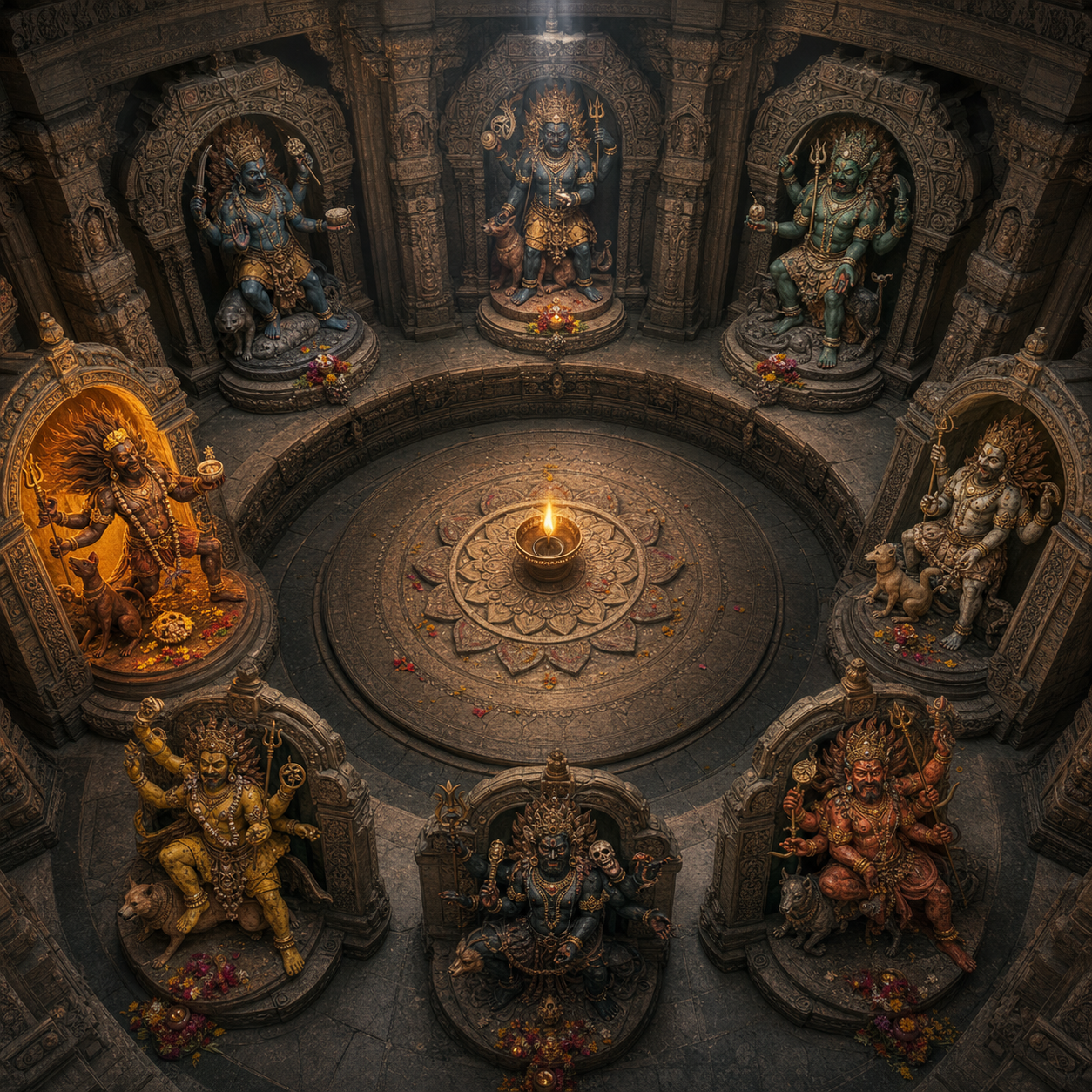
Unmatta belongs to a larger mandalic system. Common lists name Asitanga, Ruru, Chanda, Krodha, Unmatta, Kapala, Bhishana, and Samhara Bhairava. Together they present Bhairava through distinct modes rather than dividing him into unrelated gods. Unmatta’s sacred frenzy becomes clearer when you see it as one facet of a complete theology of guardianship, awe, dissolution, knowledge, and transformation.
Directional and Shakti correspondences require care. Many traditions place Unmatta in the western quarter and some associate him with Varahi or another fierce goddess. Other lineages preserve different arrangements. These variations are not an invitation to declare one temple defective because it does not match a chart encountered elsewhere. They tell you that the Ashta Bhairava system is transmitted through Agamic, Tantric, temple, and regional frameworks with their own ritual integrity.
Use three checks when you meet conflicting identifications:
- Identify the setting. A temple’s ritual order, a lineage manual, and a modern symbolic diagram may organize the same deities for different purposes.
- Ask whether the claim is universal or local. A western direction or a particular Matrika pairing may be authoritative within one sampradaya without functioning as a rule for every community.
- Preserve the theological center. Directional details may vary, but Unmatta’s recognizable work remains the transformation of fear, fixation, and constrained awareness.
This approach also helps when viewing historical art. Bhairava imagery appears in early medieval works associated with the Pala-Sena world, dynamic Chola bronzes, and Newar masterpieces of the Kathmandu Valley. The family resemblance includes ascetic power, fierce ornament, liminal guardianship, and imagery associated with the cremation ground. Yet Unmatta-specific details are not mechanically identical across regions. Variation is part of the tradition’s life, not evidence that symbolism has no structure.
If you are visiting a shrine, let its living practice interpret its image. Observe the placement of the deity, his relation to the sacred enclosure, the form of circumambulation, and the instructions of the temple’s custodians. That will usually teach you more than trying to impose an abstract pan-Indian diagram on a local manifestation.
Move from non-dual theology to disciplined practice
Kashmir Shaivism provides a precise philosophical language for what the Unmatta image enacts. Supreme reality is luminous consciousness, Chit or Anuttara. It is not a motionless object behind the world; it expresses itself dynamically as spanda. The many forms of experience therefore arise within consciousness rather than outside a separate, passive witness.
Bondage begins when this open field contracts around a possessive claim: my fear, my status, my injury, my object, my version of events. Unmanī names the quieting of that appropriating movement. Sahaja, the natural condition, is not an artificial trance added to life. It is what becomes evident when awareness ceases to mistake its contractions for its whole nature.
Unmatta Bhairava dramatizes this shift. To convention, a person no longer governed by praise, blame, acquisition, or fear may appear incomprehensible. From the non-dual standpoint, however, the real disorder was the fragmentation that preceded freedom. Divine madness is thus radical lucidity viewed from inside a culture of normalized compulsion.
The Vijnana Bhairava Tantra helps explain the contemplative mechanism, but precision matters: it teaches Bhairava-oriented dharanas generally rather than presenting itself as a manual devoted specifically to Unmatta Bhairava. Its attention to the natural gap between breaths, the interval between sounds, and the instant before perception is named shows how intensity can settle into clear awareness. You are not asked to manufacture a spectacular state. You learn to recognize the opening that conceptual activity usually covers.
A non-initiatory way to work with the symbolism
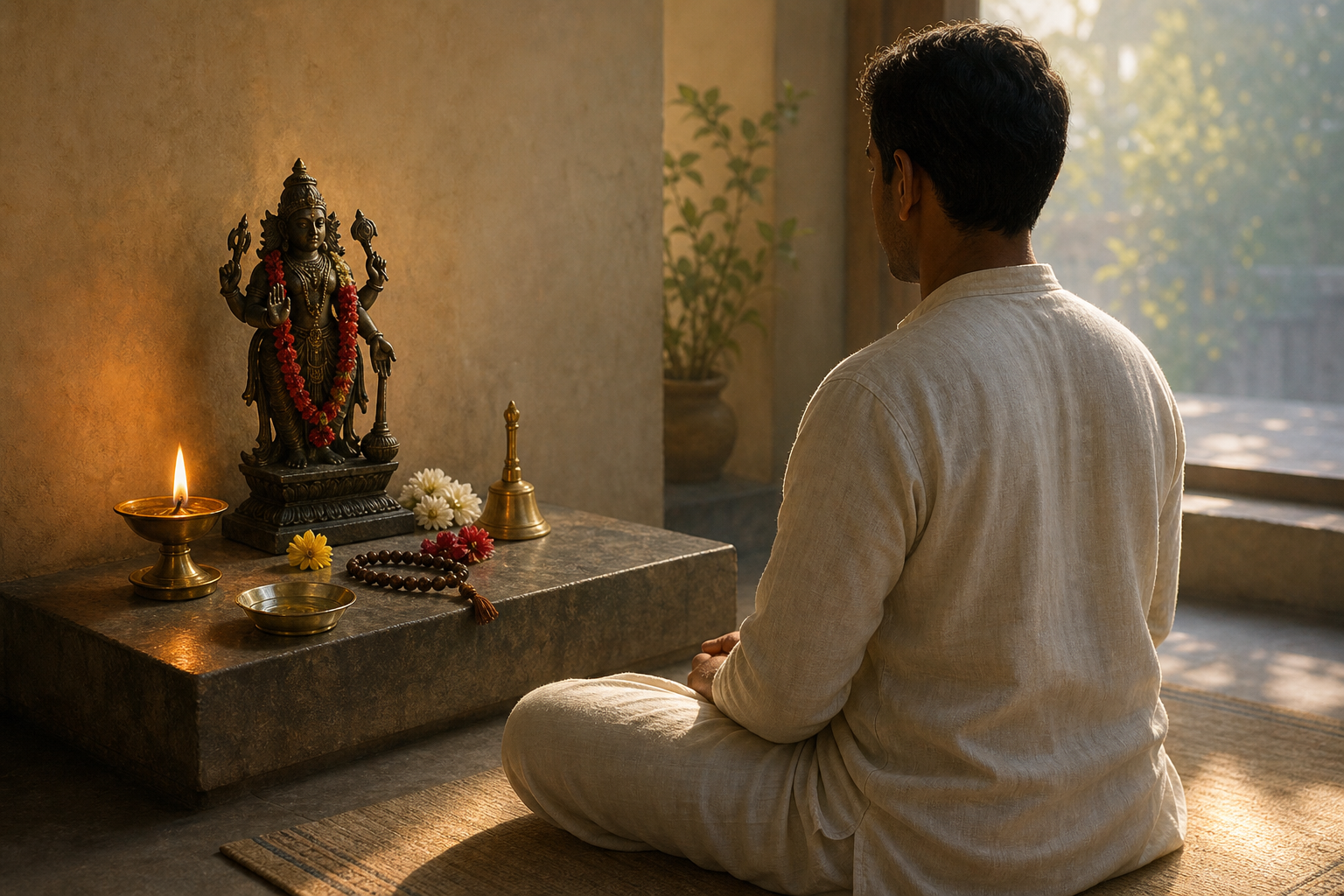
You do not need to imitate advanced Tantra to begin testing the teaching in daily conduct. Use these three modest disciplines:
- Keep a brief period of mauna. Choose a repeatable part of the day for silence. Put aside speech and digital input, then notice how quickly the mind searches for something to consume, rehearse, or display. The urge itself is the material of practice.
- Notice the unforced pause after exhalation. Let breathing remain natural. Attend to the still interval without extending it, manipulating it, or turning it into a contest. The point is recognition, not breath retention.
- Relinquish one small recurring compulsion for a fixed period. Digital overuse and reactive speech are suitable examples. Name one behavior precisely, notice the trigger when it appears, and refrain from the usual response. This converts a grand idea about freedom into an observable change in conduct.
Judge the practice by its ethical fruit. If it makes you more truthful, less reactive, more capable of compassion, and less controlled by an urge, the symbolism is becoming embodied. If it produces theatricality, contempt for ordinary duties, or a sense that ethical limits no longer apply to you, stop and correct the interpretation.
Why formal Bhairava worship needs lineage
Formal Bhairava cycles may include nyasa, japa, homa, bali, circumambulation, and observance at twilight or before dawn. Specific mantras and ritual sequences vary by sampradaya. Nyasa installs mantric energies upon the body; homa and bali operate within consecrated ritual structures. These are not interchangeable techniques to assemble from disconnected fragments.
If you intend formal Unmatta Bhairava sadhana, seek instruction from a competent guru within a recognizable lineage. Until then, darshan, respectful pradakshina, ethical vows, ordinary prayer to Shiva or Bhairava, silence, and natural breath awareness provide a sound boundary. Initiation is not an obstacle placed before sincerity. It is one of the guardrails by which fierce practice remains ordered toward liberation.
Kalashtami and regional Bhairava Jayanti observances can be occasions for fasting, vows, shrine visitation, and intensified worship. Kashi, Ujjain, and sacred places across Nepal, Tamil Nadu, Karnataka, and Kashmir preserve rich Bhairava traditions, but local forms and observances differ. Follow the vrata and temple discipline actually transmitted in the place you visit rather than assuming one regional custom governs all others.
A shared Dharmic principle without forced equivalence
Other Dharmic traditions also refuse to separate freedom from responsibility. Vajrayana accounts of crazy wisdom place unconventional action within awakening and bodhisattva ethics. Jain aparigraha and samyama loosen the rule of possession through non-attachment and restraint. The Sikh affirmation nirbhau, nirvair joins fearlessness to the absence of enmity.
These are illuminating parallels, not interchangeable doctrines. You do not need to collapse their distinct theologies to notice their common warning: freedom that increases harm, vanity, or hostility is counterfeit. Across these paths, liberation becomes credible through responsibility.
Key takeaways: five tests for any interpretation
- Ask what is being transcended. A sound interpretation targets fear, pride, fixation, possessiveness, and compulsive reaction. It does not target sanity, accountability, or care for others.
- Look for ethical structure. Ahimsa, satya, and daya are not optional restraints placed on Bhairavic freedom from outside. Non-harm, truthfulness, and compassion show whether fearlessness has matured.
- Read the icon inwardly. The sword cuts fixation, the skull-bowl exposes impermanence, the noose reveals bondage, and the dog guards the threshold. None of them authorizes literal aggression.
- Respect lineage variation. Western direction and Varahi associations occur in some systems, not all. Learn the local or sampradaya-specific arrangement before presenting it as universal.
- Distinguish contemplation from initiated ritual. Silence, natural awareness of the breath’s pause, and relinquishing a minor compulsion are accessible disciplines. Mantra, nyasa, homa, and bali belong within competent guidance.
The next time you stand before Unmatta Bhairava, choose one emblem rather than trying to decode the whole image at once. Ask what bond it reveals in you, then make one small vow that weakens that bond without harming anyone. If the encounter leaves you more watchful, less compulsive, and more responsible for your conduct, you have begun to understand why the madness is called divine.