

If you have paused over the Kāliya episode and wondered why Balarāma does not reassure the terrified residents of Vṛndāvana or immediately help Kṛṣṇa, you have noticed the right difficulty. His silence can look strangely passive unless you read it together with his knowledge, his smile and his relationship with Kṛṣṇa.
Balarāma is not silent because he lacks concern. He remains composed because he knows exactly who has entered the poisoned Yamunā. His restraint allows Kṛṣṇa’s saving power to become visible while giving us a demanding lesson: spiritual steadiness is not the absence of danger or emotion, but the refusal to let fear dictate what we believe.
The knowing smile changes the meaning of the silence

The opening of Śrīmad-Bhāgavatam 10.16 places two responses beside each other. The Vrajavāsīs are overwhelmed by Kṛṣṇa’s disappearance into a river made deadly by Kāliya’s venom. Balarāma, described as the master of transcendental knowledge, smiles and says nothing because he understands the extraordinary power of his younger brother.
Each element matters. Knowledge without the smile could appear cold. A smile without knowledge could look careless. Silence without either could be confusion. Together they disclose calm certainty. Balarāma sees the same crisis as everyone else, but he does not share their conclusion that Kṛṣṇa may have become helpless.
His smile should not be read as mockery of the Vrajavāsīs. Their distress arises from love. Their attachment to Kṛṣṇa is so immediate that awareness of his divine invincibility does not cancel their parental, friendly and communal fear. The Bhāgavata does not treat that fear as a defect to be ridiculed. It lets loving anxiety and realized confidence occupy the same scene.
This distinction corrects a common misreading. Faith does not require you to imitate Balarāma’s outward expression while inwardly panicking. His composure rests on realization, not on the performance of composure. If you copy the silence without cultivating its foundation, you reproduce the appearance of wisdom while missing its substance.
Balarāma’s non-interference protects Kṛṣṇa’s revelation

Balarāma could have spoken. He could have announced that Kṛṣṇa was safe, dispersed the crowd’s anxiety or intervened directly. His decision not to do so preserves something words would have interrupted: the residents of Vṛndāvana must encounter Kṛṣṇa’s power through Kṛṣṇa’s own action.
That is important within the theology of līlā. Balarāma is understood in the Vaiṣṇava tradition as Kṛṣṇa’s first plenary expansion, nondifferent in divine essence yet distinct in service. He supports Kṛṣṇa without competing for the centre of the scene. In the Kāliya episode, support therefore takes the form of restraint. Balarāma does not need to demonstrate his own strength when the purpose of the moment is to disclose Kṛṣṇa’s.
Gauḍīya Vaiṣṇava theology also sees Balarāma as the principle of guru, shelter and divine support, associated with Saṅkarṣaṇa and Ananta Śeṣa. That makes his silence pedagogical. A genuine guide does not always remove uncertainty by supplying commentary. Sometimes the guide remains steady long enough for the disciple to see the truth directly.
This is māuna-upadeśa, instruction through silence, but it is not a doctrine that silence is always superior to speech. Its fitness depends on the moment. Here, Balarāma knows that Kṛṣṇa is fully capable, that the apparent danger cannot defeat him and that premature reassurance would weaken the unfolding revelation. The restraint is precise because the knowledge behind it is precise.
Commentators such as Jīva Gosvāmī and Viśvanātha Cakravartī Ṭhākura help readers attend to gestures, glances, pauses and changes of mood as carriers of theological meaning. Balarāma’s brief smile is therefore not decorative detail. It tells you how to interpret the silence: he is not disengaged from the līlā but perfectly situated within it.
Realized knowledge becomes a stabilizing presence

The verse calls Balarāma the master of transcendental knowledge, yet he offers no discourse. That apparent paradox reveals what jñāna means here. Knowledge is not merely the ability to explain a doctrine. It has entered character so deeply that it governs posture, timing and response under pressure.
You can test the difference in yourself. Information says that the Divine is a shelter. Realized trust begins to alter what you do when the familiar world appears poisoned, when other people panic or when no quick explanation is available. It does not make you numb. It prevents emotion from becoming your only instrument of judgment.
Balarāma’s presence also matters as much as his silence. He does not abandon the distressed community. He remains among them while refusing to amplify their fear. This gives spiritual leadership a concrete shape: stay present, perceive accurately and do not add your own agitation to a field that is already unstable.
That principle is easy to misuse, especially by people with authority. A leader who withholds necessary information, ignores preventable harm or leaves frightened people unsupported cannot appeal to Balarāma’s silence. Balarāma knows the outcome because he knows Kṛṣṇa’s power. Ordinary human beings usually possess no such certainty. Humility about that difference is part of learning from the episode.
How to practise Balarāma’s steadiness without imitating passivity
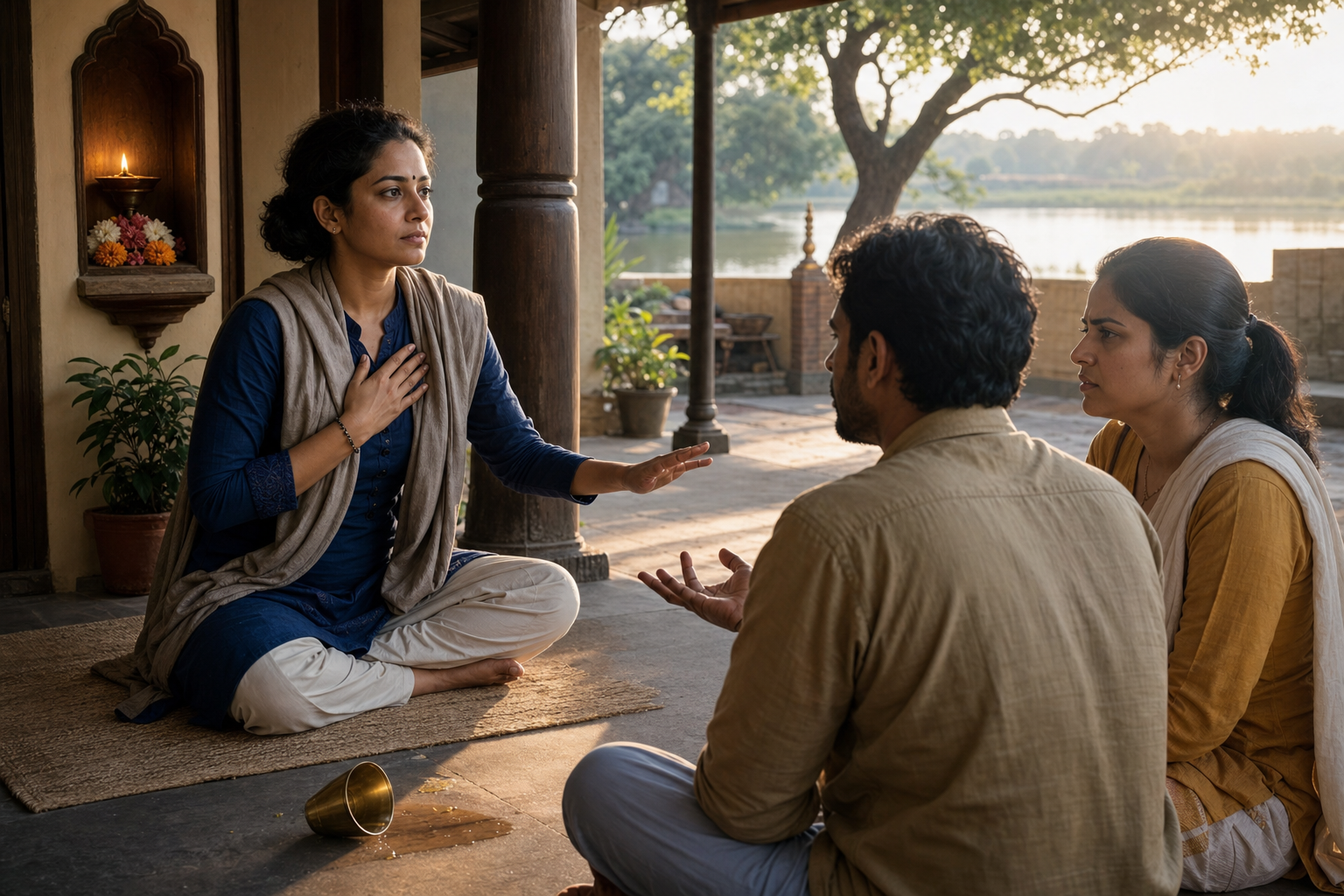
Kāliya’s venom can be read on more than one level. Within the narrative, it has corrupted the Yamunā and endangered Vṛndāvana. In a contemplative reading, the poison also resembles the anarthas that disturb the inner current: envy, anger and pride. Kṛṣṇa’s dance upon Kāliya’s hoods then becomes an image of divine grace bringing disordered forces back under dharma.
Do not reduce the episode to private psychology, however. A poisoned river is also a communal and ecological emergency. Inner purification cannot become an excuse to ignore damaged waterways, habitats or neighbours. The movement of the līlā is toward a Yamunā in which life can flourish again. Devotion should sharpen that responsibility.
When fear rises in your own circumstances, use a sequence that respects both contemplation and duty:
- Separate what you know from what you fear. State the known facts plainly. If you do not possess Balarāma’s certainty, do not disguise an assumption as spiritual confidence.
- Check whether immediate action is required. If a person, community or environment faces preventable harm, intervene or call for capable help. Silence is not sacred when it permits avoidable injury.
- Stop feeding the emotional contagion. Take a deliberate breath, remember your Iṣṭa through nāma-smaraṇa or another established practice, and avoid repeating speculation merely because everyone else is repeating it.
- Choose the form of service the moment lacks. Some situations need accurate words. Others need practical assistance, patient listening or one person who can remain composed while necessary work is done.
- Let the outcome teach you. Balarāma does not explain Kṛṣṇa’s potency in advance because the līlā will reveal it. After a crisis passes, examine what proved trustworthy, which inner poison distorted your judgment and what discipline must be strengthened before the next test.
This sequence keeps the teaching from collapsing into a slogan such as “stay calm.” Calmness is useful only when joined to truthful perception and dharmic action. Balarāma’s example does not ask you to become less responsive. It asks you to become less reactive and more exact about when to speak, when to serve and when to wait.
Key takeaways
- Balarāma’s silence means confidence in Kṛṣṇa’s power, not indifference to the Vrajavāsīs.
- His smile is the interpretive key: it reveals knowledge, affection and freedom from panic.
- By not intervening, Balarāma allows Kṛṣṇa’s saving agency to appear directly and preserves the devotional mood of the līlā.
- As an expression of guru-tattva, his conduct shows that guidance can consist of stable presence as well as spoken instruction.
- Human beings should imitate the principle, not the surface: verify what you know, act against preventable harm and remain silent only when silence genuinely serves truth.
- Kāliya’s poison invites both inner and outer responsibility: confront envy, anger and pride while also treating harm to shared waters and habitats as a matter of dharma.
The next time fear spreads around you, ask one practical question before reacting: does this moment need information, intervention or steadiness? Then supply what is actually missing. That is a more faithful application of Balarāma’s silence than merely saying nothing.