
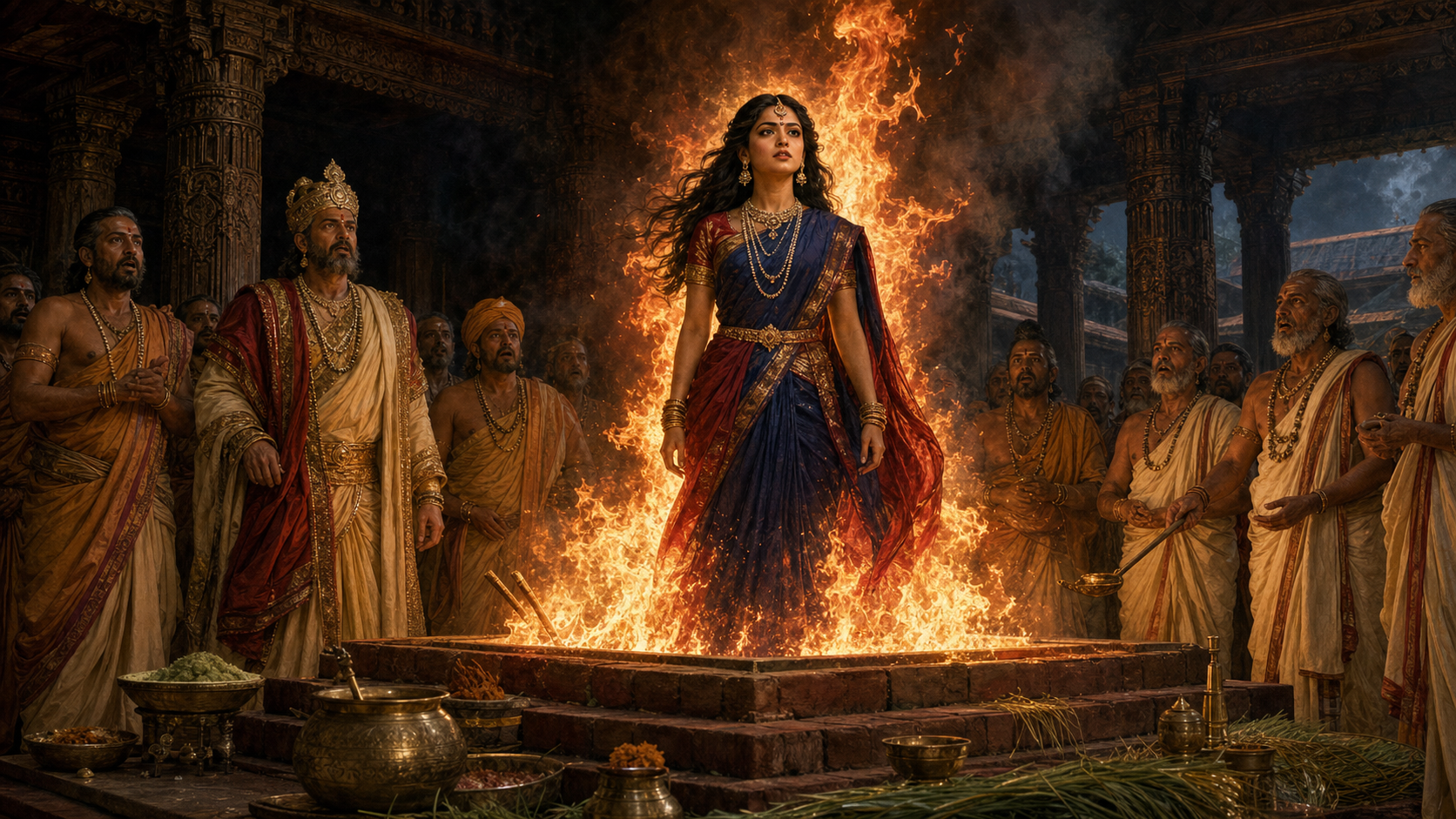
If Draupadi’s fire-birth has always seemed like a dramatic prelude to the Mahabharata, the most important question is not whether the event is miraculous. It is why the epic brings her through a sacrificial altar rather than an ordinary household.
The answer is more precise than the familiar idea that fire represents her strength or anger. Yajna fire transforms an intention into a consequence, places private desire before a higher order, and bears witness to what follows. Draupadi enters the story from that process. To understand her symbolism, you need to keep three distinctions in view: birth and lineage, ritual and moral purity, destiny and personal agency.
Fire makes Draupadi’s birth larger than a royal succession
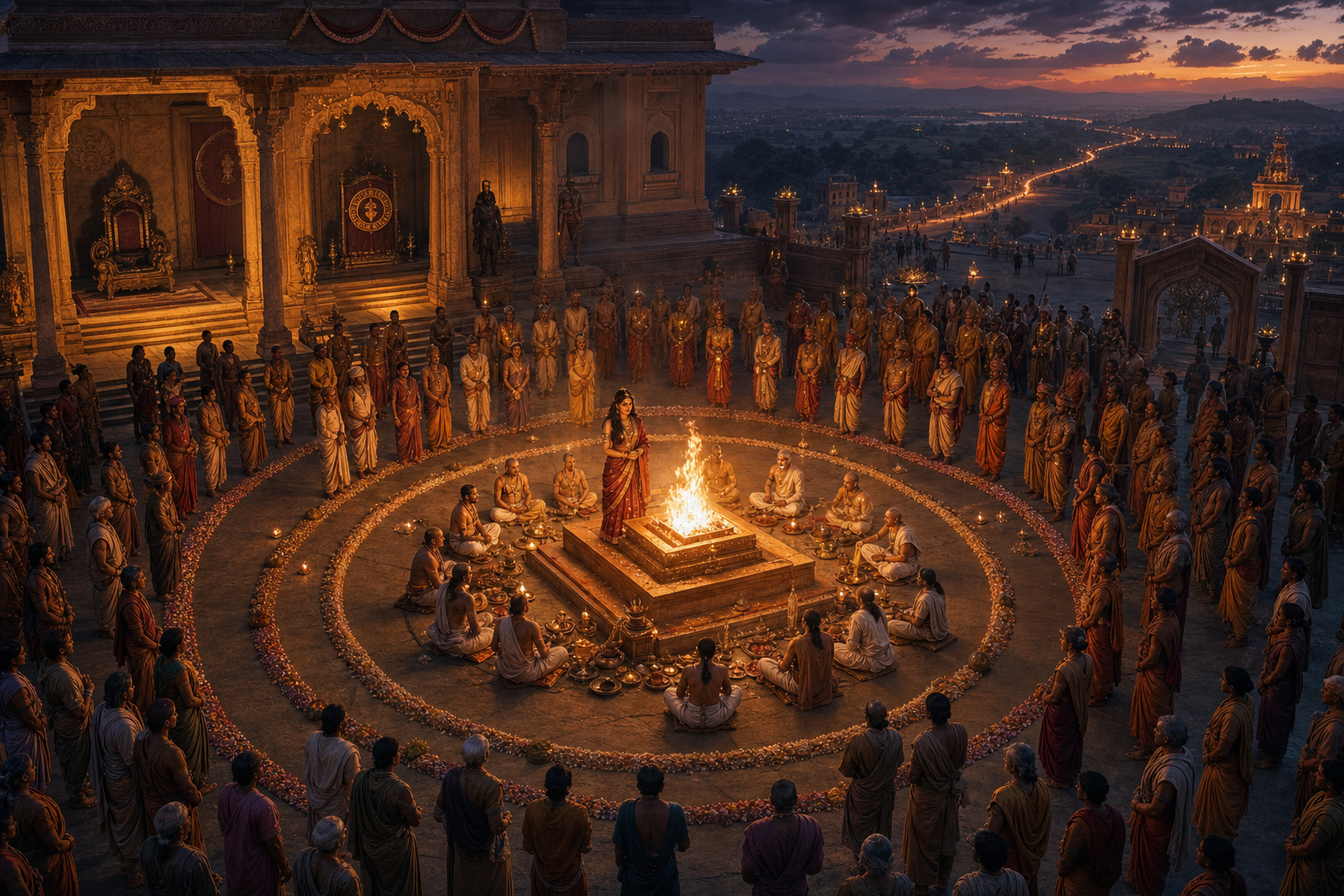
Draupadi’s origin begins with King Drupada’s humiliation, not with Draupadi herself. Drupada and Drona had once shared a youthful friendship, but their relationship became a struggle over status, sovereignty and a disputed promise. After Drona defeated him and took part of his kingdom, Drupada sought a son capable of defeating Drona in return.
That motive matters because the yajna is an attempt to answer a political and personal wound through sacred action. The narrative sequence is deliberate: Dhrishtadyumna emerges from the fire with a proclaimed role in Drona’s death, and Draupadi follows him. Drupada asks for an answer to one enemy; the altar produces two lives whose effects spread across the political and moral world of the epic.
Draupadi is therefore described as ayonija, not born from a womb. That does not mean she has no family, social identity or human relationships. Her names establish precisely the opposite. Draupadi identifies her as Drupada’s daughter. Panchali connects her to Panchala. Krishna recalls her dark complexion. Yajnaseni preserves her sacrificial origin.
These names give you a practical way to read her appearances. When the epic calls her Draupadi, notice the dynastic relationship. When it calls her Panchali, notice the kingdom and alliance she represents. When it calls her Yajnaseni, notice the unresolved connection between intention, sacrifice and consequence. Her extraordinary birth does not remove her from history; it gives her several simultaneous locations within it.
Fire is the right generative setting because Agni is not merely an image of destruction. In Vedic ritual, Agni serves as the priestly mediator and the mouth through which offerings are conveyed. An offering enters the flame in one form and passes beyond human possession. Draupadi’s emergence reverses that movement: something comes back from the sacred fire as an answer, but the petitioner does not control the full meaning of what has been received.
This is the first interpretive key. Draupadi is born at the point where a king’s private grievance becomes a public destiny. Whenever her presence changes the political field, ask what private desire or hidden disorder is being forced into the open.
The yajna transforms Drupada’s intention; it does not excuse it
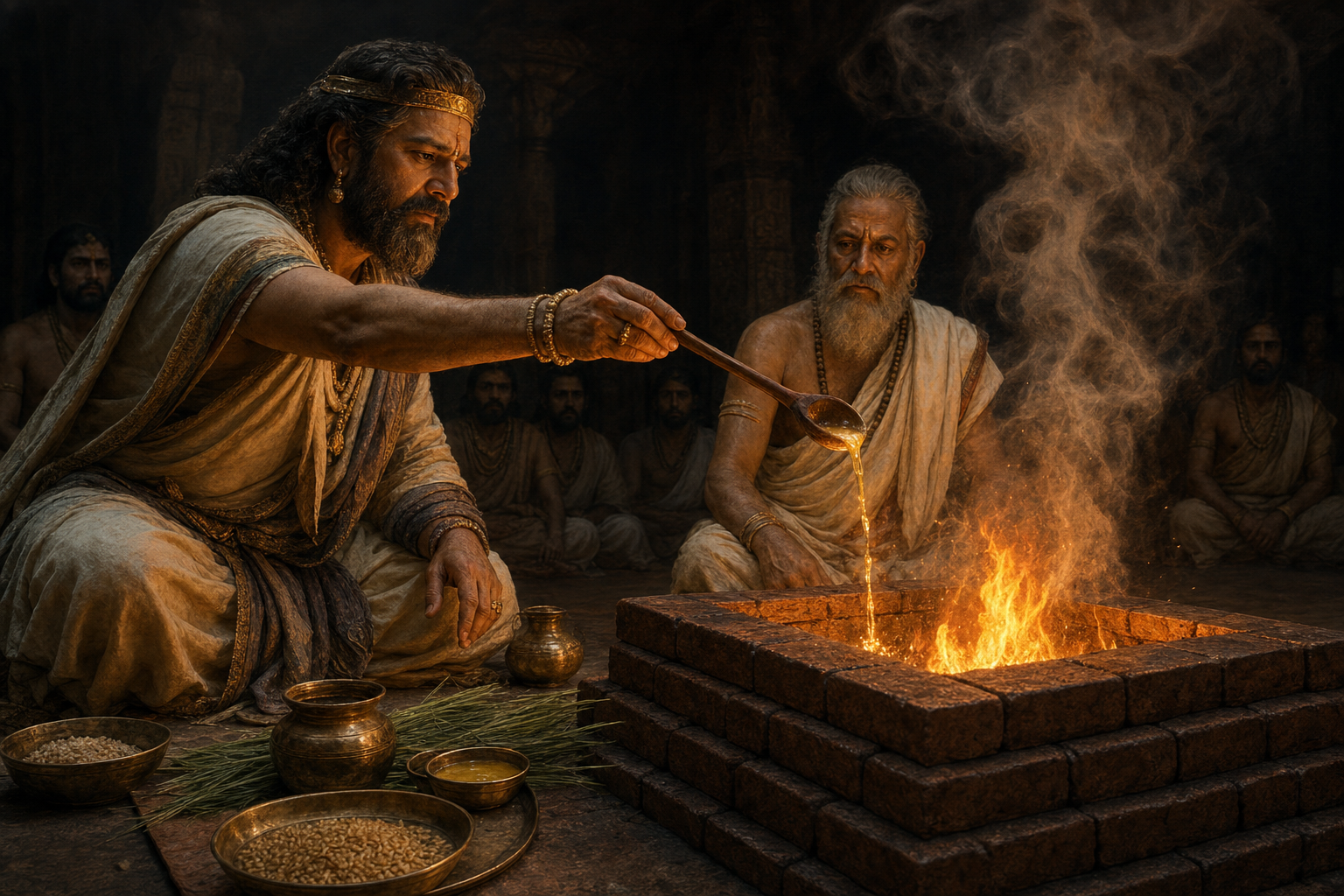
A common devotional misreading treats any desire pursued through a sacred rite as automatically sanctified. Drupada’s yajna does not support that conclusion. His wish contains wounded honour, ambition and revenge. The hesitation associated with the sages Yaja and Upayaja keeps that moral difficulty visible: ritual competence and ethical intention are related, but they are not identical.
The Bhagavad Gita’s categories of sacrifice provide a useful lens here. A sattvic sacrifice is undertaken as duty, without attachment to reward. A rajasic sacrifice is bound to gain, display or desired results. Drupada’s purpose is recognisably rajasic because he wants a particular person capable of settling a particular grievance. The rite’s sacred form does not erase the quality of that motive.
Yet the outcome is not confined to Drupada’s revenge. Dhrishtadyumna directly answers his demand for a warrior. Draupadi becomes something more difficult to reduce to that demand: a queen, a bond between Panchala and the Pandavas, and the person whose treatment exposes the Kuru order’s inability to restrain power through dharma.
This excess of outcome over intention is central to yajna symbolism. A sacrifice is not a transaction in which the divine simply delivers the object ordered by the sacrificer. The offering passes into an order larger than the person making it. Drupada can initiate the rite, but he cannot confine its consequences to his original horizon.
You can apply the same distinction whenever sacred language is used to justify ambition. Ask three separate questions: What does the person want? By what discipline is that desire being pursued? What consequences are released beyond the desired result? A correct form does not purify an unjust motive by itself, and a mixed motive does not guarantee that every later consequence will serve only that motive.
Draupadi’s birth also prevents a simplistic account of karma in which every result neatly resembles the initiating desire. Drupada seeks retribution, but the fire produces a much wider reckoning. Human intention enters the causal field; it does not become sovereign over that field. Destiny in the Mahabharata responds to action without becoming a servant of human plans.
Her fire origin foreshadows alliance, witness and reckoning

Draupadi’s later life develops three capacities already present in the altar scene. She joins separate powers, she reveals the moral quality of those around her, and she turns concealed disorder into unavoidable consequence.
Her swayamvara brings Panchala and the Pandavas into alliance. Her marriage to the five Pandava brothers intensifies the theme of plurality held in one demanding relationship. Later traditions explain the five husbands through a former-life boon, while symbolic readings associate the five with the elements or human faculties. Those interpretations can illuminate the pattern, but they should not be mistaken for a rigid code in which each husband has to equal one element. The safer conclusion is simpler: Yajnaseni becomes a point of unity among distinct powers whose cooperation will shape the struggle over dharma.
Fire also functions as a witness in Hindu marriage. A couple enters a fire-attested bond because relationship is not only private affection; it carries duties before a sacred witness. Draupadi’s life is thus framed twice by flame: she is born from a sacrificial fire and enters marriage in the presence of fire. Both moments place human relationships under accountability.
That framing becomes decisive in the Kuru court. Draupadi’s humiliation is sometimes described too casually as the event that causes the war. That makes her responsible for a catastrophe produced by a much deeper accumulation of adharma. Her treatment is better understood as a diagnostic moment. It reveals whether kinship, kingship, law and conscience can restrain those who possess power. When the court fails that test, its disorder can no longer be disguised as a private family dispute.
The fire symbolism therefore does not mean that Draupadi burns down the Kuru world through personal fury. She exposes what is already combustible. Her dignity becomes the point at which equivocation is no longer morally neutral. The people present must speak, act, evade or remain silent, and each response reveals a position toward dharma.
When you reread the court episode, pay attention not only to what is done to Draupadi but also to the surrounding failures of witness. Who recognises the violation? Who possesses the standing to intervene? Who hides behind procedure? Who treats silence as innocence? Those questions carry the meaning of her yajna origin into the scene more faithfully than the vague claim that she is simply a fiery woman.
None of this turns Draupadi into an impersonal mechanism of fate. A destiny-laden birth establishes narrative responsibility, not puppetry. Her resolve and moral presence matter because she acts within the burden placed upon her. If her origin alone mechanically produced the result, the choices made by her and by everyone around her would have no ethical weight. The Mahabharata preserves that weight.
Four tempting interpretations obscure the symbolism
Fire is not a shorthand for female anger
Describing Draupadi as fiery can sound admiring, but it easily reduces her to temperament. Agni in the birth scene does more than suggest heat. Fire conveys offerings, illuminates, witnesses and transforms. Read her force as moral clarity and catalytic presence before reading it as anger. That shift keeps attention on what her words and treatment disclose about the surrounding order.
Sacrificial birth does not make revenge righteous
Drupada’s access to yajna does not prove that his grievance is pure. The ritual brings his intention into a sacred process where it is transformed and enlarged. If you use the episode to claim that religious performance legitimises retaliation, you miss the tension built into the priests’ response and the unforeseen scale of the outcome.
Destiny does not make Draupadi responsible for the war
Foreshadowing identifies Draupadi as central to a coming reckoning; it does not transfer responsibility from those who choose adharma to the woman against whom it is enacted. Her humiliation makes the condition of the Kuru court visible. It does not create that condition. Preserve the difference between revealing a crisis and causing it.
Shared flame imagery does not make every Dharmic practice identical
Hindu homa and havan, Buddhist homa-like or goma rites, and the use of sacred light in Jain and Sikh settings can all evoke purification, insight or remembrance. These resonances allow a constructive Dharmic conversation about disciplined transformation. They do not erase differences in theology, ritual form or community practice. Look for the shared ethical question rather than forcing every flame into one doctrinal explanation: what must be clarified, offered or remembered so that conduct aligns more closely with truth?
Key takeaways for reading Draupadi’s fire-birth
- Draupadi’s ayonija birth marks her as ritually generated, but her names still root her firmly in family, kingdom, appearance and sacrificial origin.
- Agni represents mediation, transformation and witness, not merely destructive power or personal anger.
- Drupada’s rajasic desire enters the yajna, but the outcome exceeds the revenge he intended.
- Dhrishtadyumna answers the immediate demand for an avenger; Draupadi carries the consequences into alliance, marriage, kingship and public accountability.
- Her humiliation reveals the Kuru order’s accumulated adharma. It should not be used to blame her for the war that follows.
- A destiny-bearing origin gives Draupadi a demanding role without cancelling her agency or the responsibility of those who act around her.
On your next reading, follow one thread: whenever Draupadi enters a decisive scene, ask whose intention is being tested, what hidden disorder becomes visible, and who accepts or refuses the duty to respond. That is where the fire of her birth continues to burn within the epic.