
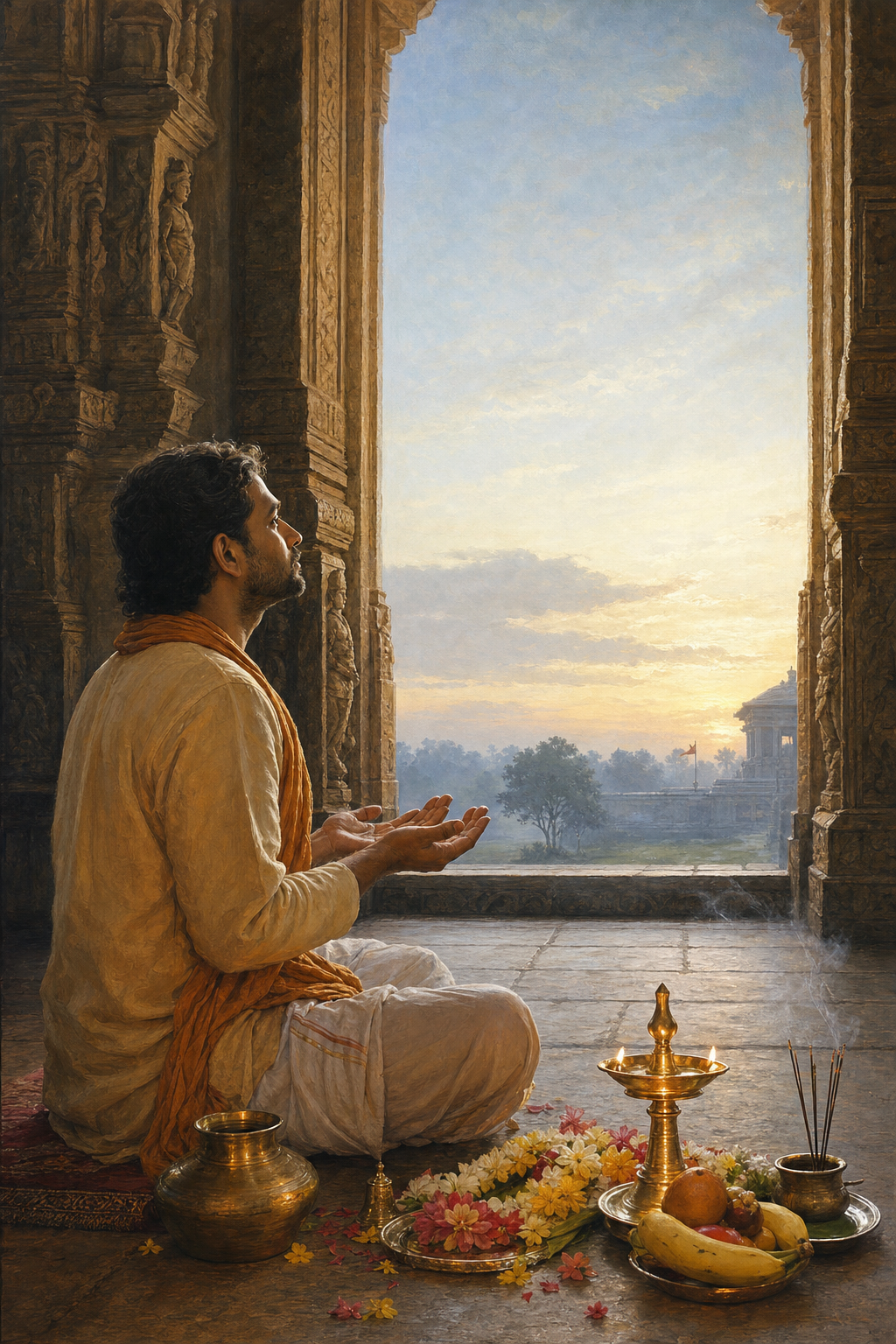
You can perform puja, keep family observances, visit temples, and still carry a difficult question: is any of this moving you toward moksha, or are you merely preserving a custom? Hindu traditions do not answer that question by dismissing ritual or by promising that every sacred act automatically produces liberation. They ask what the act is for, what kind of desire drives it, and what understanding of the self accompanies it.
Once you separate ritual duty, devotional surrender, and liberation, the path becomes easier to read. Ritual can order your conduct and attention. Bhakti can redirect desire away from self-importance. Knowledge and non-attachment can uproot the conditions of bondage. These functions can reinforce one another, but they should not be confused.
First identify the job your practice is doing
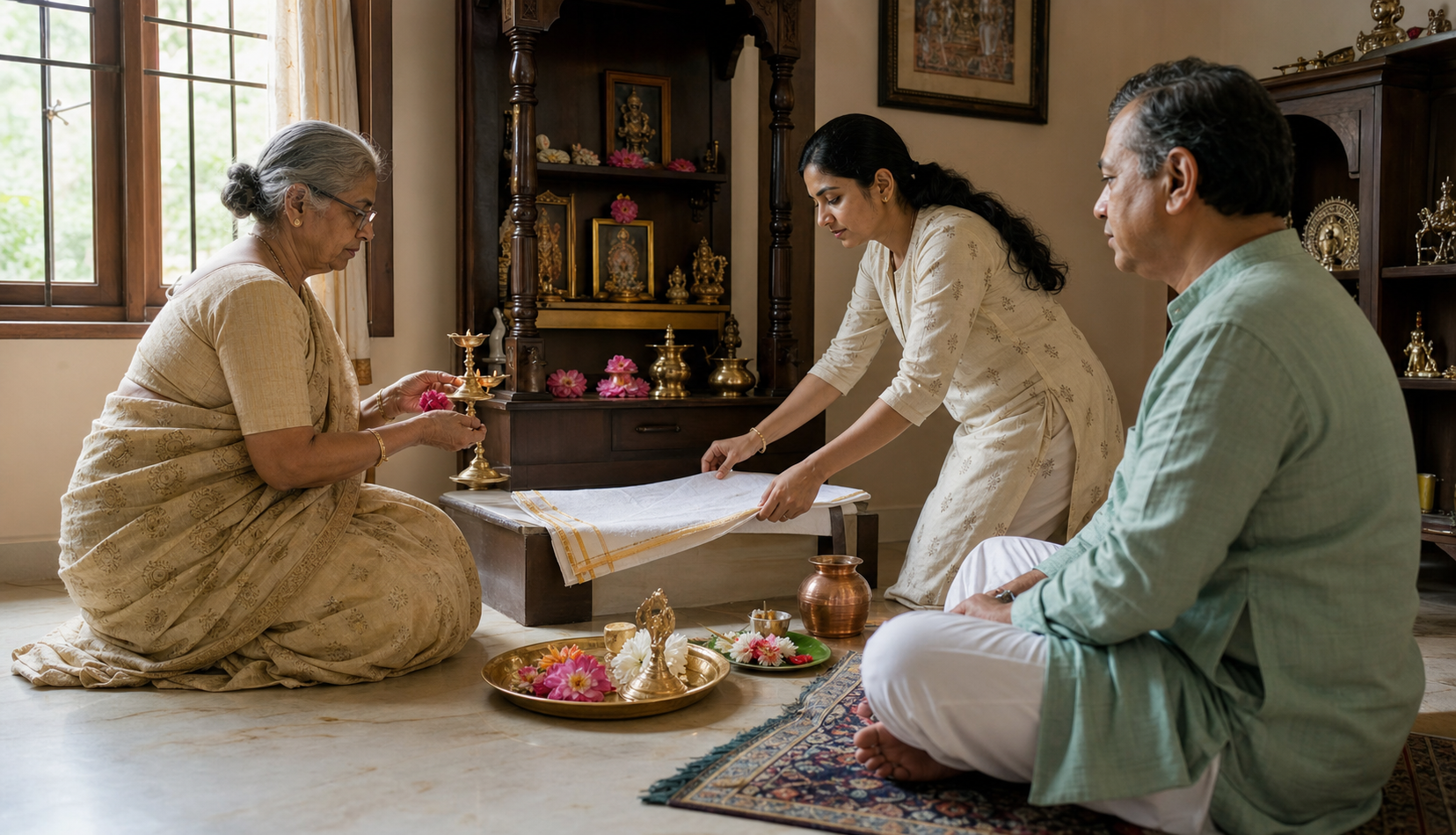
The word spiritual often hides several different aims. A rite may uphold dharma, seek a particular benefit, repair a wrong, express love of the deity, prepare the mind for knowledge, or participate directly in a tradition’s path to liberation. You cannot judge the practice intelligently until you know which of those purposes applies.
- Dharma: Obligatory and occasion-specific actions sustain moral, familial, and sacred order. Mimamsa classifies these as nitya and naimittika karmas. Their immediate point is not necessarily a mystical experience.
- Finite results: Kamya karma is undertaken for a desired outcome. A rite for welfare or another limited benefit may be valid within its proper sphere, but its result remains limited.
- Repair: Prayaschitta addresses a lapse or burden of action. It joins accountability to a concrete discipline instead of treating regret as sufficient.
- Devotion: Bhakti changes the relationship between the worshipper, the action, and its fruit. The act becomes an offering rather than merely a technique for obtaining something.
- Liberation: Moksha concerns release from bondage itself. It is not simply a larger reward placed at the end of the same chain of transactions.
This distinction prevents two common mistakes. The first is expecting every ritual to deliver moksha directly. The second is declaring ritual useless because it has a limited or preparatory function. A lamp lit as part of daily worship, an expiatory act, a temple consecration, and inquiry into the nature of the self need not perform the same task.
Before evaluating a practice, ask five questions:
- Is this an obligation, an observance for a particular occasion, an act of atonement, a request for a desired result, or an offering of devotion?
- Does your tradition present it as a direct means to liberation, a preparation for liberating knowledge, or a practice with a finite result?
- Are you following a received form, or have you replaced it with an improvised performance that only resembles the rite?
- Does the practice weaken grasping, pride, and misidentification, or merely give them religious language?
- What understanding of the self and moksha makes the practice intelligible?
The last question matters because Hindu schools do not define liberation identically. You should not borrow a ritual from one framework, a definition of the self from another, and a promise of liberation from a third without noticing the tensions. A coherent practice does not require hostility toward other paths. It requires knowing the logic of your own.
Ritual becomes a discipline when form and motive agree
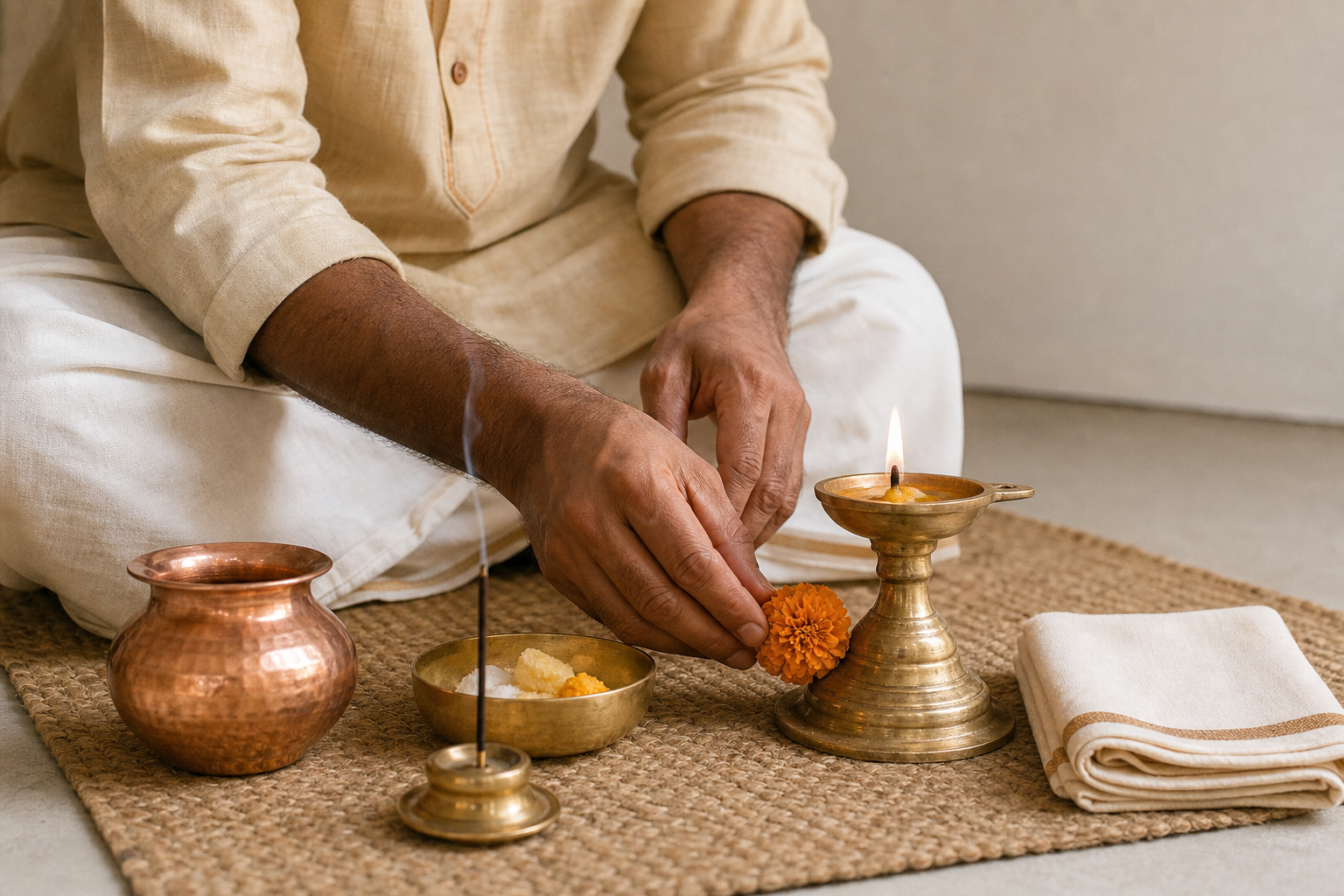
A well-formed ritual coordinates body, speech, materials, memory, intention, and time. That coordination is part of its value. It interrupts the assumption that a passing mood is the final authority and places the practitioner inside an order that was not invented for personal convenience.
A full Shaiva consecration can include sankalpa, nyasa, prana-pratishtha, abhisheka, alankara, and arcana. Sankalpa establishes the sacred resolve. Nyasa ritually places or associates divine presence within the ordered field of worship. Prana-pratishtha vitalizes the consecrated form. Abhisheka offers sanctified libations. Alankara adorns the deity, and arcana offers names, mantras, leaves, flowers, or other prescribed substances. A temple consecration is not a checklist for casual household improvisation, but its structure reveals an important ritual grammar: intention is embodied through correct sequence and concrete action.
Mimamsa takes that formal dimension seriously. Vedic action is not treated as free-form self-expression. The tradition grounds dharma in an apaurusheya Veda and distinguishes injunctions, or vidhi, from explanatory and laudatory passages, or arthavada. Its doctrine of apurva explains ritual efficacy through an unseen potency connecting a correctly performed action with its later result. This is why sincerity alone cannot replace the prescribed form within a Mimamsa account of Vedic ritual.
Yet correct form does not make every motive liberating. Desire-driven action generates finite consequences, while liberation requires the ending of the forces that produce further embodiment. A perfectly executed action undertaken for status, pleasure, or power remains within the economy of desired results. Its sacred setting does not automatically change its aim.
You can bring form and motive into alignment at three moments:
- Before the rite: State its actual purpose. If you want a finite result, acknowledge that honestly. If it is a duty, do not secretly convert it into a bargain for praise or advantage.
- During the rite: Follow the received sequence with attention. For technical observances, preserve the instructions transmitted through your family, temple, teacher, or sampradaya. Attention does not authorize you to discard form; form does not excuse inattentiveness.
- After the rite: Carry its discipline into the next duty. Do not use a peaceful moment in worship to overlook impatience, dishonesty, or neglect once you leave the shrine.
This gives you a better test than asking whether the ritual produced a powerful feeling. Feelings can accompany worship, but they are unstable. A more demanding test is whether the practice makes your conduct steadier, your motives more visible, and your attachment to recognition less controlling.
Bhakti is tested by humility, service, and accountability
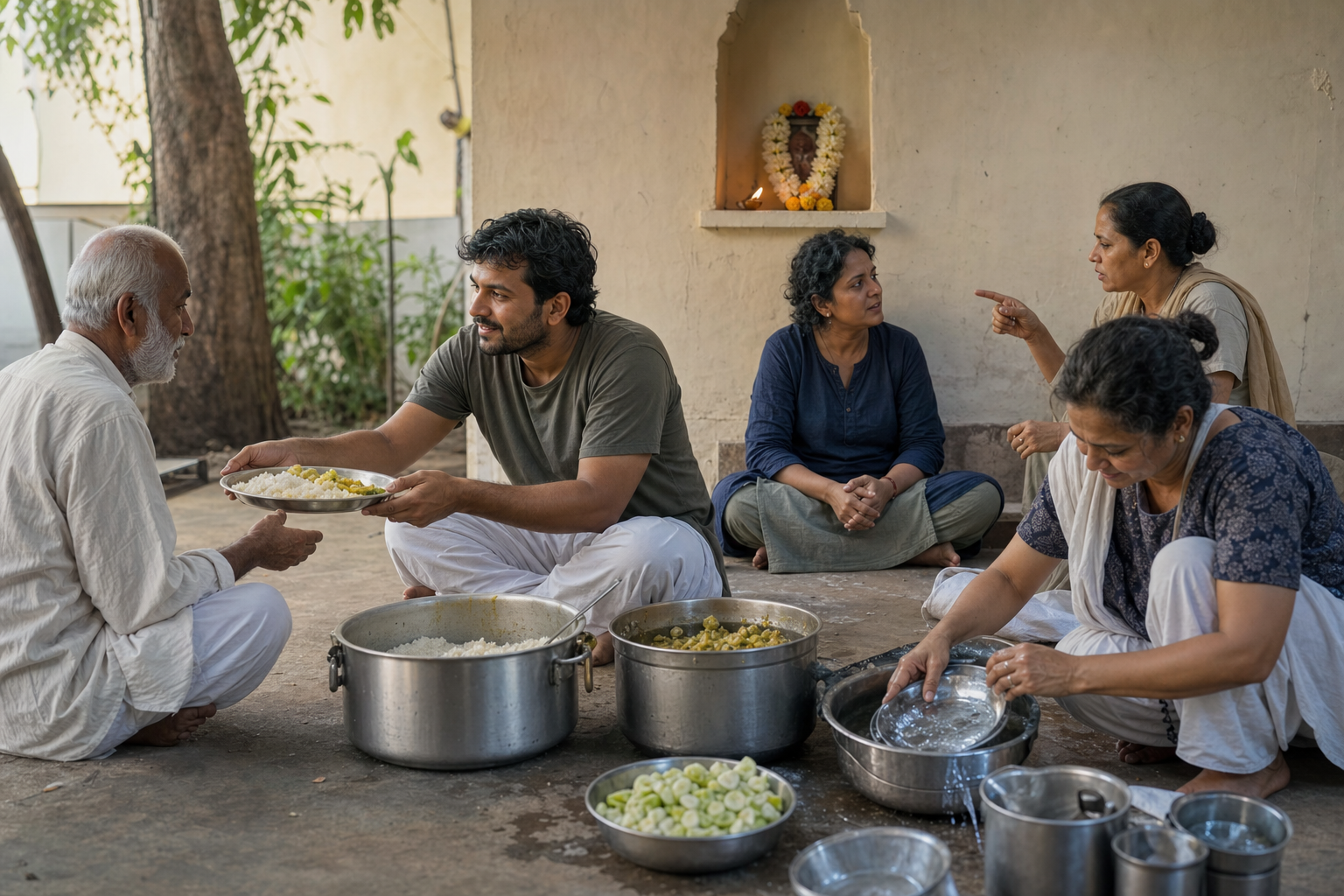
Devotion is sometimes reduced to emotion, but Hindu sacred memory gives it a harder edge. Bhakti asks whether strength can bow, whether accomplishment can remain grateful, and whether worship makes room for duties that the ego would rather avoid.
Rameshwaram offers a particularly clear example. The consecration of Shiva’s linga by Rama appears in the Ananda Ramayana and later Puranic, regional, and temple traditions rather than in the Valmiki Ramayana. Some retellings emphasize worship before battle; others emphasize post-battle atonement. In the latter framing, Rama undertakes prayaschitta after defeating Ravana, who is remembered as a Brahmana by lineage. The point is not that the defeat of adharma becomes morally equivalent to wrongdoing. The king accepts exemplary responsibility for the burden of action even after a just struggle.
The accompanying temple memory deepens that lesson. Hanuman is sent to Kashi for a linga, while Sita forms a sand linga so worship can occur at the required time. When Hanuman returns, Rama installs both. Worship begins with the Vishvalinga associated with Hanuman’s service before proceeding to the Ramalinga. Ritual order thereby becomes an act of gratitude: the devotee’s service is remembered rather than absorbed into the glory of the ruler.
The Shaiva and Vaishnava dimensions are equally important. Rama’s reverence for Shiva does not erase Rama-bhakti, and Shiva’s exalted place does not require hostility toward Vaishnava devotion. Rameshwaram holds both without reducing either to a sectarian trophy. The linga can also be understood as pointing beyond attributes while making the divine accessible through consecrated form. Form and transcendence need not be enemies.
Use four tests to distinguish devotion from religious self-importance:
- Accountability: Does worship make it easier to acknowledge the consequences of your actions, even when you believe your original aim was justified?
- Gratitude: Do you remember the service of those who helped you, or does every success become evidence of your own spiritual importance?
- Humility across sampradayas: Can you honor another Hindu path without weakening your own commitments or turning difference into rivalry?
- Service after surrender: Does bowing before the deity return you to duty with greater clarity, or become an escape from obligations?
Bhakti serves liberation by changing the direction of desire. Instead of treating the divine as an instrument for securing the ego’s preferred future, the devotee learns offering, dependence, remembrance, and surrender. Devotional Hindu traditions may give this surrender a direct liberating role. Mimamsa, by contrast, does not require a creator-God to guarantee ritual efficacy. That difference should be respected, not concealed under the claim that every school teaches exactly the same path.
Moksha is not a larger reward produced by more ritual

If a ritual produces a desired result through action, it is natural to imagine that enough merit, enough observance, or an especially great rite must eventually produce moksha. Mimamsa draws a decisive line against that assumption. Finite action can generate finite fruit; liberation requires the cessation of the process that binds the self to further embodiment.
Classical Mimamsa commonly describes moksha as atyantika-duhkha-nivritti, the complete cessation of suffering, and also uses terms such as apavarga and kaivalya. Its many eternal selves are distinct from bodies and senses. Pleasure, pain, memory, volition, and ordinary cognition depend on the embodied mind-sense complex. Liberation is therefore the self released from that complex and from the karmic causes of renewed embodiment.
This is a precise but comparatively austere account. It should not be silently rewritten as the bliss of devotional union or as the realization of non-dual Brahman. Nyaya-Vaisheshika also gives apavarga a cessation-centered character. Yoga speaks of kaivalya through disciplined stilling and discernment. Vedanta centers knowledge of Brahman and often describes liberation more positively, especially in non-dual interpretation. Lived Hindu practice can combine duty, devotion, contemplation, and knowledge, but the philosophical explanations remain genuinely different.
Within Mimamsa, the route to release involves knowledge of the self, the ending of binding desire, and the exhaustion of karma. Atma-jnana corrects identification of the self with body and mind. When desire no longer generates new action aimed at limited ends, fresh bondage-producing apurva ceases. Existing karmic conditions can then run their course without being replenished by another cycle of grasping and result-seeking.
The place of obligatory action remains nuanced. Bhatta and Prabhakara interpreters do not simply equate ritual performance with moksha. Obligatory duties performed without desire may purify or stabilize the practitioner and coexist with the pursuit of self-knowledge. Some interpretations emphasize that these duties express dharma rather than independently causing liberation. Knowledge and dispassion remain indispensable; kamya action aimed at finite results cannot end the whole structure of bondage.
Build a practice that points beyond itself
You do not need to discard observance in order to take liberation seriously. You need to stop assigning every observance the wrong promise. Use this sequence to keep the parts of your practice connected without collapsing them:
- Classify the act: Is it nitya, naimittika, kamya, prayaschitta, or primarily devotional? If more than one applies, name each function instead of leaving the purpose vague.
- Use an honest sankalpa: Do not call a request for a specific outcome pure renunciation. A finite wish can be approached within dharma, but it should not be disguised as moksha.
- Preserve the received form: Follow the discipline appropriate to the rite. Complex consecrations and expiatory acts should not be reconstructed from fragments merely because their names are familiar.
- Release ownership of the fruit: Notice the demand that the action produce your preferred result, timetable, recognition, or emotional state. Offering begins where that demand loosens.
- Pair worship with inquiry: Ask what in your experience changes and what you take the enduring self to be. In a Mimamsa framework, this means discriminating the self from body, senses, and mind. In another sampradaya, use that tradition’s own disciplined account rather than assembling an accidental philosophy.
- Test the next action: The first duty after worship is a useful mirror. If reverence in the shrine immediately becomes contempt, carelessness, or pride outside it, the practice has not yet penetrated conduct.
Know what needs correction before adding more observances
When a practice feels mechanical, the first remedy is not necessarily to abandon it or add a more dramatic ritual. Restore attention to its purpose and sequence. When it has become bargaining, name the desired result and place it in its proper category. When it produces sectarian superiority, return to humility. When devotional intensity becomes an excuse to neglect family, ethical, or social duty, dharma has been displaced rather than fulfilled.
If you remain unclear about whether your path understands ritual as preparation, participation in divine grace, or an independent duty, ask the question in the vocabulary of your sampradaya: What is bondage? What exactly is liberated? What removes bondage? What role belongs to karma, knowledge, devotion, and grace? Those answers determine how the pieces fit.
Key takeaways
- Ritual, devotion, and moksha are related, but they are not interchangeable names for the same activity.
- A rite directed toward a finite result has not necessarily failed; it simply belongs to a different level of purpose from liberation.
- Intention matters, but Mimamsa also insists on received form, scriptural authority, and correct performance.
- Bhakti is visible in humility, gratitude, service, and accountability after worship, not only in emotional intensity during it.
- Mimamsa does not treat moksha as the greatest ritual reward. It requires self-knowledge, non-attachment, the cessation of new binding karma, and release from embodiment.
- Hindu schools can share practices while explaining liberation differently. Coherence requires learning your path’s definition of the self, bondage, and release.
Begin with the observance you already keep. Name its real purpose before you perform it, follow its form carefully, and watch what happens to your claim on the result. That small act of clarity can turn inherited custom into conscious sadhana without pretending that one ritual has already completed the whole journey to moksha.
References
- DharmaRenaissance Blog — Rameshwaram’s Sacred Paradox: Ananda Ramayana on Rama Consecrating Shiva’s Jyotirlinga
- DharmaRenaissance Blog — Moksha in Mimamsa Darsana: Unraveling Liberation through Dharma, Ritual, and Knowledge