

You may have arrived with a blunt question: did Dharmic cosmology discover relativity before modern physics? The honest answer is more useful than either a boast or a dismissal. Dharmic traditions developed disciplined accounts of cosmic cycles, multiple realms and the limits of human perception. Modern relativity mathematically describes how clocks, distances and simultaneity depend on motion, gravity and the path of an observer.
The comparison matters because both unsettle the assumption that ordinary human experience is the measure of the cosmos. But they do so in different ways. If you distinguish shastric cosmology, physical measurement and contemplative experience, you can appreciate the resonance without forcing a Purana into a physics textbook or stripping it down to a metaphor.
Three different claims hide inside the word relative
When someone says that time is relative, ask what kind of claim is being made. At least three distinct meanings appear in conversations about Dharmic cosmic time:
- Physical relativity: two clocks can accumulate different amounts of proper time because they follow different paths through spacetime or occupy different gravitational conditions. Distances and simultaneity also depend on the observer’s frame and the spacetime geometry.
- Cosmological plurality: time is not presented as flowing uniformly across every loka. A duration measured in a higher realm can correspond to an immense span in human reckoning. This is a claim about the architecture of the cosmos and the beings who inhabit it.
- Experienced duration: attention, embodiment and mental state affect how long an interval feels. Absorption in japa or dhyana may make an hour seem brief, while agitation can make a few minutes feel prolonged.
These meanings can illuminate one another, but they are not interchangeable. A change in felt duration does not mean that a nearby laboratory clock has slowed. A ratio between the time of devas and humans does not, by itself, identify a velocity or gravitational field. And physical time dilation does not establish a metaphysical hierarchy of lokas.
This distinction gives you a quick way to assess ambitious claims. If a speaker moves from meditation to black holes to Brahmaloka without marking the change of category, the argument has probably outrun its evidence. Keep asking: is this a measurement, a cosmological teaching, an experience or a spiritual conclusion?
Read the shastric clock on its own terms

Dharmic cosmic time is not merely a vague assertion that the universe is old. Hindu cosmology presents nested units connected by definite ratios. In the conventional yuga calculation, one deva year corresponds to 360 human solar years. Each yuga includes a principal period as well as an opening sandhya and closing sandhyamsha. Omitting those transitions or treating deva years as ordinary human years produces a radically shorter chronology that does not match the classical calculation.
| Cycle | Composition in deva years | Total deva years | Human solar years |
|---|---|---|---|
| Satya Yuga | 4,000 + 400 + 400 | 4,800 | 1,728,000 |
| Treta Yuga | 3,000 + 300 + 300 | 3,600 | 1,296,000 |
| Dvapara Yuga | 2,000 + 200 + 200 | 2,400 | 864,000 |
| Kali Yuga | 1,000 + 100 + 100 | 1,200 | 432,000 |
| Mahayuga | All four yugas | 12,000 | 4,320,000 |
The scale continues upward. One thousand mahayugas make the daytime of Brahma, equal to 4.32 billion human years. A night of the same length follows, producing an 8.64-billion-year day-night. With 360 such day-nights in a year of Brahma and 100 such years in Brahma’s lifespan, the total reaches approximately 311 trillion human years. The recurring 4.32 ratio gives this temporal architecture a recognizable internal rhythm.
This arithmetic also settles a practical dispute about our present place in the cycle. The traditional Kali epoch begins in 3102 BCE. By 2026 CE, roughly 5,127 to 5,128 solar years have elapsed, depending on the calendar convention and the exact February boundary used in the count. Roughly 426,000 to 427,000 years therefore remain within the 432,000-year Kali Yuga. A period of spiritual renewal within Kali Yuga may still be described as golden, but it should not be confused with the formal beginning of Satya Yuga.
What should you conclude from the precision? First, the numbers deserve to be represented accurately. They form a coherent shastric system rather than an invitation to choose whichever cycle suits a modern theory. Second, numerical coherence is not the same thing as experimental confirmation. Multiplying deva years by 360 reconstructs the traditional chronology; it does not derive gravitational time dilation. Respecting that boundary protects the integrity of both discussions.
What modern relativity establishes, and where the analogy stops

Modern relativity does not merely say that time feels different to different people. It concerns what ideal clocks and rulers measure under specified physical conditions. Space and time form a connected spacetime structure, and measured intervals depend on an observer’s motion, trajectory and gravitational environment.
- Motion: observers moving relative to one another can disagree about elapsed time, length along the direction of motion and whether separated events are simultaneous.
- Gravity: clocks in different gravitational conditions can accumulate different amounts of time. Near a black hole, a distant observer assigns an increasingly slow rate to a clock approaching the event horizon, although the traveler does not experience the local clock as malfunctioning.
- Geometry: mass-energy affects spacetime curvature. Space is therefore not an inert, universal container against which every distance can be read in exactly the same way.
- Cosmic expansion: the distance between remote galaxies cannot always be reduced to movement through a fixed background. Proper, comoving and luminosity distances answer different observational questions in an expanding geometry.
That is the precise sense in which space as well as time is relative. It does not mean that space is imaginary, that every estimate of distance is equally valid or that concentrated thought physically shortens a journey. It means that a meaningful distance requires a metric, a path, an observer and a stated measurement procedure. The same discipline applies to time: you must specify which clock follows which trajectory.
Where the comparison is sound
The strongest bridge is conceptual. Both frameworks warn you against treating the human clock and map as the unquestioned standard for all reality. Dharmic cosmology assigns different temporal scales to different lokas; relativity shows that elapsed duration and spatial separation are not universal quantities detached from physical context. Both therefore discipline the instinct to universalize one limited standpoint.
A second bridge concerns the relation between space and time. Puranic cosmography places beings within an ordered plurality of realms whose spatial and temporal scales belong together. Relativity joins spatial and temporal measurements within spacetime. The ontologies differ, but neither picture leaves time as a single cosmic metronome ticking independently of every condition.
Where the comparison becomes overclaim
- A resemblance is not a derivation. The statement that time passes differently in two lokas does not supply the spacetime metric, gravitational field or relative velocity needed to calculate physical time dilation.
- A loka is not automatically a reference frame. The terms belong to different explanatory systems. Equating them requires an argument, not a shared use of ratios.
- Felt time is not proper time. Meditation may profoundly change temporal awareness without producing a corresponding difference between physical clocks.
- Large numbers are not experimental measurements merely because they are exact. The yuga figures have shastric, calendrical and philosophical significance. Relativity earns physical precision through operational definitions and testable consequences.
- Physics does not answer the soteriological question. An equation describing clocks cannot determine the nature of moksha, karma, the Self or the Timeless.
Before repeating a claim that Dharmic texts contain modern relativity, apply four tests. What exactly is being measured? Which conditions cause the difference? Can the claim generate a distinct prediction? Is the proposed connection an analogy, an interpretation or an asserted identity? If no clock procedure, mechanism or prediction is available, call it a philosophical resonance rather than a scientific equivalence.
One cosmic question receives several Dharmic answers
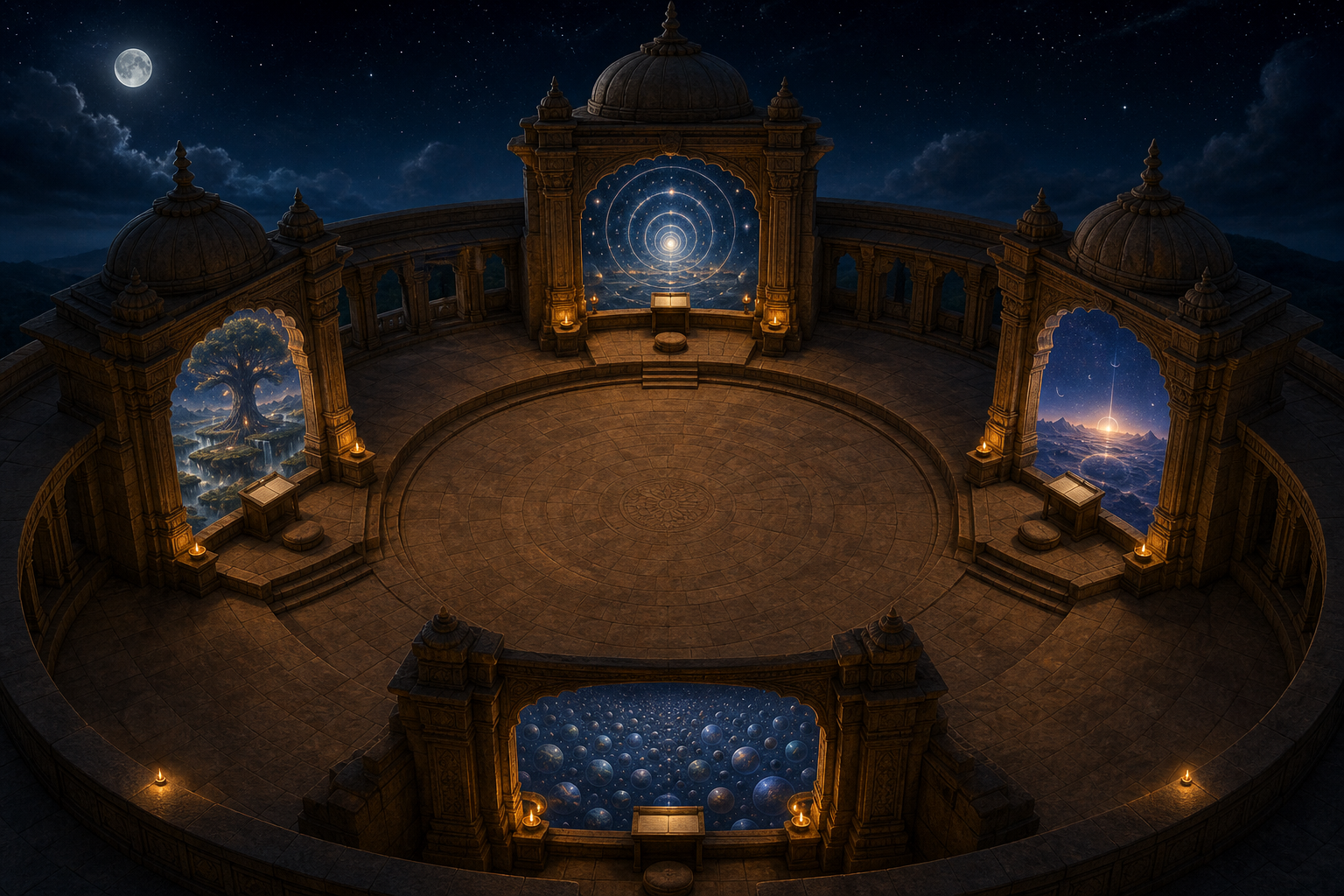
The Dharmic family shares an expansive refusal to confine reality to one human lifetime, but unity does not require flattening every tradition into the same doctrine. Each tradition asks what persists, what changes and how liberation relates to temporal existence. Their answers remain distinct.
- Hindu traditions: Puranic cosmology describes yugas, kalpas and multiple lokas. Nyaya-Vaisheshika treats kala and dik as all-pervading substances while explaining how intervals and directions are apprehended relationally through bodies, senses and mind. Upanishadic reflection turns from immense duration toward the Self that is not exhausted by temporal change.
- Buddhist traditions: vast kalpas and innumerable world-systems expand the scale of conditioned existence. Some Buddhist analyses emphasize momentariness, while dependent arising and emptiness deny that temporal and spatial properties possess an independent essence untouched by relations and conditions.
- Jain traditions: loka-akasha designates the space occupied by beings and matter, while aloka-akasha lies beyond that inhabited cosmos. Spatial units such as pradesha accompany cyclical time expressed through avasarpini and utsarpini, with units and spans extending far beyond ordinary imagination.
- Sikh thought: Akaal directs attention to the Timeless, while Hukam situates the changing cosmos within divine order. References to yugas serve a spiritual orientation rather than making liberation dependent on waiting for a more favorable epoch.
The shared insight is not that Brahman, shunyata, the Jain liberated vantage and Akaal are interchangeable names. It is that human beings should not mistake their present location in time and space for the whole of reality. When comparing traditions, begin with that common discipline of humility, then let each vocabulary retain its own philosophical work.
This also changes how you approach a dark age. Cosmic scale is not permission for fatalism. A long Kali Yuga does not postpone dharma until the calendar improves. Buddhist practice does not wait for the end of a kalpa, Jain discipline does not wait for a favorable half-cycle, and remembrance of Akaal does not require escape from present responsibility. The scale relativizes the ego’s urgency, not the moral weight of action.
Turn cosmic scale into better judgment and practice

Key takeaways
- Dharmic cosmic time and physical relativity share a challenge to naive human-centered absolutes, but they are not the same theory.
- The traditional mahayuga calculation uses 12,000 deva years, equivalent to 4.32 million human years; the sandhya periods are part of the total.
- Physical relativity requires defined clocks, rulers, observers, trajectories and gravitational conditions.
- Altered time-sense in japa or meditation concerns experience unless a separate physical clock effect is demonstrated.
- The responsible claim is philosophical resonance, not proof that Puranic cosmology secretly contains modern field equations.
You can now make the comparison useful in three concrete ways:
- Reproduce the arithmetic before debating it. Write down the deva-year total, include both transitional periods, multiply by 360 and state the resulting human-year scale. This immediately exposes most short-yuga category errors.
- Label the level of every claim. In your notes, use four columns: shastric quantity, physical observable, experienced duration and metaphysical meaning. Do not move a statement from one column to another without explaining the bridge.
- Test your own time-sense modestly. Before japa, dhyana or silent prayer, note the clock time. At the end, estimate the elapsed interval before checking the clock again. Record both values. The difference can teach you how attention conditions experience, but do not present it as evidence that physical spacetime changed.
A careful sentence is often stronger than a grand one. Instead of claiming that the Vedas proved Einstein, say: Dharmic cosmology articulated a layered universe in which temporal scales differ across realms, while modern relativity mathematically derives differences in measured duration from motion and gravity. That formulation honors the achievement of each framework and tells your listener exactly what the comparison can bear.
The next time a cosmic claim crosses your screen, do not choose between embarrassment and exaggeration. Check the conversion, identify the kind of relativity and mark where the analogy ends. Then bring the scale back to the decision in front of you: however immense the kalpa, the time available for dharma is the present moment.
References
- Dandavats – Is Space Also Relative? Dharmic Cosmology and Modern Physics on Time, Place, and Perception
- Dandavats – Decoding the Four Yugas: Shastric Evidence, Deva-Year Calculations, and Our Place Today