

If you are trying to judge whether West Bengal is heading for continuity or a change of government in 2026, do not begin with the loudest rally, a single confrontation, or the latest allegation circulating online. Begin with a harder question: which party is resolving the specific doubt that prevents a swing household from trusting it?
That question makes this election easier to read. The BJP must show that its Hindutva, Bengali identity, security and anti-corruption appeal can expand beyond its stronger regions without appearing culturally external or threatening welfare continuity. The TMC must show that reliable welfare still outweighs fatigue over corruption allegations, recruitment controversies, public safety and the shortage of dignified work. You can track both tests without pretending that every headline changes the race.
The 2021 result is a baseline, not a prediction
The TMC ended 34 years of Left Front government in 2011. The BJP then surged in the 2019 Lok Sabha election and established itself as the principal opposition in the 2021 Assembly election. That last contest produced the essential numerical baseline: TMC won 213 of the Assembly’s 294 seats, while BJP won 77.
Those numbers do not prove that 2026 will repeat 2021. They do show the different scale of each party’s task. The TMC can defend power by preserving enough of its welfare coalition even if dissatisfaction rises. The BJP needs more than a broad anti-incumbent mood: it must hold its established ground and produce connected clusters of gains elsewhere.
This distinction matters because Assembly elections are decided constituency by constituency. A large swing concentrated in seats already held comfortably may change the statewide vote without changing many seats. A smaller swing across a belt of closely contested constituencies can alter the seat map sharply. When you see a poll, rally or defection, therefore, ask where the effect is located. A claim of statewide momentum that cannot identify its conversion corridors is incomplete.
- Retention: Can BJP preserve and extend its position in North Bengal and Jangalmahal? Can TMC prevent local dissatisfaction from becoming a regional pattern?
- Expansion: Can BJP make sustained gains in the Hooghly-Howrah-Nadia belt, the 24 Parganas and outer Kolkata rather than win scattered constituencies?
- Consolidation: Does the minority vote remain concentrated behind TMC, or do local issues and smaller parties create meaningful seat-level variation?
- Turnout: Which side can bring women, young voters and first-time voters to the booth in the suburban and peri-urban constituencies where small changes may decide several seats?
Read West Bengal as five electoral theatres

West Bengal is not one uniform contest. Its border districts, tribal belts, industrial corridors, riverine districts and metropolitan periphery present different combinations of identity, livelihood and governance. Treating them separately will tell you more than a single statewide narrative.
- North Bengal: Cooch Behar, Alipurduar, Jalpaiguri and Darjeeling form part of BJP’s necessary retention-and-expansion route. Border management may matter here, but so do tea-garden welfare, road and market access, tribal concerns in the Dooars and the everyday quality of administration. Security rhetoric becomes electorally durable only when voters can connect it to lawful policing and better local services.
- Jangalmahal: Jhargram, Purulia, Bankura and parts of West Midnapore are often discussed through identity and party loyalty. A more useful test is whether commitments on forest rights, hostels, skills, farming and routes to market are specific enough to be checked. BJP needs to retain trust here; TMC needs to turn its local network and welfare delivery into recovered support.
- The Hooghly-Howrah-Nadia and 24 Parganas arc: This industrial and peri-urban corridor is crucial to BJP’s expansion prospects and TMC’s defence. Jobs, commuting, housing, safety and service delivery meet identity politics directly here. Matua concerns also make clarity on CAA-related regularisation important in relevant constituencies. Vague assurances are less persuasive than an accessible process, a realistic timetable and protection against arbitrary treatment.
- Murshidabad and Malda: Large minority electorates make consolidation especially consequential in these eastern districts. TMC benefits when the election is perceived primarily as a choice over communal security. Education, infrastructure, jobs and fair policing can nevertheless produce local variation, while Left-Congress arrangements or ISF candidates may affect close multi-cornered contests.
- Kolkata and its outer periphery: Urban and suburban voters are especially exposed to the gap between political promises and daily experience. Employment, prices, safe mobility, recruitment fairness and municipal services can matter more than ideological messaging alone. Watch outer wards and adjacent constituencies as a cluster; isolated urban anecdotes do not establish a wider swing.
The practical rule is simple: never transfer evidence automatically from one theatre to another. A border-security message that resonates in a frontier constituency may not answer a peri-urban family’s concern about work. A cash benefit that stabilises a rural household may not overcome recruitment frustration among educated youth. Bengal’s winner will be the party that adapts its argument without losing a coherent statewide identity.
What each political camp must prove
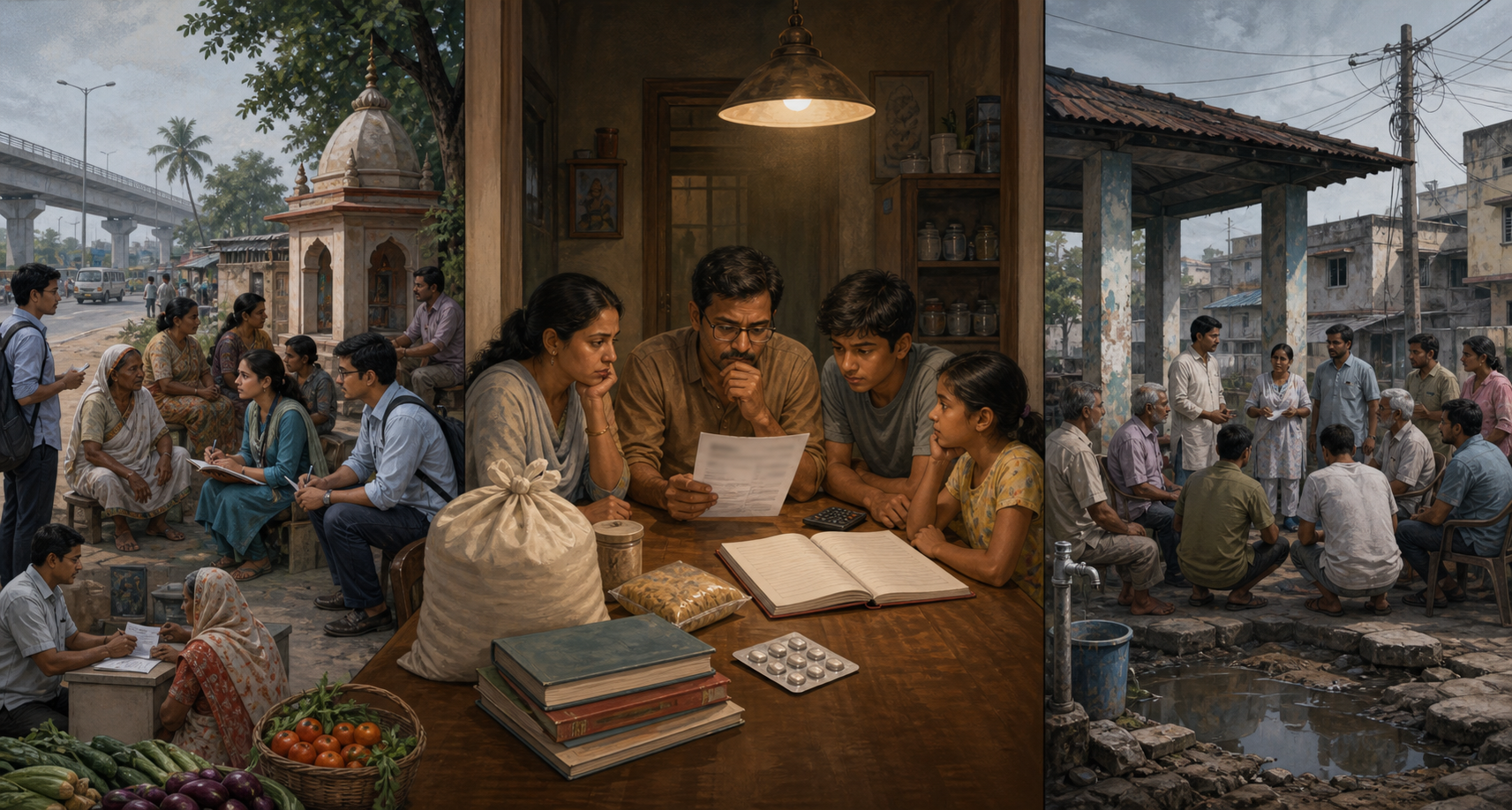
BJP: Bengali-rooted Hindutva must become a governing offer
BJP’s cultural opportunity is real, but cultural references alone will not complete the argument. Bankim Chandra Chattopadhyay, Swami Vivekananda, Netaji Subhas Chandra Bose and Durga Puja cannot be treated as decorations around a nationally standardised campaign. Their use succeeds only when language, candidate conduct, policy and local organisation demonstrate an understanding of Bengal rather than a temporary claim upon it.
This is why Bangla asmita matters to BJP’s route. The party is trying to present a Bengal-rooted civilisational identity compatible with a wider Hindutva framework. If the idiom feels imposed from Delhi, TMC’s outsider argument gains force. If it respects Bangla language and aesthetics while remaining accessible to Hindi-speaking and tribal-language communities, it can become a broader belonging rather than a narrow cultural test.
BJP must also connect security to governance. Border management, organised crime and communal tension are legitimate public concerns. Yet a security proposal needs a constitutional basis, accountable policing, accessible grievance procedures and protection for innocent citizens. Collective suspicion may create noise, but it weakens the durable coalition BJP needs. The persuasive formulation is security with justice, followed by visible investment in schools, health, transport and work.
The party’s hardest practical question concerns welfare. A household that depends on an established benefit will not necessarily exchange certainty for a general promise of cleaner administration. BJP therefore needs to explain which benefits continue, how leakage will be reduced, where complaints will go and how quickly they will be resolved. Its path widens when anti-corruption becomes better delivery rather than merely punishment of the incumbent.
TMC: welfare must survive the tests of trust and aspiration
TMC enters the contest with a recognisable delivery architecture. Duare Sarkar, Swasthya Sathi, Lakshmir Bhandar and Kanyashree allow the party to speak to households through familiar benefits rather than distant ideology. Its panchayat- and ward-level networks strengthen that advantage by tying political contact to service access.
But familiarity can become vulnerability when citizens believe access depends on intermediaries, favour or silence. Recruitment, coal and cattle-related allegations remain allegations, and TMC portrays investigative action as politically orchestrated. The electoral issue is not resolved merely by repeating either side’s accusation. It is whether voters see a credible process for recruitment, procurement, investigation and appeal that applies consistently, including to politically connected people.
TMC’s second challenge is aspiration. Welfare can protect a family from immediate volatility without producing the secure job a young voter wants. A defence based only on existing transfers leaves BJP room to speak to stagnation. TMC strengthens its case when it can link household security to industrial renewal, MSME credit, predictable approvals, logistics improvements and district-level employment.
Left-Congress and ISF: influence may exceed seats won
Smaller formations do not need a plausible statewide path to affect the final balance. Left-Congress configurations and ISF can change margins in selected constituencies by attracting voters who would otherwise consolidate behind one of the two leading parties. The relevant question is not simply how many seats a smaller party might win. It is which leading party loses votes, in which constituency, and whether the transfer is large enough to change the winner.
This is especially important in seats with a concentrated minority electorate or a strong residual Left organisation. Do not assume that an alliance announcement automatically transfers every supporter’s vote. Candidate acceptability, local history and booth organisation determine whether arithmetic on paper becomes behaviour at the polling station.
Seven indicators that can separate movement from campaign noise

You do not need privileged polling data to assess the direction of the race. Track a small set of visible indicators and insist on constituency-level evidence. Each one tests a mechanism that could actually change a vote.
- Last-mile welfare reliability: Ask whether eligible households receive cash support on time, whether health claims are accepted without unreasonable friction and whether complaints are closed with a documented outcome. A large budget or beneficiary total does not tell you whether a disputed claim was resolved in a particular block.
- Recruitment transparency: Teacher recruitment has become a test of fairness as well as employment. Look for published eligibility rules, verifiable lists, deadlines and an appeal route. A fresh announcement does not repair distrust if candidates still cannot understand how selection decisions were made.
- A real employment pipeline: Bengal has potential in the Haldia and Kolkata port economy, chemicals and petrochemicals, tea and agri-processing, leather, light engineering and creative industries. Measure progress through operational milestones: credit reaching MSMEs, logistics work advancing, power and environmental decisions being completed predictably, and employers actually recruiting. Memoranda and investment claims without execution dates are weak evidence.
- Women’s household economics: Women voters may evaluate Lakshmir Bhandar, health cover, housing, LPG affordability and safe mobility as one household-security package. A party that discusses only the headline value of a benefit misses the cumulative friction of refills, travel, medical claims and interrupted payments. Listen for evidence about access, not only entitlement.
- Rights-protective security: On border management and public order, examine the proposed method. Does it identify a legal authority, professional enforcement, judicial or administrative review and a remedy for wrongful action? A plan that cannot answer those questions risks replacing security with arbitrary power.
- SC, ST, OBC and Matua follow-through: In the relevant constituencies, track clarity on CAA-related concerns, forest rights, hostels, skills, tea-garden welfare and farm-to-market links. An endorsement by a community figure is not proof that households have shifted. Service experience and credible procedural answers are stronger signals.
- Booth strength without coercion: BJP has invested in booth management and cadre expansion, while TMC retains dense local networks. Organisation matters because it finds supporters, resolves practical problems and protects turnout. It becomes democratically corrosive when it relies on intimidation. Candidate visibility, trained booth agents, Election Commission oversight and incident-free campaigning are therefore electoral indicators as well as safeguards.
Apply the same evidentiary standard to both sides. When TMC cites welfare, ask about the unresolved case. When BJP cites corruption, ask what administrative process it would replace and how continuity would be protected. When either side cites jobs, ask for the industry, location, implementation stage and route by which a local worker will qualify.
A Dharmic standard for judging both campaigns
If you approach the election from a pro-Hindu and Dharmic standpoint, you do not have to choose between cultural confidence and competent government. Dharma does not require you to excuse corruption because a party offers welfare, excuse arbitrary power because a party promises security, or accept a decorative use of Bengali civilisation in place of cultural understanding.
Bengal’s lineage from Sri Chaitanya through Sri Ramakrishna and Swami Vivekananda offers a more demanding measure: spiritual confidence spacious enough to coexist with social responsibility. A contemporary political expression of that inheritance should respect Hindu life and festivals, recognise the presence of Buddhist, Jain and Sikh traditions, protect lawful citizens and refuse to make collective blame a substitute for evidence.
A pro-Hindu perspective has no obligation to minimise border security, communal violence or cultural marginalisation. It also gains nothing by turning every failure of policing, recruitment or municipal delivery into a communal test. The stronger position demands lawful security, equal accountability and the confidence to speak about Bengali Hindu civilisation without reducing neighbours to permanent suspects.
Use five questions when a candidate or campaign asks for your support:
- Which public service is failing in this constituency, and what is the deadline for fixing it?
- Which local industry can create dignified work here, and what obstacle currently prevents it from doing so?
- What legal protection prevents a security measure from being used against an innocent citizen?
- How will recruitment, contracting and welfare grievances be published, reviewed and appealed?
- Will the candidate commit to non-violent campaigning and accept independent electoral oversight even when it disadvantages the party?
A campaign that cannot answer these questions is asking you to vote on sentiment alone. Sentiment matters in politics, especially where identity and dignity have been neglected, but it should lead to an enforceable governing promise.
Key takeaways
- BJP’s path requires retention in North Bengal and Jangalmahal plus connected gains in the industrial and suburban corridors; a statewide rise without geographic conversion is insufficient.
- TMC’s advantage rests on welfare familiarity and local organisation, but corruption fatigue, recruitment distrust and weak employment prospects can loosen that coalition.
- Women, young voters, Matuas, SC and ST communities and minority voters should not be treated as automatic blocs; local delivery and turnout will determine how statewide messages convert into seats.
- The most credible governing formula is identity with dignity, security with due process, and welfare that leads toward work rather than permanent dependence.
Before you revise your view of the election, locate the claimed change on the map and connect it to one of these mechanisms. Then ask for evidence that a household can feel: a resolved health claim, a transparent recruitment list, a safer journey, a functioning grievance route or a job that exists beyond the podium. That is where Bengal’s 2026 verdict will become legible.