Someone has praised your child at length, your family has brought home a new vehicle, or a public success has suddenly placed you under many eyes. An elder recommends circling dried chillies and salt, but you are unsure what the ritual means, how closely its steps must be followed, or whether filling the room with chilli smoke is wise.
You can preserve the custom without turning it into fear. The chilli-salt practice known as nazar utarna, drishti nivarana, or kanna drishti tegalu is a compact household rite of protection. Its soundest form is brief, intentional, safe around fire, and free of accusations against whoever may have offered praise or attention.
Key takeaways
- The chilli-salt rite belongs primarily to lokachara, or living household custom. It should not be presented as a universally prescribed Vedic ceremony.
- A common method uses an odd number of dried red chillies and a palmful of coarse salt, circled clockwise from head toward feet three or seven times.
- Heat the materials only with good ventilation. Chilli vapour can irritate the eyes, nose, throat, and lungs, especially for children and people with asthma or respiratory sensitivity.
- Popping chillies and sharp smoke are physical effects, not reliable measurements of how much nazar was present.
- The rite should remove anxiety and restore gratitude. It should never be used to blame, shame, or identify another person as the source of harm.
- Use the ritual alongside ordinary care. It does not replace medical help, sensible privacy, vehicle safety, home security, or any other practical response to a real problem.
What the ritual is meant to do
In this folk understanding, nazar is not necessarily an independent evil being. It is the unsettling residue associated with concentrated attention: envy, excessive admiration, an unguarded glance, or praise that makes a blessing feel suddenly exposed. Terms such as drishti dosha describe that disturbance, while raksha refers broadly to protection and the restoration of balance.
This distinction changes how you perform the rite. You are not conducting an investigation into who looked at you. You are marking the end of an uncomfortable moment, placing the person or possession back within the household’s field of care, and releasing the family’s worry through a familiar action.
The Atharvaveda contains a broad concern with averting harmful influences, and the Grihya-sutras establish domestic ritual as an important part of Hindu life. Neither, however, should be cited as an exact recipe for burning dried chillies and salt. The particular method is better understood as lokachara: customary knowledge carried through families and regions. Its Dharmic intelligibility comes from the wider place given to raksha, domestic observance, and sadachara, or good custom.
The materials form a simple symbolic vocabulary. The chilli brings red colour, heat, pungency, and a cleansing sting. Salt suggests purification, absorption, and grounding. Agni provides transformation: the ingredients that have symbolically gathered the unwanted residue are changed by heat and dispersed. Mustard seeds, ajwain, or a small piece of camphor may appear in regional or family versions, but they are additions rather than requirements for every household.
Ayurvedic language can help explain why these materials feel culturally coherent, but it should not be mistaken for an Ayurvedic prescription of the ritual. Pungency, or katu rasa, is associated with sharpness and dispersion; salt, or lavana rasa, has an integrating and grounding character. In the rite, these sensory qualities support sankalpa, the intention with which the action is undertaken.
The practical sequence is therefore easy to remember: gather, circle, transform, release. If a local variation still follows that arc and remains consistent with care and non-harm, it is not invalid merely because another family performs it differently.
How to perform the rite carefully at home
Prepare the setting before you begin
Choose a calm moment rather than starting in the middle of a crowded celebration. Some families favour Tuesday or Saturday because of traditional associations with Mangal and Shani, but that timing is customary, not a universal scriptural requirement. The rite may be done after a homecoming, school honour, public appearance, vehicle delivery, wedding-related event, or housewarming whenever a family’s own tradition considers it appropriate.
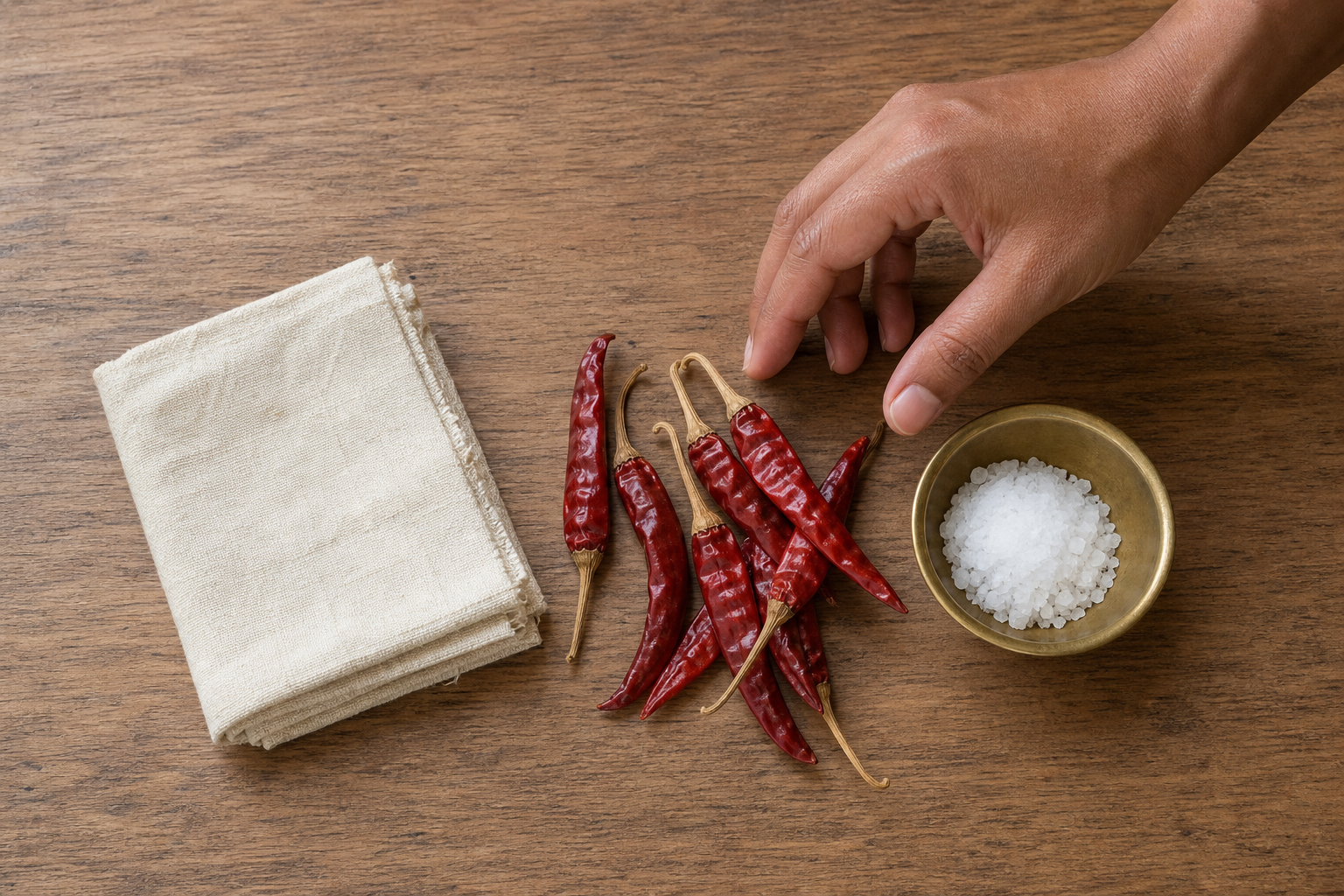
Gather an odd number of dried red chillies and a palmful of coarse salt, such as rock salt or sea salt. If mustard seeds or ajwain belong to your inherited method, place them with the salt. You will also need a heat-safe plate or bowl, a suitable hot tawa or other controlled heat source, and a safe place for the materials to cool afterward.
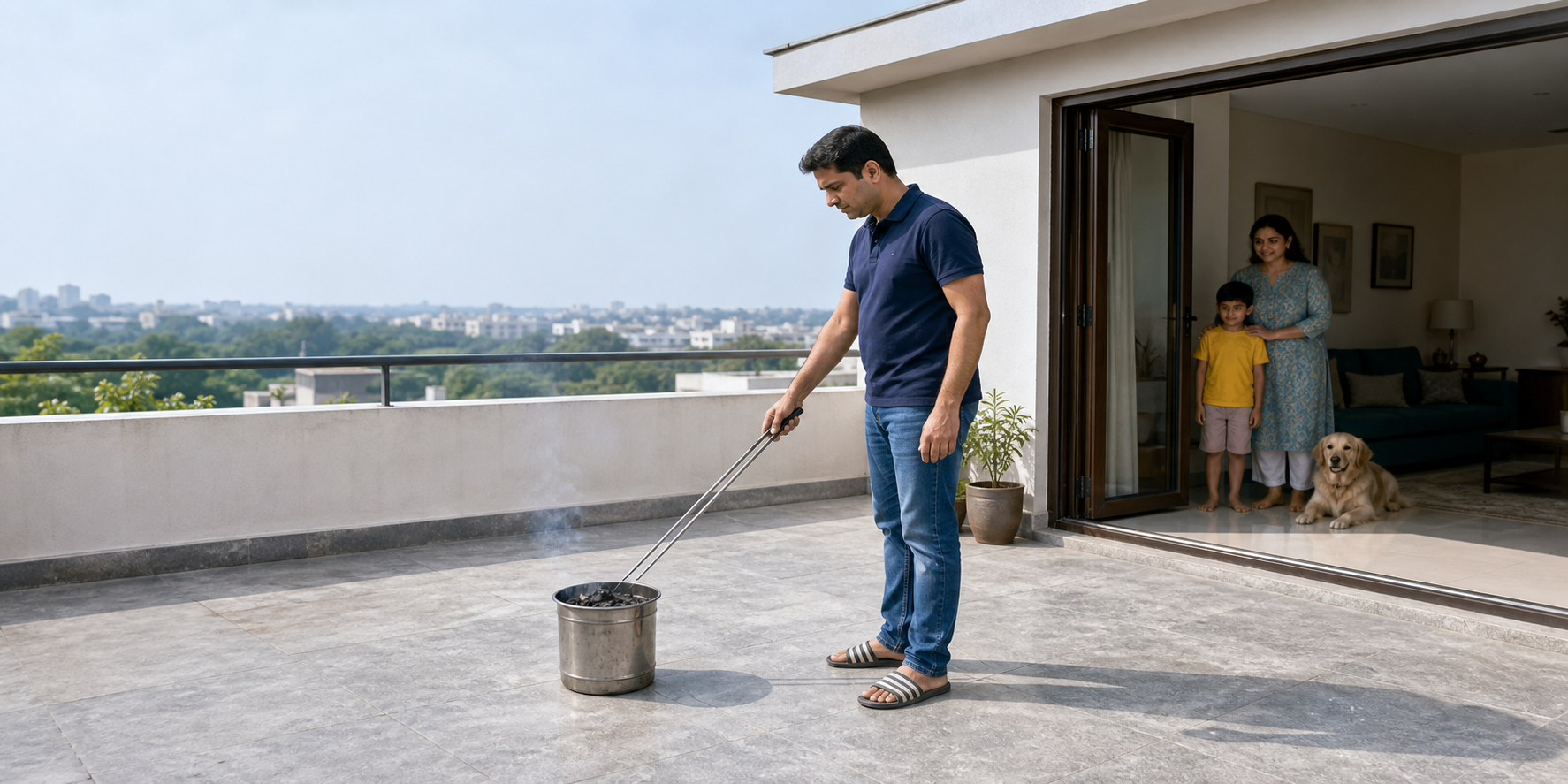
Ventilation is not an afterthought. Open the windows and use a strong kitchen exhaust if you intend to heat chillies indoors. Keep children, pets, loose clothing, and flammable objects away from the cooking area. An adult should supervise the entire process. If anyone nearby has asthma, respiratory sensitivity, or a strong reaction to pungent smoke, do not burn chillies in that space.
Follow the symbolic sequence
- Set a clear intention. Hold the chillies and salt together and pause. A short family prayer, remembrance of the chosen deity, or silent sankalpa is sufficient. There is no single mantra required across all regional versions.
- Keep a respectful distance. Have the person stand or sit comfortably. For a child, the adult performing the rite should keep the ingredients well away from the face and hands. For a vehicle or household object, avoid touching paint, fabric, lamps, or anything that could be scratched or ignited.
- Circle the ingredients. A widespread form moves clockwise, beginning near the head and sweeping toward the feet, for three or seven rounds. The downward arc represents the removal of lingering attention from the whole person. Adapt the size of the arc for an object while preserving the same intention.
- Transfer the materials to heat. Place them on a hot tawa under an exhaust or use the controlled fire method followed in your household. Do not lean over the pan or deliberately inhale the smoke. There is no spiritual advantage in producing more smoke than necessary.
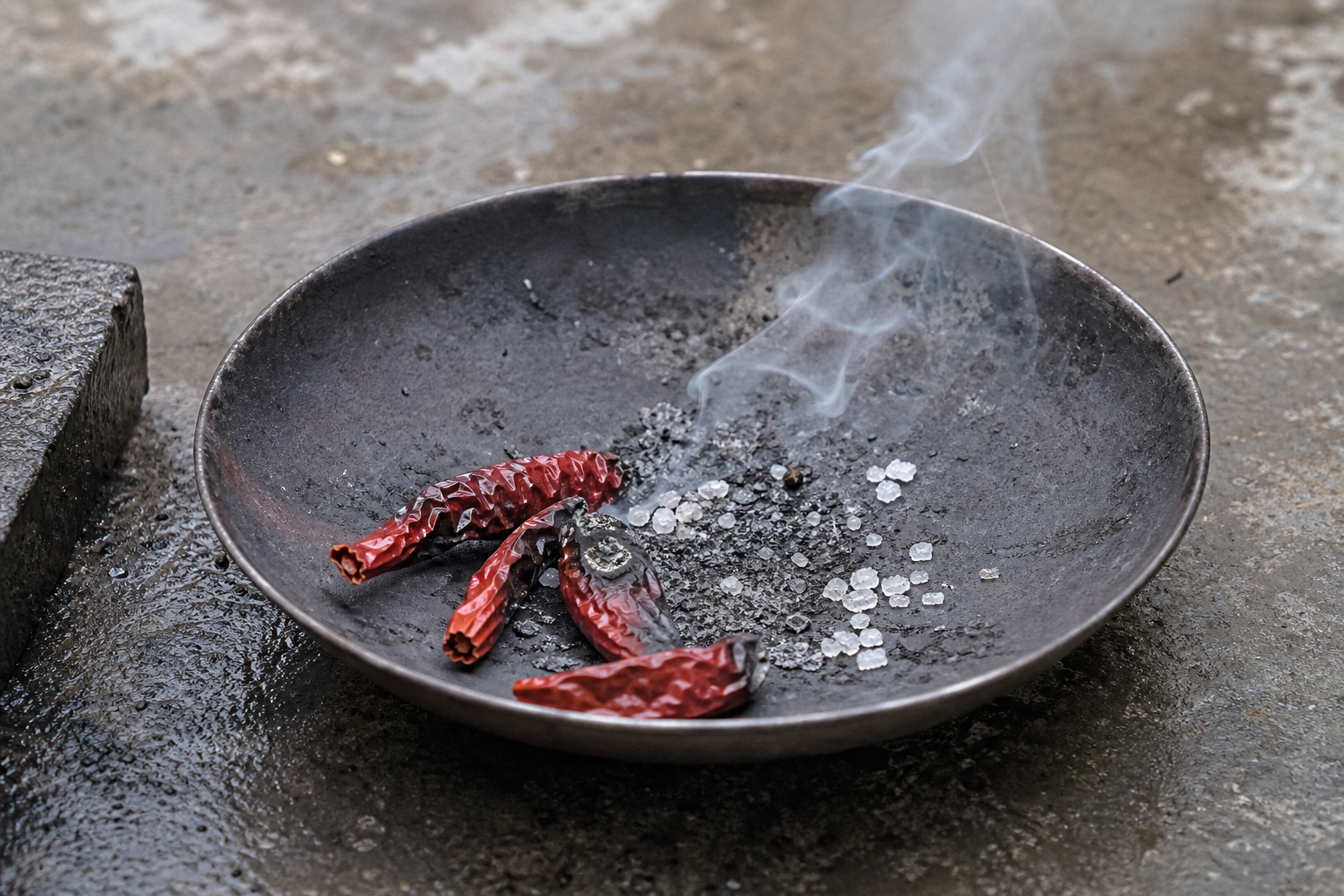
- Let the transformation finish. Crackling, pungent vapour, and some smoke may occur. Once the brief heating is complete, turn off the heat and leave the remains undisturbed until fully cool.
- Discard the cooled remains respectfully. Place them somewhere they will not be casually stepped upon. Finish with a short prayer, a diya where safely appropriate, or a moment of gratitude for the blessing that first attracted attention.
If your grandmother circles in a different direction, uses a different count, or includes a regional ingredient, treat that variation as family practice rather than an error to be corrected from a generic checklist. Precision matters most in your intention, safety, and respect. Folk rites rarely possess one centralised form binding every Hindu household.
When burning chillies is unsuitable
An apartment fire rule, a smoke detector, a newborn in the home, respiratory illness, or poor ventilation is a sufficient reason to modify the final step. You may perform the circling and use a controlled hot tawa beneath a functioning exhaust if that is safe. Some families substitute a brief camphor offering, although camphor also involves flame and vapour and must be handled carefully.
If no safe form of burning is available, retain the prayer and circling while omitting the smoke-producing step. The purpose of a household protection is not served by creating a breathing problem, a fire hazard, or distress for a child. Ahimsa and good judgement are not interruptions to the custom; they are part of its proper frame.
What popping and pungent smoke can actually tell you
Household lore sometimes treats loud popping as evidence of strong nazar and especially sharp smoke as proof of heavy drishti. These interpretations give the rite dramatic closure, but they are not dependable diagnostic tests.
The sensory effects have ordinary material causes. Moisture held within a dried chilli can expand when heated and rupture its skin. Salt may crackle on a hot surface. Airborne chilli compounds irritate mucous membranes, producing coughing, tears, or a burning sensation. The strength of these effects can vary with the chillies, their remaining moisture, the amount used, the temperature, and the ventilation.
That explanation does not make the ritual meaningless. Rituals often work through visible change, sound, scent, and a definite ending. The crackle tells the family that an action has been completed; the transformation by heat makes release tangible. The mistake is to turn a useful symbol into an instrument for measuring invisible danger or identifying a supposed culprit.
If the smoke is unexpectedly harsh, stop the heating, move people to clean air, and ventilate the room. Do not continue because you believe discomfort proves the rite is working. If a person is ill or remains physically unwell, seek appropriate medical care. If the concern is theft, harassment, or unwanted public exposure, take the relevant security and privacy measures. Nazar utarna may accompany practical care, but it cannot replace it.
The same restraint applies to anxiety. Perform the rite, close it with gratitude, and return to ordinary life. Repeating it solely because the smoke did not look dramatic enough changes a rite of reassurance into a cycle of uncertainty.
Keep the practice protective, not accusatory
The most important ethical rule is simple: clear the nazar without naming a person as its source. A relative may praise too enthusiastically without wishing harm. A neighbour may look with curiosity rather than envy. Even when you feel uneasy about someone’s attention, the ritual gives you a way to respond without confrontation, gossip, humiliation, or retaliation.
This is where gratitude becomes more than a decorative ending. Beauty, achievement, a healthy child, a new home, or a useful vehicle can produce pride as well as apprehension. A prayer, diya, or minute of silence returns the household’s attention to the blessing itself. Humility replaces the impulse to police every glance.
Regional diversity supports this restrained approach. North Indian families commonly speak of nazar utarna or a nazar battu. Tamil households may use the language of drishti pariharam or drishti suttu; in Karnataka, kanna drishti tegalu names a related protective sweep. Lemon-and-chilli charms appear on vehicles and storefronts in parts of Gujarat and Maharashtra, while protective figures such as the drishti bommai redirect attention at a threshold. Related safeguards also take locally shaped forms across Bengal, Odisha, Andhra, Telangana, and Kerala.
These forms belong to a family of practices, not one rigid ceremony. A hanging nimbu-mirchi charm creates a protective boundary; a chilli-salt firing stages removal and transformation; a threshold figure acts as a visual decoy. Knowing the difference helps you choose the form your family actually intends instead of combining every protective object into an anxious display.
Everyday protection also crosses Dharmic community boundaries without erasing theological differences. Some Buddhist households place simple safeguards beside protective paritta recitations. Jain families may give priority to inner purity while retaining gentle domestic customs. Sikh families centre Ardas and scriptural remembrance while sometimes acknowledging familiar protections around newborns or newlyweds. The shared element is care in a moment of heightened attention, not a claim that all traditions teach an identical doctrine of nazar.
When the next highly visible moment arrives, decide on the method before the room becomes busy: choose the ingredients your family recognises, settle on three or seven circles, prepare ventilation, and keep the closing prayer brief. Then let the rite do what a good household custom should do: mark care, restore proportion, and allow everyone to move forward without fear or blame.