
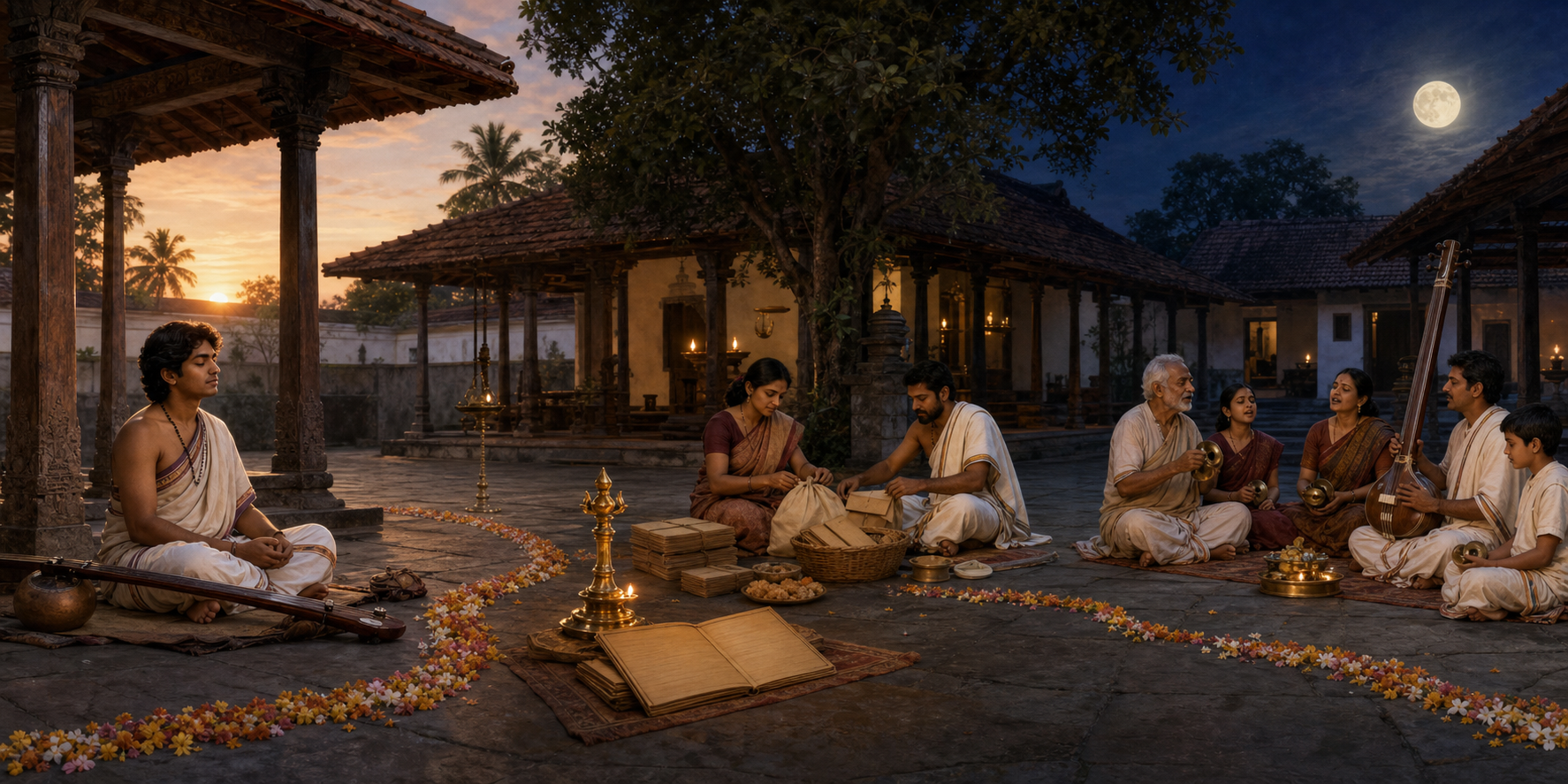
If you have saved the festival dates but still do not know what to do with them, Vaishakha can quickly become calendar clutter: three reminders, three hurried pujas, and no lasting change. In 2026, three observances offer a more coherent path. Matangi Jayanti trains speech, Vidyaranya Jayanti disciplines judgment, and Annamacharya Jayanti turns devotion into song and seva.
You do not need an elaborate ceremony for every date. You need the correct local tithi, one practice suited to each spiritual legacy, and a modest vow that survives after the festival. Here is how to build that observance without confusing distinct traditions or attempting rites that belong under guru-guidance.
Mark the tithi first, then build your civil calendar
For most Indian calendars, the three anchor dates are April 19, April 23, and May 1. Treat them as planning dates until you have checked a reliable panchang for your location.
| Civil date in most Indian panchangs | Lunar observance | Practice to emphasize |
|---|---|---|
| April 19, 2026 | Vaishakha Shukla Tritiya: Matangi Jayanti and Akshaya Tritiya | Ethical speech, learning, creative discipline, and dana |
| April 23, 2026 | Vaishakha Shukla Saptami: Vidyaranya Jayanti | Guru-bhakti, study, discernment, and institutional service |
| May 1, 2026 | Vaishakha Purnima: Annamacharya Jayanti | Sankeertana, reflection on divine oneness, and annadanam |
A tithi does not begin and end at civil midnight. Its clock times change with location, and communities may apply sunrise, daylight, moonrise, or family-specific rules when a tithi touches two dates. Amanta and Purnimanta calendar systems can also affect how the lunar month is named and understood regionally. This is why a festival date copied from an Indian calendar cannot simply be carried into another time zone.
- Enter all three civil dates in your calendar as provisional observance dates.
- Check when the relevant tithi begins and ends at your location, not merely in India.
- Ask which rule your family, temple, matha, or sampradaya follows when the tithi spans two civil dates.
- If a community celebration is moved to a weekend, keep a short home sankalpa on the locally correct tithi and attend the larger gathering separately.
- Record the rule you followed. That note will be more useful next year than a screenshot containing unexplained clock times.
If two calendars disagree, do not assume that one must be careless. First compare location, tithi boundaries, sunrise, lunar-month convention, and the observance rule being applied. A local temple calendar is especially useful when you intend to participate in its puja rather than conduct an independent household observance.
April 19: Make Matangi worship a discipline of speech
Matangi is revered as the ninth Mahavidya and as Tantrik Saraswati, the divine power associated with speech, literature, music, learning, and cultured expression. Her 2026 Jayanti falls on the same Shukla Tritiya as Akshaya Tritiya, joining the refinement of vak with the aspiration for merit and prosperity that endure.
The practical question is not whether you can perform the most complex ritual. It is whether your words become more truthful, precise, compassionate, and responsible. A person who completes an ornate puja and then returns to gossip, humiliation, or reckless public argument has preserved the outer date while missing Matangi’s most demanding lesson.
- Begin with a narrow sankalpa. Name one field of speech that needs discipline: family conversation, professional communication, teaching, writing, music, public debate, or online conduct. Avoid asking vaguely for eloquence while leaving its ethical use undefined.
- Prepare a sattvic altar. Use a clean image or yantra according to your tradition. Green cloth, foliage, a veena image, or a parrot motif may recall Matangi’s familiar iconography, but none is a substitute for inward attention.
- Offer what you can prepare reverently. Coconut, fruit, betel leaves, turmeric-scented akshata, jaggery or sugar preparations, and sattvic cooked rice are appropriate household offerings where family custom permits them.
- Keep mantra practice within your lineage. Recite a mantra received from a qualified teacher or use a familiar stotra, name-remembrance, or silent meditation. Do not assemble an advanced Tantric practice from disconnected instructions.
- Complete the puja with a speech vrata and dana. For the rest of the day, refuse gossip, deliberate exaggeration, and language meant to degrade another person. Donate a book, help a student, or support music and arts education so that the day’s concern for knowledge becomes material service.
Tantric accounts connect Matangi with ucchishta, or sacred leavings, and thereby challenge rigid assumptions about purity, exclusion, and what society discards. The household lesson is to notice how wisdom can transform the neglected into insight and compassion. It is not permission to imitate esoteric ucchishta rites without initiation. Householders generally keep Matangi worship sattvic, while advanced methods remain the responsibility of a qualified guru and parampara.
Akshaya Tritiya is often made synonymous with buying gold. A purchase may be a family custom, but it is not the measure of the observance. If resources are limited, do not turn a sacred day into financial pressure. Dana, japa, study, and the beginning of a sustainable learning practice express the promise of akshaya more directly than a purchase made only because advertising created urgency.
Give the vrata a concrete test. Before sending an important message on April 19, pause and ask: Is it true? Is its tone proportionate? Does the recipient need it in this form? That small interruption between impulse and expression is more useful than treating vak-siddhi as a supernatural guarantee of persuasive power.
This discipline also creates an honest bridge across the dharmic family. Buddhist Right Speech, Jain ahimsa in word and the humility encouraged by Anekantavada, and Sikh reverence for the shabad all resist careless or injurious language. The traditions remain distinct, but they meet in the conviction that speech carries moral consequence.
April 23: Let Vidyaranya turn study into duty
Vidyaranya Jayanti honors a sage remembered at the meeting point of Advaita, education, temple stewardship, and civilizational renewal. He is also called Madhavacharya or Madhava Vidyaranya; he should not be confused with Madhvacharya of Udupi, the major teacher of Dvaita Vedanta. That distinction matters when you search for texts, talks, or biographical material.
Vidyaranya’s name is closely associated with the Sringeri Sharada Peetham and with traditional accounts of counsel offered to Harihara I and Bukka Raya I during the emergence of Vijayanagara. His legacy therefore asks more than private contemplation. It asks what scholarship is for, which institutions preserve knowledge, and how spiritual clarity should affect public responsibility.
Panchadasi, Jivanmuktiviveka, and Sarvadarshanasangraha are traditionally associated with Vidyaranya or his intellectual circle, although details of authorship and dating remain debated. Preserve that uncertainty rather than turning traditional attribution into a claim of uncontested modern scholarship.
A useful household observance can fit into one focused study session:
- Light a lamp and remember the guru-parampara according to your tradition.
- Read a manageable passage from a trusted edition of Panchadasi, especially a selection concerned with viveka, rather than rushing through many pages.
- Write down one decision currently clouded by status, resentment, fear, or attachment. Separate what you know from what you merely prefer, then identify the duty that remains even if praise or advantage disappears.
- End with a concrete act of support for learning or community welfare: contribute to a library, help a student obtain a text, support a traditional teacher, participate in annadana, or volunteer for a temple educational program.
Panchadasi is organized as fifteen chapters in three groups associated with discrimination, illumination, and bliss. You do not need to master all fifteen on the Jayanti. Read slowly enough to notice where Advaita’s vocabulary has become a slogan in your mind rather than an instrument of inquiry. One paragraph examined honestly can be more faithful to viveka than an impressive reading target completed without reflection.
Sarvadarshanasangraha surveys markedly different schools, including Charvaka, Buddhism, Jainism, Nyaya, and Mimamsa before culminating in Advaita. Whatever position you finally hold, that architecture places a demand on debate: understand an opposing view before answering it. For one day, adopt three rules in every dharmic disagreement: state the other position in terms its adherent would recognize, separate evidence from insult, and identify precisely where the disagreement begins.
This matters for cultural advocacy. Civilizational confidence is weakened, not strengthened, when every internal difference is flattened or every difficult question is treated as betrayal. Vidyaranya’s legacy joins intellectual rigor to cultural resilience. Your observance should therefore leave either a clearer mind or a stronger institution behind, preferably both.
May 1: Move Annamacharya’s devotion from listening to participation
Annamacharya Jayanti falls on Vaishakha Purnima in 2026 and honors the Telugu saint-poet whose sankeertanas made devotion to Sri Venkateswara and Alamelu Manga intimate, memorable, and singable. Tradition attributes as many as 32,000 compositions to him, while roughly 14,000 survive in copper-plate records preserved through the work of Tirumala Tirupati Devasthanam.
That preservation history should change how you observe the day. Do not make Annamacharya merely the background music to another activity. Choose a small set of compositions, understand their meaning, and participate with your own voice, even if you are not a trained Carnatic musician or a fluent Telugu speaker.
- Prepare the devotional center. Offer a simple puja to Sri Venkateswara and Alamelu Manga according to family practice. Panchopachara or Shodashopachara may be used by those already familiar with those forms.
- Select three compositions before the day begins. Vinaro Bhagyamu Vishnu Katha, Adigo Alladigo Srihari Vasamu, and Brahmam Okate provide a workable sequence of sacred hearing, pilgrimage-oriented devotion, and reflection on divine oneness. Tandanana Ahi is another familiar option.
- Read before you sing. Find a reputable transliteration and translation, read the meaning aloud, and then listen to an established rendition. This prevents melody from concealing the theological and ethical content of the words.
- Make the gathering participatory. Give everyone the refrain and its meaning. Children can begin with Brahmam Okate, which is widely used as an accessible entry into Annamacharya’s devotional corpus.
- Let food complete the music. Arrange annadanam, contribute groceries to a community kitchen, or serve a sattvic meal. Sankeertana becomes seva when the shared voice is followed by shared care.
Annamacharya’s compositions move between metaphysical devotion and the intimate language of madhurya-bhakti. Brahmam Okate is especially remembered for expressing divine oneness in a form that carries an egalitarian ethical force. Use that teaching carefully. Oneness does not require pretending that social divisions or human indignities are imaginary; it requires refusing to turn them into measures of a person’s spiritual worth.
If you organize a community program, resist the temptation to imitate concert conditions. Print transliteration and meaning, keep at least part of the program open to group singing, and give a speaker enough time to explain one composition well. A shorter gathering in which people understand and sing is closer to the participatory force of sankeertana than a long sequence that leaves the audience passive.
May 1 also carries a wider Vaishakha context. Vaishakha Purnima is observed as Buddha Purnima or Vesak in Buddhist communities and as Kurma Jayanti in several Vaishnava traditions. This convergence is an opportunity for mutual regard, not a license to merge distinct histories and practices into a generic festival.
If you host an inter-dharmic program, let practitioners explain their own traditions. A Buddhist reflection on disciplined awareness, a Vaishnava sankeertana, a Jain account of ahimsa and intellectual humility, or Sikh shabad kirtan can illuminate a shared moral horizon without claiming that every community observes the same Jayanti. The bridge is ethical and contemplative; it need not be built by erasing difference.
Key takeaways for Vaishakha 2026
- Confirm locally: April 19, April 23, and May 1 are the principal 2026 planning dates in most Indian panchangs, but the operative tithi and observance rule must be checked for your location.
- On April 19, discipline speech: keep Matangi worship sattvic at home, follow your lineage for mantra, make an ethical speech vow, and direct Akshaya Tritiya dana toward learning or the arts.
- On April 23, connect study to service: read one Advaita passage carefully, apply viveka to a real decision, and strengthen an educational, temple, or welfare institution.
- On May 1, participate in devotion: learn the meaning of selected Annamacharya sankeertanas, sing with others, and complete the observance through annadanam or another form of seva.
- Respect boundaries: do not improvise advanced Tantra, turn traditional attribution into false historical certainty, or collapse different dharmic observances into one indistinct ritual.
- Keep one practice: carry a speech discipline, study session, singing practice, or seva commitment into an ordinary week after Vaishakha Purnima.
Before April 19, make a one-page preparation sheet. Write down your local tithi rule, one speech vow, the Vidyaranya passage you will read, three Annamacharya compositions, and the person or institution that will receive your dana. That single page removes most of the last-minute friction that turns observance into improvisation.
On May 2, choose what continues. Put one weekly practice on the calendar and make it small enough to keep: a careful pause before consequential speech, a page of serious study, one sankeertana sung with attention, or regular service to a learning or food initiative. Vaishakha’s spiritual legacies become yours only when the festival date changes the ordinary day that follows it.

References
- DharmaRenaissance Blog — Matangi Jayanti 2026: Unlock Vak-Siddhi and Prosperity on Akshaya Tritiya (April 19)
- DharmaRenaissance Blog — Annamacharya Jayanti 2026: Definitive Vaishakha Purnima Guide to Date, Rituals and Legacy
- DharmaRenaissance Blog — Vidyaranya Jayanti 2026: Date, Puja Guide, and the Timeless Legacy of Vijayanagara’s Sage