
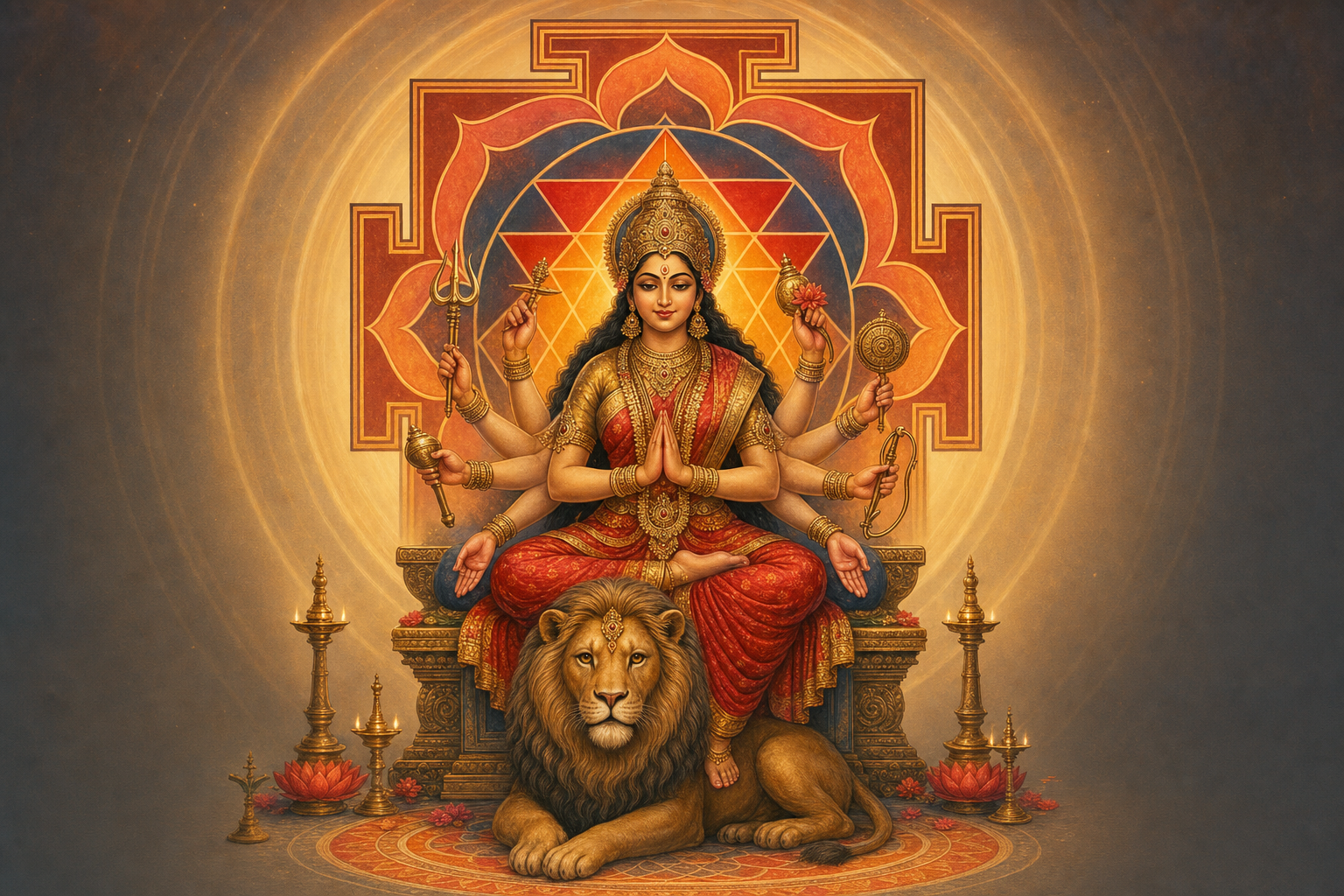
You are looking at a many-armed Goddess, a lion-throne, a geometric yantra or a single Sanskrit syllable. You sense that every detail matters, but the explanations you find either reduce it to decoration or promise an instant occult code.
There is a better way to read it. Begin with relationships: who occupies the center, what power has been placed beneath or around that center, how sound and geometry organize attention, and what the symbol asks a practitioner to become. This lets you take Shakta and Tantric imagery seriously without pretending that every symbol has one context-free translation.
Read the symbolic grammar before decoding isolated objects
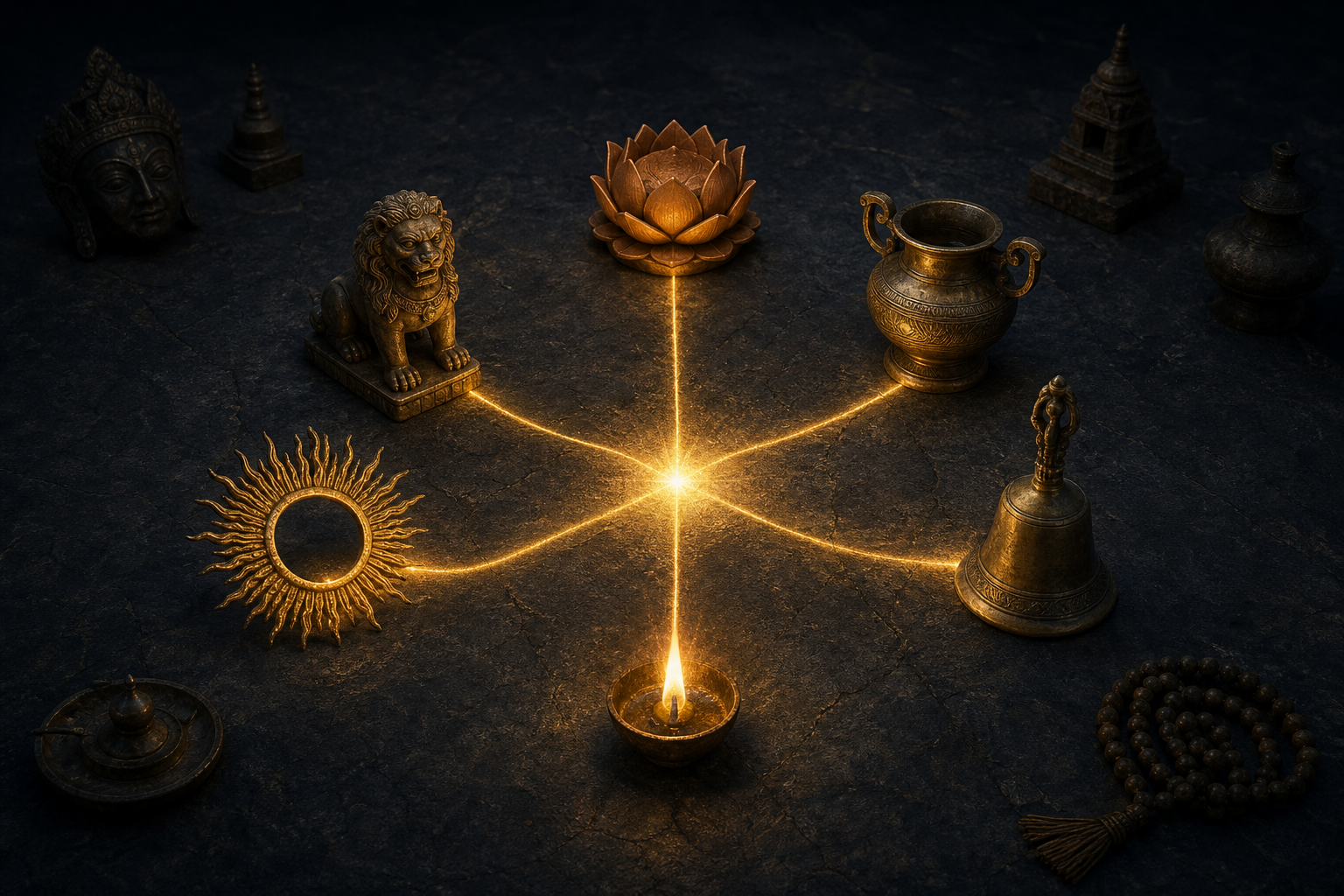
Shakta and Tantric symbolism works more like a grammar than a box of labels. A lion does not mean exactly the same thing wherever it appears. A triangle is not exhausted by a dictionary definition. A bīja, or seed syllable, cannot be understood merely by attaching an English noun to it.
Your first question should therefore be relational: What does this detail do within the whole sacred form? In Mahādevī-centered Shakta theology, the Goddess can be worshipped as the ground, governing intelligence and final goal of manifestation. Her weapons, seat, vehicle, attendants and gestures must be read within that theological claim. They are not accessories placed around an otherwise passive deity.
Tantra adds a ritual dimension to this visual language. A sign can identify a deity, express a cosmological principle and perform a function in worship at the same time. Tantric methods occur in Śaiva, Śākta and Vaiṣṇava settings, while related seed-syllable practices also appear in Vajrayāna Buddhism. Tantra is therefore not simply another word for Goddess worship, and not every Shakta image should be forced into one Tantric system.
Use four questions whenever you meet an unfamiliar symbol:
- Identity: Which deity, title, mantra or ritual system is actually present?
- Position: Is the element above, beneath, within, surrounding or facing something else?
- Function: Does it protect, enthrone, attract, sever, reveal, conceal, teach or mark a boundary?
- Practice: Is it meant to be viewed, contemplated, recited, installed through nyāsa or activated within a specific initiation?
The title Indra Parameshwari shows why this method matters. Recognizing the word Indra and immediately identifying the Goddess as Indra’s consort would produce the wrong reading. In Sanskrit compounds such as narendra, lord of men, and gajendra, lord of elephants, indra can mark pre-eminence. Parameshwari joins parama, supreme, with īśvarī, lady or ruler. The complete title therefore presents the Goddess as the Highest Sovereign; it does not name Indrāṇī or Śacī.
That correction gives you a dependable rule: never decide the meaning of a Sanskrit compound, mantra or icon by the first familiar fragment. Establish the full identity before interpreting any detail around it.
Let the lion, throne and sacred center form one statement
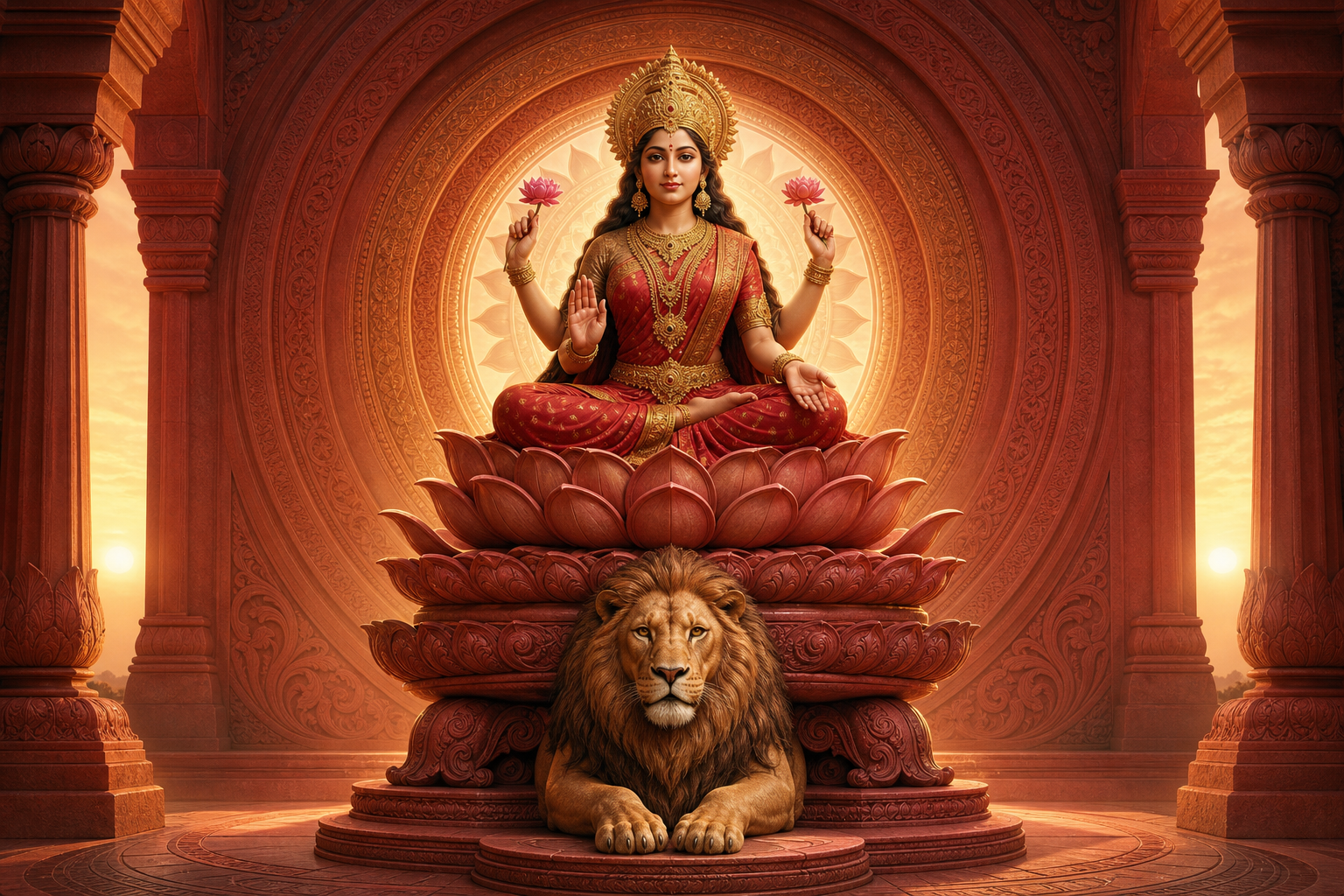
Consider the lion-seated Goddess. If you isolate the lion, you may end with a thin answer such as strength or royalty. The complete arrangement says more. The lion signifies fearless protection, royal authority and kṣatra, the capacity to defend rightful order. The Goddess seated upon it shows that this force has been governed by wisdom rather than released as appetite or aggression.
Position sharpens the meaning. A siṃhavāhinī image, in which the lion bears the Goddess, can emphasize protective action and the movement of divine power. A siṃhāsana, or lion-throne, emphasizes enthronement, stability and rightful sovereignty. During Navaratri and Durga Puja, the lion-associated Mahishasuramardini makes protective power publicly visible; in contemplative worship, the throne can also become an inward image of powers brought under lucid command.
This is why domination is a poor ethical translation of Shakta sovereignty. The image joins capacities that must not be separated: courage with discernment, protection with compassion, authority with accountability, and decisive action with humility. If an interpretation glorifies uncontrolled force, it has ignored the fact that the lion is mastered and the throne is ordered.
Śrīvidyā makes the relationship between throne and center especially precise. Lalitā Tripurasundarī is envisioned on the lion-throne upheld by the Pañcabrahmas, presiding over the Śrī Chakra. Its nine enclosures, or āvaraṇas, arrange a contemplative movement from differentiated multiplicity toward the center and the fullness of nondual bliss, ānanda.
Do not look at the Śrī Chakra as a merely attractive pattern. Ask what changes as attention moves inward. The perimeter gives way to progressively concentrated enclosures; plurality is not rejected but gathered toward its governing center. The diagram thus teaches through spatial organization: scattered experience can be recollected without denying the world from which the movement began.
The lion also belongs to a wider Dharmic visual vocabulary, but shared vocabulary does not erase doctrinal difference. The Buddha’s siṃhanāda, or lion’s roar, signifies fearless proclamation of truth, and the siṃhāsana can serve as a teaching seat. Jain symbolism associates the lion with Mahāvīra and uses the throne to express the Jina’s poised transcendence. The name Singh carries an ideal of sovereign courage in Sikh tradition. These resonances help you recognize a civilizational field of fearlessness and rightful authority. They do not make a Buddha image, a Jina image, a Sikh name and a Shakta murti interchangeable.
Connect sacred sound, geometry and the practitioner’s body

A Tantric symbol often operates through more than one medium. Mantra gives it a sonic body. Yantra gives it a spatial body. Mudrā gives it a gestural body. Nyāsa places its letters or mantras upon the practitioner’s embodied field. Reading only the picture while ignoring these connections leaves much of the symbolic structure invisible.
A bījākṣara is called a seed because a compact sound carries a larger field of deity, element, intention and realization. Sanskrit letters can be contemplated as mātṛkās, the mothers whose combinations unfold articulated existence. A bīja is therefore not an arbitrary abbreviation or a decorative character placed on a poster.
The following associations are useful starting points, not universal do-it-yourself instructions:
| Sound or group | Common association in the mapped traditions | What to notice |
|---|---|---|
| oṁ | A universal key joining Vedic and Tantric contemplative frameworks | How an all-encompassing sound prepares or frames a more specific practice |
| laṁ, vaṁ, raṁ, yaṁ, haṁ | Earth, water, fire, air and space; often correlated in sequence with mūlādhāra through viśuddha | The ordered movement from one element and subtle center to another |
| aiṁ | Vāgbhava, associated with Sarasvatī and expressive intelligence | The relationship between sacred speech, knowledge and articulation |
| hrīṁ | Often called the māyā-bīja, joining radiance with concealment and revelation | How manifestation can both disclose and veil its ground |
| śrīṁ | Auspiciousness, prosperity and sustaining abundance | Abundance as a power of nourishment and continuity, not mere acquisition |
| klīṁ | The kāma-bīja, associated with attraction, cohesion and devotional magnetism | The power that draws separated attention toward relationship and focus |
| hūṁ and phaṭ | Protection, boundary-setting, severing and obstacle-clearing | The difference between guarding a consecrated field and acting from hostility |
Even this table must be handled carefully. Bīja interpretation can change with lineage, mantra and ritual placement. A traditional analysis may read consonant, vowel and bindu as distinct powers. One interpretation of hrīṁ, for example, relates its components to Śiva, dynamic Śakti and an undifferentiated seed-state. Another lineage may emphasize the same syllable differently. The variation is not a flaw to be repaired by choosing whichever explanation sounds most attractive.
Placement matters as much as lexical association. A seed syllable at a yantra’s center establishes a concentrated locus. Syllables distributed across petals or bodily points articulate differentiated powers. In kara-nyāsa, mantra is placed on the hands; in aṅga-nyāsa, on the limbs; in mātṛkā-nyāsa, the alphabet is installed across designated bodily locations. Sound, attention and embodiment are thereby brought into one ritual act.
Japa likewise has audible, whispered and mental modes, known as vācika, upāṁśu and mānasa. These are not merely three volume settings. They represent progressively interior ways of sustaining the mantra. The method, cadence, visualization and intended result belong to the practice as a whole.
Separate informed contemplation from technical ritual performance
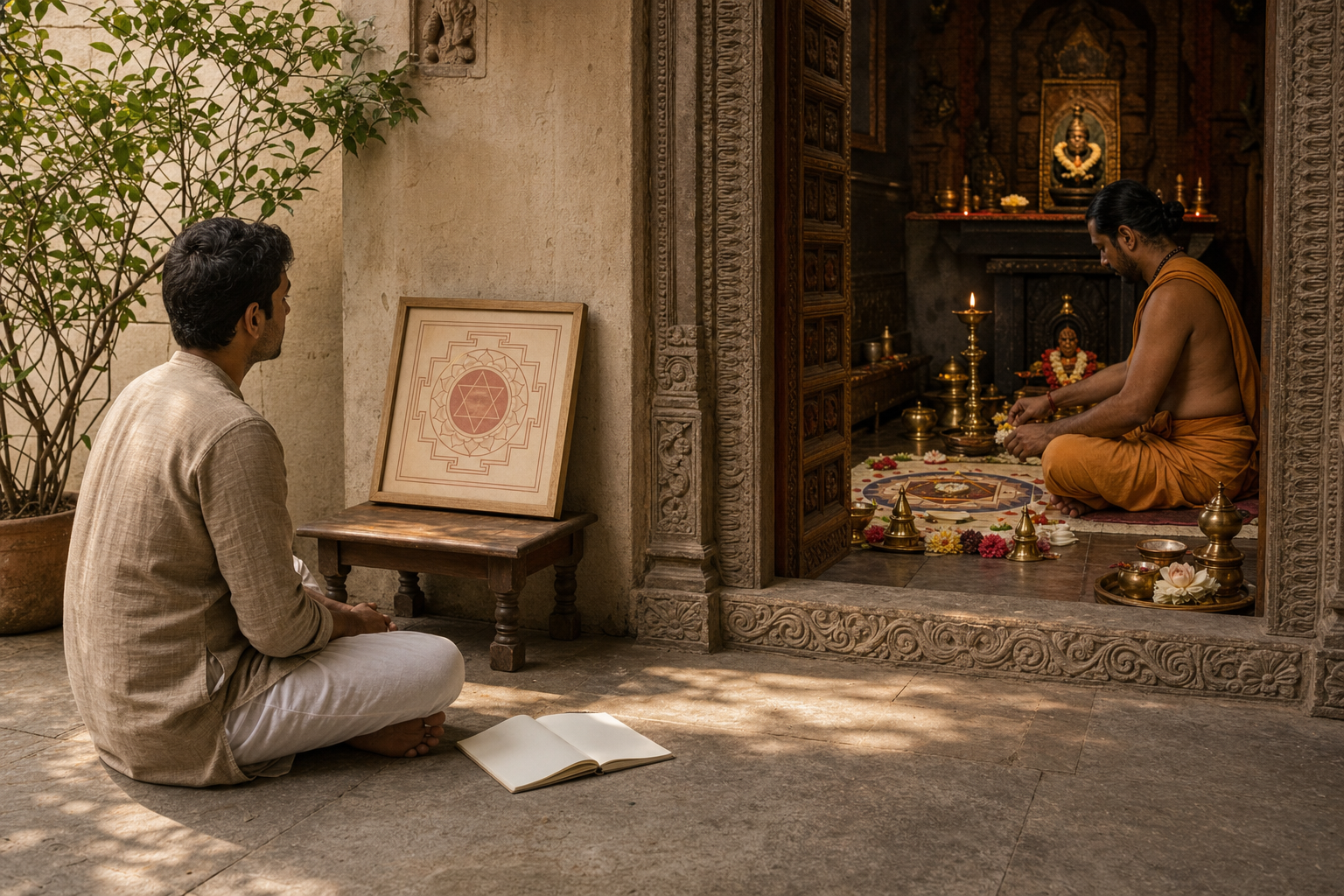
What you can do while learning
You do not need to activate every symbol you study. There is a legitimate difference between learning what a yantra or bīja signifies and undertaking the sādhana in which it becomes ritually operative. Respecting that difference protects the tradition from casual appropriation and protects you from mixing instructions that were never designed to work together.
Use this observation exercise with a complete murti, print or yantra:
- Name only what is visibly present. Record the deity’s posture, seat or vehicle, number and position of hands, held objects, surrounding figures, syllables and geometric layers. Do not interpret yet.
- Mark the hierarchy. Identify what occupies the center, what supports it, what surrounds it and what faces outward. This reveals the visual grammar.
- Look for controlled power. Notice whether a weapon is raised, held at rest or balanced by a protective or granting gesture. Notice whether an animal carries the deity, forms a throne or appears independently.
- Identify the ritual setting. Ask whether the form belongs to temple worship, a festival, domestic pūjā, Śrīvidyā practice or another named lineage. A symbol’s home context is more reliable than a generic symbol list.
- State the ethical demand in one sentence. For a lion-seated Goddess, that might be: bring courage under wisdom and use strength to protect dharma. Keep the sentence tied to the actual arrangement you observed.
- Leave unresolved details unresolved. If you cannot identify a syllable, implement or enclosure confidently, write down the question. A blank is more faithful than a borrowed meaning from an unrelated system.
Textual study can then deepen what you see. The Devī Māhātmya gives narrative form to the Goddess’s protection and moral clarity. The Lalitā Sahasranāma unfolds theology through names. Upanishadic teaching places worship within the movement toward knowledge of ultimate reality. These modes are complementary: narrative shows divine action, names train contemplative attention, and philosophical inquiry tests what sovereignty and nonduality finally mean.
What should remain under lineage guidance
Pause before adopting a lineage-protected bīja, a compound mantra such as the Śrīvidyā Pañcadaśī, a full nyāsa sequence, prescribed breath ratios or a chakra-oriented ritual from an isolated transcription. In these practices, initiation or dīkṣā, fitness or adhikāra, ethical preparation and exact method are parts of the practice rather than optional formalities.
Pronunciation is also structural. vowel length, aspiration, nasality, bindu and visarga can alter the intended phonetic form. Traditional attention to śikṣā or phonetics, vyākaraṇa or grammar, and chandas or meter reflects this precision. An English transliteration that drops diacritics may help you recognize a name, but it is not automatically sufficient for technical recitation.
Before beginning such a practice, obtain clear answers to three questions: Which lineage authorizes this form? What pronunciation and sequence does it require? Does it include nyāsa, visualization, breath coordination or other preparatory acts? If those answers are unavailable, continue studying the symbolism without improvising the ritual.
Key takeaways: five questions that prevent shallow readings
- Who is at the center? Establish the deity, title and theological setting before assigning meanings to surrounding details.
- What is the relationship? A lion beneath a Goddess, a bīja within a bindu and syllables placed on petals communicate through position, not just identity.
- What does the symbol do? Distinguish enthroning, protecting, attracting, severing, teaching, concealing and revealing.
- How is it embodied? Ask whether the symbol is viewed as icon, mapped as yantra, sounded as mantra, sealed as mudrā or installed through nyāsa.
- Where is the boundary of your knowledge? General contemplation can begin with careful observation; technical mantra, nyāsa and Śrīvidyā sequences may depend on initiation and lineage instruction.
The next time you encounter a Shakta image or Tantric diagram, make four notes: visible form, internal relationship, ritual setting and ethical demand. If the ritual setting remains unknown, you have found the question to take to a knowledgeable priest, ācārya or authorized lineage teacher. That disciplined pause is itself part of learning to see a sacred symbol as Dharma rather than as ornament or spectacle.
References
- DharmaRenaissance Blog — Indra Parameshwari, Lion-Seated Sovereign: Awe-Inspiring Shakta Theology and Iconography
- DharmaRenaissance Blog — Beejabhidhana in Tantrism: Decoding Sacred Seed Syllables for Transformative Mantra Yoga