
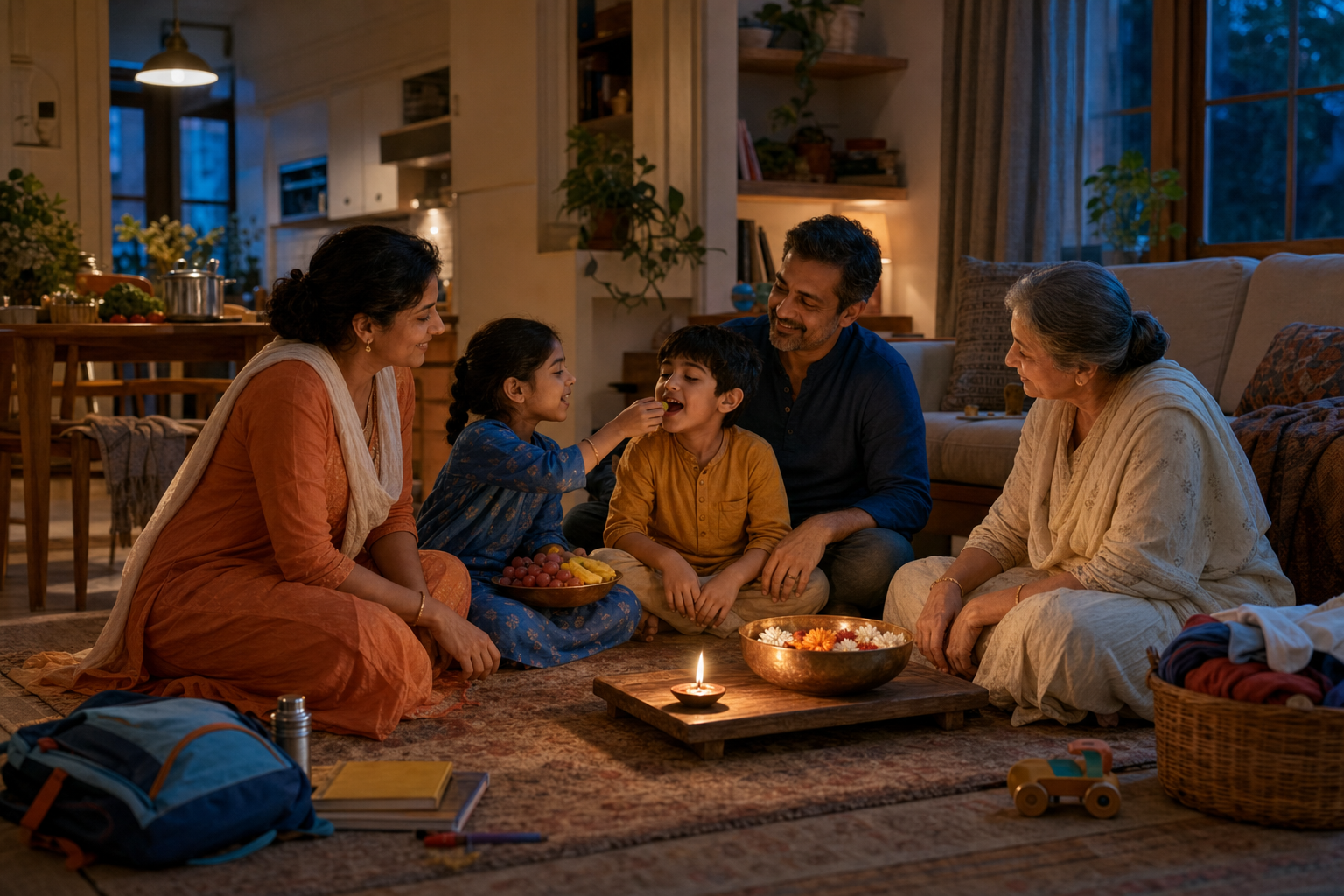
Your child may know the names of festivals, recognize a mantra, and behave respectfully in a temple or gurdwara, yet still be unsure what dharma asks when a sibling provokes them, a friend lies, or a new possession becomes an obsession. That gap is not solved by adding more religious information. It is closed when spiritual practice becomes part of how your household speaks, chooses, apologizes, serves, and begins again.
You do not need to recreate an ashram at home or turn every conversation into a lesson. You need a small, credible household rhythm: adults who model the virtues they name, practices children can actually join, explanations that connect ritual with conduct, and a community that gives belonging without teaching superiority.
The home teaches before any scripture class begins
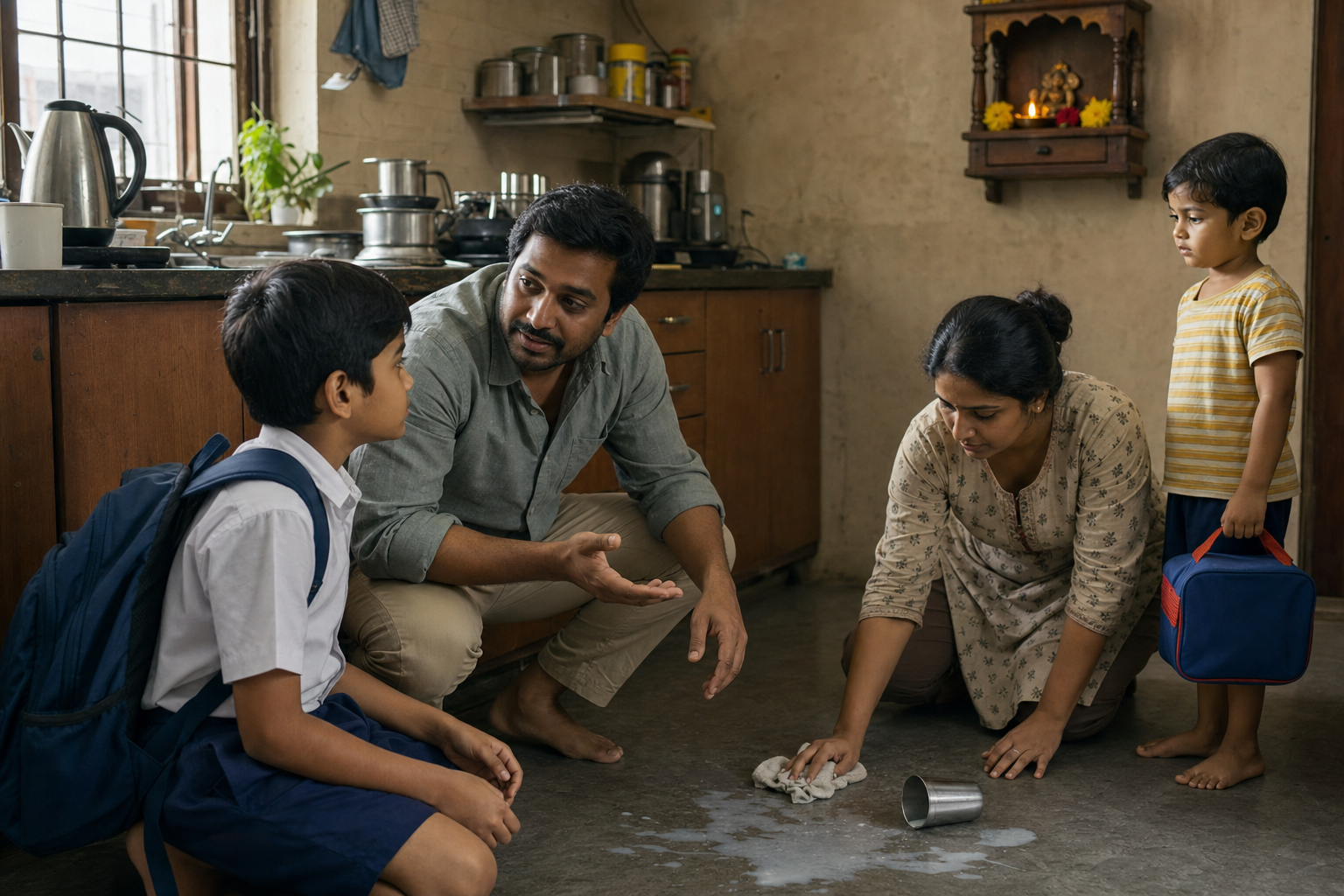
Children build their first working picture of dharma from what the adults around them repeatedly do. They notice whether prayer makes you more patient, whether truth still matters when it costs you something, and whether respect extends to people who cannot offer you status or advantage. They also notice the distance between devotional speech and ordinary conduct.
This is why parenting can be understood as seva and sadhana rather than as the management of a child’s religious compliance. The difficult moments are not interruptions to spiritual formation. They are where formation happens. A parent who admits an unfair accusation teaches satya. An adult who lowers their voice during conflict teaches ahimsa. A family that changes plans to care for an elder teaches seva. A calm refusal to buy something unnecessary teaches aparigraha.
Observe your household during several ordinary days. Do not begin with the prayer corner; begin with the moments that reveal its moral climate:
- When a child admits a mistake: does honesty make the conversation safer, even when a fair consequence remains?
- When adults disagree: does the child see restraint, listening, and eventual repair, or only domination and withdrawal?
- When someone performs unnoticed work: is that contribution acknowledged, or does gratitude appear only in ritual language?
- When desire meets a boundary: do adults model contentment, or ask children to control appetites that adults indulge openly?
- When the family encounters difference: do children hear confidence joined with respect, or is identity built by belittling another path?
This audit is not a demand for flawless parents. Flawlessness would teach little about repentance, forgiveness, and recovery. Coherence matters more: when your conduct falls short of the value you teach, name the failure, repair what you can, and return to the value without excuses. A child who sees an adult repair learns that conscience is a path back to right relationship, not a weapon for humiliation.
Shame works against that lesson. Calling a child bad, impure, selfish, or a disappointment may produce outward compliance while making honesty more dangerous. Address the act precisely instead. Explain who was affected, which value was neglected, what consequence is appropriate, and what repair is now possible. Dharma should sharpen conscience without making love feel conditional.
Build a rhythm small enough to survive real family life

A household practice becomes formative through repetition, not ambition. If the routine depends on an unusually calm morning, a perfectly prepared altar, or children who never resist, it will disappear precisely when the family most needs steadiness. Start with three anchors already supported by the shape of an ordinary day.
- Morning: keep a five-minute period for prayer, mantra, simran, mindfulness, silence, or a simple intention for the day. Let the child have a real role, such as lighting a lamp with supervision, choosing a verse or sacred song, beginning the recitation, or naming the quality the family will practise.
- One shared meal: pause for gratitude. Thank the Divine in the language of your tradition, and help children notice the people, animals, soil, water, labor, and care involved in receiving food. Keep the meal free of devices so that gratitude is joined to attention.
- Evening: reflect briefly on one virtue. Ask where truthfulness, non-harm, restraint, courage, gratitude, or service appeared. If the day included conflict, identify one repair that still needs to be made.
Attach each practice to an event that already occurs: waking, eating, or preparing for sleep. This removes a daily negotiation about when spirituality will happen. Keep the form recognizable, but allow participation to change with temperament and circumstance. One child may sing readily; another may prefer silence, arranging the space, or listening to a story. Participation does not have to look identical to be sincere.
Use the vocabulary and practices of your own lineage clearly. Puja, simran, pratikraman, and Dhamma reflection are not interchangeable labels for a generic wellness exercise. Each belongs to a distinct tradition and carries its own meaning. A rooted home can still acknowledge the kinship among Dharmic paths without blending their differences into a vague spiritual mixture.
If your family misses a practice, resume at the next natural cue. Do not turn a forgotten mantra or hurried evening into proof of spiritual failure. The routine is meant to hold family life, not become another source of family anxiety. Consistency grows when returning is normal.
This approach also works in single-parent, blended, adoptive, nuclear, and multigenerational households. The forms may differ, but the essentials do not: a realistic rhythm, trustworthy adult conduct, a place for questions, and repeated contact with people who embody the values you want your child to recognize.
Translate virtues into choices a child can practise
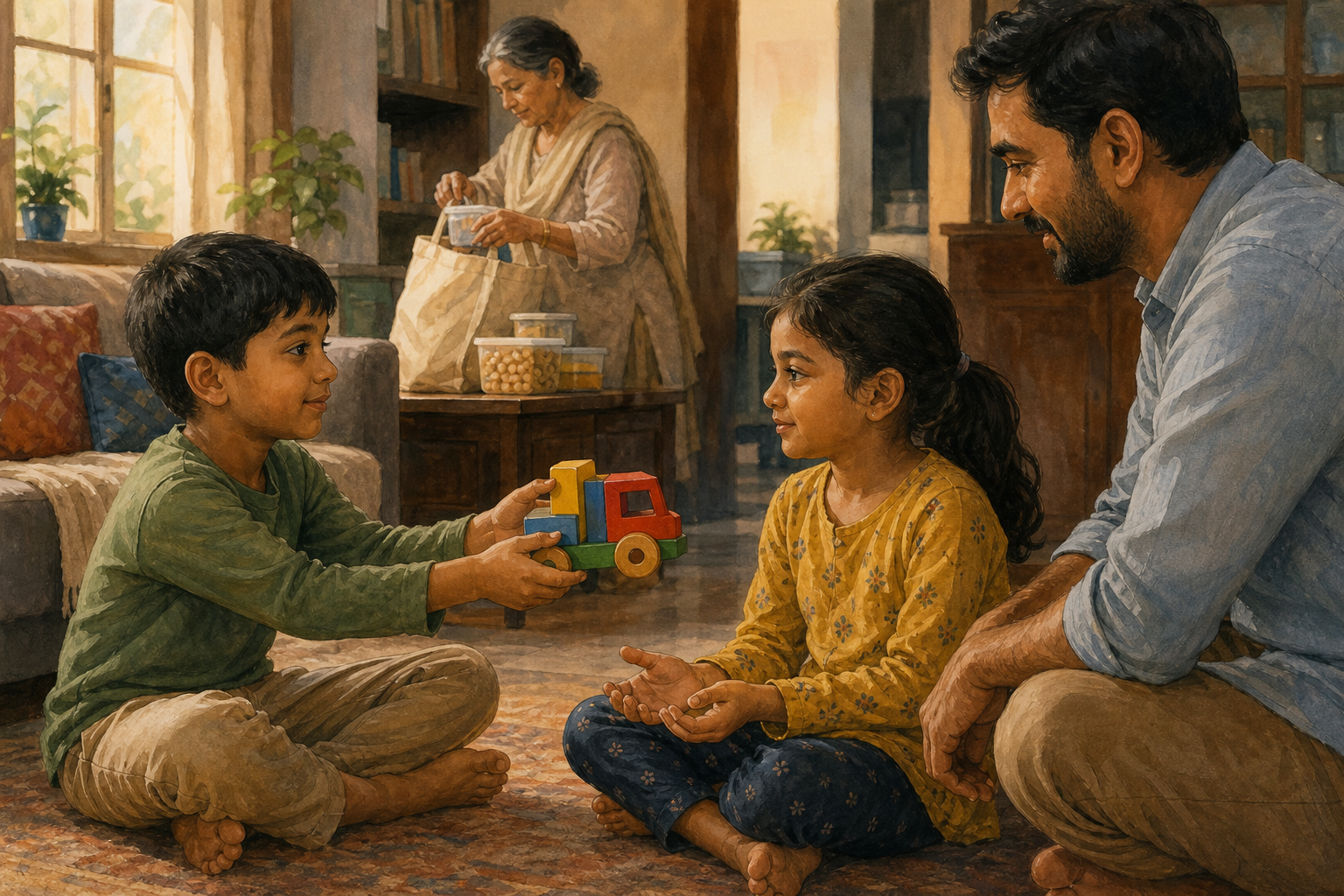
Words such as ahimsa and seva become formative only when children learn what they change. Give each virtue a visible household expression. Then refer to the virtue during real decisions, not only during formal instruction.
- Ahimsa: apply non-harm to tone of voice, teasing, treatment of animals, food and lifestyle choices, media consumption, and conflict. When harm occurs, ask what would stop it, what would repair it, and how the family can respond without creating more harm.
- Satya: make truthfulness possible after a mistake. Listen fully before reacting, distinguish an honest confession from the original wrongdoing, and let children see adults correct their own false or exaggerated claims. Truth does not erase consequences, but it should change the quality of the response.
- Aparigraha: practise restraint around buying, keeping, wasting, and comparing. Before a purchase, separate need, usefulness, beauty, status, and impulse. Invite children to care for what the family already owns and to share resources that are no longer serving a genuine need.
- Seva: give children recurring responsibilities inside the home and opportunities to serve beyond it. Environmental care, visiting elders, helping with a community kitchen, and supporting an education effort show that spirituality concerns the welfare of beings outside the family circle.
Do not use seva merely as punishment for poor behavior. That teaches a child to associate service with disgrace. Household responsibilities can carry consequences, but service itself should be presented as participation in a shared duty and as an expression of gratitude.
Stories give these virtues moral texture. A weekly conversation drawn from the Ramayana, Mahabharata, Jataka tales, Jain parables, or Sikh Janam Sakhis can do more than deliver a tidy moral. Ask questions that make the child reason:
- What duty did the character believe they had?
- Who might be helped or harmed by the decision?
- Which truth was difficult to face?
- Did loyalty support dharma here, or obscure it?
- What could the character repair after making the wrong choice?
- Would another character see the situation differently?
Let the child disagree respectfully. Dharmic narratives contain difficult loyalties, imperfect decisions, sacrifice, and consequences; reducing every episode to obedience wastes their ethical depth. The aim is not to make the child guess the adult’s approved answer. It is to help them connect inherited wisdom with judgment.
Digital life needs the same translation from value to practice. A workable family agreement can keep devices away from shared meals and sacred spaces, set expectations for truthful online behavior, and connect privileges with responsibility. Adults must follow the visible parts of the agreement too. A parent who interrupts prayer to check notifications teaches a stronger lesson about priority than any warning about screen time.
Give children roots without teaching them to need an enemy

A child needs more than the claim that all paths are the same. That phrase may sound tolerant, but it can leave them unable to explain their own practice or appreciate why another family practises differently. Give your child a clear home: the names, stories, prayers, disciplines, and obligations of the tradition your family actually follows. Then teach respect as a consequence of rootedness, not as a substitute for it.
The Dharmic traditions share important moral ground while preserving distinctive forms. Hindu family life can frame the grihastha stage itself as a field of duty, worship, and service. Buddhist family practice can cultivate mindfulness and right conduct. Jain household vows can train non-harm and self-mastery. Sikh life can unite simran with seva and participation in the sangat. Children can recognize these convergences without pretending that every theology, discipline, or ritual is identical.
When a child encounters a different form of worship, begin with description rather than ranking. Ask what the practitioner is doing, what value the practice may cultivate, and how it differs from your family’s practice. If your tradition makes a distinctive claim, explain it honestly and without contempt. Confidence that survives questions is more durable than confidence protected by caricature.
Children may also develop a personal devotional affinity, or Ishta, that does not mirror a parent’s preference. Treat that difference as an opportunity for deeper participation, provided it remains within the family’s tradition and responsibilities. Spiritual formation is not the production of a miniature copy of the parent. It is the cultivation of a person able to choose and live dharma with understanding.
Rites, festivals, and life-cycle observances strengthen identity when children understand what they are entering. For a Samskara or other community ceremony, use a simple sequence:
- Before: explain what will happen, why the family observes it, and which value or transition it marks.
- During: give the child an age-appropriate role rather than leaving them as a passive object of adult performance.
- After: ask what they noticed, what confused them, and what the observance now asks them to do differently.
Community turns those explanations into belonging. Satsang, sangha, and sangat let children see adults beyond their parents pray, study, serve, disagree, and cooperate. Relationships with grandparents and elders add family memory, language, devotional atmosphere, and lived history. Where distance prevents frequent visits, regular calls, shared festival preparation, and story sessions can preserve the relationship. The point is not ceremonial contact with elders; it is an actual bond in which the child can ask questions and be known.
Choose community carefully. Look for warmth joined with clear standards, room for honest questions, meaningful roles for children, and service that extends beyond display. A community that normalizes competition, status anxiety, fear, or contempt can undermine the virtues celebrated in its ceremonies.
Key takeaways: notice formation, not religious performance
Spiritual growth is subtle. Counting completed rituals or memorized verses may tell you whether a practice occurred, but not whether it reached conduct. Look over time for signs such as these:
- Patience becomes more available: the child sometimes pauses, listens, or chooses a less harmful response with siblings and peers.
- Truth returns sooner: after concealment or denial, the child becomes more willing to acknowledge what happened.
- Gratitude becomes spontaneous: appreciation appears outside the prompted prayer before a meal.
- Help requires less prompting: the child notices another person’s need and occasionally acts without bargaining for recognition.
- Repair follows conflict: the child can apologize, replace what was damaged, correct a falsehood, or re-enter a relationship after anger.
These signs should be read as a pattern, not turned into a new scorecard. A child may participate enthusiastically in worship and still struggle with anger. Another may resist public recitation yet show unusual compassion. Temperament affects how devotion is expressed. Keep expectations clear, but do not confuse quietness with holiness, performance with conviction, or questioning with rejection.
Predictable routines and responsive caregiving help make this growth possible. Children learn attention, restraint, and empathy more readily when the adults around them can help settle conflict instead of escalating it. This does not mean parents must remain serene at all times. It means they should be willing to pause, regulate their own response, and return to a hard conversation without shaming the child.
If ritual participation increases while honesty, kindness, or trust declines, do not prescribe more performance as the automatic cure. Examine the moral climate of the home. Moralizing without modeling breeds cynicism; rules without warmth encourage concealment; and public piety without private repair teaches children that appearance matters more than transformation.
Begin tonight with one existing transition in your household. Add a five-minute morning practice, gratitude at one shared meal, or a brief evening question about a virtue. Keep it modest enough to become ordinary. Once that anchor is stable, add a weekly story conversation and a monthly act of service. Your child does not need a spiritually impressive home. They need a truthful one in which devotion repeatedly becomes conduct.