
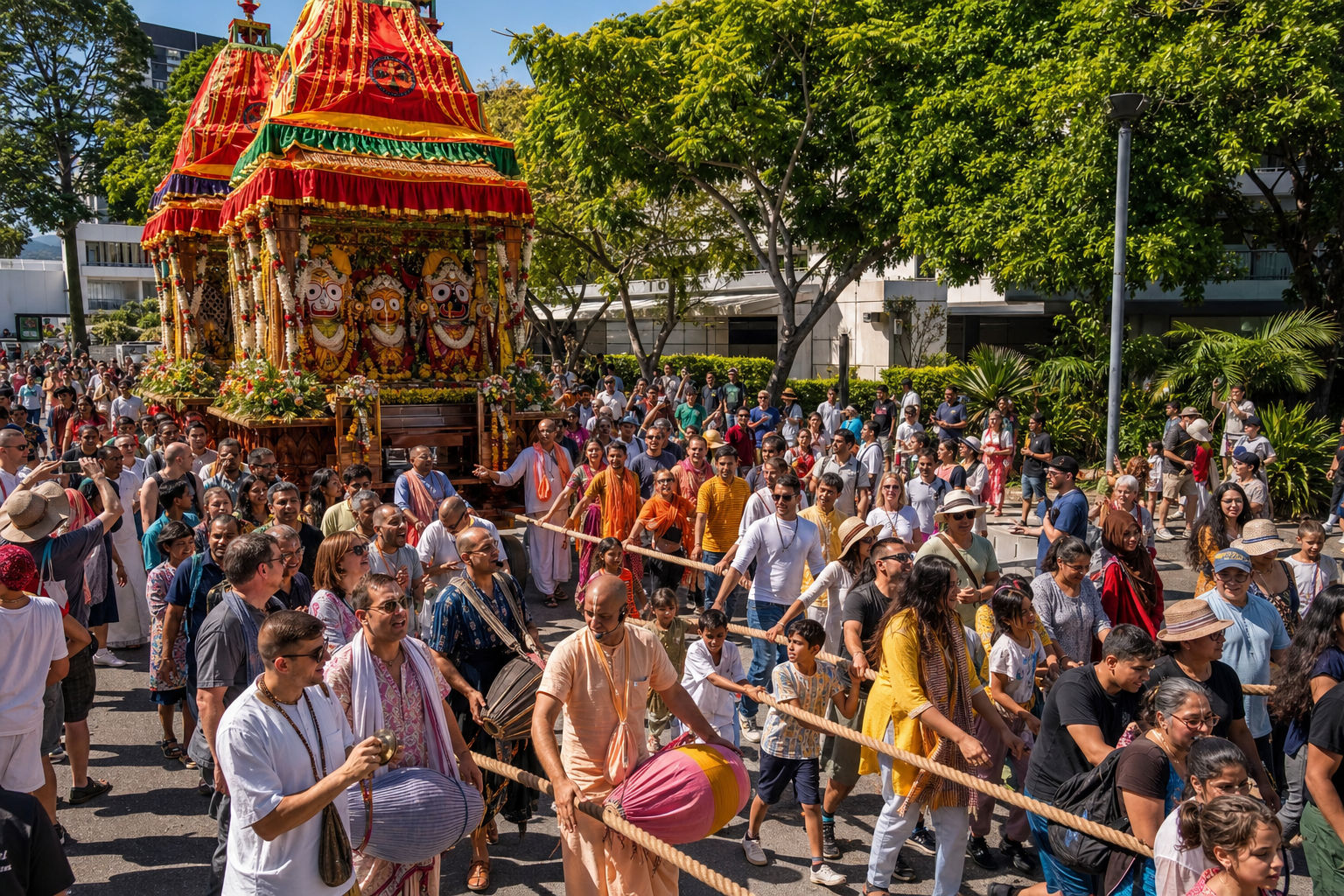
If you missed Brisbane’s Ratha Yatra on 18 April 2026, you probably want more than a date and a collection of photographs. You want to know what moved through the city, why people pulled the ropes, and whether this was chiefly a colourful parade or a serious act of worship.
The short answer is that ISKCON Brisbane brought Lord Jagannath, Balabhadra, and Subhadra into public space through a decorated chariot procession, congregational kirtan, shared service, and prasadam. Its deeper value lay in making an old Vaishnava practice legible to families, neighbours, and visitors without emptying it of theology.
What Brisbane carried into the public square
Lord Jagannath, Balabhadra, and Subhadra stood at the centre of the Brisbane celebration. The chariot was not merely a mobile stage, and the ropes were not decorative props. Together they created a moving shrine in which worshippers could sing, serve, walk, and pull as one congregation.
The classical form comes from Jagannath Puri, where the deities ceremonially travel from the principal temple to Gundicha Temple. Brisbane did not need to reproduce Puri’s sacred geography street for street. It retained the essential movement: the deities came beyond the fixed sanctum and allowed the wider public to encounter them. That distinction helps you judge a diaspora festival fairly. Fidelity does not require a physical copy of Puri; it requires the ritual centre, devotional purpose, and discipline of service to remain recognisable.
The procession therefore turned an ordinary civic route into a temporary place of darshan, kirtan, hospitality, and learning. Children offered flowers. Elders helped guide the ropes. Families walked together, and visitors from different backgrounds received prasadam. Participation did not depend on prior scriptural study or an inherited place inside the community.
Public worship also carries practical obligations. A chariot that looks complete is not ready merely because its decorations are finished. Route planners must account for gradients, turning space, emergency access, pedestrian flow, and crowd pinch points. The structure must handle changing pull forces, braking, and lateral movement. Tow points, wheels, brakes, and stopping arrangements need inspection, while stewards must keep tension on the ropes controlled and even.
That work is not separate from dharma. It is part of seva. If you attend a future procession, follow the pace and direction set by the stewards rather than pulling independently. A sudden surge can destabilise both the rope line and the chariot. Devotional enthusiasm becomes responsible participation when it protects the people beside you.
How to read the chariot, ropes, music, and prasadam
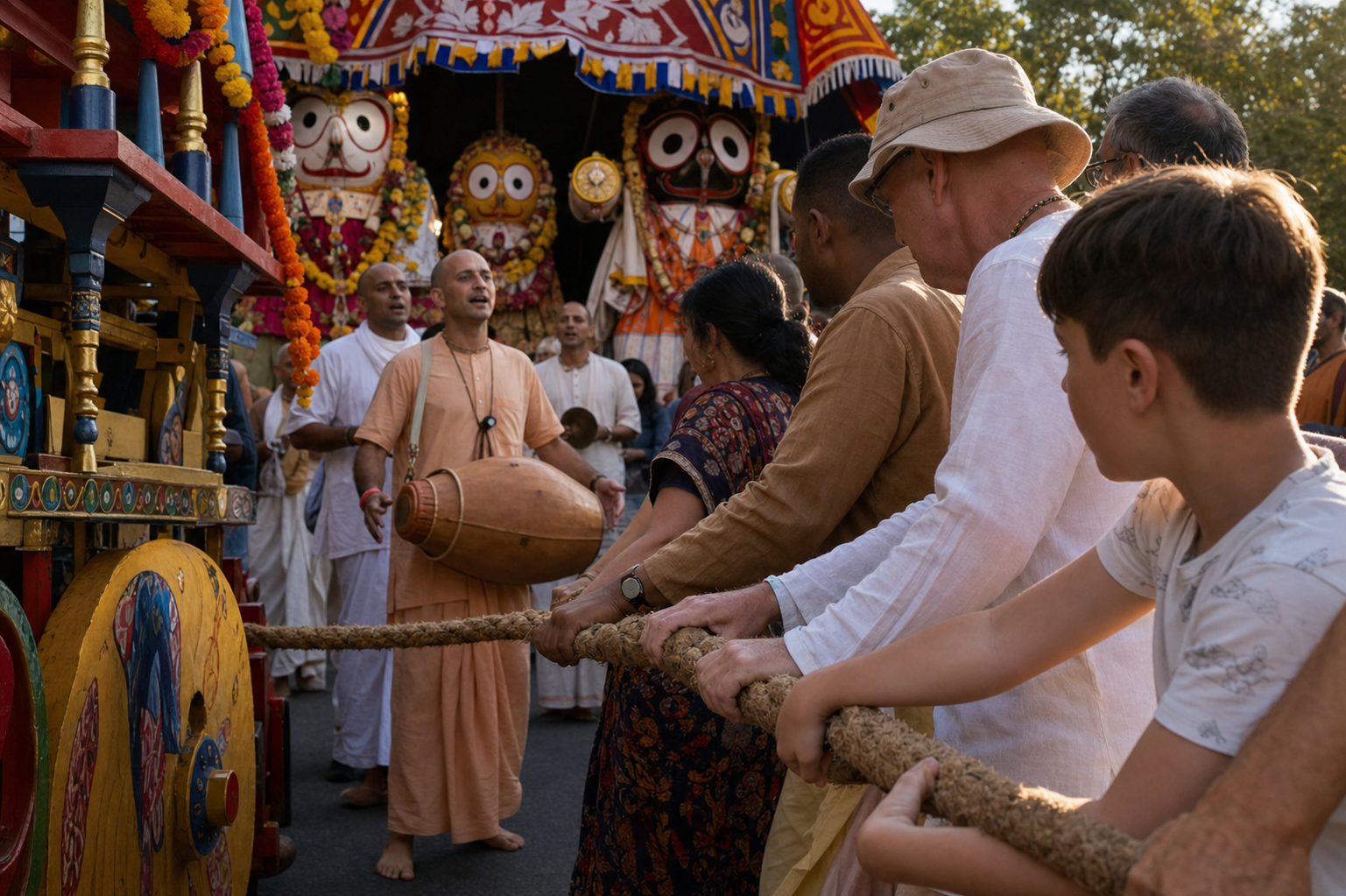
Ratha Yatra communicates through actions as much as through spoken explanation. If you know what each action is doing, the celebration stops looking like a sequence of unrelated sights.
- The deities: Lord Jagannath, Balabhadra, and Subhadra make divine presence publicly accessible. Darshan is no longer confined to a temple interior; the Lord comes before people who may never otherwise enter a Vaishnava sanctuary.
- The chariot: The moving shrine places sacred presence inside the movement of ordinary life. Its wheels can also be read as a reminder of kala, the passage and power of time.
- The ropes: Pulling expresses shared seva. No single person moves the chariot alone. Progress depends on many hands accepting a common rhythm, direction, and responsibility.
- The kirtan: Call-and-response singing turns the route into a participatory devotional space. The mrdanga supplies its grounding pulse, the kartals sharpen the rhythm, and voices carry remembrance of the divine through the crowd.
- The prasadam: Sanctified food completes the movement from seeing to receiving. It makes hospitality tangible and gives visitors a simple, dignified way to participate.
Two familiar chariot images from Hindu scripture add useful depth, provided we treat them as interpretive resonances rather than origin stories for the festival. The Katha Upanishad uses the body as a chariot and the intellect as its charioteer, directing attention toward disciplined self-governance. The Bhagavad-gita places its great dialogue about dharma on a chariot, where discernment must become action. Ratha Yatra makes a related demand of the participant: devotion must move, and movement must be guided.
Centuries of public Jagannath devotion in eastern Bharat established this processional character, while the sixteenth-century renaissance associated with Sri Chaitanya Mahaprabhu gave it powerful Gaudiya Vaishnava expression. Bhakti was presented as a path open to people regardless of birth, social rank, or prior learning. You can see that principle at street level when a newcomer can hear the kirtan, offer respect, help with service, or receive prasadam without first passing an intellectual test.
This gives you a practical way to participate even if the ritual is new to you. Begin with respectful attention. Keep clear of the chariot’s wheels and control zones. Join the response when you recognise it, pull only when invited, and receive prasadam with gratitude. You do not have to pretend to understand every symbol before taking part sincerely.
What to notice in the photographs
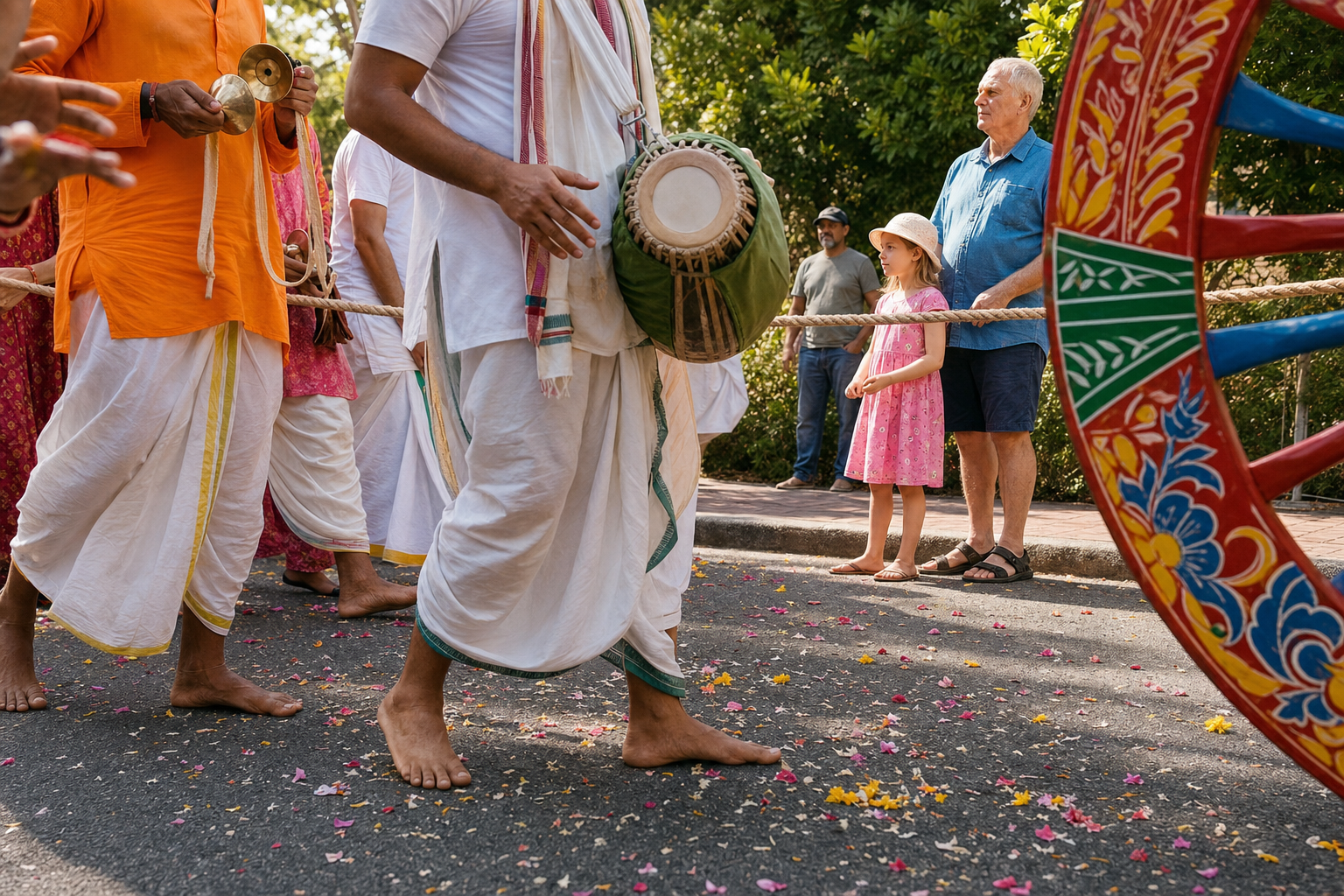
The most useful way to approach the photographs is not to ask which frame is the most colourful. Ask what each moment preserves about the relationship between deity, devotee, volunteer, visitor, and city.
- Begin with the sacred centre. Look for the three divine faces, garlands, floral decoration, and chakra imagery. These details identify whose journey gives the gathering its meaning.
- Follow the hands. Hands hold kartals, beat mrdangas, offer flowers, guide ropes, serve food, and reach toward the shared pull. They show that devotion is enacted rather than merely observed.
- Notice how knowledge moves between generations. Children participate through flowers and family activity, while elders guide the ropes with measured attention. Heritage survives because younger people are given a role, not merely told to watch.
- Look beyond the front of the chariot. Prasadam queues, stewarding, conversations with visitors, and moments of rest reveal the supporting network that makes public worship hospitable and safe.
The documented scenes include marigolds, musicians, smiling families, children with flowers, elders at the ropes, and visitors receiving prasadam. Those details matter because they resist a shallow reading of Ratha Yatra as spectacle. The festival’s real texture lies in coordinated service and small acts of welcome.
Pay attention to quieter moments as well: a hand joining the rope, closed eyes during kirtan, or neighbours greeting one another. Loud music and a large chariot naturally draw the camera, but inward attention is often visible at the edges. A strong visual reading holds both registers together: collective joy outside and recollection within.
Why this procession matters in a multicultural city
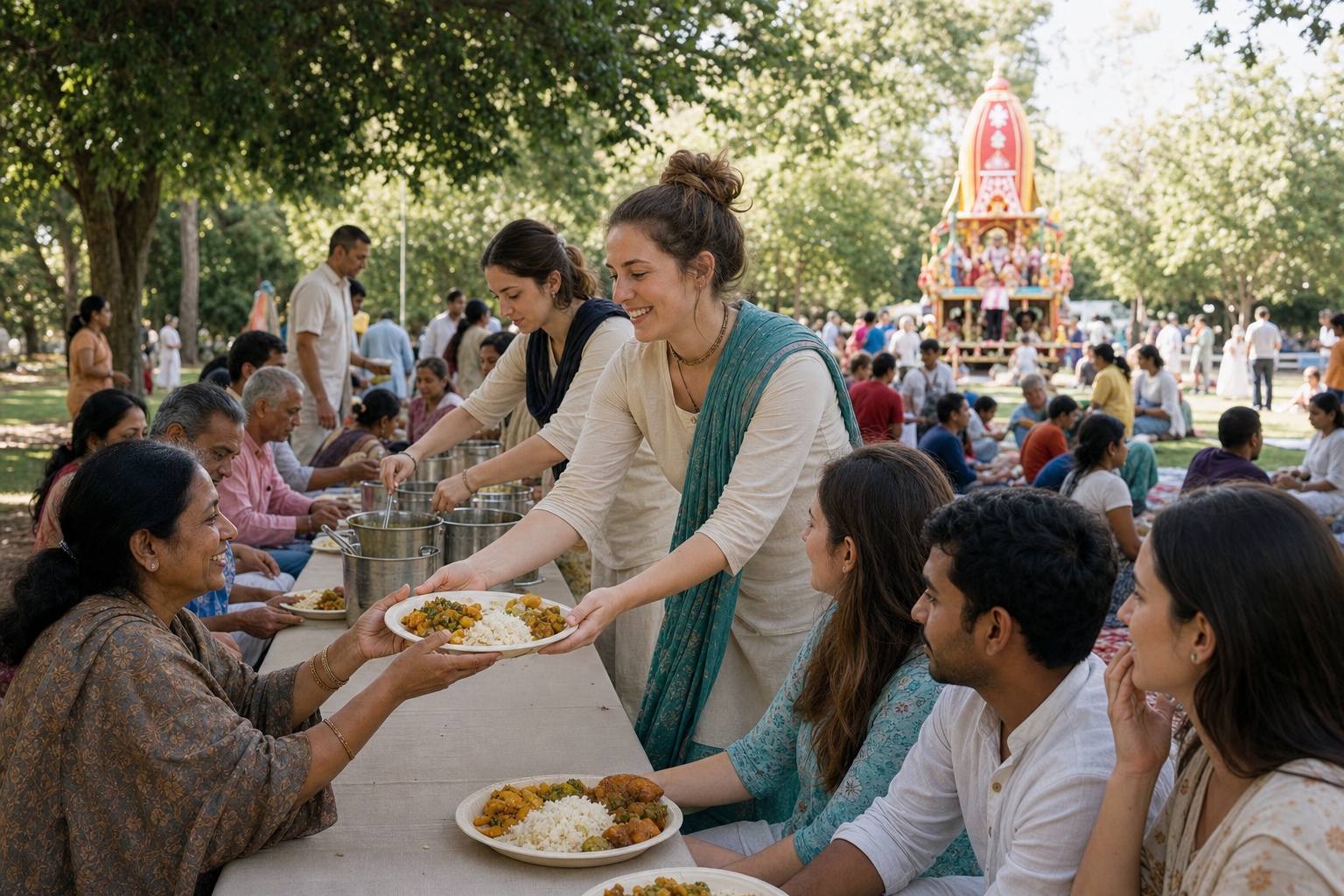
For a Hindu family in the diaspora, a public Ratha Yatra does something a private observance cannot. It allows children to see that their tradition can inhabit civic life openly, competently, and generously. They encounter Sanskrit names, Vaishnava music, ritual service, and community responsibility as living practices rather than fragments reserved for home.
For a neighbour unfamiliar with Hindu traditions, the same procession offers cultural literacy without demanding formal study. Public kirtan is simultaneously sadhana for the devotee and an invitation to listen for the visitor. Prasadam converts that invitation into hospitality. Clear explanations, visible stewarding, and respectful sound management show that confident religious expression can coexist with consideration for the surrounding city.
Ratha Yatra also belongs within a broader Dharmic conversation. Jain rathotsava celebrations likewise place sacred images in procession. Sikh Nagar Kirtan brings devotional singing and seva into shared streets. Buddhist community practice gives central importance to compassion and mindful conduct. These are meaningful family resemblances, but they do not make the traditions interchangeable. Lord Jagannath’s identity, Gaudiya Vaishnava theology, Jain understandings of liberation, Sikh devotion to the Guru, and Buddhist teachings must retain their own integrity.
The useful principle is unity without flattening. Music, voluntary service, ethical conduct, processional movement, and food sharing create points of recognition across Dharmic communities. Respect grows when we name both the common grammar and the real theological distinctions.
Inclusivity also has a material form. Multilingual information helps visitors understand what they are seeing. Shaded seating gives elders somewhere to remain engaged without standing for the entire procession. Disability-friendly viewing points make darshan possible without forcing people into a dense crowd. Children’s crafts, rhythm activities, and guided storytelling turn attendance into transmission. These are not optional decorations around the ritual; they determine who can actually participate.
The same test applies to prasadam and environmental care. Hygienic service, safe hot holding, allergen information, and orderly queues protect the dignity of the meal. Reusable or compostable serving items, water stations, separated waste, restrained generator use, and responsible decoration choices extend ahimsa into event operations. A festival teaches through the systems it builds as surely as through the words spoken from its platform.
For you, the clearest measure is this: does the celebration keep a faithful sacred centre while giving an unfamiliar person a respectful way to approach it? Brisbane’s combination of worship, service, cultural explanation, and civic cooperation shows how both aims can be pursued together. Openness need not dilute identity, and a strong identity need not become insular.
Key takeaways for your next Ratha Yatra
- Brisbane Ratha Yatra 2026 was held by ISKCON Brisbane on 18 April 2026 for Lord Jagannath, Balabhadra, and Subhadra.
- The chariot is a moving shrine, the ropes embody shared seva, kirtan makes devotion participatory, and prasadam turns welcome into an act you can receive.
- Puri provides the festival’s sacred model. A diaspora celebration remains faithful by preserving its devotional centre and ritual purpose, not by pretending Brisbane is geographically identical to Puri.
- If you join a rope line, move only under steward direction. Keep away from wheels, tow points, braking areas, and tight turns.
- If you receive prasadam and have dietary restrictions, check the available allergen information rather than assuming every preparation is suitable for you.
- Before attending a future Brisbane edition, confirm the current date, route, access arrangements, and weather guidance with the organiser. Details from 18 April 2026 should not be treated as a future schedule.
When the next procession is announced, choose one form of participation before you arrive. Learn the response “Jai Jagannath,” volunteer for prasadam or accessibility service, bring a child to a storytelling activity, or simply make space for someone who needs a clearer view. The chariot moves through coordinated hands; the tradition moves forward in much the same way.