
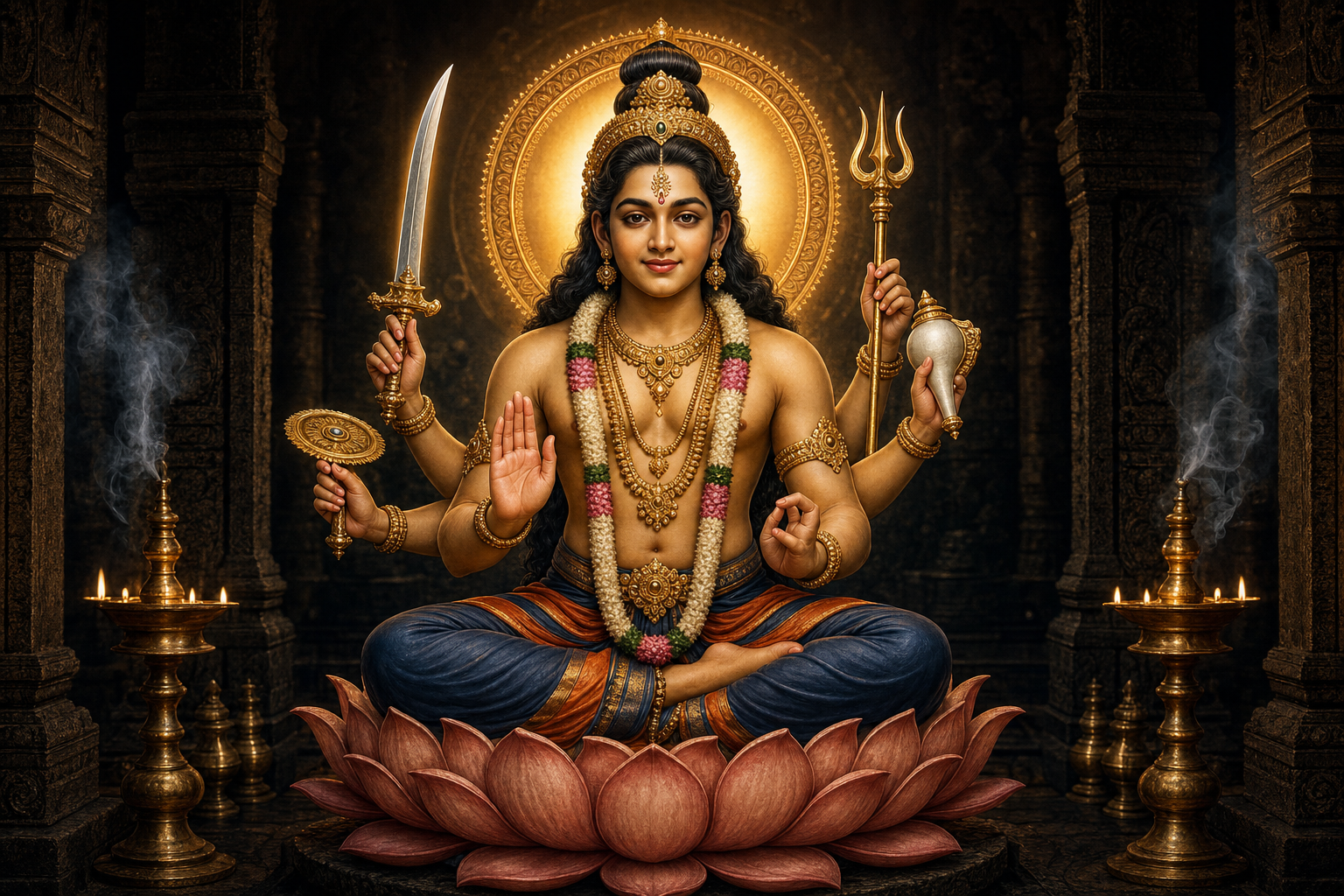
You are looking at an image of Ayyappa with several arms, an open palm, a sword, a trident, perhaps a conch or discus. Is this the Ayyappa of Sabarimala? Does each weapon promise a different kind of protection? And why does a compassionate deity need weapons at all?
The answer begins with the order in which you look. Ayyappa’s iconography asks you to notice composure before force, mudrā before weapon, and dharma before victory. Once you follow that order, the image becomes more than a collection of sacred objects. It becomes a practical lesson in how protection should work.
Key takeaways
- Ayyappa is Dharma Shasta: the protector is also a teacher, so every expression of power must be read as governed by dharma.
- Begin with the face, posture, and principal mudrās. The weapons explain how protection operates; they do not override the icon’s serenity.
- Abhaya promises refuge, while varada offers auspicious well-being. Together they show that protection and blessing are complementary.
- A sword, trident, discus, conch, bow, or noose should not be identified in isolation. The complete arrangement, temple tradition, posture, companions, and local name determine the form.
- The yogic Sabarimala form, ten-armed Kalyana Varada form, and more visibly protective Śāstā forms emphasize different disciplines without representing contradictory deities.
- Use the image to connect fear with a dharmic response: clearer judgment, restraint, a protected boundary, timely action, or service.
Read the protector as a teacher first
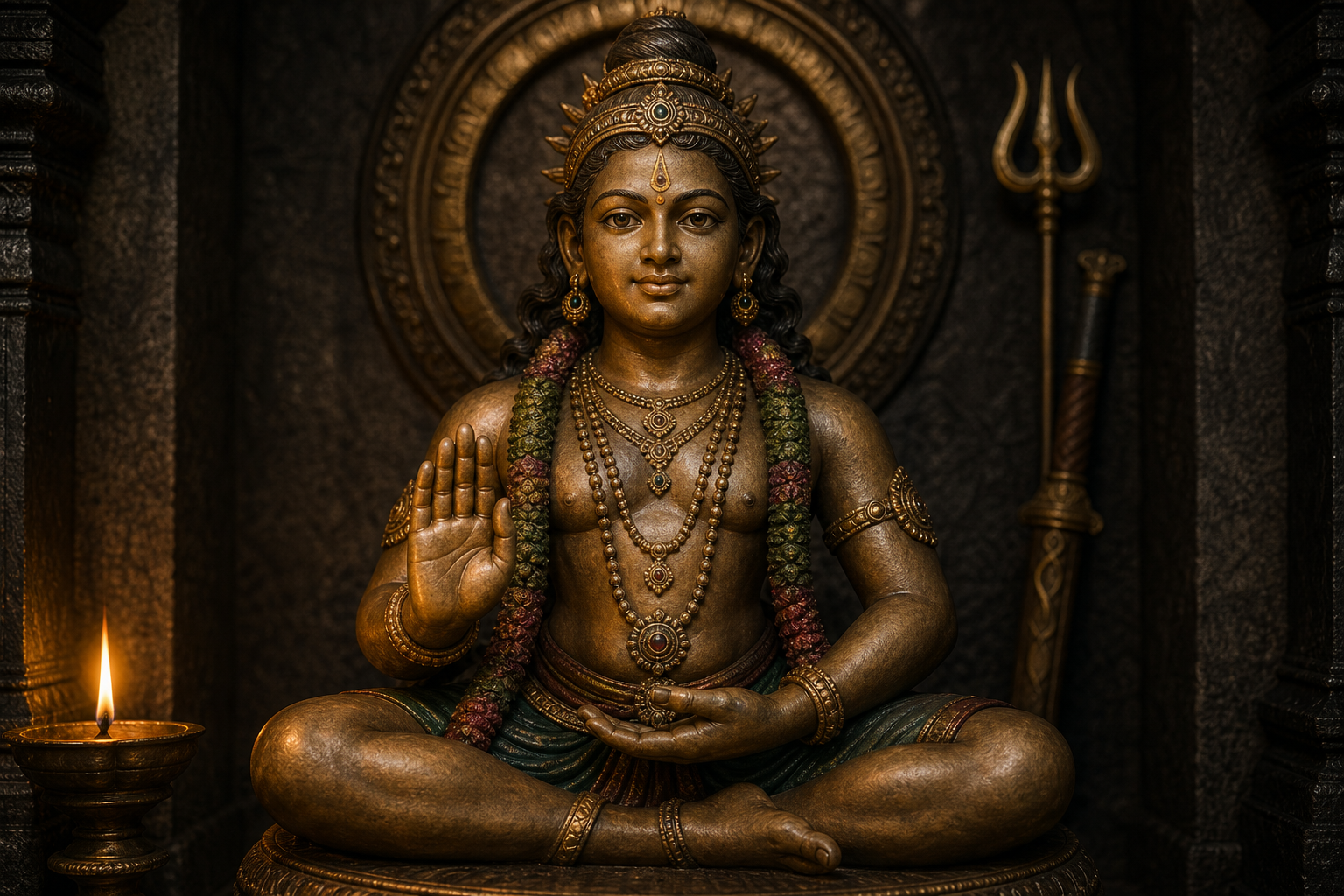
The name Shasta carries the sense of a teacher or guide who establishes and upholds dharma. This changes the meaning of the entire image. A weapon in the hand of Dharma Shasta is not an independent celebration of force. It belongs to a moral intelligence that knows what to restrain, what to defend, when to intervene, and when to remain still.
Ayyappa is also revered as Hariharaputra, the son of Hari and Hara, or Vishnu and Shiva. His iconography therefore brings Shaiva and Vaishnava signs into a harmonious field. A trident can stand beside a conch or discus without confusion. Their coexistence makes visible a larger Hindu principle: distinct sampradāyas can retain their identities while serving the same dharmic order.
This is particularly clear in the ten-armed Kalyana Varada Shasta manifestation. The number of hands indicates many simultaneous capacities, but the composed face tells you who governs them. The deity can cut through ignorance, stop disorder, direct the wavering mind, grant refuge, and bless a household without becoming inwardly agitated.
Use the following sequence whenever you encounter an unfamiliar Ayyappa image:
- Look at the face. A steady, benevolent gaze establishes the governing mood. If the face is calm while the hands carry weapons, read the power as controlled rather than wrathful.
- Identify the principal hand gestures. An open palm facing outward usually carries the message of abhaya, or freedom from fear. A lowered boon-giving hand communicates varada, the bestowal of grace and auspicious outcomes.
- Notice the posture. A balanced standing pose communicates accessible readiness. A dignified seated posture suggests effortless sovereignty. A compact yogic posture shifts attention toward restraint and inward mastery.
- Map the implements. Name only what you can actually see. Then interpret related objects as pairs: sword with shield, bow with arrow, noose with goad, or conch with discus.
- Check the setting. Temple name, sthala tradition, attendants, consorts, vāhana, inscriptions, and ritual use can identify the form more reliably than one object can.
This order prevents a common mistake: seeing many weapons and calling the icon fierce before noticing that its central message may be reassurance. In Ayyappa’s protective grammar, serenity is not passivity. It is evidence that power remains under command.
Decode the hands, weapons, and protective relationships
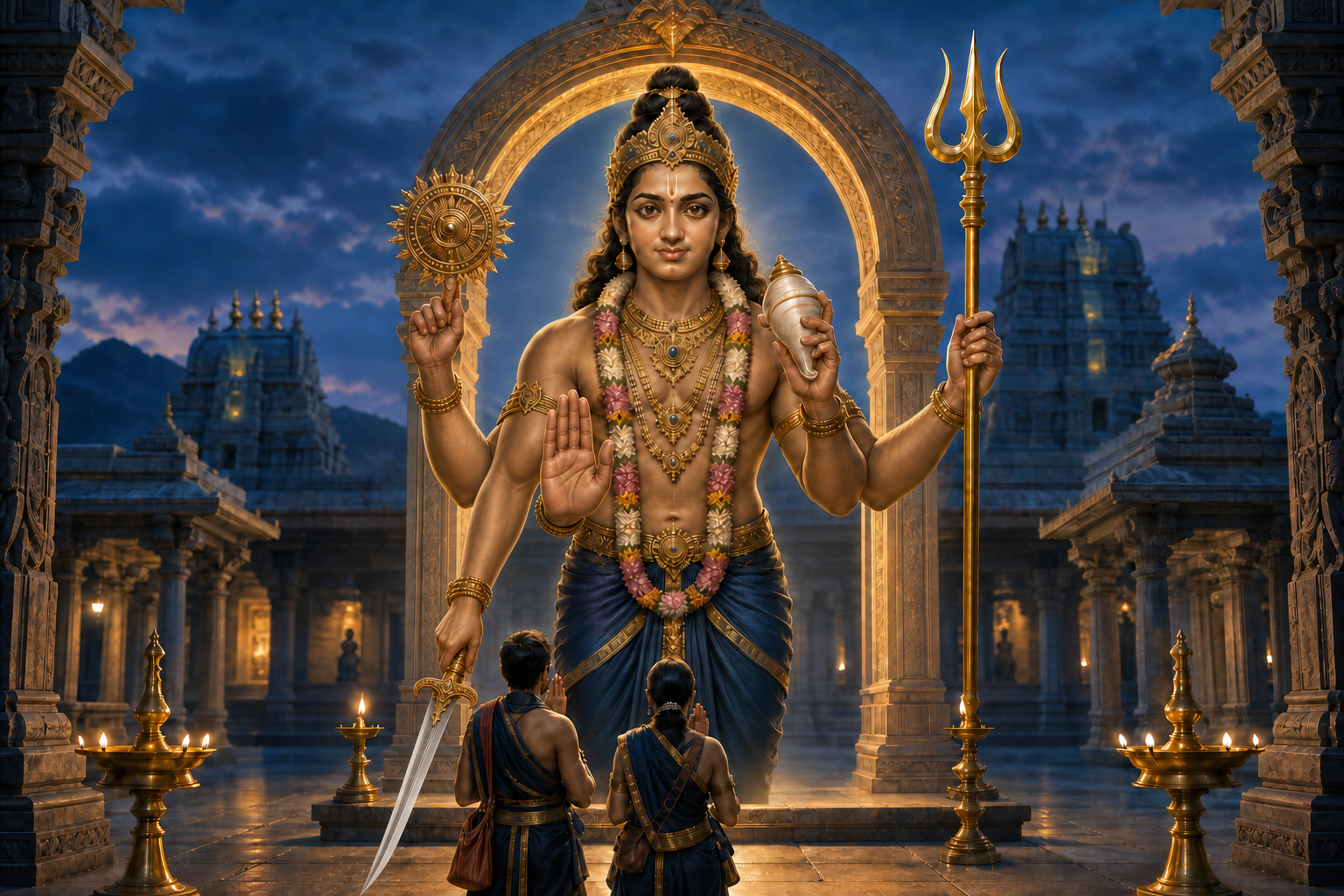
Hindu protection symbols are best understood as aids to attention, memory, and ethical resolve. They work within a larger ritual language that includes mantra, mudrā, and yantra: sound, gesture, and sacred diagram. Their practical value lies in what they train you to remember when fear narrows your perception. The open palm recalls fearlessness; the sword demands discrimination; the shield establishes refuge; the bow asks for concentration.
The precise selection of implements in a multi-armed Ayyappa image varies across Kerala Tantram, Shaiva and Vaishnava Āgamic streams, regional śilpa practice, and individual temple lineages. Do not assume that every ten-armed form must carry an identical inventory. A useful interpretation preserves that variation while reading the established visual relationships.
| What you see | Protective meaning | The question it places before you |
|---|---|---|
| Abhaya mudrā | Refuge, reassurance, and the courage to meet fear without surrendering judgment | What would you do if panic were no longer making the decision? |
| Varada mudrā | Grace, auspicious well-being, and righteous flourishing | Is the outcome you seek good only for you, or does it support household and community welfare? |
| Sword, or khaḍga | Viveka, the discrimination that cuts ignorance, confusion, and self-deception | Which fact must be separated from assumption? |
| Shield, or kheṭaka | Sanctuary, endurance, and a boundary that protects what is worthy | What needs protection before further action is possible? |
| Bow, or dhanus | Readiness, concentration, and disciplined preparation | Have you chosen one clear aim, or are you reacting in every direction? |
| Arrow, or bāṇa | Focused and timely action | What is the next precise action, rather than the largest imaginable response? |
| Noose, or pāśa | Restraint of impulses and the binding of tendencies that pull one away from dharma | Which habit, appetite, or reaction must be contained? |
| Goad, or aṅkuśa | Direction, correction, and movement toward right effort | Once the harmful impulse is restrained, where should your energy go? |
| Trident, or triśūla | Mastery of the three guṇas, the three divisions of time, and other triads that condition experience | Are you trapped by the past, agitated by the present, or projecting fear into the future? |
| Conch, or śaṅkha | The auspicious proclamation and awakening call of dharma | What truth must be stated clearly? |
| Discus, or cakra | Cosmic order, time, right vision, and the correction of adharma | What restores order instead of merely defeating an opponent? |
| Vajra or ḍamaru in some renderings | Unshakable spiritual force or the rhythm through which sacred order unfolds | Which quality must remain firm, and which situation must be brought back into rhythm? |
The mudrās govern the weapons
Abhaya and varada are not decorative additions placed around a set of more important weapons. They provide the interpretive key. Abhaya says that the purpose of power is refuge. Varada says that removing danger is incomplete unless the result permits life to flourish.
This pairing corrects two opposite errors. Protection is not helpless niceness, because Ayyappa retains the capacity to confront adharma. It is not aggression either, because the weapons remain subordinate to compassion, discrimination, and blessing. You should therefore resist interpretations that glorify the implement while ignoring the hand that grants fearlessness.
Read related implements as a sequence
The paired objects describe a process. The sword identifies and cuts through confusion; the shield prevents needless injury while that work is done. The bow gathers energy; the arrow releases it toward a defined aim. The noose stops a wayward impulse; the goad redirects the same energy into right effort. The conch announces dharma; the discus restores its order.
That sequence matters in ordinary life. If you use the arrow’s decisiveness without the bow’s preparation, you become impulsive. If you use the sword’s sharpness without the shield’s duty of care, discernment can become cruelty. If you restrain an impulse with the noose but never redirect it with the goad, suppression replaces transformation.
See Ayyappa within the wider Hindu grammar of protection
The same ethical order appears across Hindu protective iconography. The triśūla pierces delusion and conditions that bind the mind. Sudarshana represents beneficent vision and law in motion. Narasiṁha protects the devoted and vulnerable when oppressive power appears invincible. Hanumān’s gadā represents strength carried as responsibility and service. The svastika invokes svasti, or auspicious well-being, at thresholds and ritual beginnings.
These are not interchangeable emblems, yet they share a decisive principle: sacred protection must restore dharma, not merely transfer fear from one person to another. The open palm, triśūla, Sudarshana, Narasiṁha, gadā, and svastika give different visual forms to courage, clarity, restraint, service, order, and well-being. Ayyappa’s multi-armed form gathers several parts of this grammar into one disciplined presence.
Abhaya also appears in Buddhist and Jain sacred art, while fearlessness has a distinct expression in the Sikh teaching of nirbhau. The traditions should not be collapsed into one iconographic system. What can be recognized across them is an ethical kinship: courage matures through clarity, self-mastery, compassion, and responsibility rather than intimidation.
Distinguish Ayyappa’s forms before assigning meaning
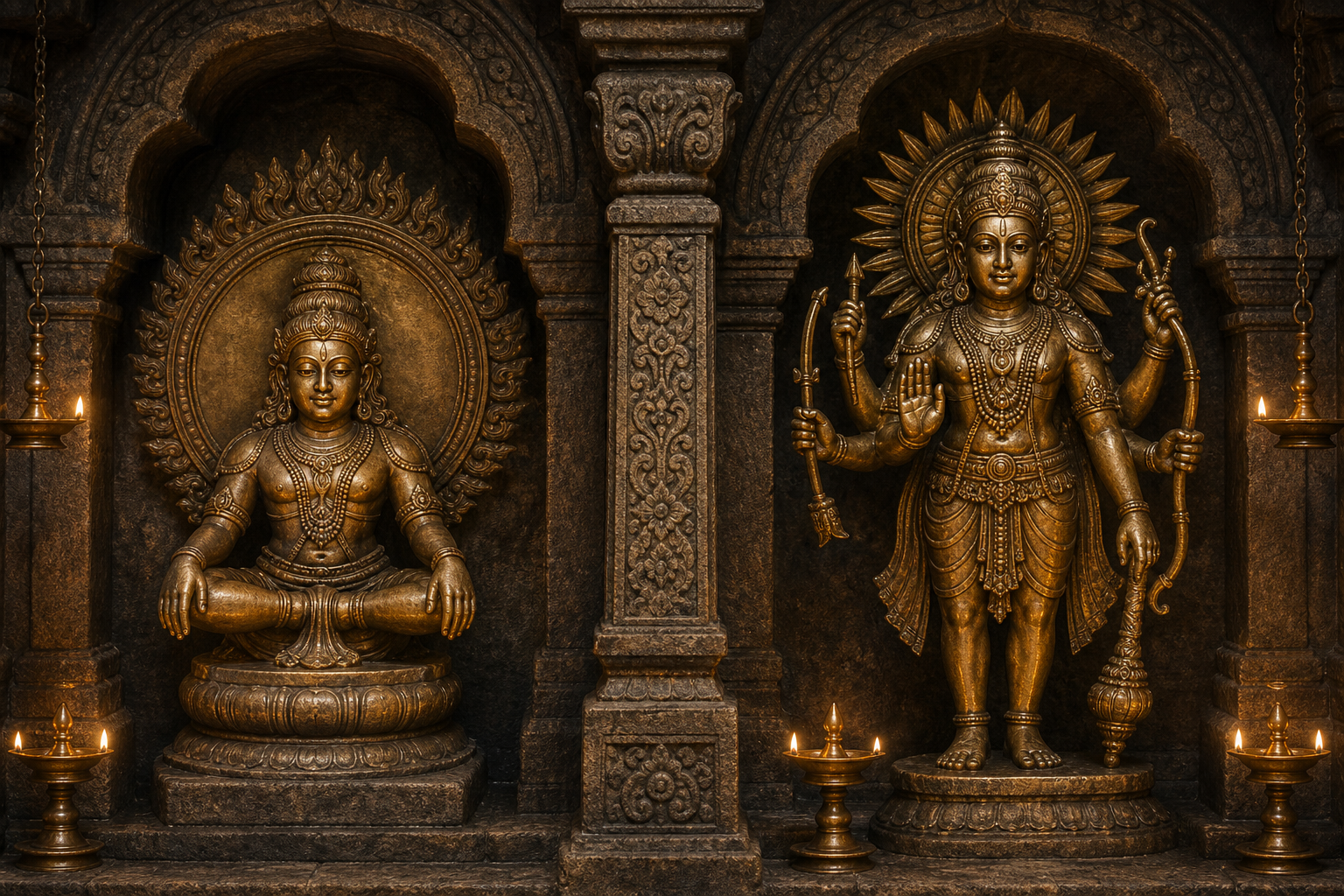
Not every image of Ayyappa teaches through the same mode of life. One emphasizes renunciation, another the protection of social order, and another auspicious household flourishing. Confusion begins when the rule of one sthala is treated as the only possible expression of Dharma Shasta.
The yogic Sabarimala form
At Sabarimala, Ayyappa is venerated as a naiṣṭhika brahmacārī, a strict celibate, in a compact yogic posture. The form directs your attention inward. Restraint, disciplined observance, silence, endurance, and mastery of the senses carry the protective teaching. The apparent stillness is itself power: the devotee learns not to be ruled by appetite, fatigue, distraction, or fear.
If this is the form before you, do not search for a weapon in every detail. The posture is the central sign. Its protection begins with the ordering of the practitioner.
The Kalyana Varada form
Kalyana Varada means the bestower of auspicious well-being. This manifestation may appear with ten arms, abhaya and varada mudrās, and a selection of protective implements. The icon can be standing in poised balance or seated with royal composure. Crown, ornaments, sacred thread, upper garment, and aureole may emphasize moral sovereignty without changing the central union of compassion and vigilance.
This form brings protection into household and community life. Its ritual associations include harmonious unions, family stability, ethical livelihood, health, and communal welfare. The request for prosperity is not separated from the conditions that make prosperity sustainable: truthfulness, restraint, right effort, mutual responsibility, and protection from adharma.
Some Śāstā traditions portray Pūrṇa and Puṣkalā as consorts, especially in Tamil and Kerala settings related to Aiyanar or Ayyanar worship. Their presence conveys completeness and abundance. It does not invalidate the celibate Sabarimala form. The two settings illuminate different modes of the same tattva: yogic discipline in one, auspicious household order in another.
Vīra and village-guardian expressions
More visibly vīra-oriented Śāstā images emphasize alert protection, boundaries, and the defense of communal order. A tiger may signify fearless guardianship in some South Indian settings, while other shrines omit a vāhana to keep attention on blessing or instruction. Attendants or bhūta-gaṇas can appear, but their absence does not make the form incomplete.
Use context rather than assumption when identifying one of these images. Record the temple or shrine name, locality, posture, arm count, visible mudrās, implements, vāhana, companions, and any name supplied by the worshipping community. If a museum label, temple authority, or hereditary tradition gives the form a specific name, that evidence is stronger than an identification based on one damaged or indistinct attribute.
Four common misreadings can then be avoided:
- “A trident makes the figure Shiva.” In a composite Ayyappa arrangement, the triśūla can express Shaiva inheritance without changing the deity’s identity.
- “A conch and discus make the figure Vishnu.” Their presence can express the Vaishnava current within Hariharaputra.
- “Many arms mean an angry form.” Multiple arms signify multiple capacities. The face, mudrās, posture, and ritual name determine whether the governing mood is tranquil, protective, auspicious, or more overtly heroic.
- “Consorts contradict the celibate Ayyappa.” They belong to a different sthala and theological emphasis. Hindu sacred geography often preserves complementary forms rather than forcing one image to erase all others.
Turn darśan into a discipline you can act on
An icon becomes practically protective when it changes how you meet a real situation. This does not require inventing a private ritual or assigning supernatural guarantees to every object. It requires sustained attention followed by a dharmic action.
- Name the fear plainly. Replace a large statement such as “everything is going wrong” with the actual concern: an unresolved conflict, an uncertain livelihood decision, a harmful habit, an unsafe boundary, or a duty you have postponed.
- Begin with abhaya. Look first at the open palm or recall it mentally. Let your breathing settle. The immediate task is not to deny risk but to prevent panic from taking command.
- Select one relevant attribute. Choose the sword when facts must be separated from assumptions, the shield when a boundary is needed, the bow and arrow when preparation must become focused action, or the noose and goad when an impulse must be restrained and redirected.
- Pass the desired outcome through varada. Ask whether your solution creates genuine well-being. A response that protects your pride while damaging dependants, neighbours, or legitimate obligations has not yet reached the level of kalyana.
- Take one visible action. Make the necessary call, state the truthful boundary, complete the delayed duty, seek qualified help, repair a breach, or begin the disciplined practice the situation requires. Return to the image later and ask whether the action reduced confusion and restored order.
Suppose your fear concerns livelihood. Abhaya stops catastrophic thinking from becoming the whole field of vision. The sword separates confirmed facts from imagined outcomes. The bow identifies the objective. The arrow turns that objective into the next application, conversation, or completed obligation. The shield reminds you to protect essential responsibilities while uncertainty continues. Varada asks whether the livelihood you seek is ethically sustainable, not merely profitable.
In a family conflict, the noose can represent restraint of the first angry response. The goad redirects that energy into a necessary but measured conversation. The shield establishes a boundary against genuinely harmful conduct. The conch calls for clear speech, while the discus asks what would restore a workable order rather than produce a momentary victory.
If fear points to immediate physical danger, serious illness, abuse, or another urgent threat, symbolic contemplation is not a substitute for leaving danger and seeking the relevant professional or emergency assistance. The dharmic meaning of protection supports timely action; it does not require passive endurance.
If you are selecting an Ayyappa image
Choose the form according to the discipline you intend to remember, not according to which image displays the most weapons. Ask the seller, artist, priest, or temple community five concrete questions:
- What is the traditional name of this form?
- Which sthala, sampradāya, or regional convention does it follow?
- Which mudrās and implements are represented, and are all of them clearly formed?
- Is the image intended for formal worship, festival procession, household devotion, or educational display?
- If consorts, attendants, or a tiger appear, what role do they have in this particular tradition?
For a household setting, clarity is more useful than iconographic excess. A well-proportioned image with a readable face, stable posture, and recognizable hands will support contemplation better than a crowded rendering in which the attributes cannot be distinguished. Stone and pañcaloha are established materials for sculptural and ritual forms, but material alone does not establish ritual status. Consecration, worship procedure, and temple-specific observance belong to living lineages and should be learned from the relevant tradition.
Abhiṣekam, alaṅkāram, and archana express the same movement visible in the icon: purification, reverent presentation, and the focused offering of sacred names. If you already follow a household or sampradāya practice, let that discipline guide you. If you do not, begin with respectful darśan, a settled mind, and an honest commitment to the quality represented by one visible symbol rather than assembling elaborate rites from fragments.
The next time you stand before Ayyappa, look at the face before counting the arms. Find abhaya, identify one capacity you need, and choose the action that lets varada become more than a hoped-for boon. The image has done its protective work when fear gives way to clear, restrained, and responsible conduct.
References
- DharmaRenaissance Blog — Kalyana Varada Shasta: Revealing Lord Ayyappa’s Compassionate Ten-Armed Power
- DharmaRenaissance Blog — Sacred Shields of Dharma: 7 Hindu Protection Symbols to Conquer Bhaya and Adversity