
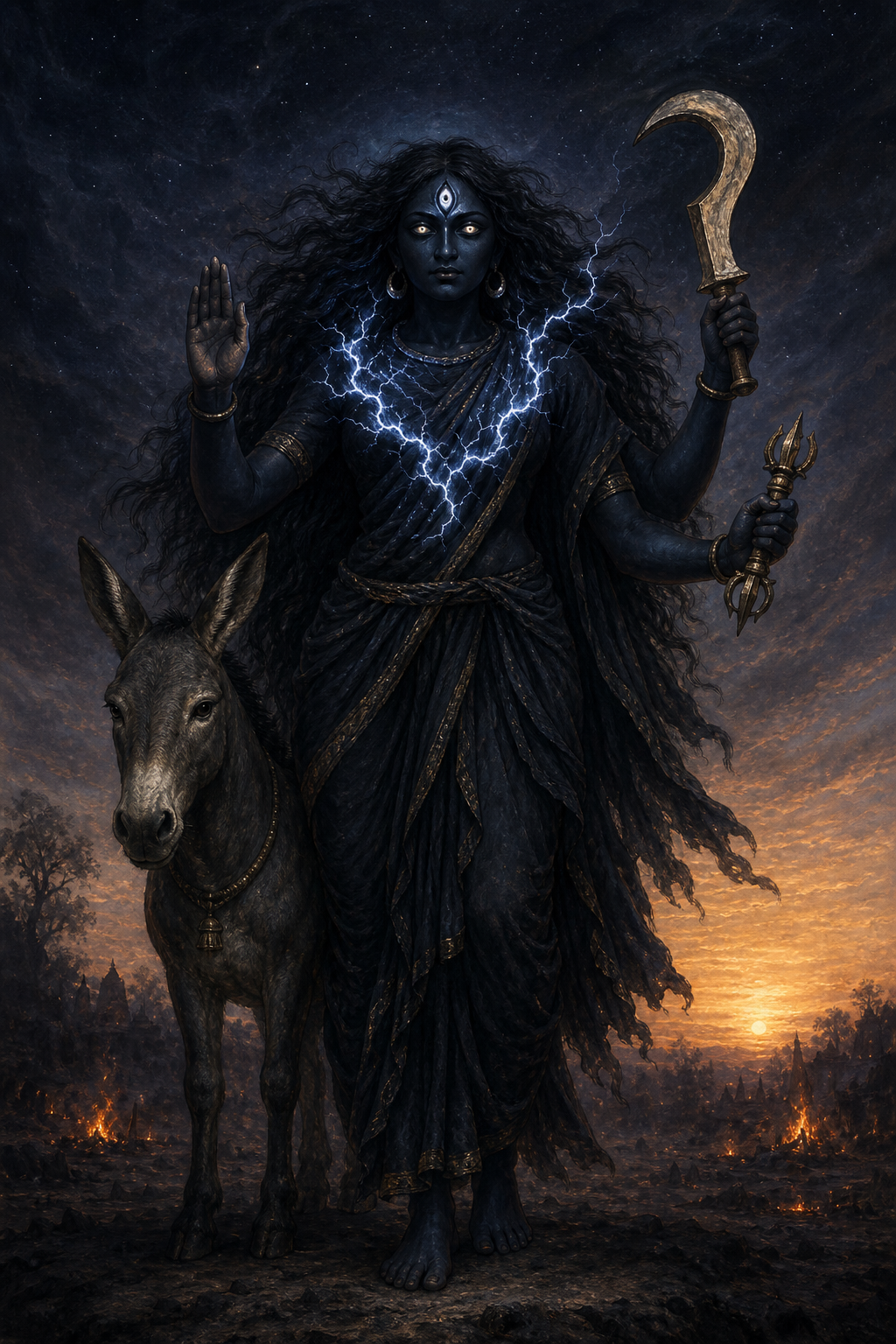
You may feel drawn to Goddess Kalaratri and unsettled by her at the same time. That tension is not an obstacle to understanding her symbolism. It is where the understanding begins.
Her darkness asks a difficult question: what remains when the mind can no longer protect itself with familiar explanations, reassuring appearances, or the illusion of control? A Tantric reading does not ask you to admire terror. It asks you to notice what terror reveals.
Kalaratri’s darkness is not the same as evil

The first mistake is to import a simple opposition between light and goodness on one side, darkness and evil on the other. That reading turns Kalaratri into a frightening supernatural personality and misses the spiritual work performed by her form.
Darkness is also what cannot yet be seen, named, measured, or controlled. It is the condition in which the mind’s usual distinctions lose their certainty. When Kalaratri embodies that darkness, she confronts the habit of treating the unknown as an enemy.
This is why she can be understood as a raw and transformative form of the Divine Mother rather than a symbol of moral corruption. Her appearance does not tell you to become dark in conduct. It challenges you to stop confusing a comforting appearance with truth.
That distinction gives you a practical test whenever you encounter fierce sacred imagery. Ask whether the image is glorifying harmful action or exposing your dependence on safety, predictability, and surface beauty. In Kalaratri’s case, the second reading opens the deeper path.
Terror, destruction, and death point beyond themselves

Kalaratri is easily reduced to three ideas: terror, destruction, and death. Tantric symbolism does not require you to deny those associations. It requires you to ask what is terrified, what is destroyed, and what is allowed to die.
- Terror exposes attachment. Fear becomes spiritually instructive when it reveals the identity, expectation, possession, or certainty you believe you cannot live without. The useful question is not merely, “What frightens me?” It is, “What does this fear say must remain unchanged?”
- Destruction removes a false refuge. In this symbolic reading, destruction is not a licence for aggression or a wish that other people be defeated. It is the collapse of whatever keeps consciousness confined: denial, pretence, self-deception, or the demand that reality obey the ego’s preferred arrangement.
- Death marks the limit of the constructed self. The symbol need not be read as a prediction of bodily death. It points toward the ending of an identity assembled from roles, memories, status, approval, and control. What ends is the claim that these temporary structures exhaust what you are.
These meanings belong together. Fear protects the constructed identity; the prospect of destruction intensifies that fear; death represents the final loss of everything the identity uses to define itself. Kalaratri brings the entire structure into view at once.
When you see this structure, her fierceness becomes intelligible. A gentle image can console the personality that seeks protection. Kalaratri addresses the deeper problem: the personality’s conviction that liberation depends on keeping all its protections intact.
What it means for fear to dissolve into pure consciousness

“Dissolving fear” does not mean that a devotee will never again feel alarm, vulnerability, or grief. Nor does “pure consciousness” need to be imagined as emotional numbness. The symbolic movement is subtler: fear ceases to be the unquestioned centre around which awareness is organised.
Ordinary fear fuses several things together. There is an immediate sensation, a story about what it means, an image of the future, and an identity that feels threatened. Because these arise quickly, they appear to be one solid reality. Kalaratri’s symbolism invites you to stop treating that bundle as indivisible.
You can notice fear without granting every story produced by fear the status of truth. You can experience uncertainty without turning uncertainty into proof of catastrophe. You can watch an identity defend itself without assuming that the threatened identity is the whole of consciousness.
Pure consciousness, in this reading, is the awareness in which fear appears but which is not exhausted by fear. Kalaratri does not merely stand against the frightening object. She represents the awareness vast enough to contain the frightened person, the object of fear, and the darkness surrounding both.
This changes the question you bring to her. Instead of asking only, “Will the Goddess remove what I fear?” ask, “What becomes visible when I no longer let fear define the limits of awareness?” The first question seeks relief from an object. The second seeks freedom from domination by fear itself.
A responsible way to contemplate Kalaratri

You do not need to invent an esoteric ritual to work with this symbolism. If you have a prescribed practice from your tradition or teacher, follow its discipline. Otherwise, use the image for careful reflection rather than treating fragments of Tantric language as permission to improvise ritual instructions.
- Begin with your actual response. Look at the name or image of Kalaratri and notice whether you recoil, become fascinated, seek protection, or romanticise fierceness. Do not correct the response immediately. It shows you the assumptions you are bringing to the Goddess.
- Name one concrete fear. Avoid an abstract statement such as “I fear change.” Identify what you believe change could take from you: a role, relationship, reputation, plan, possession, or self-image.
- Separate the event from the identity. Write two sentences: “What may happen is…” and “I believe this would mean that I am…” The first concerns circumstances. The second exposes the identity fear is defending.
- Ask what must be destroyed. Do not ask whom you want defeated. Ask which illusion, demand, or pretence prevents you from meeting reality truthfully. The target of the reflection is bondage, not another person.
- Remain with awareness, then choose an ordinary action. Notice that the fear is present within awareness rather than identical to it. Finish by taking one honest, proportionate step: admit a fact, stop a deception, have a necessary conversation, or release a demand you cannot justify.
The final step matters. Without ethical action, fierce symbolism can become an aesthetic mood. The point is not to feel spiritually dramatic. It is to become less governed by avoidance and more capable of meeting truth without disguise.
Four misreadings that weaken the symbol
Kalaratri’s symbolism is powerful partly because it is easy to misuse. Watch for these four reductions.
- “Dark means wicked.” This imports a moral judgement based on appearance. Correct it by distinguishing the unknown and unmanifest from deliberate wrongdoing.
- “Destruction means harming an enemy.” This lets the ego recruit the Goddess into its conflicts. Turn the question inward: what falsehood, attachment, or fear-driven demand needs to lose its authority over you?
- “Fearlessness means feeling no fear.” This encourages suppression and performance. A more useful measure is whether fear dictates your perception and conduct.
- “Kalaratri is only a psychological metaphor.” Symbolic reflection can illuminate your inner life, but reducing the Goddess to a mental technique strips devotion of its sacred relation. Hold both dimensions together: the symbol reveals consciousness, and the Divine Mother is not exhausted by your private interpretation.
There is another common shortcut: collapsing every fierce or dark form of the Goddess into one interchangeable figure. Similar themes do not erase distinct names, forms, devotional settings, or traditions. When details matter, remain with the form actually before you instead of building a composite deity from scattered impressions.
Key takeaways
- Kalaratri’s darkness should not be confused with moral evil; it confronts the mind’s fear of what cannot be controlled or clearly seen.
- Terror reveals attachment, destruction removes false refuge, and death signifies the limit of an identity built from temporary conditions.
- Fear dissolves when it is experienced within awareness without being allowed to define the whole of awareness.
- Contemplation should lead to truthful and ethical conduct, not fascination with violence, danger, or spiritual drama.
- The most useful question is not only what you fear, but which identity or illusion that fear is trying to preserve.
Let the darkness clarify your next step
Bring one real fear to Kalaratri, not every fear at once. Identify the story it tells, the identity it protects, and the truth it keeps you from facing. Then take one action that no longer serves that fear. Her symbolism becomes practical at precisely that point: when darkness stops being an object of superstition and becomes the place where false certainty can no longer hide.