

If you have heard a Sama chant and wondered why it does not sound like ordinary Sanskrit recitation—or whether you can simply repeat it as a meditation—the distinction matters. A sāman reshapes Vedic verse through pitch, duration, inflection, melodic extension, and added stobha syllables. It is not merely a familiar prayer sung more beautifully.
You can still let the Sama Veda deepen your spiritual life without imitating a specialist performance. The practical task is to know what you are hearing, keep liturgical chant distinct from personal japa, and choose a form of sacred sound whose discipline you can preserve.
First, separate sāman from everyday mantra repetition
The word mantra covers more than one kind of practice. Its Sanskrit formation associates contemplation with an instrument or means of protection and release. In practice, however, a Vedic mantra, a sāman, a divine name, and a Tantric seed syllable do not make identical demands on the practitioner.
The categories can overlap. A sāman is built from sacred verbal material, while japa may employ a Vedic or post-Vedic mantra. But overlap does not make the methods interchangeable. Use this working distinction before deciding whether to listen, study, or recite:
| Form | What the sound is doing | Your practical responsibility |
|---|---|---|
| Sāman | Transforms a verse, primarily drawn from the Ṛgveda, into an inherited liturgical chant | Hear and learn it as a precise performance tradition, not as a tune to improvise |
| Vedic mantra recitation | Preserves sacred speech through articulation, accent, metre, and ritual or contemplative use | Do not assume that knowing the translation is enough to reproduce the recitation |
| Nāma-japa | Repeats a divine name so that devotion and remembrance become continuous | Give priority to steadiness, attention, and bhāva rather than vocal display |
| Bīja mantra and deity upāsanā | Uses concentrated seed syllables such as Om, Hrīm, Śrīm, or Aim within a particular contemplative frame | Seek guidance when the mantra or method belongs to a lineage-specific discipline |
This distinction prevents a common error. A recording may move you deeply without giving you a form that you are prepared to reproduce. Before chanting along, ask what has actually been presented: a sāman, a recited Vedic mantra, devotional kīrtan, nāma-japa, or a later musical setting. If the label does not tell you, enjoy it as an introduction but do not treat it as an instructional model.
Listen for the work being done by pitch, syllable, and breath
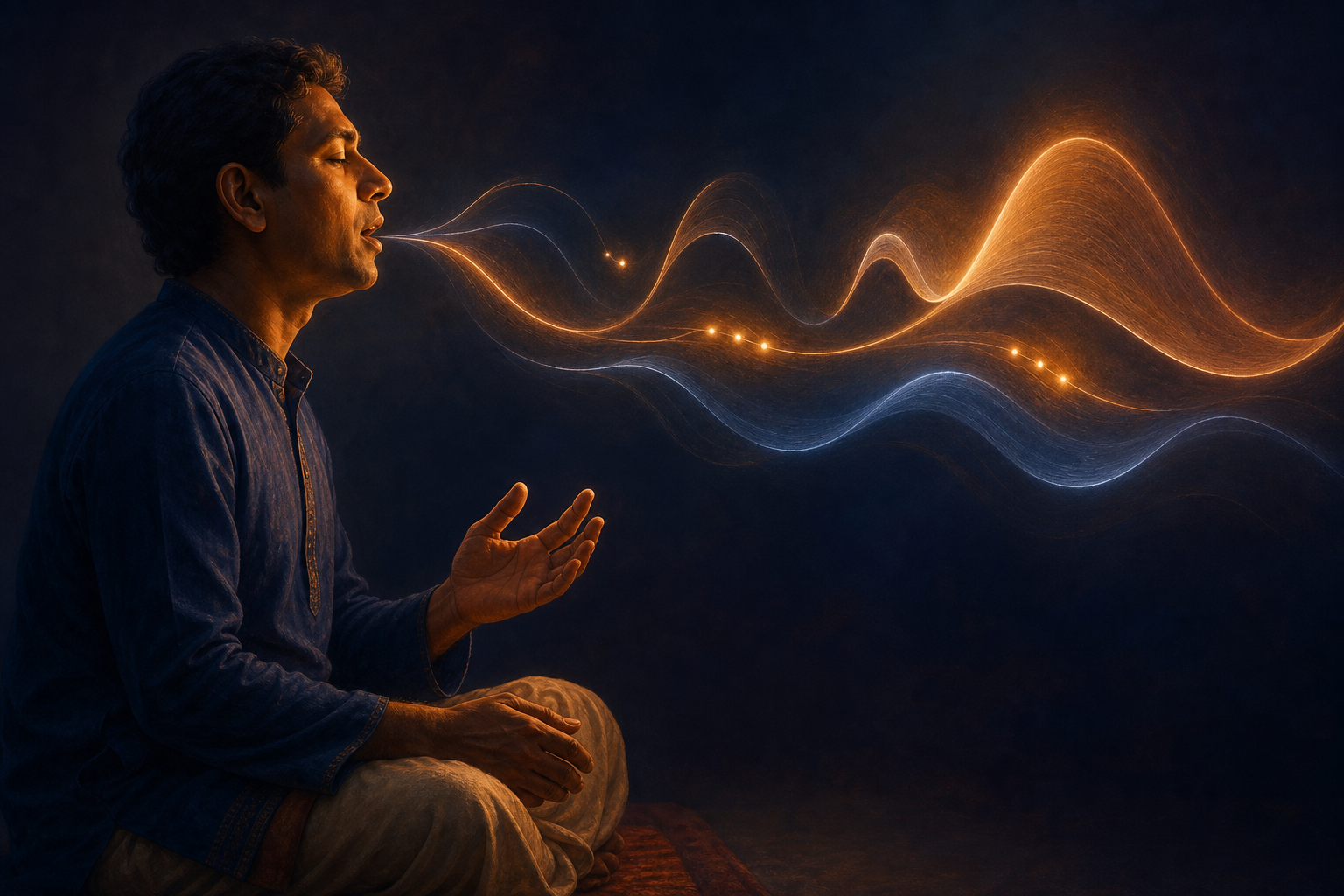
The Sama Veda is often called the Veda of melodies, but that description can mislead a modern listener. Its melody belongs to ritual action. In the Soma sacrifice, the prastotṛ, udgātṛ, pratihartṛ, and subrahmaṇya participate in shaping and sustaining its sonic structure. The aim is not personal musical interpretation. It is faithful placement of voice within an inherited rite.
Vedic accents—udātta, anudātta, and svarita—underlie the practice. Sāman performance then works with pitch, prolongation, inflection, and stobha syllables. Named forms such as grāma-geya and āraṇya gāna, along with the contextually adapted ūha and ūhya forms, remind you that “Sama chanting” is not one undifferentiated melody.
On your next careful listening, use this sequence:
- Identify the form before evaluating it. Look for a clear indication that you are hearing a sāman rather than generic “Vedic music.”
- Track the pitch contour. Notice where the voice rises, settles, or turns rather than waiting for a song-like melody.
- Notice duration. A prolonged vowel is part of the construction of the chant, not empty ornament between meaningful words.
- Listen for stobha syllables. Do not dismiss an unfamiliar syllable as a mistake merely because it does not read like the underlying verse.
- Follow the breath. Hear how a phrase is supported, sustained, and released. Breath is carrying the form, not merely preventing the singer from running out of air.
- Return to meaning after hearing the structure. Translation matters, but it does not replace phonetic form, cadence, and attentive listening.
The Chāndogya Upaniṣad gives this listening a contemplative depth by identifying the udgītha, Om, as the essence of the sāman and relating it to prāṇa. Sound and breath are therefore not two unrelated components. The voiced form depends upon vital movement, while disciplined voicing makes that movement perceptible to attention.
The Kena Upaniṣad supplies an equally important restraint. Its inquiry reaches toward the ground that speech and mind cannot grasp as ordinary objects. That prevents a crude equation between spirituality and pleasing vibration. Sacred sound matters because of its revealed form, disciplined transmission, contemplative use, and capacity to point beyond itself—not because every resonant sound automatically becomes a Vedic mantra.
When sacred sound appears in stone
A horse-faced figure in a temple or museum can make this theology of breath and resonance visible. It may represent Hayagrīva, the horse-headed form of Viṣṇu associated with the recovery and teaching of the Vedas, or it may be a personified Sama Veda. Do not identify it from the horse head alone.
Use three clues: context, company, and attributes. A supporting figure accompanied by three comparable Veda personifications and holding a manuscript or rosary points toward the Sama Veda Purusha. An autonomous, prominently installed figure with Vaiṣṇava emblems such as śaṅkha and cakra points more strongly toward Hayagrīva. Regional workshops vary, so take a photograph of the full sculptural group rather than cropping out the surrounding figures that make identification possible.
Choose the practice you are actually prepared to preserve
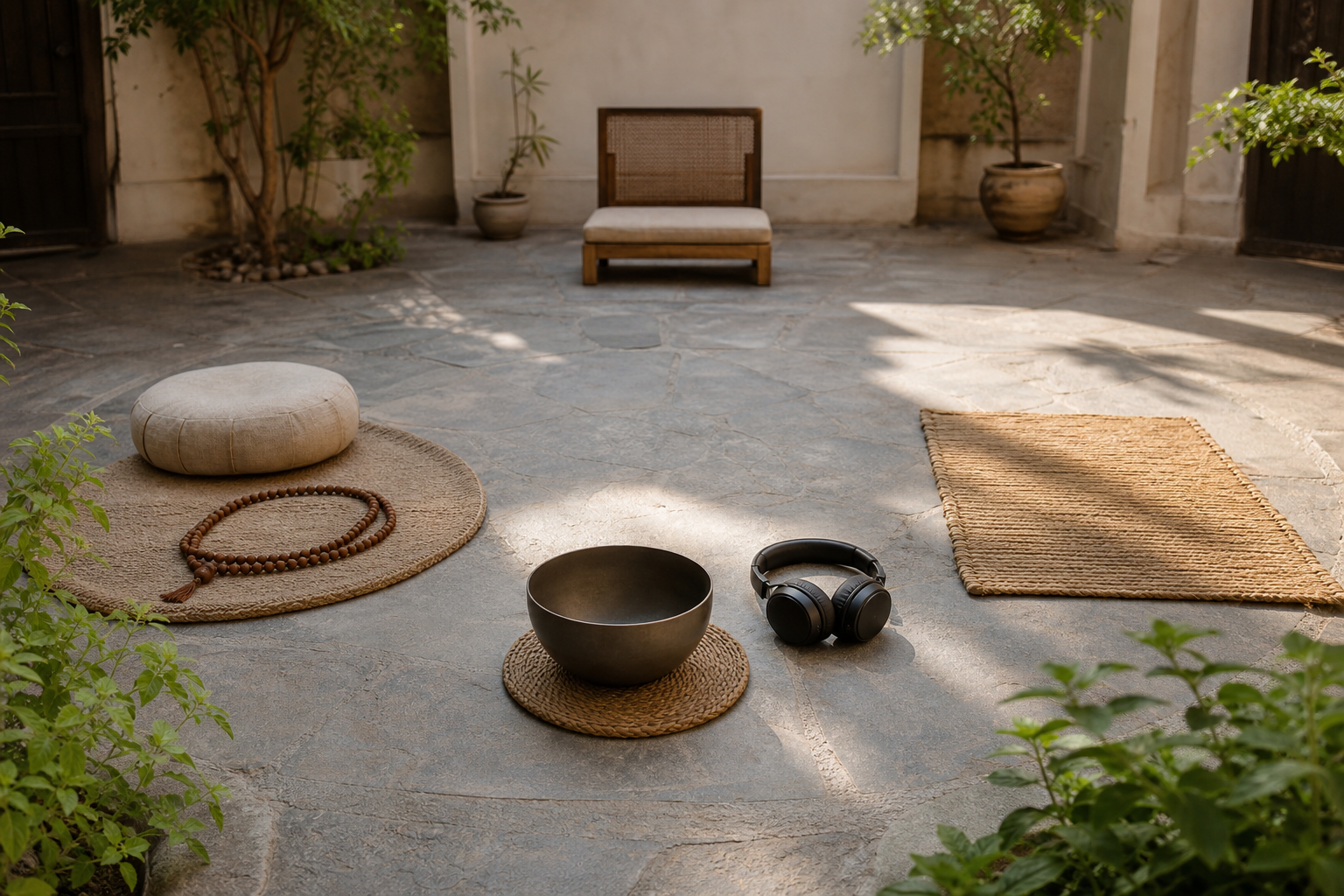
Precision in sacred recitation is not pedantry. The Vedāṅgas—śikṣā, chandas, kalpa, nirukta, vyākaraṇa, and jyotiṣa—locate phonetics and metre within a larger system that protects Vedic understanding and ritual performance. Phonetic form, rhythm, meaning, attention, and intention work together in mantra; removing all but the translation leaves out part of the practice.
If you want to learn Sama Veda chanting
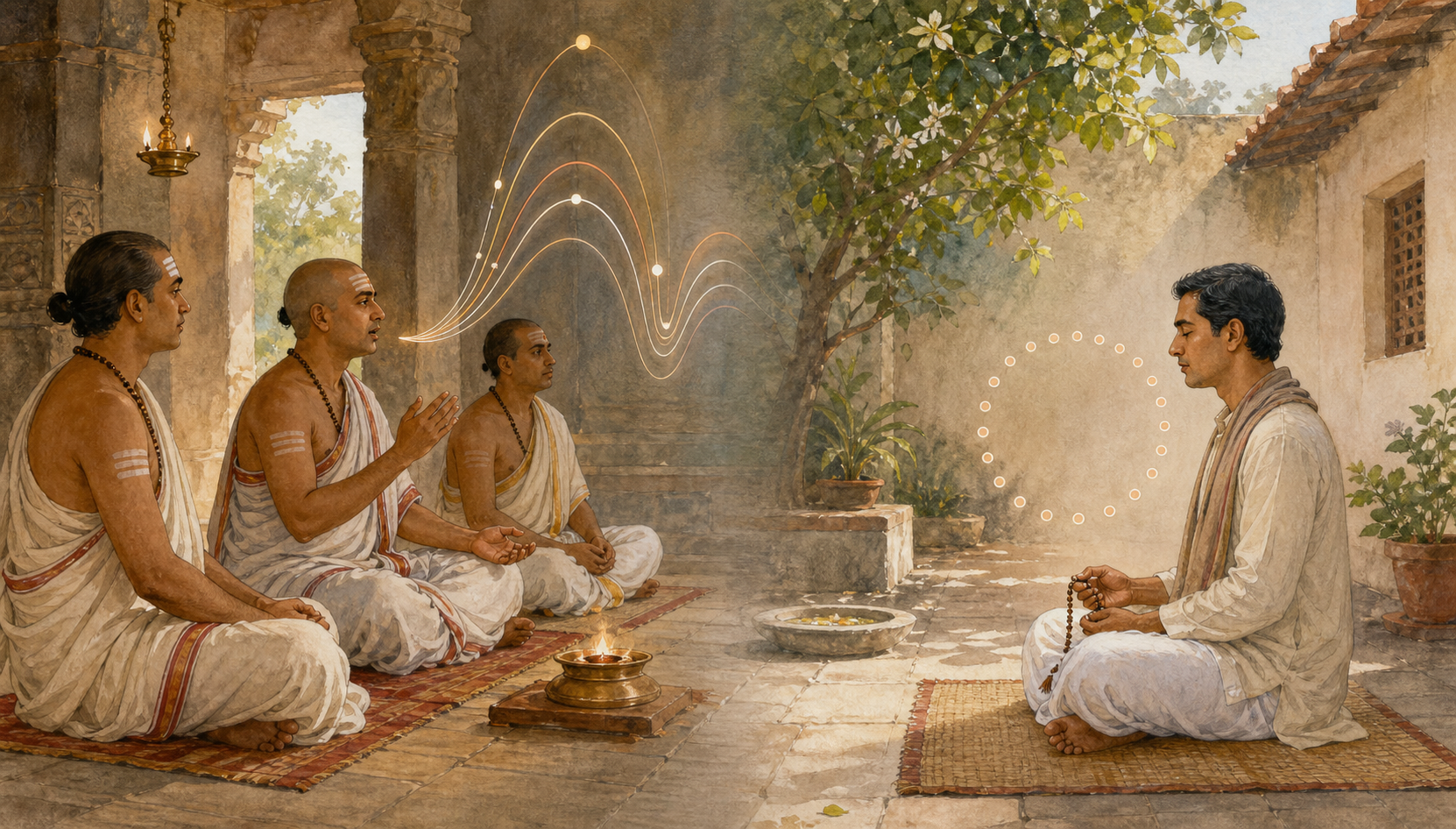
Seek a teacher who can hear and correct you. A printed transliteration may help you follow the verbal material, and a recording may help you recognize the overall sound, but neither can notice your misplaced pitch, shortened duration, blurred syllable, or unstable breath. Those errors are often inaudible to the person making them.
- Ask whether you are learning the underlying verse, its sāman transformation, or both.
- Ask what ritual or liturgical setting belongs to the form being taught.
- Keep one transmitted version stable while learning it; do not assemble a personal composite from unrelated recordings.
- Prioritize correction over volume. Repeating an uncertain form more often only makes the uncertainty habitual.
- Allow the teacher or lineage to determine whether initiation or other preparation is appropriate for that practice.
You do not need specialist training merely to listen reverently. The boundary appears when appreciation turns into claimed performance. If you want to reproduce a sāman, transmission and correction become part of respecting it.
If you want a sustainable daily mantra practice
Your personal practice can begin more simply. General forms such as Om or repetition of a divine name are widely used, while specialised bīja and deity mantras may call for guidance. Choose one practice aligned with your path instead of cycling through unrelated sounds in search of a stronger sensation.
- Set aside a clean, quiet place and a regular time. Dawn or dusk can provide a stable rhythm, but consistency matters more than creating an elaborate setting.
- Sit comfortably with the spine upright. Let the breath settle before you begin; mantra does not require strained breathing.
- Start audibly. Use your own hearing to refine pronunciation, pace, and continuity.
- Move to upāṃśu, the whispered mode, when audible repetition is stable. The sound becomes quieter while tactile and auditory cues remain.
- Let repetition become mānasika, or mental, as attention grows continuous. If it becomes vague or mechanical, return to a more audible mode.
- Use a mālā if counting distracts you from the mantra. Its purpose is to carry the counting burden, not to turn the practice into a race.
- Finish with silent attention. Do not fill the final moment by immediately reaching for another chant, notification, or task.
The movement from audible to whispered to mental japa describes increasing internalisation, not a hierarchy to rush through. Audible recitation trains articulation and rhythm, whispering draws the sound inward, and mental repetition cultivates subtler continuity. Use the mode that keeps you attentive.
Judge the practice by its ordinary fruits. Is your attention steadier? Is remembrance easier to recover after distraction? Are you less reactive? Are truthfulness, non-harming, purity, contentment, and disciplined effort becoming more concrete in your conduct? Classical mantra practice is supported by ethics; unusual sensations are not a substitute for that foundation.
Shared sacred sound does not make every tradition interchangeable
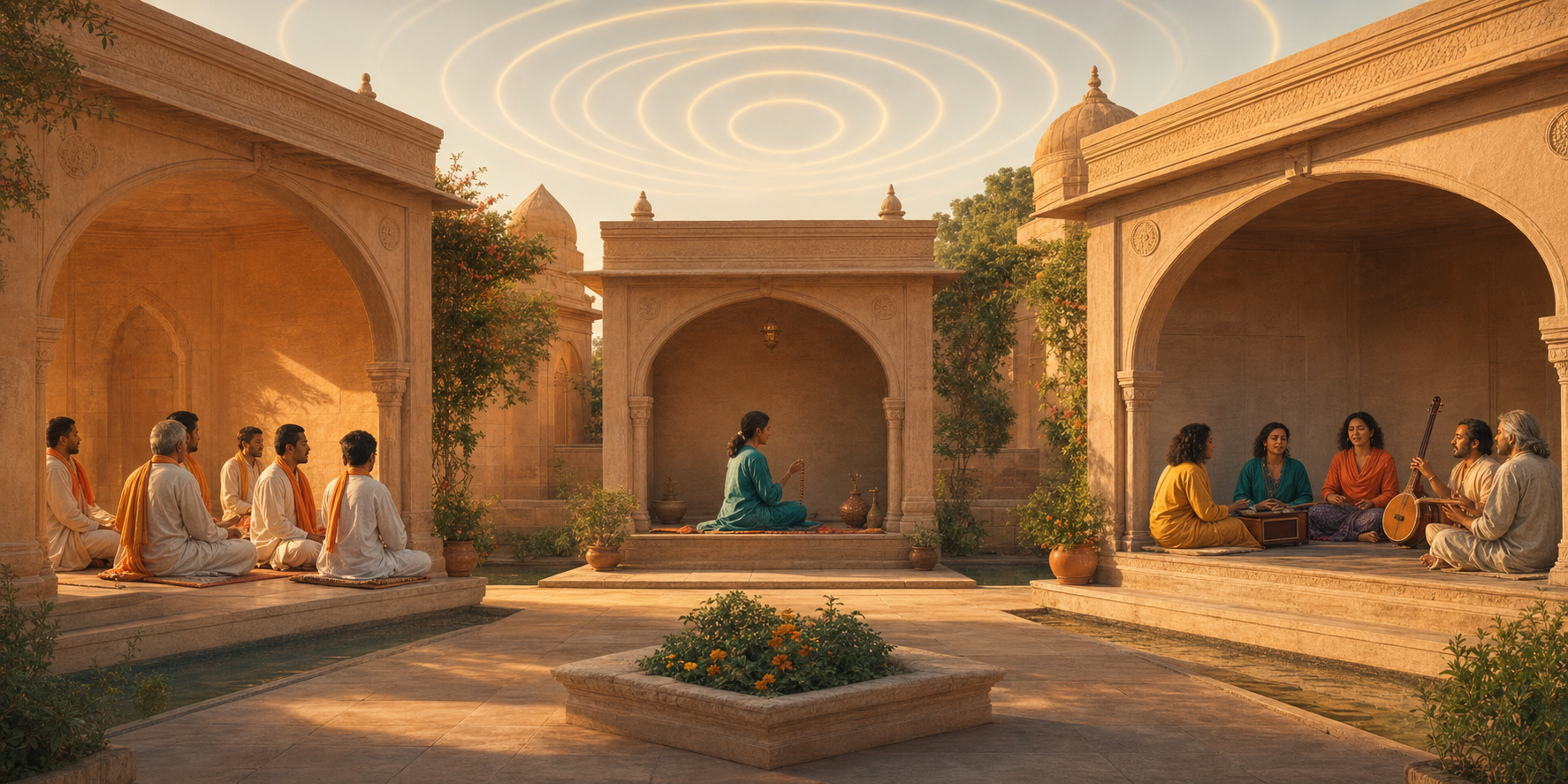
Bharat’s Dharmic traditions repeatedly place disciplined sound and remembrance near the centre of spiritual life. That civilizational kinship is real, but it is best understood through careful comparison rather than by placing every mantra under a single theology.
- Hindu paths include Vedic recitation, sāman performance, Om contemplation, bīja mantra, deity upāsanā, and nāma-japa. Each joins sound to a particular combination of revelation, ritual, meditation, or devotion.
- Buddhist mantra and dhāraṇī can operate as skillful means for stabilising attention and cultivating compassion. Om mani padme hum is a prominent example, but its use belongs to a Buddhist framework rather than to Vedic liturgy.
- The Jain Namokar or Navkar Mantra reveres perfected beings and directs the practitioner toward equanimity, supporting the weakening of karmic influx.
- Sikh Mūl Mantar, Naam Simran, and Gurbāni kīrtan centre remembrance of the Divine and the living authority of Shabad. Their musical and congregational forms should not be reduced to Hindu japa under another name.
The useful common ground is disciplined remembrance: sound gathers attention, engages memory, and reorients the practitioner. The distinctions lie in what is remembered, how the sound is authorised, what liberation means, and which community carries the practice.
Before borrowing a mantra from another Dharmic path, ask four questions. What or whom does it invoke? What spiritual aim gives it meaning? Is its vocal form fixed or adaptable? Does its tradition expect a teacher, initiation, congregational setting, or other preparation? Those questions let you honour shared origins and values without treating sacred forms as interchangeable wellness techniques.
Key takeaways for listening and practice
- A sāman is a disciplined transformation of Vedic verse, not generic Sanskrit singing.
- Pitch, duration, accent, stobha syllables, breath, and ritual setting are part of what you are hearing; translation alone cannot reproduce them.
- You may listen to Sama chanting reverently without claiming the ability to perform it. Performance calls for transmitted instruction and correction.
- For daily japa, begin with an accessible mantra aligned with your path, establish audible clarity, and internalise it gradually through whispered and mental repetition.
- Hindu, Buddhist, Jain, and Sikh traditions share confidence in disciplined sacred sound, but their mantras retain distinct authorities, aims, and methods.
At your next listening, resist the urge to call everything “mantra music.” Name the form first, then attend to what its pitch, syllables, and breath are doing. For your own practice, keep one appropriate mantra at one steady time and allow silence to complete the recitation. If the Sama Veda draws you from listening toward performance, let the search for a qualified teacher be your next act of reverence.
References
- DharmaRenaissance Blog — Decoding the Horse-Faced Sama Veda: Iconography, Sacred Sound, and Hayagriva
- DharmaRenaissance Blog — Unlocking Moksha with Mantra: The Transformative Science of Sound Across Dharmic Paths