
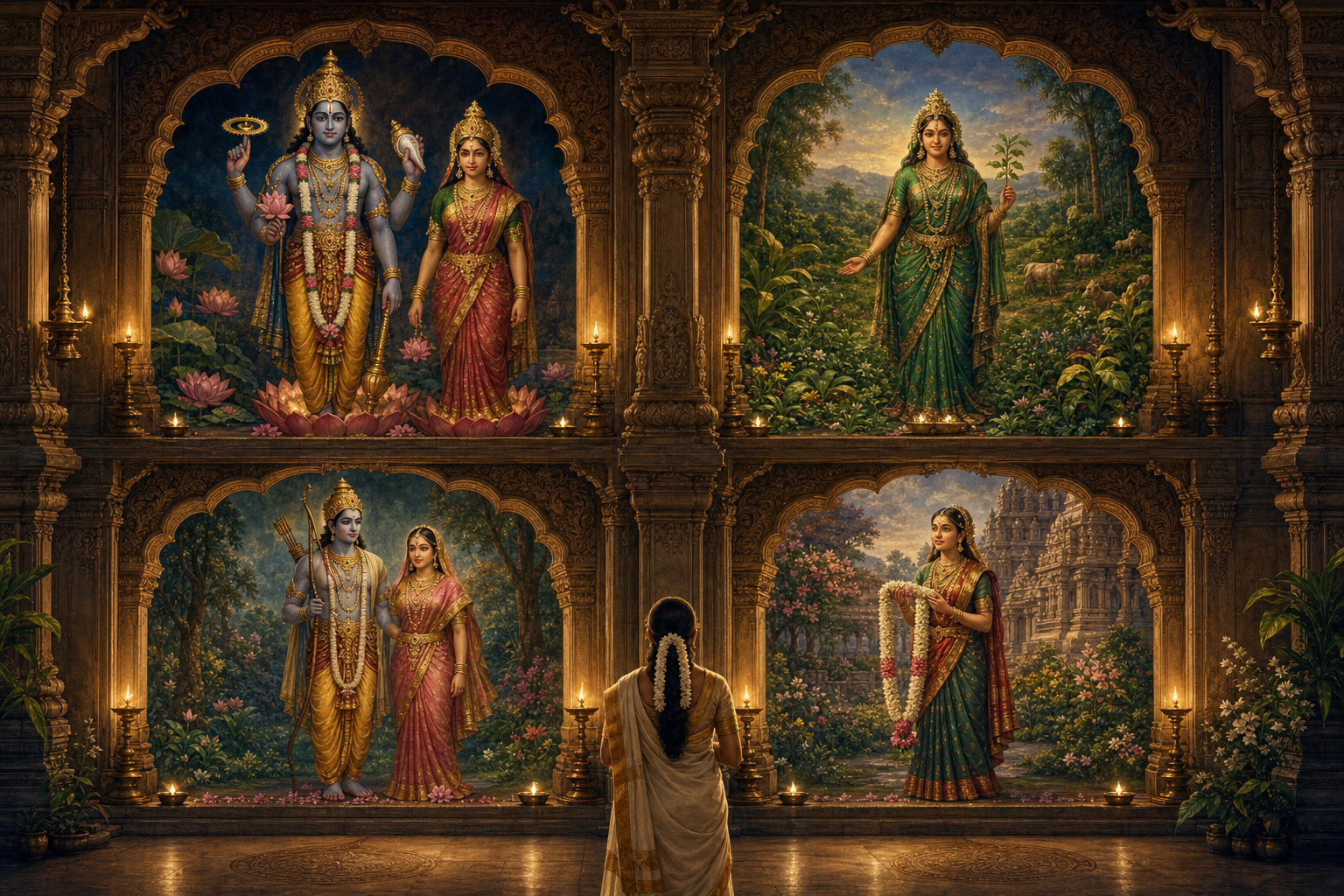
You stand before Rama and Sita, or Narayana and Sri, and a simple question arises: is the feminine figure merely accompanying the Lord, or is she showing you something essential about the divine? Your answer changes how you see the murti, hear the poetry and participate in the festival calendar.
In Vaishnava tradition, the Sacred Feminine is not one interchangeable goddess-form. Lakshmi, Bhumi, Sita and Andal disclose related but distinct modes of grace, sacred earth, moral sovereignty, devotional longing and service. Once you learn those distinctions, reverence becomes attentive practice rather than a vague feeling.
Begin with relationship, not a hierarchy
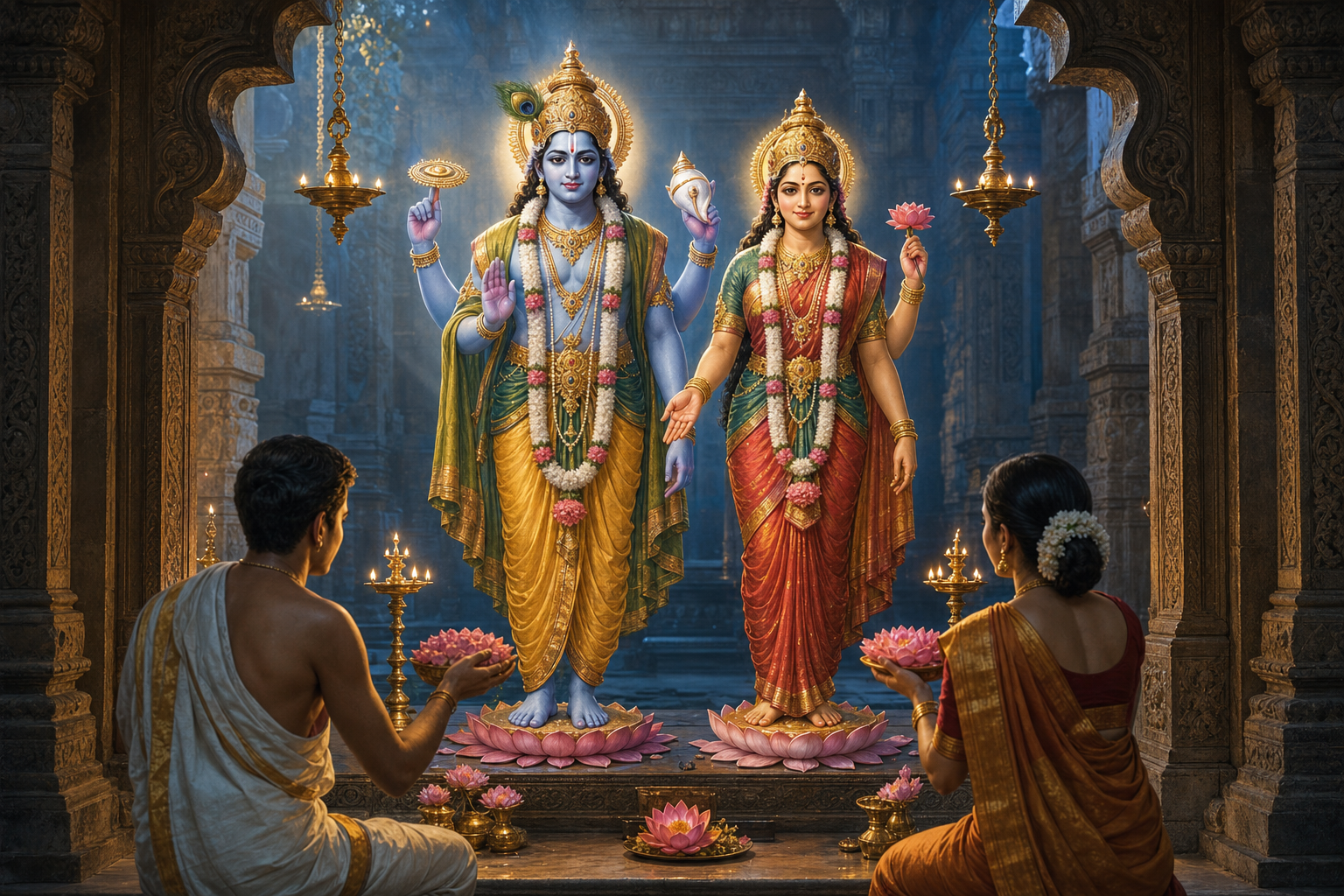
A hurried viewer can misread a Vaishnava image as a central male deity with a supporting female figure. That visual hierarchy obscures the theology. A divine consort is not an accessory added to an otherwise complete portrait. Her presence reveals how divine power is encountered: through grace, belonging, nurture, moral order and relationship.
Vaishnava sampradayas do not all describe the relationship between Vishnu and his shakti in exactly the same philosophical language. You do not need to erase those differences to recognize a dependable interpretive rule: look at what the feminine presence makes visible. Sri reveals gracious and auspicious sovereignty. Bhumi reveals the Earth as sacred support rather than inert property. Sita brings cosmic divinity into the tests of household, forest, kingdom and public judgment. Andal shows a devotee’s embodied longing becoming a path to God.
Key takeaways
- Do not treat Lakshmi, Bhumi, Sita and Andal as interchangeable names. Ask what each form reveals about divine-human relationship.
- Read Sita through both of her theological coordinates: she is honored as Lakshmi manifest and as Bhoomija, the daughter of the Earth.
- Read Andal as a speaking saint-poet, not merely as a beautiful feminine figure beside Vishnu.
- Let image, name, poetry and festival interpret one another. Isolating any one of them produces a thinner understanding.
Sri and Lakshmi: grace beside sovereignty
When you see Sri with Narayana, resist the popular habit of reducing Lakshmi to money or good fortune. Begin with the pair. Her auspicious presence tells you that divine sovereignty is not barren command. It is power joined to beauty, welcome and sustaining grace.
This changes a simple act of darshan. Do not mentally pass over Sri in order to reach the supposedly more important figure. Notice her posture, proximity and shared worship. If you maintain a home shrine, learn the names by which both members of the divine pair are invoked in your tradition. The point is not visual symmetry. It is theological relationship.
Bhumi and Sita: sacred earth with a human voice
Sita joins the celestial and terrestrial dimensions of the Sacred Feminine. She is revered as a manifestation of Lakshmi and as the Earth-born Bhoomija. King Janaka finds her in a furrow while ritually ploughing the sacrificial field, and her name itself is connected with that furrow. Her appearance binds royal responsibility, cultivation, yajna and the generosity of the Earth into a single scene.
Her names are therefore interpretive tools, not ornamental aliases. Janaki asks you to remember her relationship with Janaka. Vaidehi and Maithili locate her within Videha and Mithila. Bhoomija directs attention to Earth as mother and giver. Sita directs attention to the cultivated furrow, where human labor depends upon gifts it did not create.
When you read an episode involving Sita, ask two questions together: what does her choice reveal about dharma, and what does her Earth-born identity add to the episode? This prevents her from being reduced either to an abstract goddess beyond human difficulty or to a passive mortal carried through someone else’s heroic story.
Andal: the devotee whose longing becomes sacred speech
Andal occupies another position entirely. She is the only woman among the twelve Alvars and is often placed in the eighth or ninth century CE. Her significance lies not only in how she is portrayed but in the fact that her own devotional voice survives in the Thiruppavai and Nachiyar Thirumozhi.
Her bridal language is sringara-bhakti: longing, adornment and the desire for union are directed toward Vishnu. That language should be neither trivialized as ordinary romance nor sanitized into disembodied philosophy. Andal’s yearning is one-pointed spiritual orientation. Body, flower, fragrance, poetry and vow all take part.
The beloved account of Andal wearing garlands before offering them to the Lord captures this theology in one action. An object of worship passes through the devotee’s embodied love and is then offered. The gesture is intimate, but it does not remain private. The Thiruppavai summons a community to rise, sing and undertake devotion together. Andal is simultaneously lover, teacher, poet and participant in collective worship.
Let image, flower and festival teach together
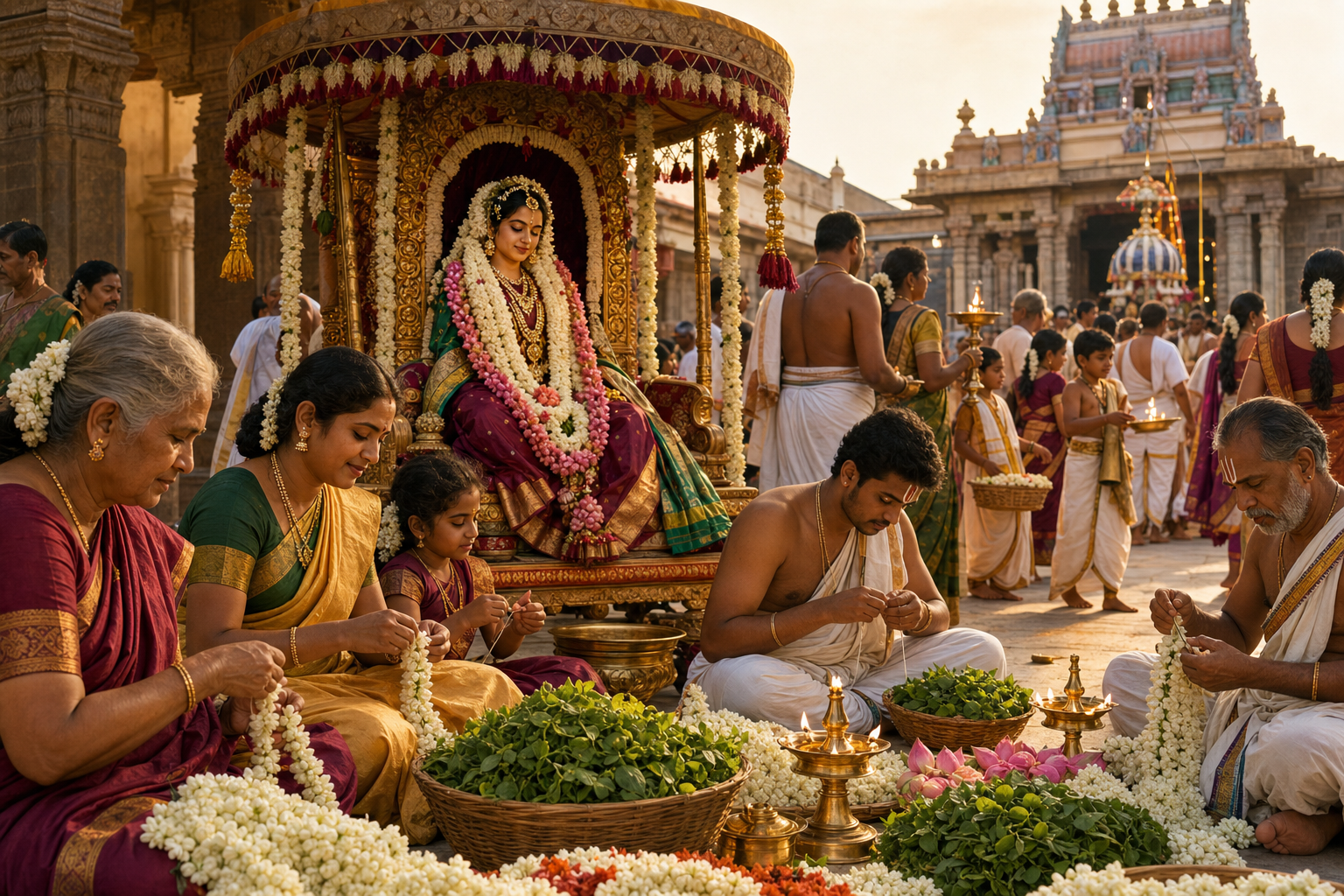
Vaishnava alankara is sometimes dismissed as decoration placed around the supposedly serious work of theology. Andal’s iconography exposes that mistake. The crafted form communicates before an explanation begins. Hair, flowers, metal ornaments and garlands make devotional meaning visible and memorable.
When you encounter Andal in a temple image, wedding representation or dance performance, look for four visual cues:
- The kondai silhouette. The characteristic bun is compact and elevated, sometimes set slightly to one side and sometimes placed more toward the back of the head. Regional variation does not make one version inauthentic; the recognizable grammar matters more than mechanical uniformity.
- The meeting of flowers and metal. Jasmine rings soften the brilliance of ornaments and convey coolness and sattvic purity. Other locally available flowers may add color and fragrance. Living material is part of the sacred form, not a disposable filler around the jewelry.
- The ordered line of ornaments. The nethi chutti frames the forehead, sun and moon motifs relate face and crown, rakodi discs articulate the bun, and the jadai nagam and terminal kunjalam establish the decorated axis of the braid.
- The garland and parrot. These immediately recall Andal’s association with flowers, poetry and loving offering. They help distinguish her from a generic representation of auspicious femininity.
Do not stop at identification. Ask what the materials are doing. A flower is cultivated, gathered, arranged, offered and renewed. Its fragrance spreads without being hoarded. Its freshness cannot be permanently possessed. Andal’s alankara therefore trains you to notice service, impermanence and renewed offering through beauty.
Sita’s iconography teaches differently. She frequently appears with Rama and Lakshmana, and that grouping can look like a static royal family portrait if you ignore the epic. Read her presence as the moral center of relationships tested by exile, separation, kingship and social judgment. Serenity in sacred art need not mean passivity. It can signify self-possession under pressure.
Read the ritual calendar as commentary
A festival does more than commemorate a date. It directs attention toward a particular dimension of the deity or saint. If you know the emphasis, you know what to watch and hear.
- Aadi Pooram: Andal’s thirunakshatram and divine wedding bring bridal devotion to the foreground. Temple adornment may become fuller and more elaborate. Listen for how marriage language expresses the soul’s orientation toward Vishnu rather than treating the event only as visual pageantry.
- Margazhi: Dawn recitation of the Thiruppavai places Andal’s voice inside communal discipline. The practical lesson is to join the recitation rather than approaching her only as an image to be viewed.
- Sita Navami: Observed on the Shukla Navami of Vaishakha, the occasion centers Sita’s appearance and invites Ramayana recitation, worship of Sita with Rama, and reflection on truth, compassion and household dharma.
If you attend one of these observances, prepare by learning one epithet and the outline of one associated episode or hymn. That small preparation makes the ritual intelligible. You will recognize why a particular garland, recitation or marriage motif is present instead of receiving the whole occasion as an undifferentiated display of tradition.
Protect feminine agency without forcing modern labels
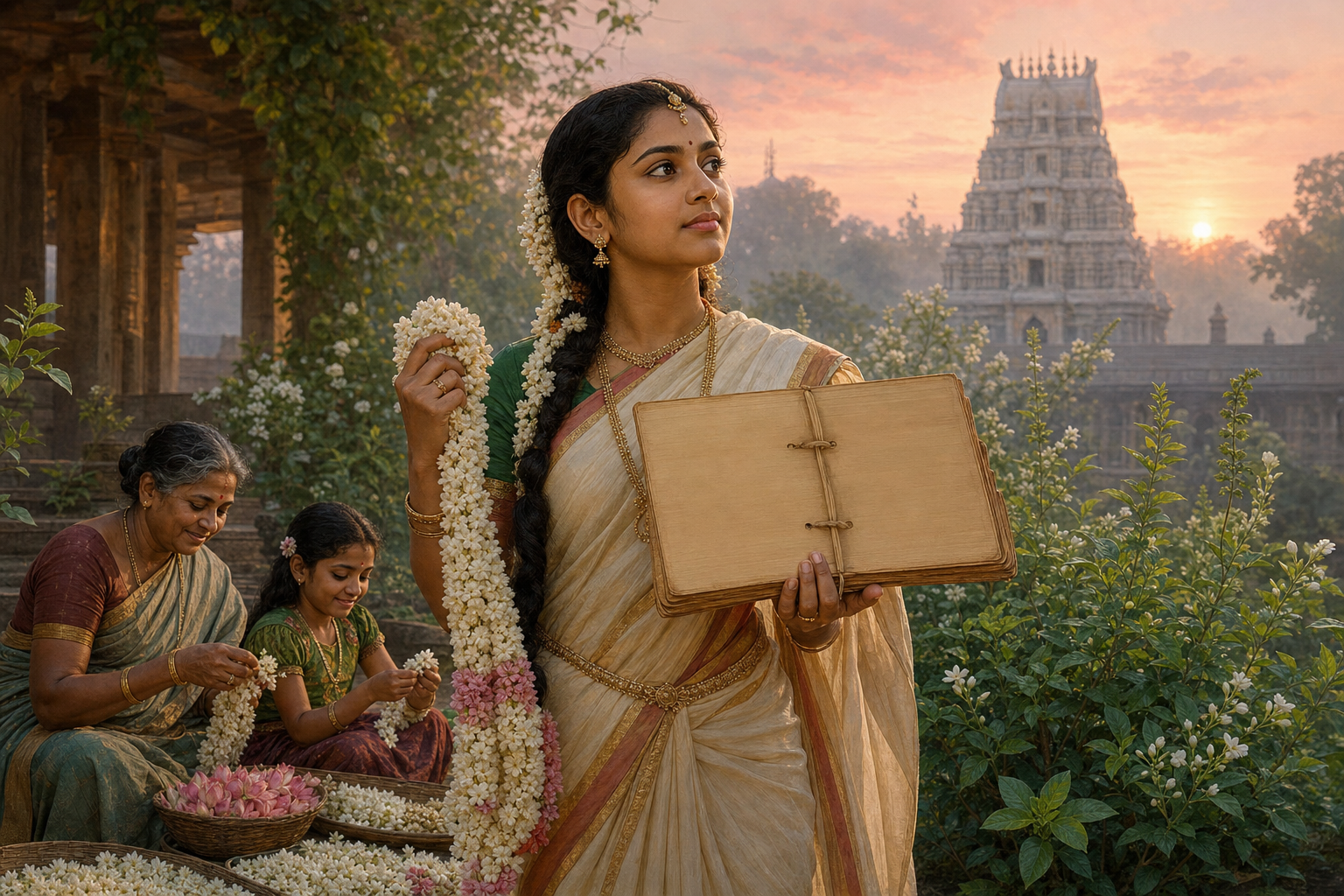
Discussions of Sita often swing between two reductions. One makes her an icon of unquestioning submission. The other recognizes agency only when she resembles a modern individual detached from family, vow and sacred relationship. Neither approach pays enough attention to what she actually chooses, refuses, endures and says.
The traditional description of the Ramayana as Sita-ayah Charitam Mahat, the great account of Sita, is a useful corrective. It does not remove Rama from the epic or turn Sita into its sole narrator. It warns you not to treat her as narrative cargo in a story about male heroism. Her abduction, resistance to Ravana, reunion with Rama and eventual return to Bhumi form an ethical arc concerning dignity, truth and the cost of public suspicion.
The agni-pariksha requires particular care. Several devotional traditions understand it as a theophany in which Agni restores the real Sita, while strands involving Maya-Sita hold that her true form was protected during captivity. Recensions and sarga numbering vary, and some textual historians also regard parts of the Uttara Kanda as later additions. These distinctions do not oblige every reader to find the episode ethically easy. They do show why a claim that “Hinduism simply says” one thing about Sita is usually too blunt.
When you encounter a confident claim about Sita, test it with four questions:
- Which telling is under discussion: the Valmiki Ramayana, a Puranic strand, a regional retelling or a performance tradition?
- Is the speaker making a textual claim, a theological interpretation or a contemporary ethical judgment?
- Does the interpretation acknowledge Sita’s own words, decisions and refusals, or only what other characters do to her?
- Does it distinguish devotional conviction about Sita’s purity from historical questions about recension and composition?
Apply the same discipline to Andal. Calling her poetry romantic without attending to its divine object turns bhakti into psychology. Calling it purely symbolic while ignoring her body, garlands and bridal self-presentation removes the very medium through which she speaks. Her agency is devotional: she names her longing, directs it toward Vishnu and calls others into disciplined worship.
Agency in this setting does not have to mean freedom from every relationship. It can mean the capacity to choose dharma within relationship, refuse adharma, speak desire toward God, preserve dignity under judgment and transform embodied life into offering. That wider definition helps you see strength without rewriting Vaishnava figures as replicas of contemporary political categories.
Build a practice that joins understanding and devotion
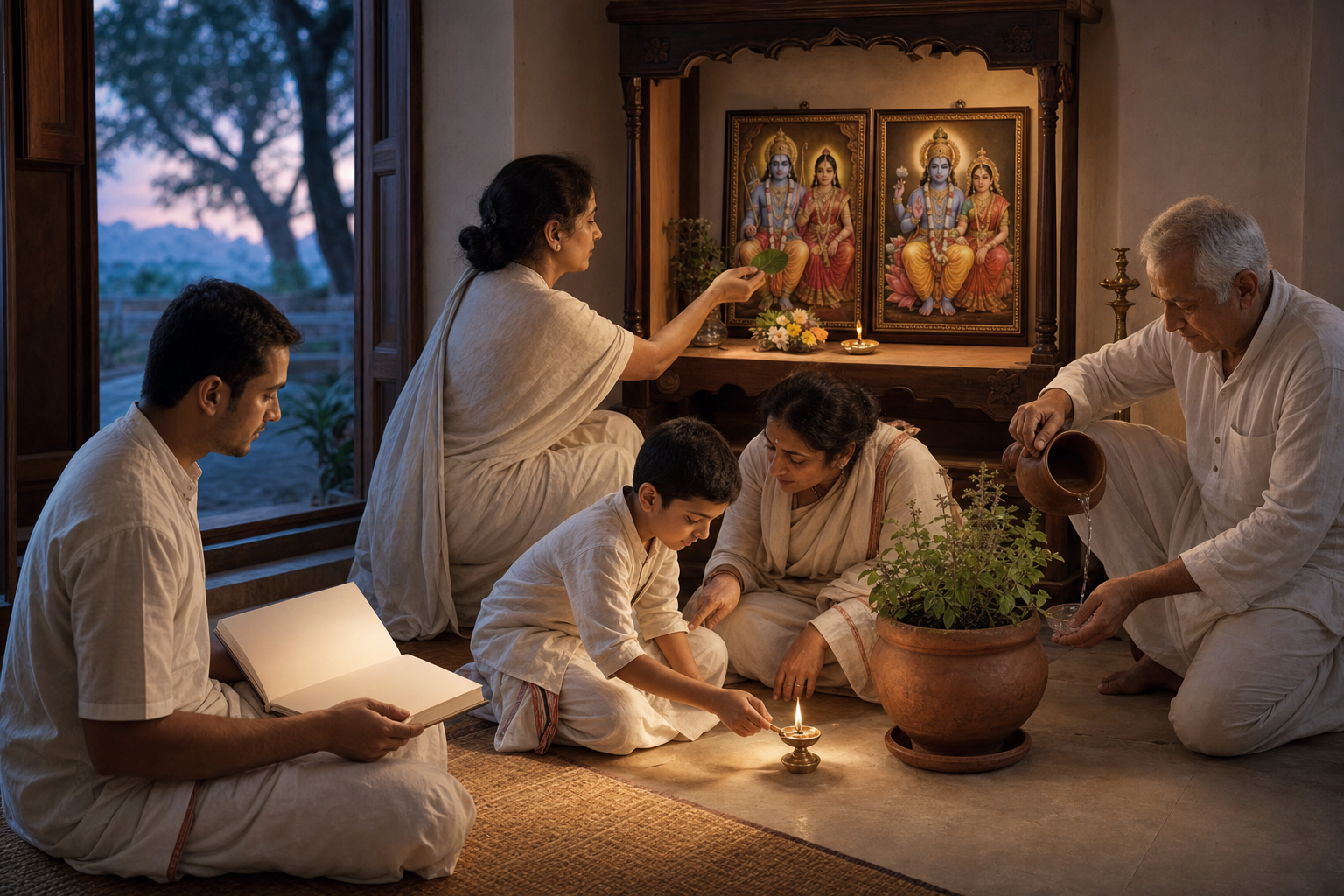
You do not need to master every branch of Vaishnava theology before beginning. Choose one form of the Sacred Feminine and work with her name, image, text, season and ethical demand together. The following sequence is simple enough for personal worship and substantial enough for a study group.
- Choose the question before the figure. If you are reflecting on grace and divine welcome, begin with Sri. If your concern is land, sustenance or the moral weight of household life, begin with Bhumi-Sita. If you want to understand longing, poetry and communal devotion, begin with Andal.
- Learn one name precisely. Say Janaki, Vaidehi, Maithili or Bhoomija and remember what the name directs you to notice. Say Goda or Nachiyar and remember the saint-poet rather than a generic bridal goddess. Precision in naming prevents devotion from becoming abstraction.
- Read the voice in its ritual setting. Approach the Thiruppavai during Margazhi or read Sita’s Ramayana episodes around Sita Navami. If you use a translation, choose one respected in the sampradaya or temple community you are learning from. Do not build a settled judgment from an isolated verse circulating without narrative context.
- Observe before explaining. At darshan, inventory what is actually present: the paired deities, posture, flowers, hairstyle, garlands, attendants and festival objects. Then ask what relationship the arrangement expresses. This is more reliable than imposing a memorized slogan upon every image.
- Convert one symbol into one duty. Reflection on Bhumi-Sita can become careful treatment of food, soil and the labor that sustains a household. Sita’s association with satya and daya can become truthful speech delivered without cruelty. Andal’s collective call can become regular participation in recitation instead of spirituality practiced only as private preference.
- Carry heritage with its meaning intact. If your family adopts an Andal kondai for a wedding, or a dancer uses it in an Andal composition, preserve the recognizable relationship among bun, flower rings, braid ornaments and devotional context. A secure base, balanced ornament weight and breathable flowers protect the wearer while honoring the temple craft from which the form draws its meaning.
At the end of worship or study, ask one final question: what did the feminine presence change in your understanding of God? If your answer is only “beauty,” look again. Grace may be standing beside sovereignty. Earth may be speaking through a queen. A Tamil poet’s longing may be turning solitary desire into collective devotion.
The next time you encounter Sri, Sita, Bhumi or Andal, begin with one name, one visual cue and one act of response. Let that small discipline mature across a festival season. The Sacred Feminine becomes intelligible when you stop treating her as a theme and begin meeting her as a presence who asks something of you.
References
- DharmaRenaissance Blog — Andal Kondai Unveiled: Iconography, Ritual Craft, and the Living Heritage of Goda Devi
- Dandavats — Earth-born Sita Devi: A Scholarly, Soul-Stirring Portrait of Dharma in the Valmiki Ramayana