
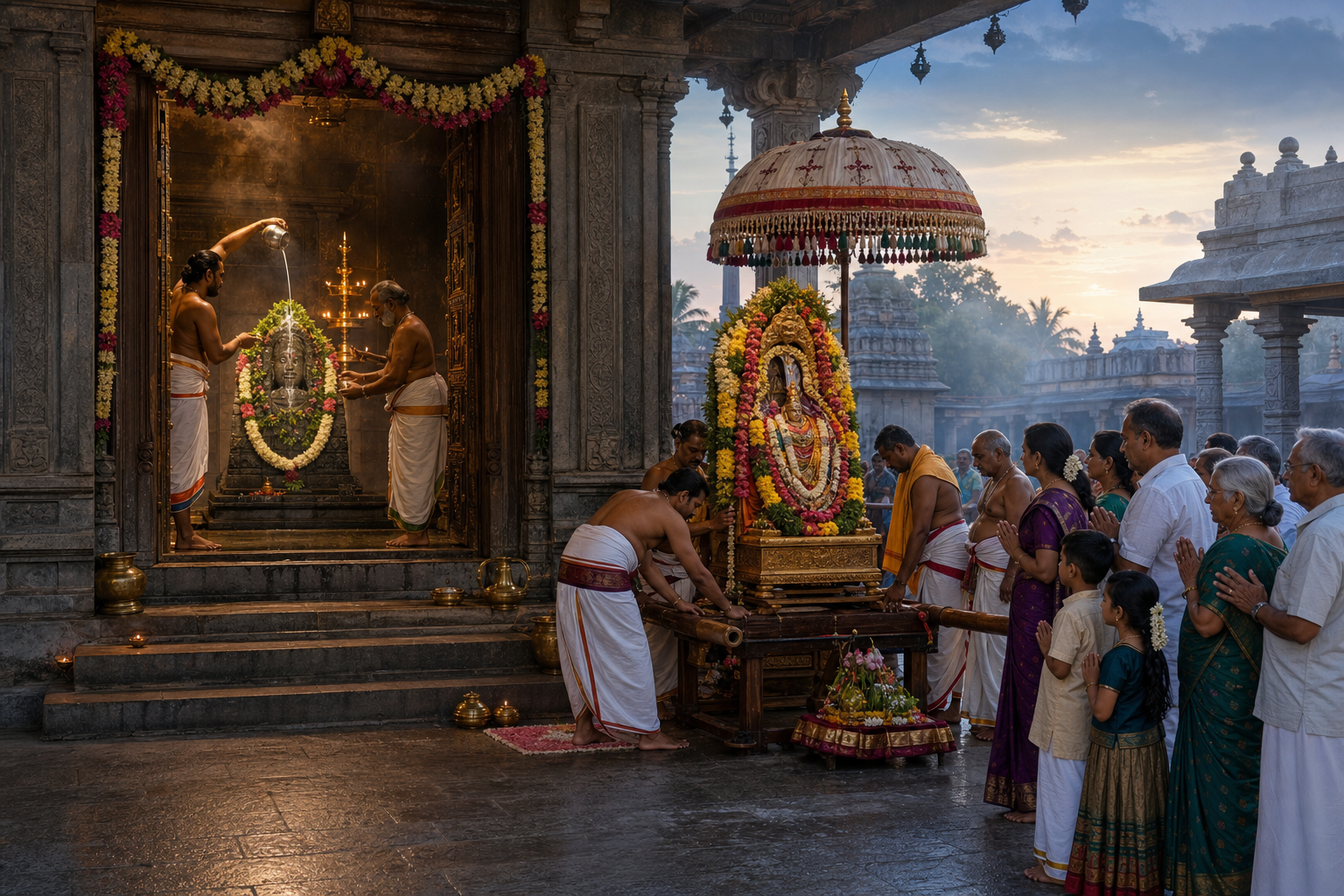
If you are attending a temple abhisheka for the first time, the difficult part is rarely knowing when to bow. It is understanding what kind of participation the ritual asks of you. Should you try to see every offering, book a seva, join the chanting, wait for the procession, or simply stand quietly?
Use one simple frame. Abhisheka gathers attention around the deity; the procession carries darshan into the shared life of the community. Once you recognize these inward and outward movements, the schedule, substances, sounds, and crowd discipline begin to form one intelligible act of worship.
Why abhisheka and procession belong together
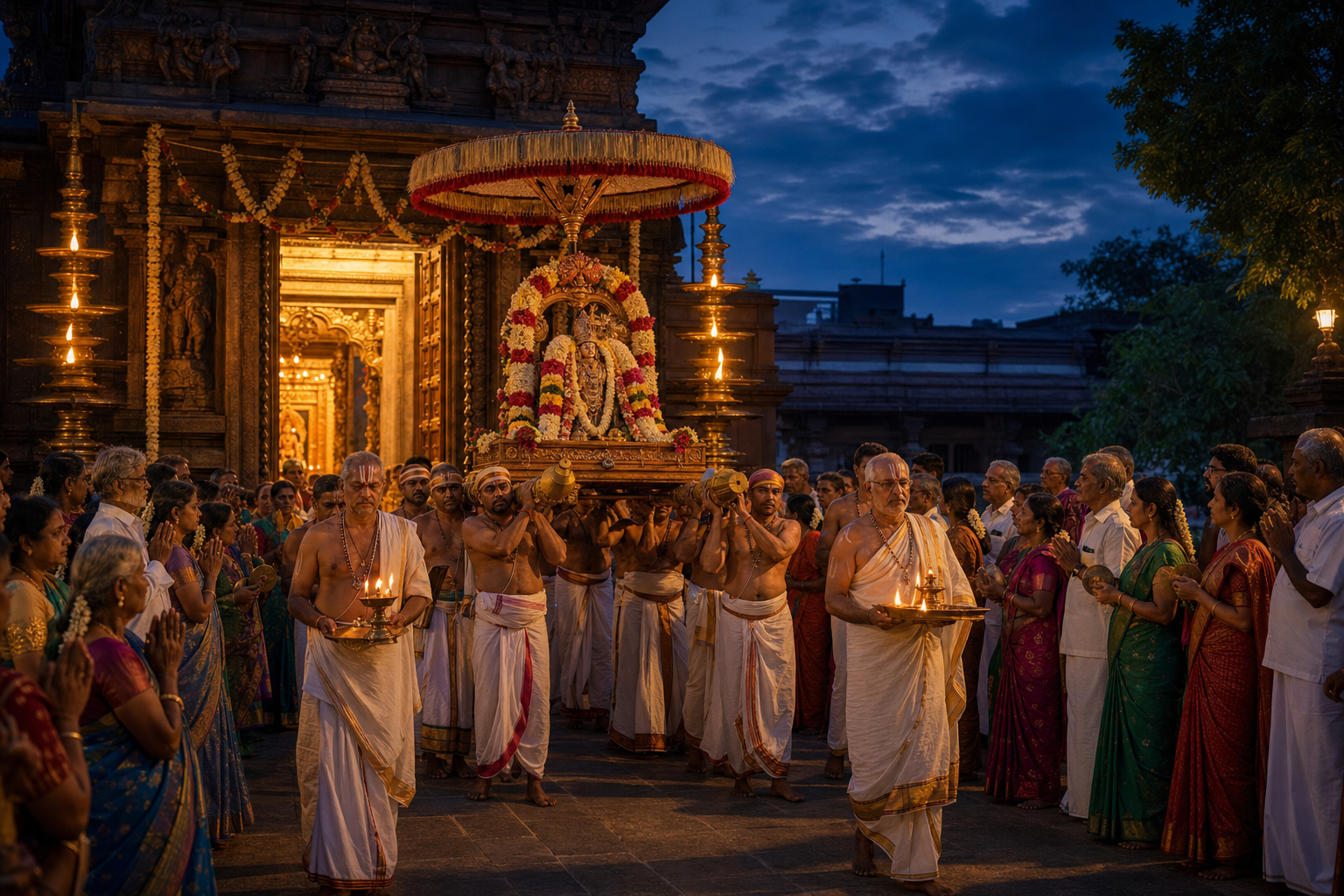
A temple festival can look like a collection of separate events: bathing in the morning, alankara later, prasada distribution, and an evening procession. Liturgically, however, these moments are connected. The deity is bathed, honored, dressed, adorned, offered food, and presented for darshan. When an utsava-murti is then carried outside, the worship does not leave the sacred order behind. It expands that order into public space.
This distinction matters when you plan your visit. At Sri Kodandarama Swamy Temple in Tirupati, for example, the May 2026 Poornima observances placed an Ashtottara Shatakalasabhishekam at 9:30 AM and a Mada-street procession at 5:30 PM on May 1 and May 31. A devotee who treated the morning ceremony as the whole festival would have missed its public culmination. Someone who arrived only for the procession would still receive darshan, but without seeing the ritual preparation that preceded it.
Schedules differ among temples, so this is not a universal timetable. It illustrates a useful planning principle: do not assume that abhisheka and procession are one continuous program. Check whether they are separated by several hours, whether each requires different access, and whether a seva booking covers only the sanctum ceremony rather than the evening route.
Many temples distinguish between the principal icon established in the sanctum and a movable utsava-murti used for festivals. The exact arrangement follows the temple’s sampradaya. Ask locally rather than assuming that every icon can be bathed, touched, or carried in the same way. What appears to a visitor as a practical difference in size or material also carries a liturgical purpose.
Darshan in the sanctum concentrates the encounter. The lines narrow, voices soften, and attention turns toward the consecrated form. A procession reverses that spatial movement. The deity comes through gates, streets, sounds, lamps, and waiting crowds. In the Tirupati observance, Sri Kodandarama Swamy, Sita, and Lakshmana were to pass through the four Mada streets, accompanied by conch, chant, percussion, and traditional music. The route itself became part of worship.
That is why a public ritual should not be approached merely as a religious performance. You may be watching, but you are also helping to create its conditions. The corridor you leave clear, the silence you maintain during recitation, and the space you yield to an elder are forms of participation. Public access does not make the rite casual; it makes shared discipline more important.
How to read what is being offered
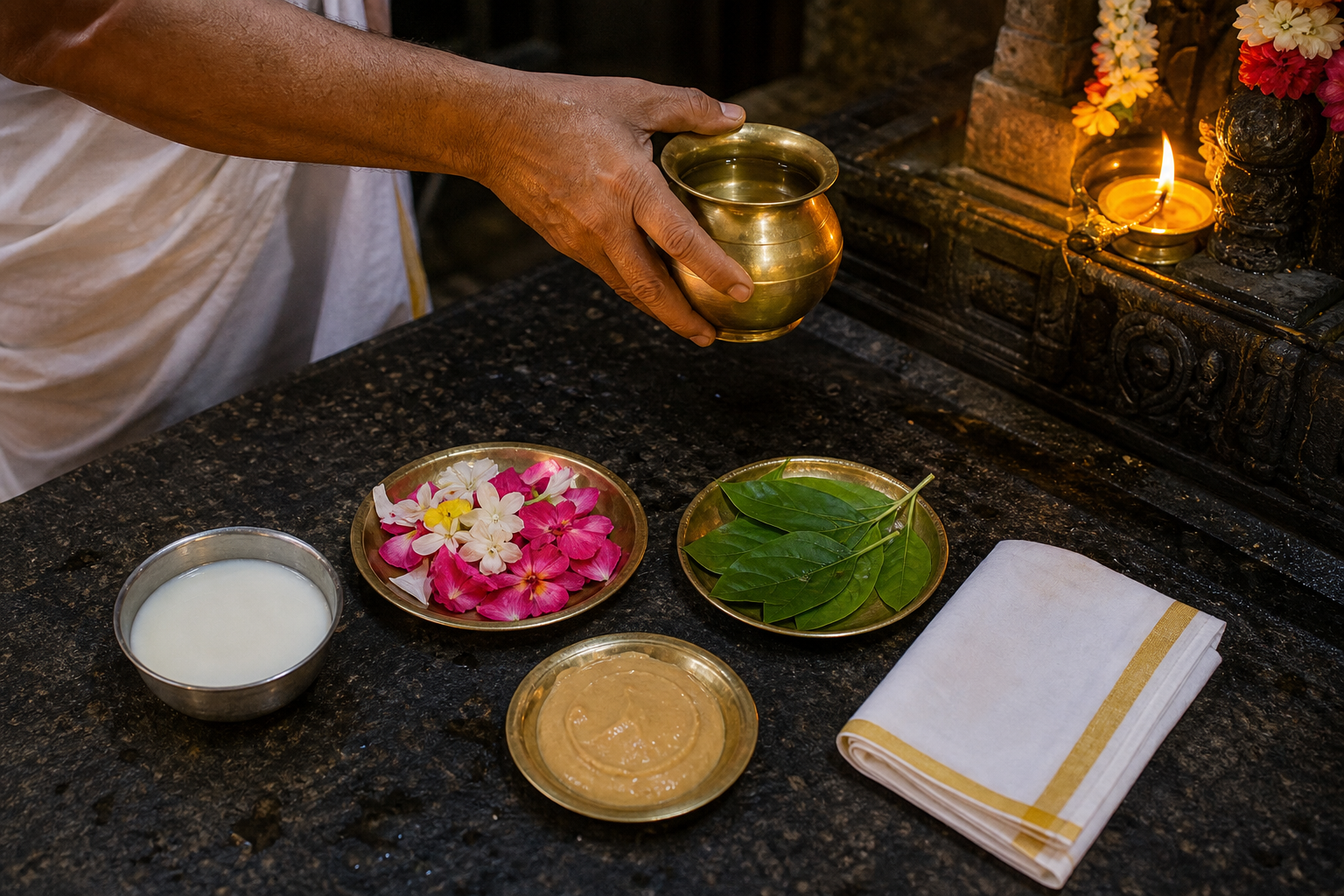
Abhisheka is the ceremonial bathing of a deity with water or other prescribed substances. The visible pouring is only one layer. Mantra, intention, sequence, the authority of the officiating archakas, the nature of the murti, and the temple’s inherited procedure all shape the rite. Bringing a sacred-looking substance from home does not give a visitor permission to pour it over an icon.
A fuller worship sequence may begin with water and, where the tradition prescribes it, purification with panchagavya. Panchamrita may then be offered before further rinsing, fragrance, dress, alankara, and naivedya. The five customary nectars are milk, curd, ghee, honey, and sugar or jaggery. Regional practice may favor rock sugar, mishri, or jaggery, but substitution is governed by lineage and temple procedure rather than personal preference.
Each ingredient gives you a way to follow the rite inwardly:
Milk evokes purity, nourishment, benevolence, and the cooling luminosity associated with the lunar principle.
Curd represents transformation: one nourishing substance has matured into another form without losing its origin.
Ghee recalls Agni and yajna. What sustains the sacrificial flame also becomes an offering upon the divine form.
Honey gathers the work of many blossoms into one sweetness, making it a natural image of unity without sameness.
Sugar or jaggery expresses concentrated sweetness and the devotional intention to make one’s own speech and conduct gentler.
These meanings are contemplative aids, not a formula you must memorize. If the ceremony is crowded or your darshan is brief, choose one correspondence and stay with it. When honey is poured, for example, consider whether your conduct is capable of harmonizing differences. When curd is offered, consider which part of your life needs disciplined transformation rather than sudden rejection.
The sequence matters as much as the ingredients. Panchamrita is not simply mixed, displayed, and finished. The icon must be handled according to its material and ritual requirements, and residue must be carefully removed. Temple traditions therefore pair anointment with meticulous washing and wiping after the offering. This is another reason to leave quantities, mixtures, and application to the authorized attendants. More substance does not mean more devotion.
An Ashtottara Shatakalasabhishekam uses 108 kalashas. Do not confuse this with 108 different ingredients. The kalashas contain sanctified water, traditionally prepared through purification, fragrance, and recitation, and are offered in an ordered succession. The number 108 carries several familiar dharmic correspondences, including 27 nakshatras with four padas each and the 108 beads of a japa mala. The repetition turns time itself into part of the offering.
If you cannot see every pour, listen for the cadence. Notice how recitation continues across repeated actions, how the attendants coordinate vessels and cloths, and how the visual character of the murti changes when bathing gives way to dressing and alankara. The ceremony is not only a sequence of substances. It is a movement from purification and offering toward renewed presence and darshan.
Panchamrita may later be received as prasada where temple practice permits. Receiving a symbolic amount is sufficient if you need to limit it for dietary or health reasons. Reverence is not measured by the quantity consumed. If you are uncertain about ingredients or distribution, ask a temple volunteer before accepting it rather than taking it and discarding it.
How to attend a public ritual without becoming an obstacle
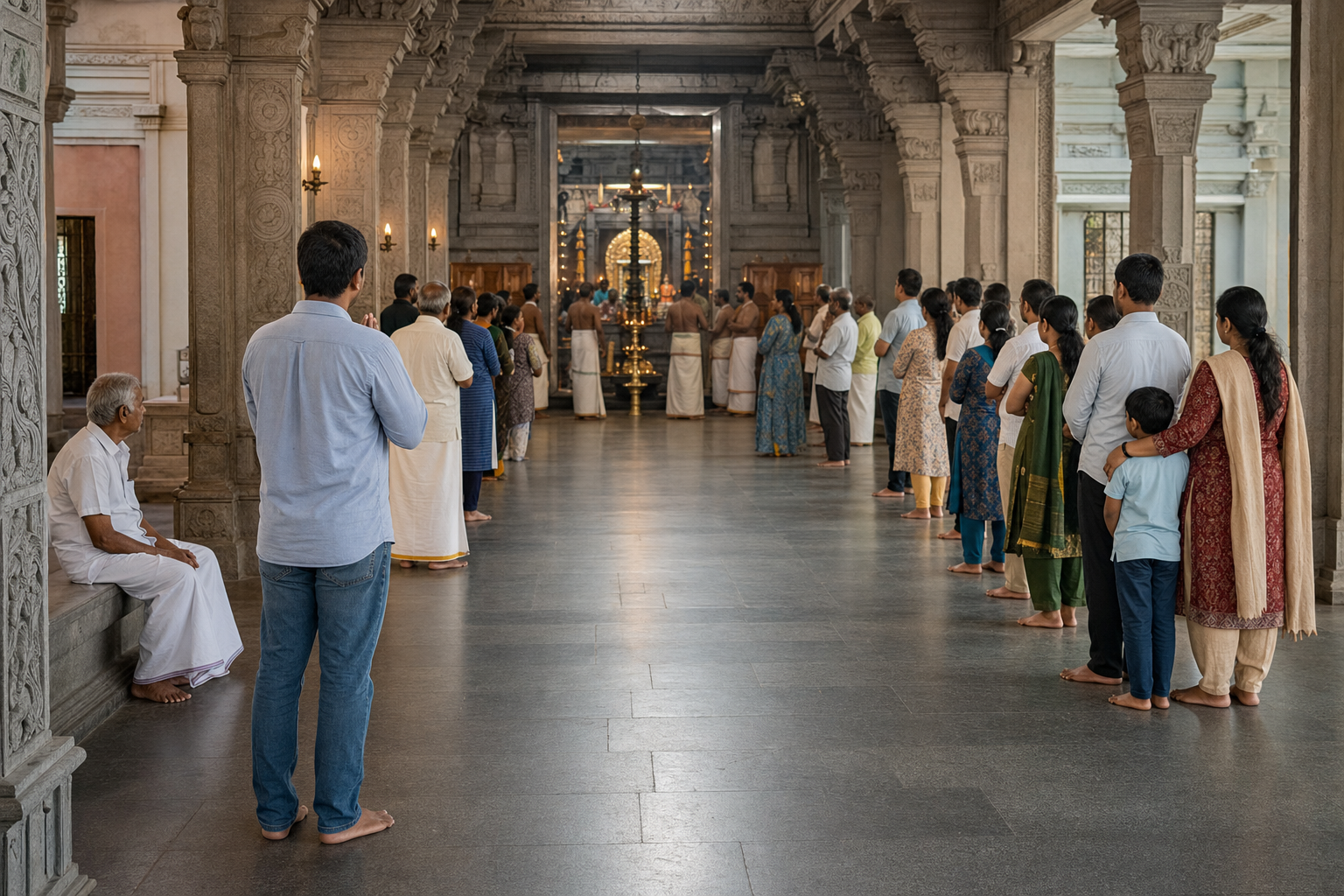
The best preparation is operational as well as devotional. A festival draws regular worshippers, families, visitors, musicians, bearers, vendors, volunteers, and security personnel into the same limited space. A small uncertainty at an ordinary darshan can become a serious bottleneck when hundreds of people stop at the same gate or turning.
Before leaving for the temple
Verify the day’s timing through the temple administration or its official channel. Published festival times can still be adjusted for crowd management, weather, security, or liturgical needs.
Ask whether you need a booked seva for closer attendance or whether ordinary darshan is available. A seva ticket, a general queue, and a public procession may have different entry arrangements.
Identify both the ritual venue and the processional route. The sanctum entrance is not necessarily the best place to wait for an evening veedhi-utsavam.
Arrive early without inventing a universal lead time. The necessary margin depends on security checks, the size of the festival, local transport, and whether you are accompanying children or elders.
Wear modest clothing suitable for the temple and the weather. Carry as little as possible, because bags slow security screening and become difficult to manage in a compressed crowd.
Choose a family meeting point outside the most congested zone. Mobile reception and conversation can both become unreliable when music, chanting, and crowd movement intensify.
Do not assume photography is permitted simply because the ritual is public. Rules can change between the sanctum, outer prakara, and street. Check before raising a phone or camera. A prohibited photograph can interrupt your own darshan, distract nearby devotees, and create an avoidable dispute with volunteers.
During the abhisheka
Settle before the main recitation begins if seating or a viewing area is available. Keep passageways open, lower your voice, and do not push forward each time a new vessel appears. If the line must continue moving, accept the pace. A brief, attentive darshan is more faithful to the occasion than obstructing everyone behind you in pursuit of a perfect view.
Join a chant only when you know its words and rhythm well enough not to compete with the officiants. Quiet attention is complete participation. You can maintain nama-japa inwardly, observe the offering, or hold a simple sankalpa for shanti, well-being, and steadiness in dharma.
Do not reach across barricades, hand unsolicited substances to an archaka during a critical sequence, or place vessels where attendants are moving. If the temple accepts offerings, use the designated counter or handover point. Liturgical coordination and physical safety are inseparable when liquids, metal vessels, lamps, polished floors, and tightly packed participants occupy the same space.
Between the morning rite and evening procession
If the two programs are hours apart, leave the active temple corridor rather than holding a place all day. Eat, hydrate, rest, and return with enough time to find the designated viewing area. This is especially important in a hot season. May conditions in Tirupati can exceed 35 degrees Celsius during the day, making shade, water, sun protection, and a realistic plan for elders and children matters of safety rather than convenience.
A position immediately beside the busiest gate is not always the best vantage point. A shaded section or a less congested turning along the route may give your family a clearer and calmer darshan. Speak to volunteers near barricades about designated areas for seniors or people who cannot stand for long. Do this before the procession approaches; it becomes much harder to move safely once the route fills.
As the deity enters the street
Treat the processional path as sacred working space. Bearers need an unobstructed line, musicians need room to maintain formation, and security personnel need access to the edges of the crowd. Stay behind barriers, obey changes in direction, and never step backward into moving devotees merely to frame a photograph.
The music is not background entertainment. Conch, nagaswaram, percussion, chant, the pace of the bearers, and the ornamented utsava-murti work together to make the procession perceptible across a large public space. Let the sound alert you to the deity’s approach, then lower the phone and receive darshan directly.
You do not need to follow the procession through every street. For a family with a child, an elder, or anyone vulnerable to heat or crowd pressure, one stable viewing point and a planned exit are usually wiser than repeatedly entering and leaving the moving crowd. If conditions become uncomfortable, step away before the procession reaches your position. Waiting until the densest moment makes withdrawal harder.
Once the procession passes, keep moving as directed. Do not stop in an exit channel to discuss the darshan, distribute food, or search through a bag. Carry your waste out if no receptacle is available. The final act of seva may be as ordinary as leaving the street clean and the route open for those behind you.
Shared dharmic values do not erase real differences
Abhisheka resonates beyond one Hindu sampradaya, but the resemblance should be handled carefully. Jain worship also includes Panchamrut Abhishek of Tirthankara images, expressing purity, reverence, and disciplined offering. Buddhist uses of abhisheka commonly emphasize consecration or empowerment with water and fragrant substances. These are genuine civilizational resonances, not proof that every tradition assigns the same theology to an image, substance, or officiant.
Sikh practice makes the distinction even clearer. It does not employ image worship. Amrit Sanchar and the communal receiving of karah prasad can still illuminate related dharmic values of sanctified preparation, sweetness, humility, discipline, and seva, but they should not be described as Sikh versions of murti abhisheka. The parallel lies in ethical and devotional qualities, not in identical ritual form.
This precision is useful when you bring a friend or relative from another dharmic community. Explain what will happen in the temple without telling them what their own tradition supposedly means. A helpful introduction is concrete: the deity will be ceremonially bathed, dressed, and offered darshan; later, a movable festival form may be carried through the streets. Let your guest notice the resonances and differences without being pressured to flatten either one.
The broader unity appears most clearly in conduct. Purification should make us less careless. Sweetness offered to the Divine should make our speech less harsh. Public darshan should widen our concern for people who cannot command the best position. A ritual loses part of its moral force when devotion at the shrine is followed by pushing, littering, or disregard for the vulnerable outside it.
Key takeaways
Plan abhisheka and procession as related but potentially separate events. Confirm the time, access rule, route, and return interval for each one.
Read the ceremony as a sequence: purification, offering, rinsing, adornment, naivedya, and darshan. Do not focus so narrowly on the pouring that you miss the transformation of the whole ritual space.
Milk, curd, ghee, honey, and sugar or jaggery form the customary five nectars. The temple’s lineage and authorized attendants decide the exact materials and method.
An offering of 108 kalashas is an ordered discipline of repetition, not a display of 108 different substances.
Crowd discipline is seva. A clear corridor, a quiet voice, a safe viewing position, and prompt cooperation with volunteers directly support the ritual.
Shared dharmic themes such as purification, sweetness, consecration, and service can be acknowledged without claiming that Hindu, Jain, Buddhist, and Sikh practices are interchangeable.
Before your next temple visit, make four notes: the confirmed start time, the seva or darshan entry rule, the procession route, and the safest exit for your family. Then choose one moment to follow with full attention: the first water offering, the unveiling after alankara, or the turn of the deity into the street. Let that moment, rather than the pressure to see everything, set the rhythm of your participation.
References
- HinduPad — May 2026 Sacred Festivals at Tirupati Sri Kodandarama Swamy Temple: Timings, Rituals, Processions
- HinduPad — Panchamrita Abhisheka: Sacred Science, Symbolism, and Temple Tradition of the Five Nectars