

Perhaps you chant daily, yet the thought of death still produces a sharp question: what if pain, confusion, or fear prevents me from remembering the Divine at the final moment? If that question has made your practice anxious, the anxiety itself is showing you where the work belongs.
Bhakti gives a demanding but merciful answer. Final remembrance is not a password to improvise under pressure. It is the ripening of a relationship cultivated in ordinary time through the Divine Name, truthful self-review, seva, and a kind of joy that does not depend on circumstances going your way.
Final remembrance begins long before the final breath

Bhagavad Gita 8.5-6 connects remembrance at the time of departure with the trajectory that follows. Read carelessly, this teaching can turn death into a terrifying examination: one wrong thought, after a lifetime of devotion, appears to decide everything. That reading overlooks how memory is formed. What comes readily to mind in a crisis is usually what attention, affection, and conduct have made familiar.
The practical question is therefore not, What spiritual thought can I force into the last second? Ask instead: Where does my mind seek shelter now when a plan fails, an insult lands, or uncertainty rises? If it runs automatically toward resentment, distraction, or control, that is not a verdict on you. It is a diagnosis of the habit that needs retraining.
The Isavasya Upanishad 17 adds an essential dimension. As the body returns to ash and breath returns to the greater breath, the inner directing faculty, kratu, is commanded to remember what has been done. The repetition of smara, remember, makes moral recollection part of conscious dying. The Upanishadic sequence places honest remembrance of action immediately before the prayer for guidance along the auspicious path.
This joins two tasks that are sometimes separated. You remember the Divine, and you remember your deeds truthfully. The first gives consciousness its refuge. The second clears self-deception from the path toward that refuge. Reviewing harmful speech, neglected duties, generosity, restraint, and service is not a rival to bhakti. It helps prevent unresolved habits from occupying the mind when you most need clarity.
Gaudiya Vaishnava thought describes the path through sambandha, abhidheya, and prayojana: your relationship with Krishna, the practices that express that relationship, and the mature fruit of divine love. This order matters. Final remembrance belongs to the whole movement. You first know where you belong, then live that belonging through sadhana and seva, and gradually discover that remembrance has become less forced.
Ananya Sharan Bhaava names this undivided refuge. It does not require contempt for other paths or nervous policing of other people’s devotions. Its opposite is inner fragmentation: appealing to one object when afraid, another when ambitious, and a third when seeking social approval. Choose your Ishta, Divine Name, mantra, or established prayer clearly enough that the mind knows where to return.
Related disciplines appear across the dharmic family without becoming identical. Buddhist maranasati brings mortality into mindful awareness. Jain pratikramana makes recollection, contrition, and renewed resolve regular practices. Sikh simran keeps the Divine Name close to truthful conduct and seva. Their metaphysical accounts remain distinct, but each refuses to leave clarity at death to chance.
Inner bliss gives the mind a reason to return

Fear may start a discipline, but fear rarely makes it intimate. The mind returns most naturally to what it has learned to love. That is why ananda is not an ornamental promise added to bhakti. Inner bliss helps explain how remembrance can become spontaneous rather than merely compulsory.
Dharmic philosophy distinguishes pleasure produced by contact with changing objects from happiness discovered within a relationship to the eternal. Sensory pleasure is not condemned simply because it is pleasant. Its limitation is that it depends on conditions that shift, fade, or become unavailable. Bhagavad Gita 5.21 speaks of finding happiness within, while 6.21 describes a supreme happiness beyond the senses yet grasped by a clarified intelligence.
For a Krishna bhakta, Krishna as Paramananda means that the highest joy is personal and relational. Hearing, chanting, remembering, worship, and service do more than suppress worldly desire. They redirect the capacity to love toward its enduring center. Devotees of Shiva, Devi, Rama, or another Ishta can recognize the same practical distinction within the language of their own sampradaya: stimulation rises and falls, while devotion seeks a joy rooted in the Real.
Do not turn this teaching into a demand that every session feel blissful. A peaceful mood may accompany japa, but it is not proof of realization. Dryness does not prove that bhakti has failed. Some of the most important practice occurs when you keep the appointment with the Divine without receiving an immediate emotional reward.
- When laya, heaviness or dullness, takes over, shorten the session temporarily, sit in a brighter place, or begin with gentle kirtan before returning to quieter remembrance.
- When vikshepa, distraction, repeatedly carries the mind away, use the breath as a simple landing place and return to the Name without turning each distraction into an argument with yourself.
- When kashaya, unresolved emotional residue, dominates, name the injury or fault honestly. Apologize or make amends where possible, and let disciplined seva replace self-absorbed guilt.
- When rasasvada, attachment to a pleasant inner state, appears, receive the sweetness gratefully but do not collect it as a spiritual achievement. Return the mind to the Ishta and let the session end in service.
These four obstacles require different responses. Treating every difficulty as insufficient devotion creates needless confusion. Dullness needs enlivening, distraction needs an anchor, moral residue needs correction, and attachment to spiritual pleasure needs renewed dedication.
You can notice inner bliss by its fruit before it becomes an intense experience. Craving loses some authority. Praise and blame become less commanding. Patience under provocation grows. Seva feels less like a performance. These changes are quieter than a peak state, but they prepare consciousness for dependable remembrance.
Use a small daily rule to train the direction of memory
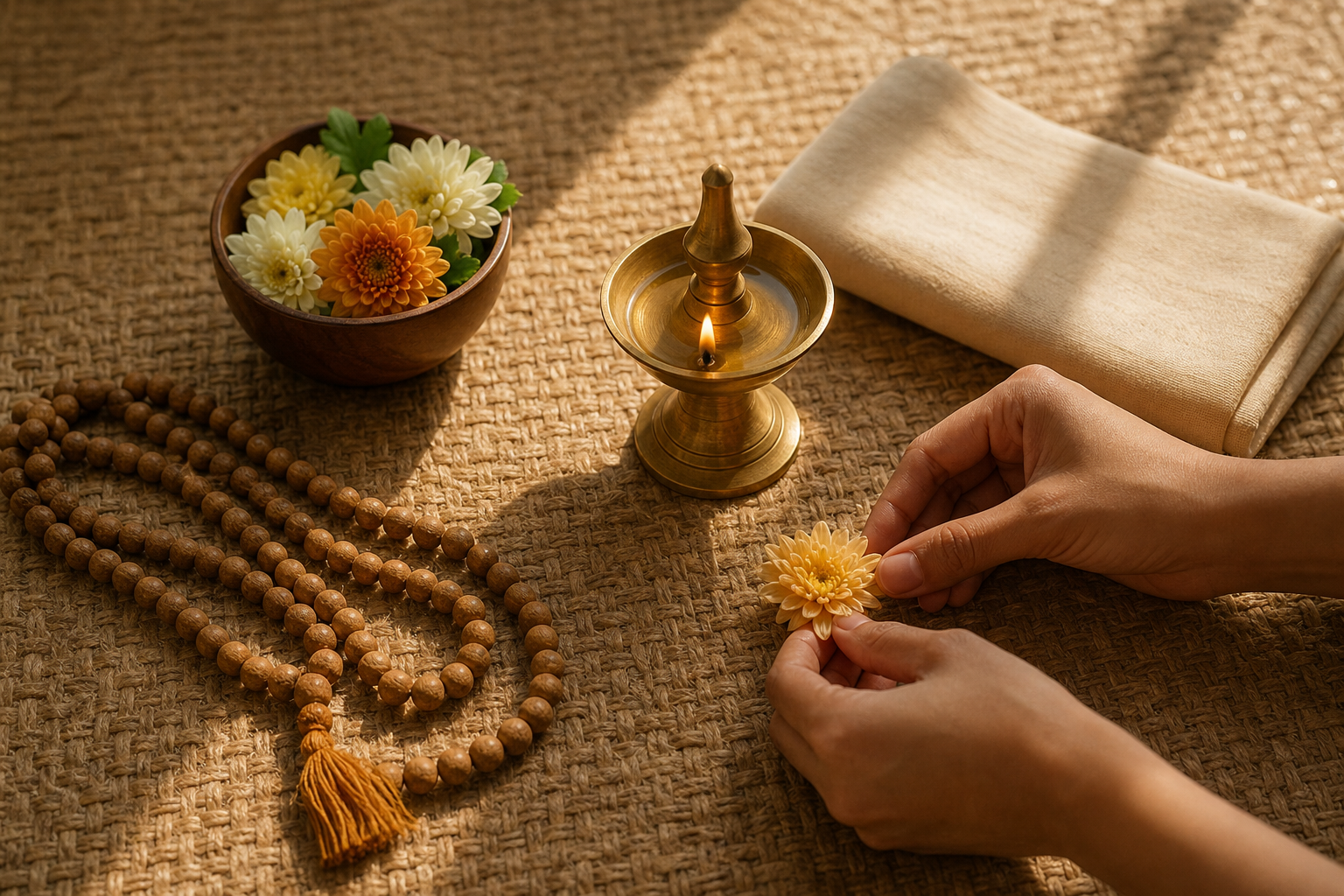
You cannot schedule the conditions of your last hour, but you can give remembrance a dependable place in the hours you have now. A householder does not need an elaborate system. The rule needs to be clear enough to follow on an ordinary workday and simple enough to resume after disruption.
- Choose one devotional center. Write down the Name, mantra, verse, or prayer that expresses your refuge. If you belong to a sampradaya, use the form received through that tradition rather than constantly assembling a private mixture.
- Protect a twelve-minute morning anchor for japa, Naam Simran, prayer, or attentive chanting. Twelve minutes is a practical householder example, not a sacred quota. Consistency matters more than selecting an impressive duration that you repeatedly abandon.
- Place brief recollection at three natural thresholds: on waking, before meals, and at the end of the day. The purpose is to connect remembrance with transitions that already occur, so it is not dependent on a special mood.
- During repetition, listen. When the mind wanders, return to the next Name you are actually saying. Do not spend the remaining time prosecuting yourself for having wandered.
- Perform one concrete act of seva without arranging for recognition. Help a family member, support someone vulnerable, carry an unnoticed community duty, or give your full attention to a person who needs it. Devotion becomes resilient when it enters relationships.
- Before sleep, review speech, choices, and omissions. Acknowledge what aligned with dharma. Where you caused harm, decide what repair is possible. Offer both the good and the unfinished to the Divine, then close with your chosen Name.
The evening review should be factual, not theatrical. I spoke harshly is useful because it identifies an action. I am spiritually hopeless is not useful because it converts one action into an identity and supplies no remedy. Kratu remembers what was done so that resolve can become cleaner, not so that memory can become a chamber of punishment.
If you miss the morning session, do not answer inconsistency with novelty. Pause at the next natural threshold for deliberate remembrance, then return to the established practice. Constantly changing mantras, teachers, techniques, or sacred objects can make seeking feel active while preventing any one discipline from becoming deep.
A simple test exposes spiritual shopping. Does a new recommendation strengthen remembrance, ethical clarity, compassion, and courage? Or does it increase fear, dependency, transactional expectation, and the need for another novelty? Sacred places and objects can support devotion, but they should direct consciousness toward the Divine rather than replace sadhana with acquisition.
Keep some regular connection with satsang and svadhyaya as well. Hearing the Bhagavad Gita, the lives and teachings of saints, Gurbani, or the texts of your own lineage protects remembrance from becoming a purely private construction. Competent guidance should deepen discernment and responsibility, not demand psychological dependence.
At a deathbed, create shelter rather than pressure

When someone you love is approaching death, your role is not to manufacture a dramatic spiritual ending. You can create conditions of familiarity, dignity, and remembrance. You cannot certify another person’s inner state, and you should not turn an externally visible final word into a verdict on the soul’s destination.
- Honor the person’s actual refuge. If they can communicate, ask which Name, prayer, recitation, or form of silence they want. Do not use their vulnerability to introduce your preferred path.
- Reduce devotional clutter. A familiar mantra offered gently is usually more helpful than several people competing with different instructions. Let the atmosphere communicate shelter, not urgency or performance.
- Use practices already meaningful to the person. In Vaishnava settings, these may include Harinama-sankirtana, soft scriptural recitation, Tulasi, tilaka, and, where appropriate, Ganga-jala. The shared purpose is to center consciousness in the Divine Name and devotional association.
- Coordinate spiritual care with physical care. Do not force liquid into the mouth of someone who cannot swallow safely, and do not let a ritual interfere with necessary comfort or treatment. Ask the family and healthcare team how a customary element can be observed safely.
- Follow the person’s sampradaya and family guidance after death. Antyeshti customs vary by region and lineage. A knowledgeable priest, granthi, monastic, acharya, or community guide can help the family avoid turning one local custom into a supposedly universal rule.
- Let remembrance continue as seva. Japa, kirtan, scriptural hearing, assistance to the bereaved, and support for vulnerable members of the community turn grief toward disciplined compassion without pretending that grief has disappeared.
The bedside also reveals whether a community has understood bhakti. Loud certainty, rivalry over ritual, and judgment of relatives scatter the very consciousness everyone claims to protect. Gentle speech, cooperation, and respect for the dying person’s devotion are themselves acts of remembrance.
If circumstances prevent a preferred rite, do not confuse the absence of an object or location with the absence of divine grace. Mayapur, the Ganga, Tulasi, kirtan, and sacred association carry profound devotional meaning, but bhakti is ultimately refuge in the Divine, not a technique for controlling every external condition.
Key takeaways
- Final remembrance is best approached as the mature direction of a life, not as a last-second mental trick.
- The Divine Name and honest recollection of deeds work together: one establishes refuge, while the other exposes what still requires repair.
- Inner bliss is not constant excitement. Its practical signs include reduced compulsion, greater steadiness, gentler speech, and less self-conscious seva.
- A modest daily rule is stronger than restless spiritual shopping: keep one morning anchor, remember at ordinary transitions, serve concretely, and review the day before sleep.
- At life’s end, support the person’s chosen devotion, protect physical comfort, follow lineage-specific guidance, and create an atmosphere of shelter rather than pressure.
Before you sleep tonight, complete one sentence: My refuge is ____. Place that Name or prayer at tomorrow’s first waking moment, protect the morning practice, and return to it after the day’s final review. Final remembrance becomes less frightening when remembrance has already become the way you live.
References
- Dandavats – Honoring HG Saudamini Devi Dasi ACBSP: Legacy of Bhakti, Seva, and Grace in Mayapur
- HinduPad – Ananya Sharan Bhaava Explained: Fearless Single-Minded Devotion Beyond Spiritual Shopping
- HinduPad – Krishna as Paramananda: Unlocking the Highest Pleasure and Enduring Inner Bliss
- HinduPad – Decoding Om krato smara kritam smara: karma, memory, and the art of conscious dying