
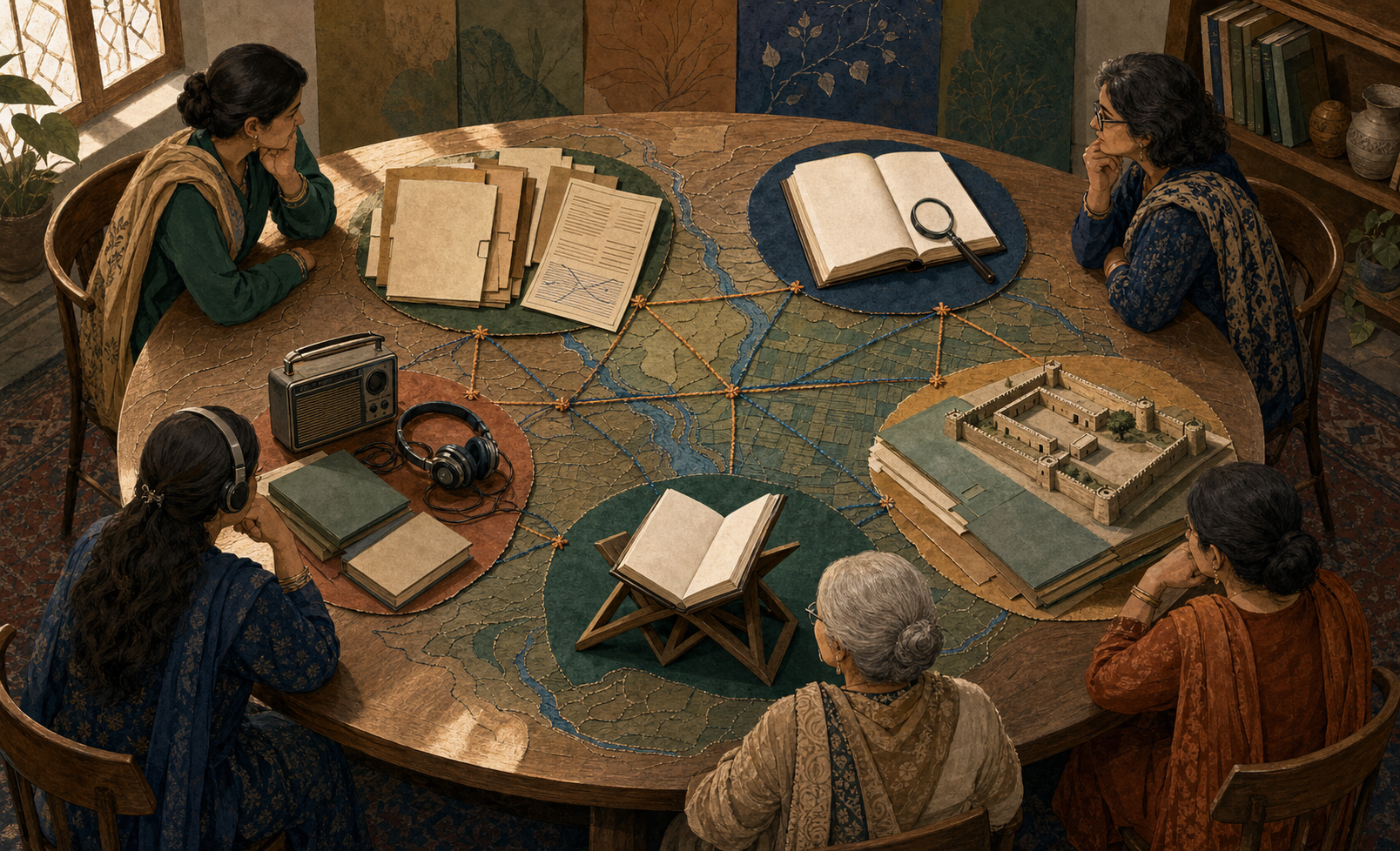
If you are trying to understand Pakistani Punjab, a roster of eminent academics will not take you very far. You need to know which scholar can help with the question in front of you: Partition, the politics hidden inside a textbook, the cultural work performed by Urdu and Punjabi, the interpretation of religious texts, or the institutional power of the military.
The five women considered here do not constitute a single school, and they should not be treated as representatives of every woman in the region’s universities. Their value lies precisely in their differences. Read them as five distinct routes into the intellectual life of Pakistani Punjab and the larger South Asian questions that Punjab cannot be separated from.
Key takeaways
- Choose a scholar by the problem you need to understand, not by general prominence: Ayesha Jalal for Partition and state formation, Rubina Saigol for education and nationalism, Arfa Sayeda Zehra for language and cultural memory, Riffat Hassan for religious interpretation and gender, and Ayesha Siddiqa for civil-military power.
- Method matters as much as conclusion. Archives, textbooks, literary language, scriptural interpretation and institutional accounts reveal different forms of power.
- Do not reduce these women to a generic category called women’s scholarship. Each has a defined field, a characteristic body of evidence and a different kind of public intervention.
- For a Dharmic reader, the productive approach is neither suspicion of everything produced in Pakistan nor romantic talk about a shared culture. Preserve real differences while examining the region’s connected history.
- Read in pairs when possible. The strongest pairings expose how an event becomes a national story, how language becomes identity, or how a state created through negotiation develops durable institutions.
Five scholars, five entry points into Pakistani Punjab
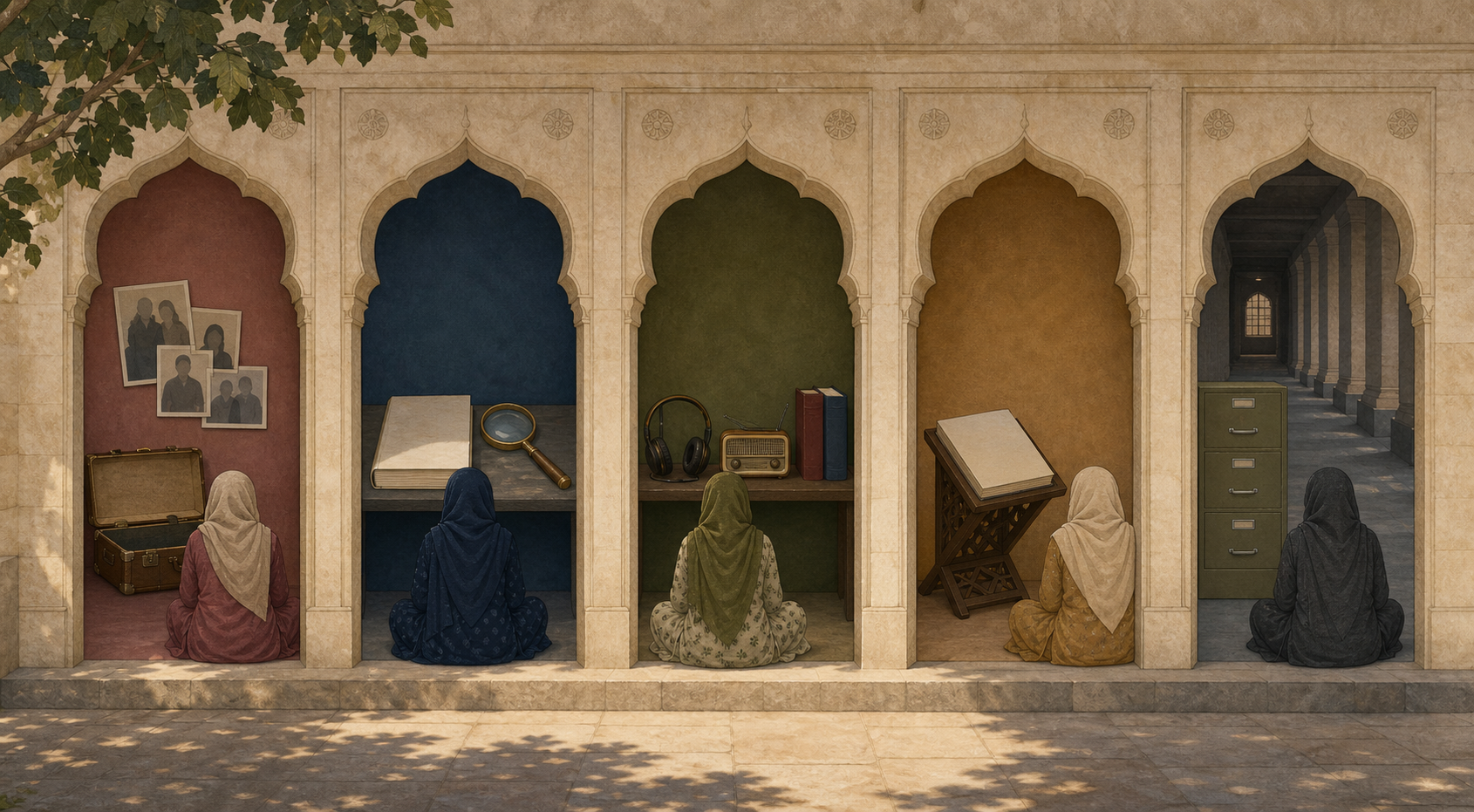
| Question you are asking | Scholar to begin with | Primary lens | What to notice |
|---|---|---|---|
| Was Partition inevitable, or did political choices and negotiations shape its outcome? | Ayesha Jalal | Modern South Asian history | Archives, competing interests, political agency and the alternatives visible to people at the time |
| How does a state teach children to imagine the nation, gender and religious minorities? | Rubina Saigol | Gender and education | Textbooks, language policy, classroom practice and the implied model of the ideal citizen |
| How do Urdu and Punjabi carry cultural memory and shape civic belonging? | Arfa Sayeda Zehra | Literature and education | The ethical vocabulary, historical memory and social criticism embedded in literary language |
| How can inherited religious interpretation be distinguished from the primary text it claims to explain? | Riffat Hassan | Religious studies and hermeneutics | The movement from text to commentary, the historical setting of interpretation and assumptions about gender |
| How does military power extend into politics and economic life? | Ayesha Siddiqa | Civil-military relations | Organizational incentives, public accounts, non-military activity, opacity and civilian oversight |
This is a map, not a ranking. The right starting point depends on what you are trying to explain. It also depends on the evidence you are prepared to examine. A claim about a political negotiation requires different proof from a claim about a poem, a scriptural commentary or an institution’s economic incentives.
Ayesha Jalal: recover the choices hidden by hindsight
Ayesha Jalal is a Lahore-born historian of modern South Asia whose work addresses Partition, state formation and political leadership through archival inquiry. Her most useful lesson for a reader is methodological: an outcome that appears inevitable in retrospect may have emerged from negotiations among actors facing uncertain and constrained choices.
Do not approach this history only to obtain a verdict about which leader or community was responsible. Build a decision map instead. For every major claim, record the actor, the objective attributed to that actor, the constraint operating at the time and the evidence used to connect intention with outcome. Then ask which alternatives were genuinely available at that moment. This keeps you from turning history into a moral drama written backwards from 1947.
Jalal is especially valuable when public debate collapses the end of empire into a single motive. Her attention to contingency does not make responsibility disappear. It makes responsibility more exact by distinguishing what people wanted, what they could control and what followed from the interaction of several decisions.
Rubina Saigol: examine what the classroom normalizes
Rubina Saigol, who lived from 1959 to 2021, worked at the intersection of gender, education, curriculum and nationalism in Lahore. She treated schooling as more than the transfer of information. Textbooks, language choices and classroom practices also teach students which people belong at the center of the national story and which appear mainly as outsiders.
You can apply this lens to any history or civics lesson. Mark who acts, who is acted upon, whose suffering receives detail and whose beliefs are described only from a distance. Notice whether women appear as decision-makers or mainly as symbols of family and nation. Then inspect the questions at the end of the lesson: do they reward recall, or do they permit students to compare evidence and question the frame?
Keep three things separate while doing this: the official curriculum, the wording of the textbook and the practice of an individual teacher. They can reinforce one another, but they are not interchangeable. That distinction prevents a justified criticism of a passage from becoming an unsupported claim about every classroom or every student.
Arfa Sayeda Zehra: treat language as an archive
Arfa Sayeda Zehra has connected scholarship in Urdu and Punjabi with teaching, public lectures and academic leadership. Her work makes language central to cultural memory. A literary text does not merely decorate an argument about society; its idioms, allusions and moral vocabulary preserve ways of seeing that a factual chronology can miss.
When you read an Urdu or Punjabi passage, make a small glossary before interpreting its politics. Identify the terms for duty, dignity, community, justice, love, land and belonging. Ask whether an English equivalent carries the same social or ethical weight. If you are working only from translation, mark the concepts for which you need linguistic help instead of silently treating the translation as transparent.
This matters to readers across the divided Punjab. A shared word can preserve a cultural connection, but identical vocabulary does not guarantee identical political memory. Let language reveal the connection without forcing the speakers into one historical position.
Riffat Hassan: separate scripture from inherited interpretation
Riffat Hassan, born in Lahore, is known for religious scholarship that combines attention to primary texts, interpretive history and questions of gender justice. Her approach challenges readings in which male-centered assumptions have acquired the appearance of scriptural necessity.
A disciplined way to read this kind of argument is to keep three columns in your notes: what the primary text states, how a named interpretive tradition explains it and what ethical conclusion a modern scholar draws. Do not merge those layers. If a gender hierarchy appears only in the second layer, that is significant; if the modern conclusion depends on a contested translation, that is significant too.
The same discipline improves comparative religion. Hindu, Buddhist, Jain, Sikh and Islamic traditions can be placed in conversation without being blended into a vague doctrine of universal sameness. Compare a precise question, such as moral agency or interpretive authority, and first establish how each tradition frames that question internally. Ethical parallels are worth noticing, but they do not erase differences in theology, metaphysics or practice.
Ayesha Siddiqa: follow institutions rather than personalities
Ayesha Siddiqa, a scholar from Bahawalpur, examines civil-military relations through the political economy of security institutions. Her field of inquiry includes organizational incentives, public accounts, budgetary opacity and military involvement outside narrowly military functions.
This lens is useful because personality-driven political analysis has a short memory. An officeholder can change while incentives, assets, reporting arrangements and institutional privileges remain. When you encounter a claim about military influence, classify it before accepting or rejecting it. Is it a documented financial fact, an account from an interview, an inference about organizational motivation or a prediction about political consequences? Those forms of evidence do not carry equal weight.
The subject is politically charged, so precision is essential. A verified claim about one economic activity does not automatically prove every wider claim about the institution. Conversely, the absence of readily accessible information does not prove that no influence exists. State what the available evidence establishes, identify the inference and leave the unresolved part unresolved.
Cross-read them to see how power travels
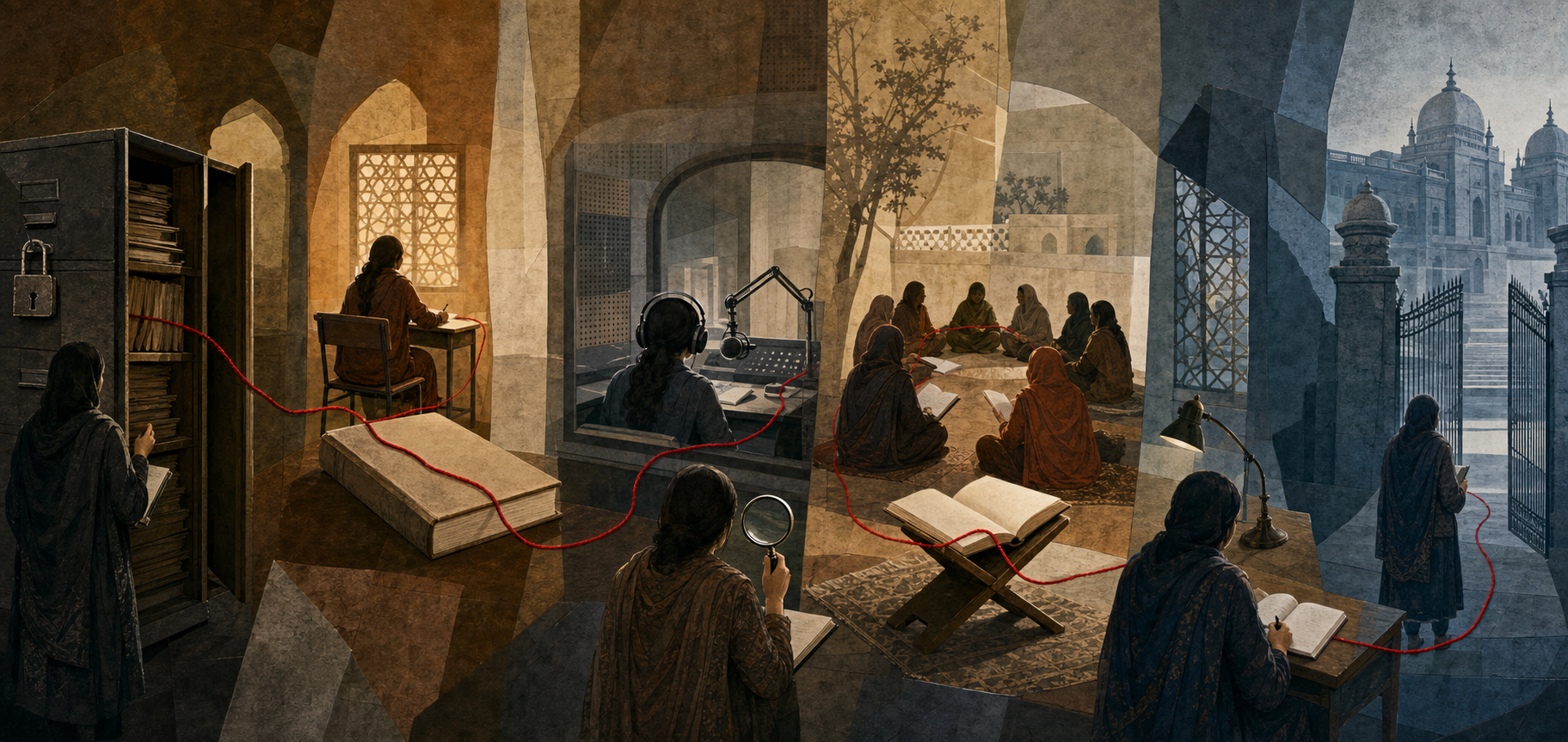
The deeper value of this group appears when you stop treating their fields as sealed departments. Political decisions produce historical outcomes. Curricula turn selected versions of those outcomes into common knowledge. Language gives that knowledge emotional and ethical form. Religious interpretation can legitimize or challenge social arrangements. State institutions then distribute authority and resources within the society shaped by those narratives.
That sequence is an analytical tool, not a claim that culture moves in one direction or that every institution obeys the same cause. Use the following pairings to test a focused question from two sides:
- Partition and the classroom: Read Jalal with Saigol to distinguish a contested historical process from the simplified national lesson that may later be built around it. Ask what disappears when negotiation becomes destiny.
- Language and religious authority: Read Zehra with Hassan to examine how words carry inherited meanings and how interpreters decide which meanings become normative. Track both philological detail and ethical consequence.
- State formation and institutional endurance: Read Jalal with Siddiqa to move from the choices surrounding the birth of a state to the incentives of institutions that operate within it. Do not assume that an institution’s later role was fully determined at its origin.
- Gender in education and exegesis: Read Saigol with Hassan to compare two sites where hierarchy can be naturalized: the school lesson and the religious commentary. In each case, identify the primary material, the interpretive layer and the social ideal being presented.
Cross-reading is most productive when the scholars remain distinct. Do not manufacture agreement. Write down where their methods answer different questions, where one field supplies evidence another cannot and where a conclusion remains dependent on interpretation.
See Pakistani Punjab as a network, not an intellectual island
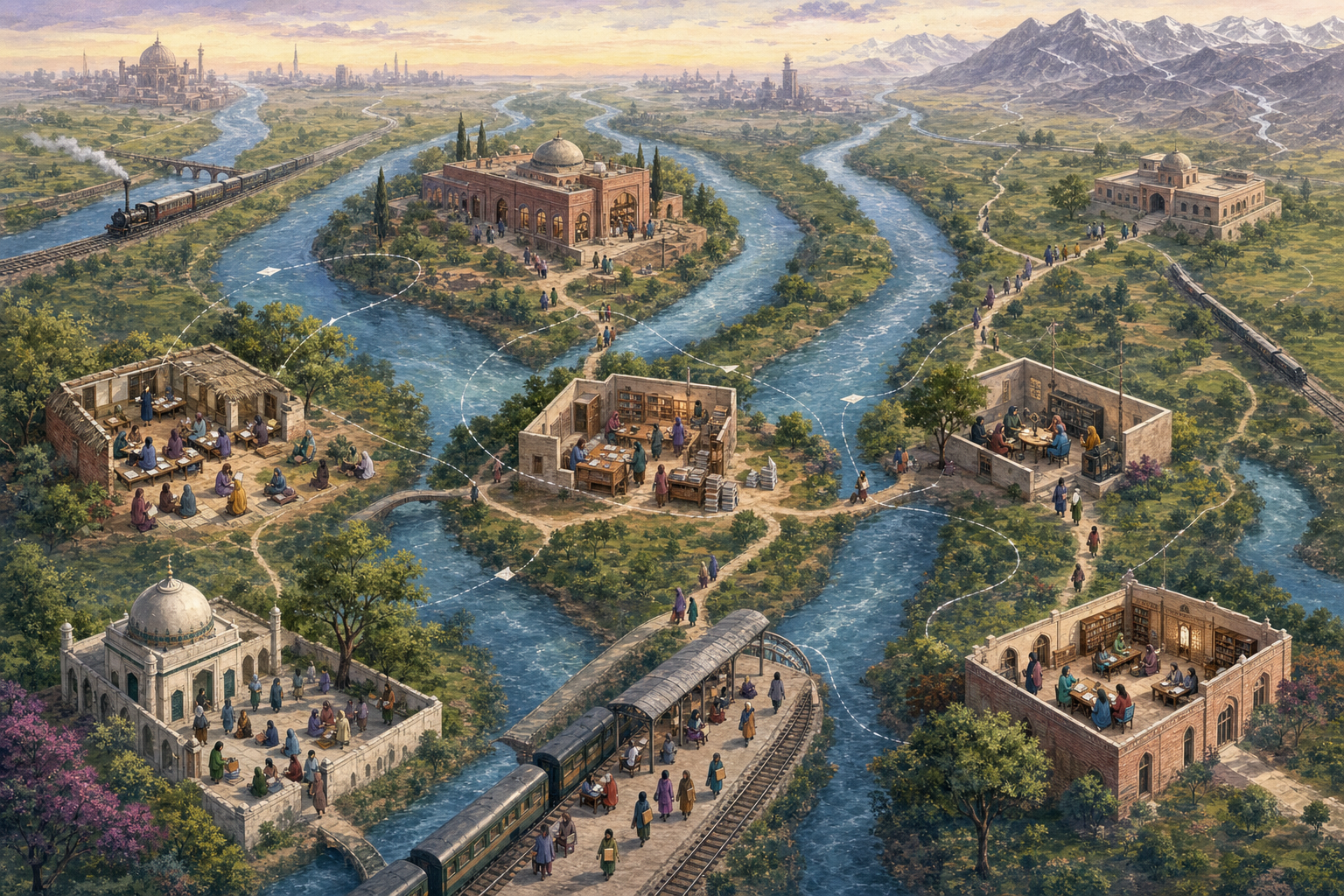
These careers are tied to Lahore, Bahawalpur and the public questions of Pakistan, but they are not confined within provincial borders. Their trajectories connect local classrooms and debates with universities, publishing networks and international scholarly conversations. That movement matters: regional scholarship can be locally grounded without being intellectually isolated.
The wider academic environment includes institutions such as the University of the Punjab, Government College University Lahore, Lahore College for Women University and LUMS. Do not treat those names as proof that every scholar followed the same institutional path. Treat them as evidence of the broader educational ecosystem in which research, teaching, mentoring and public argument circulate.
For a reader concerned with Bharat and the Dharmic traditions, this perspective corrects two common errors. The first is to see Pakistani Punjab only through security, hostility or the ideology of the state. That frame misses literature, education, religious debate and the region’s internal arguments. The second is to invoke a shared civilizational inheritance so loosely that Partition, doctrinal difference and institutional conflict become inconvenient details. That frame mistakes sentiment for understanding.
A better civilizational reading asks two questions at once: what remained connected across borders, and what changed under different states, curricula and institutions? South Asia’s interaction among Hindu, Buddhist, Jain, Sikh and Islamic traditions gives comparison a legitimate historical purpose. It does not excuse you from defining the tradition, text, period and claim under examination.
Build a reading practice that produces more than a list

You do not need to master five fields at once. You need a question narrow enough to test and a method that prevents admiration or disagreement from replacing analysis.
- Write the question first. Replace a broad theme such as Pakistani identity with a workable problem: how does a textbook turn a contested event into a settled national memory?
- Select one primary scholar and one cross-reading partner. Use the first for the main method and the second to expose what that method may not capture.
- Verify the work you choose. Begin with a book, chapter or lecture whose authorship and publication details you can confirm through a library catalogue or institutional record. Do not build your understanding from unattributed quotation cards or isolated clips.
- Keep four headings in your notes. Record the claim, the evidence, the interpretive step and the implication. If you cannot fill the evidence heading, you do not yet know whether you are reading scholarship, commentary or repetition.
- Mark the boundary of the conclusion. A finding about one textbook, period, institution or interpretive tradition should not silently become a claim about all Pakistanis, all Muslims, all Punjabis or all women scholars.
- End with a comparison you can defend. State one connection across the border or across traditions, one important difference and one question that the available evidence does not settle.
Begin with the problem you actually want to understand, then choose the scholar whose evidence fits it. If your notes can distinguish fact from interpretation and connection from sameness, these five names will become more than additions to a syllabus. They will give you a disciplined way to read Pakistani Punjab as a living part of South Asia’s contested intellectual world.