
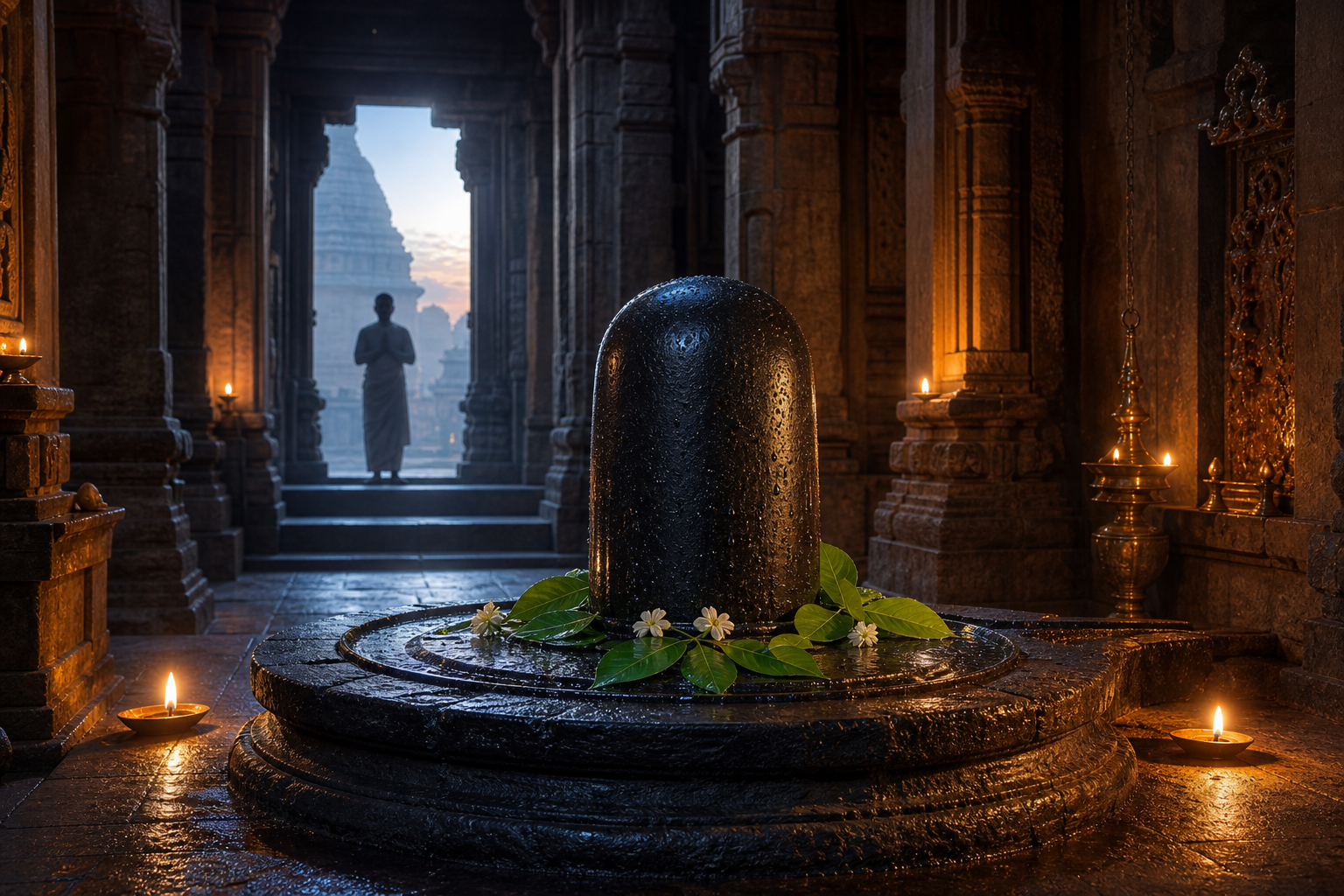
If you have stood before a Shiva linga and wondered what, exactly, you are seeing, resist the urge to force it into a single explanation. The linga can be an aniconic sign of the Supreme, a presence inseparable from a particular place, the centre of a sacred narrative, and the recipient of daily worship at the same time.
Three questions will help you approach it with greater clarity: What kind of linga does this tradition recognise? What narrative explains its presence? What response does that narrative ask of you? Those questions turn darshana from a brief look at a sacred object into an encounter with Shaiva theology, sacred geography, and dharma.
Read the linga as a sign before treating it as an object
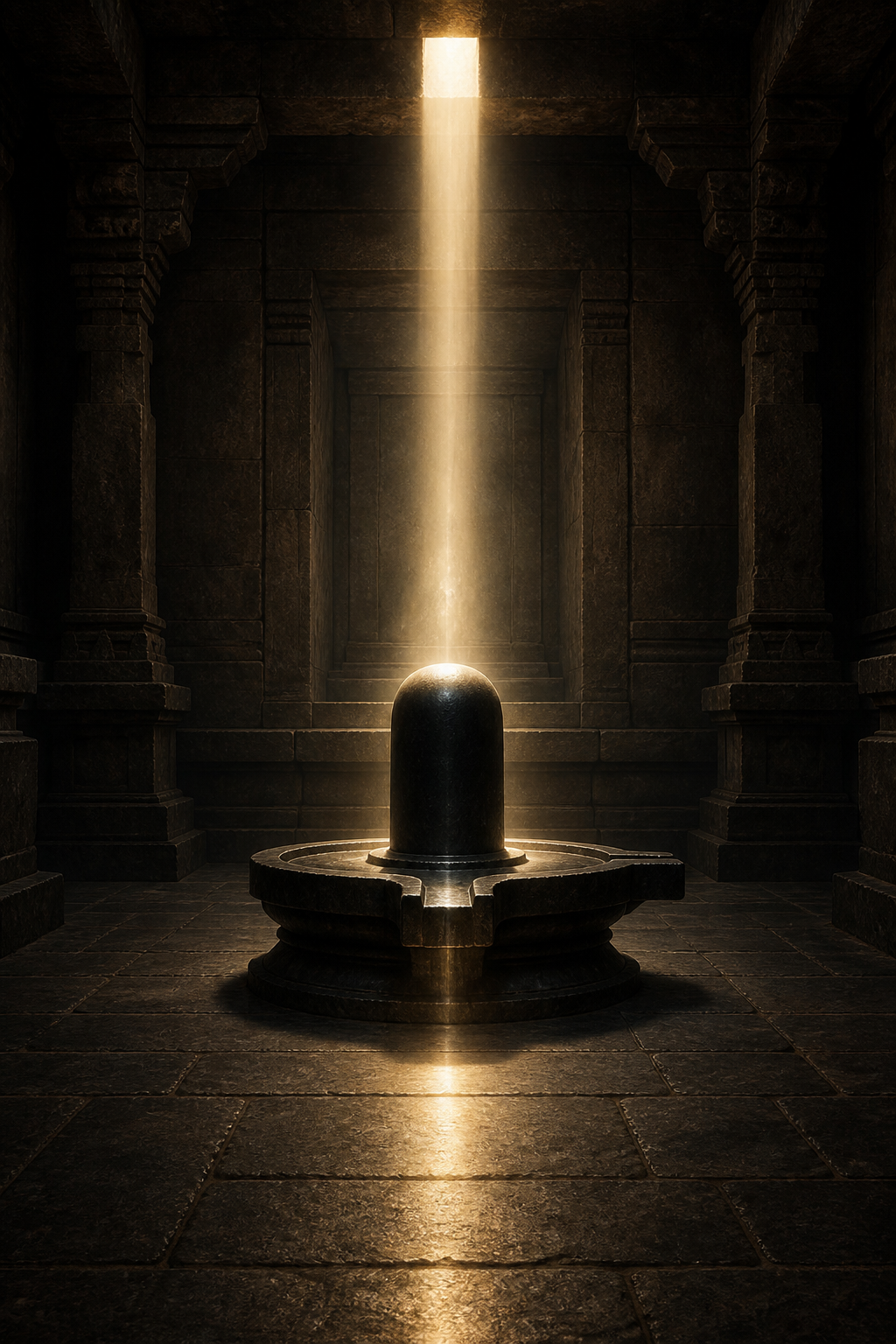
The Sanskrit word liṅga carries the sense of a mark or sign. That starting point matters. The Shiva linga is aniconic: it does not present a portrait of Shiva with a face, limbs, ornaments, and narrative attributes. It directs attention through form toward a reality that cannot be contained by form.
Aniconic does not mean empty, incomplete, or merely abstract. A road sign points away from itself, but a sacred sign does more: it becomes a place of presence, attention, offering, and relationship. The linga does not need to imitate Shiva’s physical appearance to disclose Shiva. Its apparent simplicity is part of its theological precision.
The upright linga and its surrounding pīṭha should therefore be seen together. The vertical form signifies the transcendent axis, while the base is associated with the ground of manifestation and receives the liquids used in abhishekam. Their integration presents transcendence and immanence as related rather than opposed: the unbounded is present within the world without being exhausted by it.
This gives you a practical way to receive darshana. Before looking for decoration, pause before the still centre. Notice the vertical form, the embracing base, and the path taken by ritual water. The geometry itself teaches: stillness stands at the centre, manifestation gathers around it, and movement returns to an unmoving source.
Comparable aniconic intuitions appear elsewhere in the dharmic family. The Bodhi tree and empty throne can indicate the Buddha’s presence without functioning as portraits; Jain traditions use pādukās and unadorned emblems to evoke the Tīrthaṅkaras; Sikh thought names the ineffable source through Ik Onkar. These are not interchangeable doctrines. The useful comparison is narrower: sacred presence need not depend upon physical likeness. When discussing such resonances, compare the function of the sign without erasing the distinct theology of each path.
Three narrative lenses reveal three dimensions of worship

Names such as Lingodbhava, Atmalinga, Purva Linga, Achala Linga, and svayambhū are sometimes gathered into one vague idea of an especially sacred linga. That loses the distinctions that make each tradition useful. The terms answer different questions: Is Shiva being revealed as infinite? What divine presence does the linga embody? Did its sanctity precede human installation? Is it permanently fixed to its place?
Lingodbhava: the form that reveals what no form can contain
Lingodbhava presents Shiva as an endless column of light beyond the grasp of even the highest gods. The linga becomes the world-axis: it grounds orientation while exceeding every attempt to find its limit.
The apparent paradox is deliberate. A finite form points toward infinitude without claiming to enclose it. You are given a centre for worship, but not an object that the mind can master. The correct response is therefore neither intellectual laziness nor confident reduction. It is disciplined attention joined to humility.
This lens is especially relevant during Maha Shivaratri and Lingodbhava Kalam. The night vigil, japa, abhishekam, and silence can be understood as approaches to mystery rather than attempts to possess it. When the mind demands a final visual definition of Shiva, Lingodbhava asks it to remain steady before what surpasses definition.
The Atmalinga: divine power placed under the discipline of dharma
The Atmalinga is understood in the Gokarna tradition as a linga embodying Shiva’s undivided essence. Its narrative begins with Ravana’s formidable tapas and devotion. Shiva grants him the Atmalinga on one binding condition: it must not be placed on the earth before Ravana reaches Lanka, because once set down it will remain fixed at that spot.
The condition is not a minor plot device. It places a divine gift under a vow. Ravana may possess great learning, devotional intensity, and strength, but none of those cancels the terms under which power has been entrusted to him. In dharmic narrative, a boon is not permission to ignore moral limits.
Near Gokarna, Ravana must perform his time-bound sandhya observance. Ganesha appears as a brahmin boy and agrees to hold the Atmalinga, warning that he will call Ravana three times and put it down if Ravana does not return. The boy calls, receives no answer in time, and places the linga on the earth. Ravana cannot lift it again. Some tellings include Vishnu’s illusion of premature twilight, while others give greater emphasis to the regular timing of sandhya. The mechanics vary, but the moral architecture remains stable: the boon, the vow, the religious duty, the lawful intervention, and the permanent emplacement of the linga.
Ganesha’s action is best read as intelligent guardianship rather than rivalry. He does not defeat Ravana by greater violence or revoke Shiva’s blessing. He works within the condition attached to it. Wisdom protects the welfare of the many by preventing overwhelming power from becoming the possession of one ruler and one realm.
Ravana’s devotion is not dismissed, which is why the narrative remains morally demanding. Devotion can be genuine and still coexist with ambition. Tapas can produce power without automatically producing the humility needed to hold it. The lesson for you is not that intense worship is suspect. It is that worship must reshape the way you keep promises, exercise influence, and respond to limits.
When you encounter the Atmalinga at the centre of the Gokarna tradition, do not reduce its story to a contest over possession. Ask the harder question: what discipline must accompany the power for which you pray?
Purva, Achala, and svayambhū forms: worship recognises an existing presence
In this Shaiva vocabulary, pūrva indicates what is prior or primordial. An Achala Linga is immovable. A svayambhū form is understood as self-manifest. These descriptions can converge in a sacred place, but they emphasise different aspects of its identity: temporal priority, fixed emplacement, and a presence not produced by human craftsmanship.
A Purva or Achala Linga may appear as an unhewn stone, a natural outcrop, a boulder, or an ancient form whose emergence precedes the community’s present ritual memory. Its surface need not be geometrically regular or highly polished. Do not mistake natural irregularity for damage or an unfinished image. In this context, the absence of human refinement can be integral to the form’s meaning.
The distinction from a ritually installed form is important. A crafted linga can be consecrated through prāṇa-pratiṣṭhā, while an already sacred, self-established form is approached as a presence whose sanctity did not begin with that rite. Daily worship does not animate an otherwise inert object; it recognises and serves a presence understood to precede the worshipper.
| Term or motif | Question it answers | What to notice in worship |
|---|---|---|
| Liṅga | How is Shiva signified without a portrait? | The form directs attention beyond physical likeness. |
| Lingodbhava | How does finite vision meet the infinite? | The visible axis reveals a reality whose limits cannot be found. |
| Atmalinga | What kind of divine presence and power is embodied here? | Grace must be received under vows, restraint, and dharma. |
| Purva Linga | Did this presence precede present installation and ritual memory? | Worship acknowledges primordial sanctity. |
| Achala Linga | Is the form inseparable from its place? | Location is part of the sacred identity, not incidental scenery. |
| Svayambhū | Is the form understood as self-manifest? | Natural or uncrafted appearance need not diminish sanctity. |
| Consecrated linga | Has a crafted form been ritually installed? | Prāṇa-pratiṣṭhā and the temple’s liturgical tradition govern its worship. |
Use this table as a set of questions, not as permission to relabel a shrine yourself. Local temple tradition determines the recognised identity of its linga. If you are unsure, ask how the temple names the form and how its sthala-purana explains it. The temple’s own ritual grammar is more reliable than an assumption based on appearance alone.
When the linga is immovable, place becomes part of the teaching
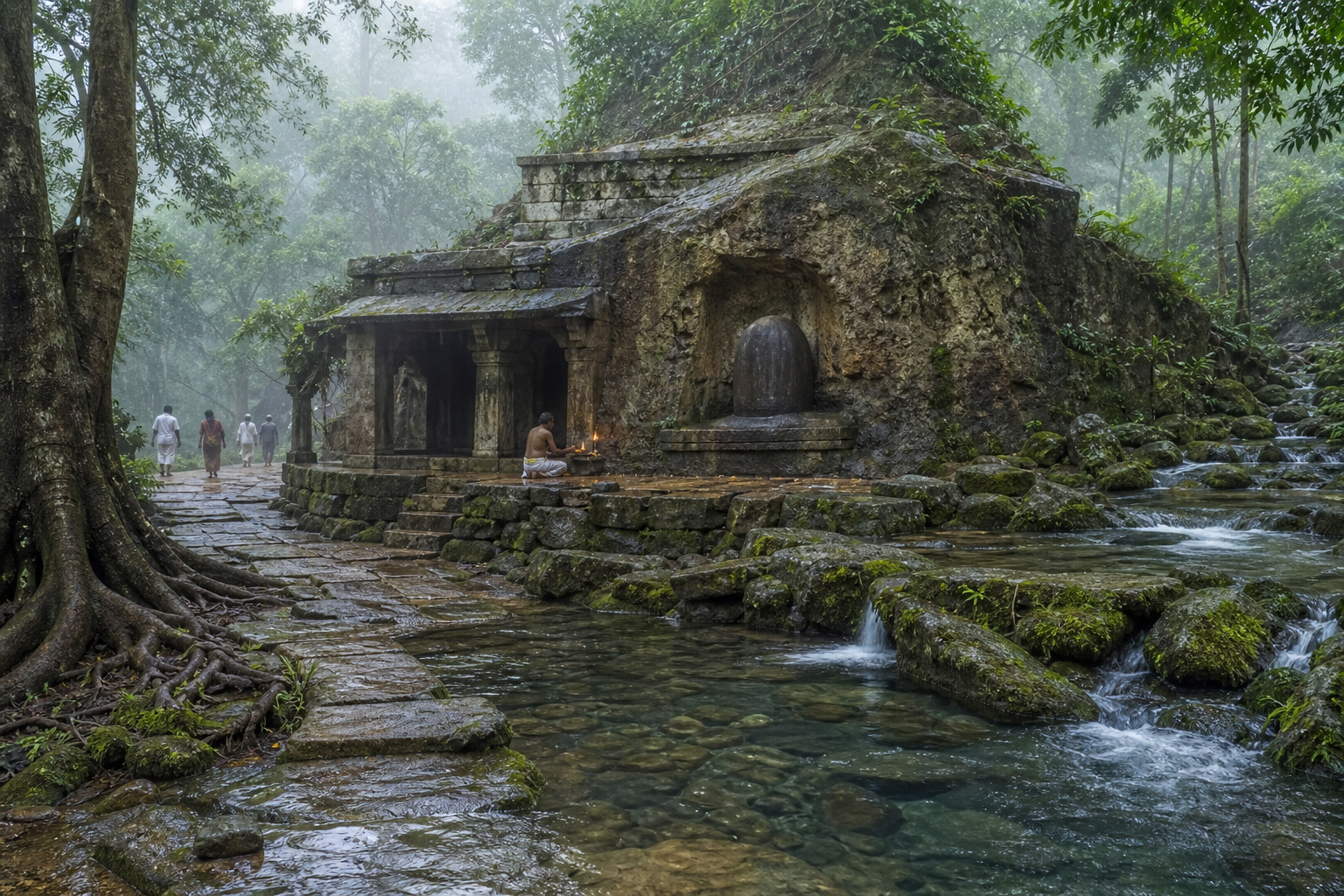
An Achala Linga does not merely happen to stand in a temple. The temple develops around a sacred centre that is not meant to be relocated. The garbhagṛha, linga-pīṭha, foundational ground, paths of circulation, and controlled approach to light all make the building an extension of the theology.
The spatial pattern is simple enough to experience directly. The linga remains still at the centre while devotees approach, withdraw, and perform pradakṣiṇā around it. Movement belongs to the periphery; stability belongs to the centre. If you slow down, the architecture begins to instruct your body before the intellect supplies an explanation.
The Gokarna narrative extends that logic across a wider landscape. Regional tellings describe Ravana trying to pull up the fixed Atmalinga and scattering associated coverings or components along the Karavali coast. Sacred memory connects Mahabaleshwar Temple at Gokarna with Murudeshwar, Gunavanteshwar or Gunavanthe, Dhareshwar, and Sajjeshwar. The precise enumeration and attribution can vary locally, so the named network should be received through the traditions of the individual kṣetras rather than forced into one rigid map.
The enduring insight is that divine potency does not become the private possession of one kingdom. It becomes accessible through a shared geography of pilgrimage and worship. Movement between sacred places becomes part of spiritual formation. The pilgrim receives presence by travelling, bowing, and participating, not by claiming exclusive ownership.
This changes how you should visit such a circuit. Do not treat its temples as interchangeable stops to be completed. At each kṣetra, ask what aspect of the sacred narrative is remembered there, how the linga is identified, and what local practice governs darshana. The unity of a pilgrimage route does not erase the particularity of its shrines.
Immovability also carries a practical heritage obligation. A self-manifest or ancient in-situ form is not raw material for well-intentioned improvement. Its original placement, irregular surface, ritual environment, and continuity of worship belong together. Conservation should favour minimal, reversible intervention and respect living custodianship. As a devotee, follow the shrine’s rules about touching, pouring offerings, photography, and movement; never assume that visible access authorises physical contact.
Let abhishekam carry the narrative into your conduct

Shiva linga worship commonly includes abhishekam, alankāra, the offering of light, darshana, japa, and pradakṣiṇā. Water, milk, pañcāmṛta, bilva leaves, and fragrant substances may be offered within established practice. These actions are not interchangeable decorations. Each belongs to a ritual relationship in which the worshipper attends to Shiva’s presence.
For a self-established or immovable linga, abhishekam should not be imagined as supplying divinity to something that lacks it. The offering acknowledges an always-present sacred reality. The liquids descend over the still axis and are received by the pīṭha, giving visible form to a deeper movement: energy is cooled, attention is gathered, and restless intention is brought under discipline.
You can bring this understanding into temple or home practice without inventing a universal liturgy. Agamic, temple, regional, and family disciplines differ, so let the relevant tradition determine mantras, substances, sequence, and who may perform each act. Within those boundaries, use the following contemplative sequence:
- Identify the context before making an offering. Ask whether the linga is regarded as svayambhū, Achala, Atmalinga, or ritually installed, and whether personal abhishekam is permitted. A temple where priests alone conduct the rite should be approached differently from a shrine that invites devotees to offer water.
- Receive darshana before reaching for ritual materials. Pause long enough to see the linga as a sacred centre rather than a surface on which to place things. Notice the form, pīṭha, orientation, and existing worship.
- Offer only what the tradition accepts. Do not equate a greater quantity of substances with greater bhakti. Use the materials and method authorised by the temple or taught in your household tradition. Simplicity with attention is preferable to an elaborate improvisation that ignores the shrine’s discipline.
- Let one element of the rite train the mind. As water flows over the linga, release the demand to possess or control the result of worship. During japa, return repeatedly to the still centre. During pradakṣiṇā, notice that your activity moves around a reality that does not depend on your movement.
- End with a concrete act of dharma. Choose one promise to keep, one use of influence to restrain, or one resource to share. This is where the Atmalinga narrative becomes personal: devotion proves its depth when power accepts an ethical limit.
The ritual calendar can deepen the same practice. Daily nitya-pūjā sustains continuity. Pradosha provides a recurring occasion for Shiva worship. Maha Shivaratri, Karthika, and Shravan can bring extended japa, sequential abhishekam, and contemplative silence. Yet the calendar should intensify an existing orientation, not postpone it. You do not need to wait for a festival to practise steadiness, humility, and fidelity to a vow.
The strongest correction offered by these narratives is directed at devotional ambition. It is possible to seek Shiva’s grace while remaining attached to control, prestige, or exclusive possession. Ravana’s tapas warns that intensity alone is not the measure of spiritual maturity. Lingodbhava warns that the divine cannot be intellectually contained. The Achala form teaches that not everything sacred exists because we installed, improved, or authorised it.
Abhishekam can therefore become an ethical rehearsal. You pour out what you might otherwise clutch. You cool what has become overheated. You move around a centre you did not create. You receive darshana, but you do not possess the presence you have seen.
Key takeaways
- Begin with the word: liṅga means a mark or sign. The Shiva linga points beyond physical likeness without being empty of presence.
- Keep the narratives distinct: Lingodbhava reveals infinitude; the Atmalinga joins divine power to vows and dharma; Purva, Achala, and svayambhū forms emphasise prior, fixed, or self-manifest sanctity.
- Do not judge sanctity by polish: an unhewn or irregular form may be integral to the identity of an immovable, self-established shrine.
- Treat location as meaningful: for an Achala Linga, the ground, sanctum, architecture, ritual community, and sacred story form one field.
- Follow local discipline: ask what offerings and forms of contact a temple permits instead of assuming that every Shiva linga is worshipped in exactly the same way.
- Complete worship through conduct: connect darshana, abhishekam, or japa to one specific vow, restraint, or act of sharing.
The next time you approach a Shiva linga, take one extra minute before making an offering. Ask what kind of presence the kṣetra recognises, what its narrative teaches, and which commitment you will carry away. Then let that commitment remain steady after the water has stopped flowing.
References
- DharmaRenaissance Blog — Ravana, Ganesha, and Shiva’s Atmalinga: Decoding the Gokarna Legend, Symbolism, and Dharma
- DharmaRenaissance Blog — Purva Linga and Achala Shivlings: Uncreated Symbols of Shiva’s Eternal Presence