

You may want to observe Narasimha Jayanti properly but feel unsure about what “properly” means. Must you keep a complete fast, arrange an elaborate abhishekam, recite every protective hymn, or reach a temple at a precise hour?
The essential observance is more focused: establish the correct local tithi, worship according to your capacity, hear Prahlada’s story with attention, and make one honest surrender of pride, fear, or cruelty. The ritual should bring you closer to that purpose, not bury it beneath anxiety about performance.
Begin with what Prahlada teaches you to surrender

Narasimha appears because Prahlada will not accept his father’s claim to absolute power. The child has no army, office, wealth, or social leverage. His strength is uninterrupted remembrance of Narayana. Hiranyakashipu possesses nearly every visible form of security, yet those securities enlarge his arrogance rather than protect him.
This is why Narasimha worship belongs with Kunti’s prayer in Srimad-Bhagavatam 1.8.26. Kunti calls the Lord akincana-gocaram, accessible to one who has no material claim to press. Birth, wealth, education, and beauty are not condemned. The obstruction is mada: the conceit that turns an advantage into proof of superiority, self-sufficiency, or entitlement before Bhagavan.
Akincanya therefore does not require you to romanticize poverty, abandon responsibility, or pretend that competence has no value. It asks you to stop presenting your possessions, learning, lineage, appearance, or religious identity as reasons the Divine should favor you. Excellence can be offered. Conceit has to be surrendered.
Before the puja, conduct a short inventory. Ask where you have become difficult to correct, whose dignity you discount, and which possession or role makes you feel exempt from ordinary moral duties. Choose one answer rather than producing a long catalogue. That answer gives your vrata a real object.
Prahlada also corrects a common misunderstanding of surrender. He is surrendered, but he is not passive. He speaks truth under pressure and refuses to let fear determine what is real. For you, surrender may mean relinquishing control over the result while remaining responsible for truthful speech, disciplined conduct, and protection of someone exposed to harm.
Understand the fierce form before asking for protection
Hiranyakashipu attempts to place himself beyond death by arranging protections through opposites. He is not to die by human or beast, indoors or outdoors, by day or night, on the ground or in the sky, or through a weapon. Narasimha answers every condition without becoming confined by any of them:
- He is neither merely human nor merely animal.
- He appears at twilight, neither ordinary day nor ordinary night.
- He acts at a threshold, neither simply inside nor simply outside.
- He places Hiranyakashipu on His lap, neither on the ground nor in the sky.
- He uses His nails rather than a forged or wielded weapon.
The point is deeper than a clever solution to a boon. A tyrant’s categories cannot make adharma untouchable. Ultimate reality is not trapped by the binaries through which worldly power tries to control consequences.
The Lord’s ferocity must be read through its object and its limit. It is directed against the active persecution of Prahlada and ends the power sustaining that persecution. It is not uncontrolled rage, a blessing for personal vindictiveness, or permission to treat every opponent as a demon. Narasimha’s raudra, or fury, serves restoration; it does not make fury an end in itself.
This distinction should shape your prayer. Asking for courage, freedom from intimidation, protection of conscience, or an end to destructive conduct fits the festival. Using a protective prayer to cultivate hatred toward a named rival does not. If your prayer cannot include a desire that wrongdoing stop without your heart becoming cruel, return first to Prahlada’s steadiness.
The principal forms of the deity help you notice this range. Ugra Narasimha emphasizes fierce intervention; Jvala Narasimha conveys blazing, purificatory power; Yoga Narasimha reveals collected inner mastery; and Lakshmi Narasimha shows protective strength held together with Sri’s tenderness. The movement from fearsome protection toward peace is part of the theology, not a retreat from it.
For household worship, a Lakshmi Narasimha image can make that unity especially clear: the same Lord who cannot be approached by tyranny becomes shelter for the devotee. If children are participating, explain who is being protected and why before dwelling on the dramatic iconography. The emotional center of the story is Prahlada’s safety, not the spectacle of Hiranyakashipu’s death.
Set the tithi and fasting discipline before planning the puja

Narasimha Jayanti, also called Narasimha Caturdashi or Nrisimha Caturdasi, is observed on Vaishakha Shukla Chaturdashi. This is a lunar observance, so a civil date copied from another city is not enough. Tithi boundaries, sunrise, and twilight must be calculated for your locality.
Consult a reliable regional panchang or the calendar used by the temple or sampradaya you actually follow. Confirm three things: when Chaturdashi operates locally, when the community holds the evening worship, and when parana, the breaking of the fast, is permitted. Evening worship recalls the Lord’s appearance at twilight, while parana is governed by the relevant tithi window. Regional practice can differ, so an isolated date graphic should not override your established calendar authority.
Choose the fast only after you know what you can safely complete. Traditional practice ranges from a day-long fast to phalahara with fruit and water or a milk fast. Where fasting is difficult, a simple sattvic diet, reduced distraction, study, and seva preserve the vrata’s spiritual direction. A medically unsafe fast does not become devotional merely because it is severe.
If a medical condition, pregnancy, age-related need, or medication makes food or fluid restriction risky, follow qualified medical advice and adopt the lighter observance your tradition permits. Do not stop medication or ignore symptoms to protect the appearance of austerity. The purpose is to weaken entitlement and sharpen remembrance, not to injure the body entrusted to your care.
Make the discipline concrete. Alongside the dietary rule, reduce entertainment, unnecessary argument, and compulsive digital use. That creates room for japa, scriptural hearing, and quiet examination. Fasting while filling the day with agitation leaves the central appetite untouched.
A complete home observance can remain simple
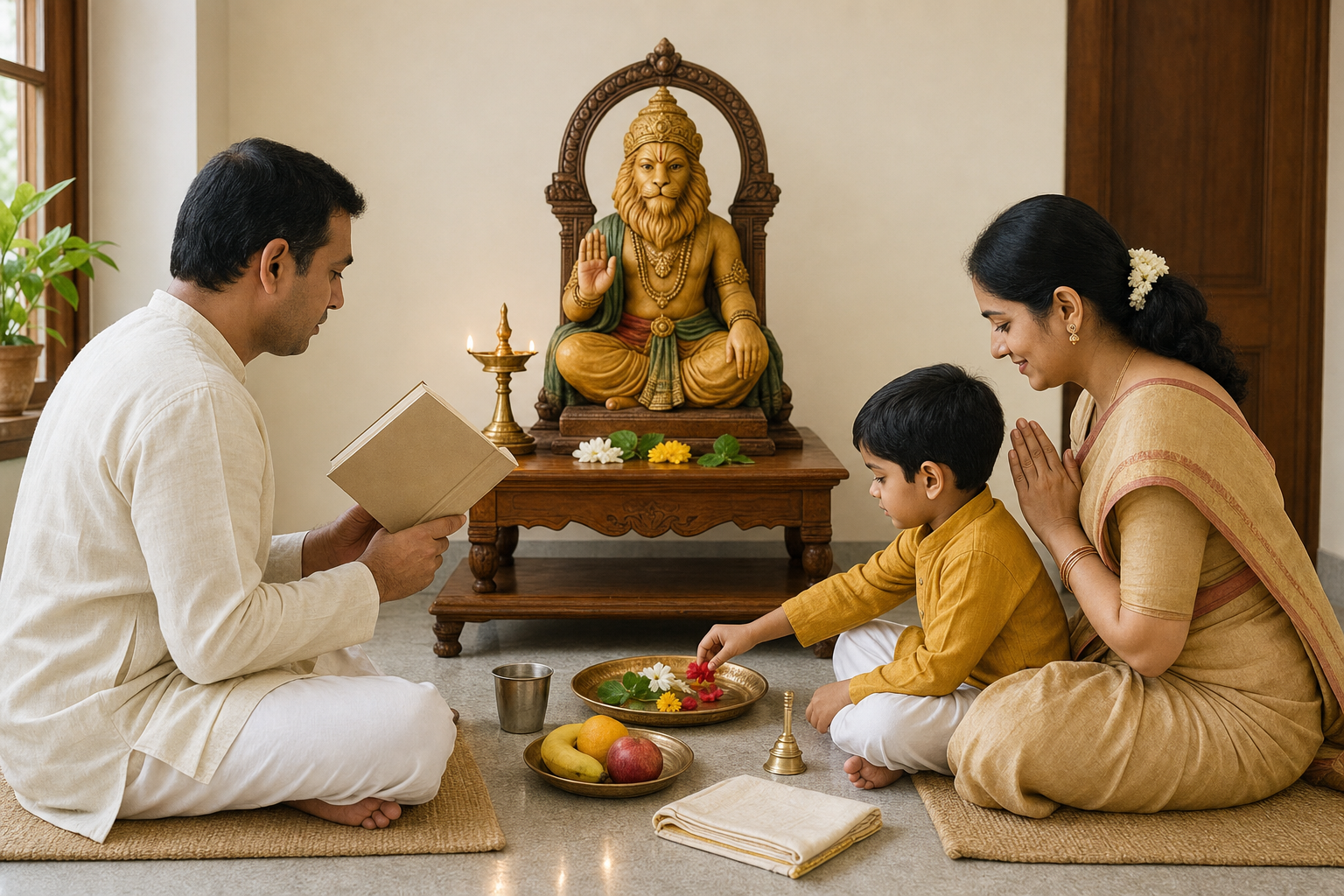
You do not need to reproduce a temple festival in your living room. A clean place, an image or suitable murti of Narasimha, a lamp, water, flowers, tulasi, incense if appropriate, and simple naivedya are enough for a coherent observance. Add items because they serve worship, not because abundance looks more religious.
- Prepare before the worship window. Clean the altar area, bathe, wear clean clothing, assemble the offerings, and silence avoidable interruptions. Keep the panchang timing where you can check it.
- State the sankalpa. Name the observance, your intention, and your capacity honestly. You can say: On Narasimha Caturdashi, I undertake this worship according to my capacity. May pride, fear, and cruelty diminish; may remembrance, courage, and service grow.
- Begin according to your household tradition. Perform achamana if it belongs to your practice, light the lamp, remember your guru and Vishnu, and invite the presence of Lakshmi Narasimha with attention.
- Hear before asking. Read the Prahlada narrative in Srimad-Bhagavatam 7.5–7.10, or concentrate on 7.8 if time is limited. Pause at Prahlada’s responses, the pillar, the twilight appearance, and the change from fury to protection.
- Offer worship. Panchopachara or shodashopachara may be used according to training and custom. Offer water, flowers, tulasi, incense, lamp, and naivedya without rushing through names you are not attending to.
- Perform abhishekam only where suitable. A Lakshmi Narasimha murti intended for ritual bathing may receive panchamrita made from milk, curd, ghee, honey, and sugar, followed by clean water. Do not pour liquids over a framed picture or a murti whose material or installation makes bathing inappropriate. When in doubt, omit the bathing and make the other offerings reverently.
- Choose one recitation and do it attentively. You may chant the Narasimha-kavacha, Sri Lakshmi-Narasimha Karavalamba Stotram, Vishnu Sahasranama, Narasimha Gayatri, or a familiar Narasimha mantra. One sustained recitation is better than hurrying through a stack of texts.
- Conclude with arati and a practical vow. Offer pranama, sit quietly, and dedicate the merit toward truthful and protective conduct. Keep the offered prasada for the time at which your vrata and local parana rule allow you to take it.
A widely used mantra is: ugram viram maha-vishnum jvalantam sarvato mukham nrisimham bhishanam bhadram mrityor mrityum namamy aham. It bows to Narasimha as fierce, heroic, all-pervading, radiant, fearsome to destructive power, auspicious to the devotee, and the death of death. The pairing of bhishanam and bhadram matters: terror and auspicious shelter are not indiscriminately distributed.
If you can attend a temple, community abhishekam, kirtan, recitation, discourse, and seva can deepen the observance. Ahobilam’s Nava-Narasimha tradition, the worship of Lakshmi Narasimha at Yadadri, and the Vaishakha observances at Simhachalam show how richly regional temple practice can embody the same protective theology. A household without temple access can still keep the tithi, read the lila, chant, and serve; distance need not become an excuse for either neglect or ritual improvisation.
Carry protective grace out of the shrine
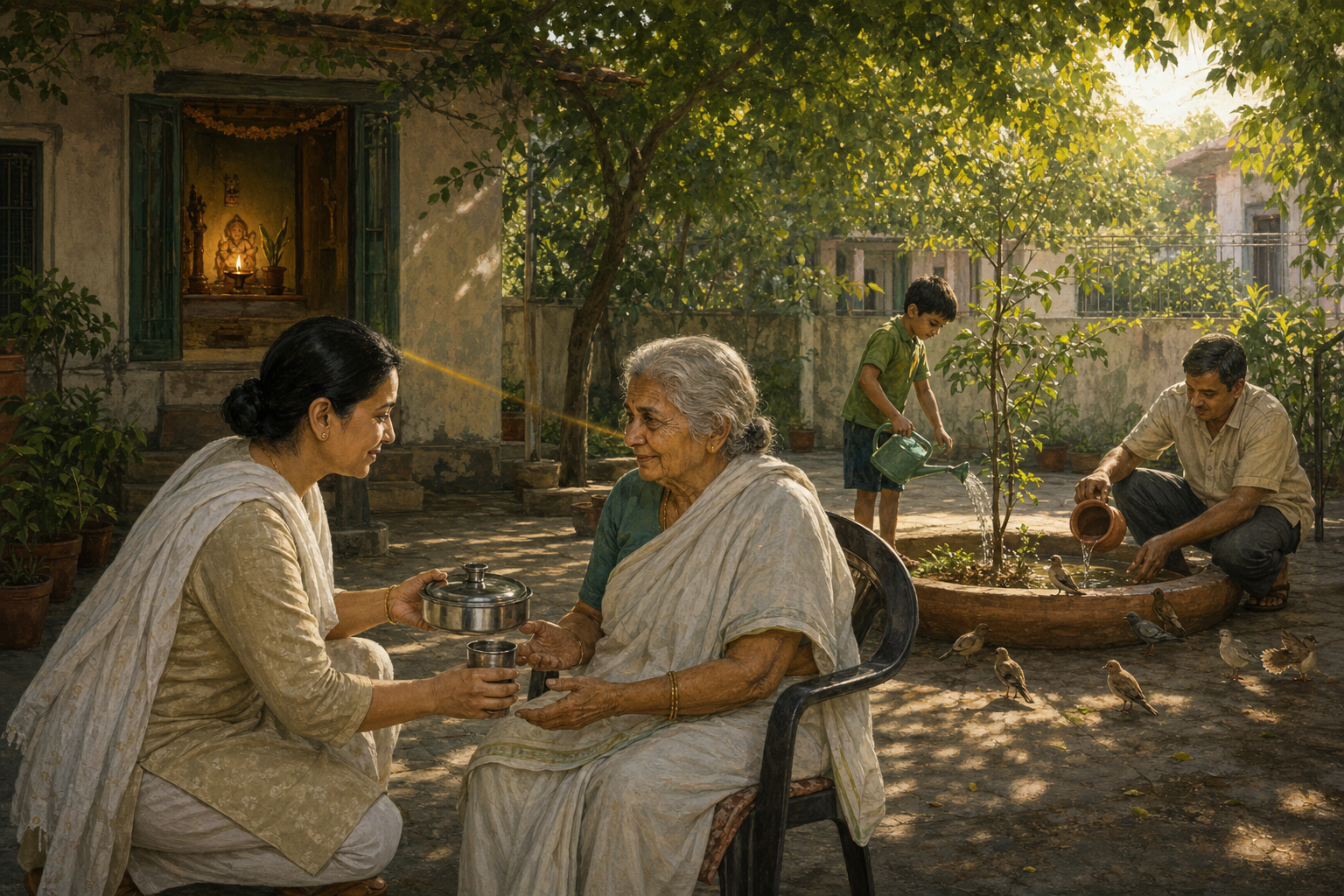
Narasimha worship becomes distorted if protection means only “keep trouble away from me.” Prahlada’s protection restores the possibility of truth under coercion. Your observance should therefore identify something that needs protection beyond your comfort: a vulnerable person, honest speech in a pressured setting, a family member’s dignity, a living being exposed to neglect, or your own conscience when silence would be easier.
Choose one narrow vow you can keep after the festival. Stop one pattern of contemptuous speech. Make one neglected duty reliable. Refuse to pass along a claim you have not verified. Offer time or resources where a vulnerable person is being overlooked. The connection between vow and grace is important: God-centered household responsibility turns ordinary duties into sustained spiritual practice.
You can also apply the narrative inwardly without reducing it to psychology. Anger, greed, arrogance, and absolutism reproduce Hiranyakashipu’s demand that everything confirm the ego. Narasimha’s intervention then becomes a prayer for decisive discernment: not that your personality be crushed, but that the inner claim to unquestionable sovereignty be broken.
The wider dharmic family offers resonant disciplines without erasing theological differences. Buddhist renunciation loosens clinging; Jain aparigraha restrains possessiveness and ahimsa protects life; Sikh Naam Simran and seva confront haumai through remembrance and service. Humility, self-restraint, fearlessness, and care for beings meet as practical ethical commitments. For a Vaishnava, these virtues remain grounded here in loving surrender to Bhagavan and His protection of Prahlada.
Key takeaways
- Use a reliable local panchang for Chaturdashi, evening worship, and parana; do not rely on a date calculated for another location.
- Treat fasting as a support for remembrance, not a contest of severity. Use the form your health, capacity, and tradition permit.
- Read Narasimha’s ferocity as limited, protective action against persecution, never as permission for personal hatred.
- Let akincanya expose one claim of pride rather than pretending that responsibility, learning, or material competence must be abandoned.
- Complete the puja with one specific act of truthful, compassionate protection in ordinary life.
Before you gather offerings, write down the one form of pride you will place before Narasimha and the one vulnerable good you will protect afterward. Then check the local tithi and build the worship around those two commitments. That is how the festival moves from an annual commemoration into lived dharma.
References
- DharmaRenaissance Blog — Sri Narasimha Caturdashi: Scriptural Insights on Humility, Surrender, and Protection
- DharmaRenaissance Blog — Srimad Bhagavatam 3.22.28 and Nrisimha Caturdashi: Timeless Dharma, Protective Grace, and Bhakti Power
- DharmaRenaissance Blog — On Narasimha Jayanti: Lord Nrsimhadeva’s Fierce Compassion, Iconography, and Dharma’s Triumph