
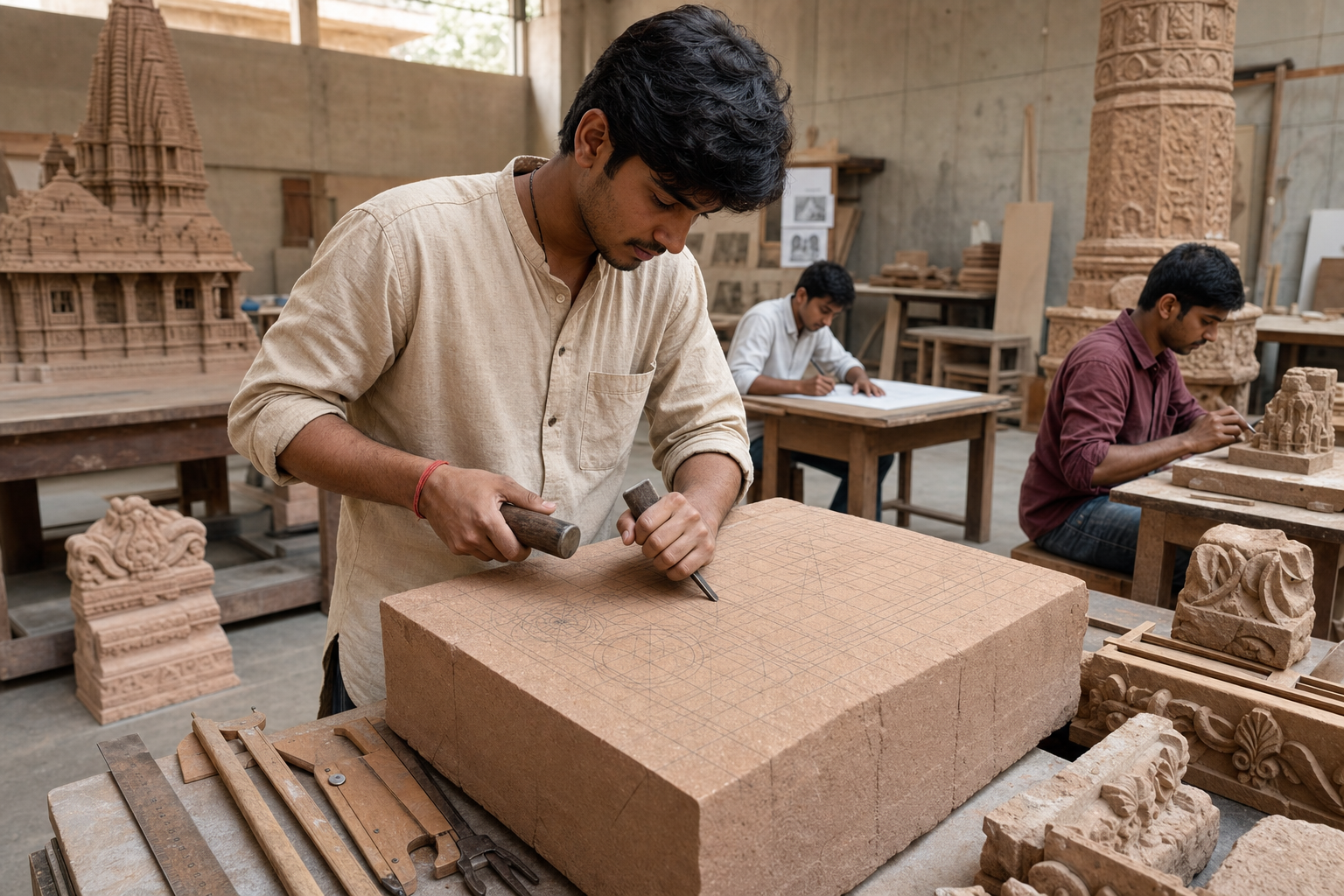
You may know that preserving temples is worthwhile and still be unsure whether to make sacred craft your livelihood. The real question is more demanding: can you spend years learning line, proportion, material and ritual context until your hands become as disciplined as your eye?
If you have passed Class 10 and are weighing traditional temple education, you need more than an admission notice. You need to understand the difference between the available pathways, test your aptitude honestly and prepare for work in which a careless line can become a careless cut in stone.
Choose the pathway by the work you want to do
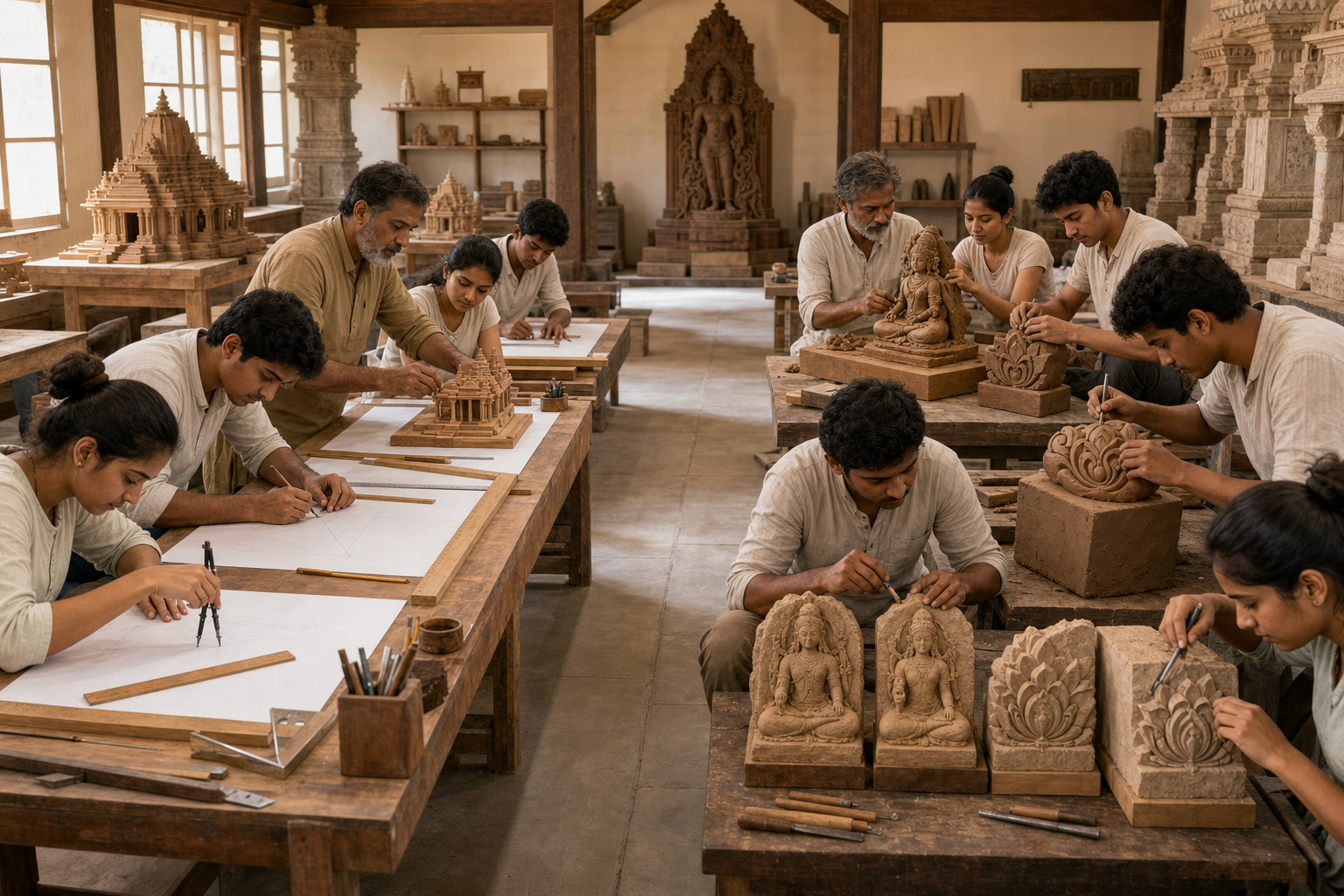
For its 2026–2027 intake, TTD’s Sri Venkateswara Traditional Temple Architecture & Sculpture College in Tirupati offered a four-year Diploma and a two-year Certificate. Both begin from traditional drawing, materials and workshop practice, but they represent different levels of commitment.
| Pathway | Likely fit | Educational emphasis | Main trade-off |
|---|---|---|---|
| Four-year Diploma | You want a sustained route toward temple design, sculpture, draughting or conservation work | Progression from foundational drawing and geometry to planning, elevations, structural logic and iconometric standards | More time for repetition and depth, but a much longer commitment |
| Two-year Certificate | You need a focused foundation in traditional craft and are not yet ready to commit four years | Core tools, materials, drawing literacy, model-making and safe supervised practice | Earlier completion, but less time for comprehensive immersion |
Choose the Diploma if your goal is to become dependable in several connected areas: measured drawing, design grammar, workshop execution and site observation. Four years do not make anyone a master sthapati, but they provide more room for correction, repetition and increasingly difficult assignments.
Choose the Certificate if you want a concentrated entry into tools, materials and drawing, or if a four-year commitment is presently unrealistic. Do not choose it merely because it is shorter. A focused course still requires patience, physical effort and willingness to repeat basic forms until their proportions are sound.
Do not assume that either credential is interchangeable with a general architecture qualification. This education is centred on sacred geometry, Shilpa Shastra, material craft and temple requirements. Before enrolling, ask what the credential qualifies graduates to do, which work remains supervised and how former students build experience after completing it.
Understand what the workshop is training you to notice
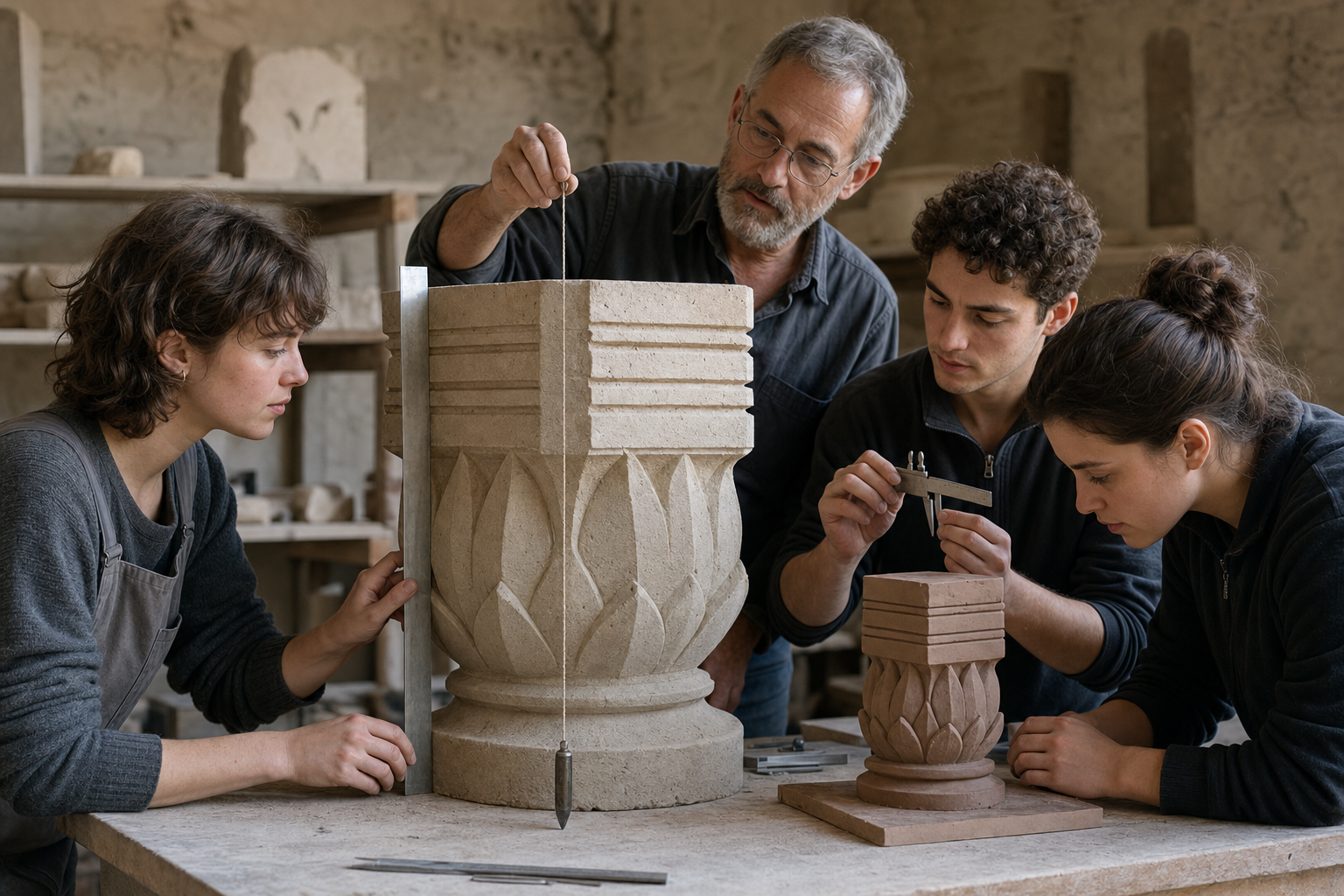
A temple is not a pile of attractive motifs. Its plan, vertical order, sculptural programme and ritual use belong to a connected grammar. Traditional education trains you to see those relationships before asking you to reproduce them.
Drawing is the first test of discipline
Temple architecture study introduces vastu-mandala layouts, orientation, prastara and superstructure composition, as well as the spatial sequence formed by the garbhagriha, antarala, ardha-mandapa, maha-mandapa, gopura, prakara and dhvaja-stambha. Sculpture adds tala–mana measurement and anga–pratyanga relationships. These are not vocabulary terms to memorise in isolation; they are systems for controlling location, scale and proportion.
Begin a working glossary before admission. Give each term one page. Add a plain definition, a small plan or elevation and an observed example from a temple you can visit respectfully. When you cannot draw the relationship clearly, you probably do not understand it clearly yet.
Freehand drawing develops observation, while instrumented drawing exposes measurement errors that the eye may excuse. Practise both. Draw a profile freely, measure its main relationships, then redraw it with tools. Keep the first attempt beside the correction; the difference is a better record of aptitude than a polished tracing.
Material resists in ways paper does not
Sculpture training joins iconometry to material judgement. Students encounter stone selection, basic geology for heritage settings, chisels, mallets and pitching tools, followed by roughing, pointing and surface-refinement sequences. Wood carving and traditional joinery can extend the same discipline to temple furniture, rathas and ceiling members.
The sequence matters. Removing material is irreversible, so a learner has to understand mass and reference points before chasing surface detail. Tool control also belongs with safety: stone and wood work are physically demanding, and unsupervised experimentation with carving tools is a poor way to demonstrate enthusiasm. Use drawing and clay models for early practice, then learn cutting techniques in a properly supervised workshop.
Murti-making adds an ethical responsibility that ordinary decorative carving does not carry. Canonical mudras, bhavas, limb relationships and tala-based measurements shape the form even when a regional idiom affects its expression. Learn to distinguish legitimate regional character from an avoidable error in proportion.
Conservation begins with documentation, not repair
Measured drawings, condition maps, traditional lime mortars, plasters and the structural behaviour of historic masonry connect craft education to conservation. A condition map records where deterioration appears before anyone proposes an intervention. That habit prevents enthusiasm from outrunning evidence.
Do not practise repair techniques on historic temple fabric. An incompatible material or poorly judged intervention can erase evidence and create further damage. Work on samples and models until a master or conservation professional authorises supervised site work. Advanced diagnostics remain the responsibility of specialists; the craft learner’s first duty is to recognise limits and document accurately.
Test your aptitude before making the commitment
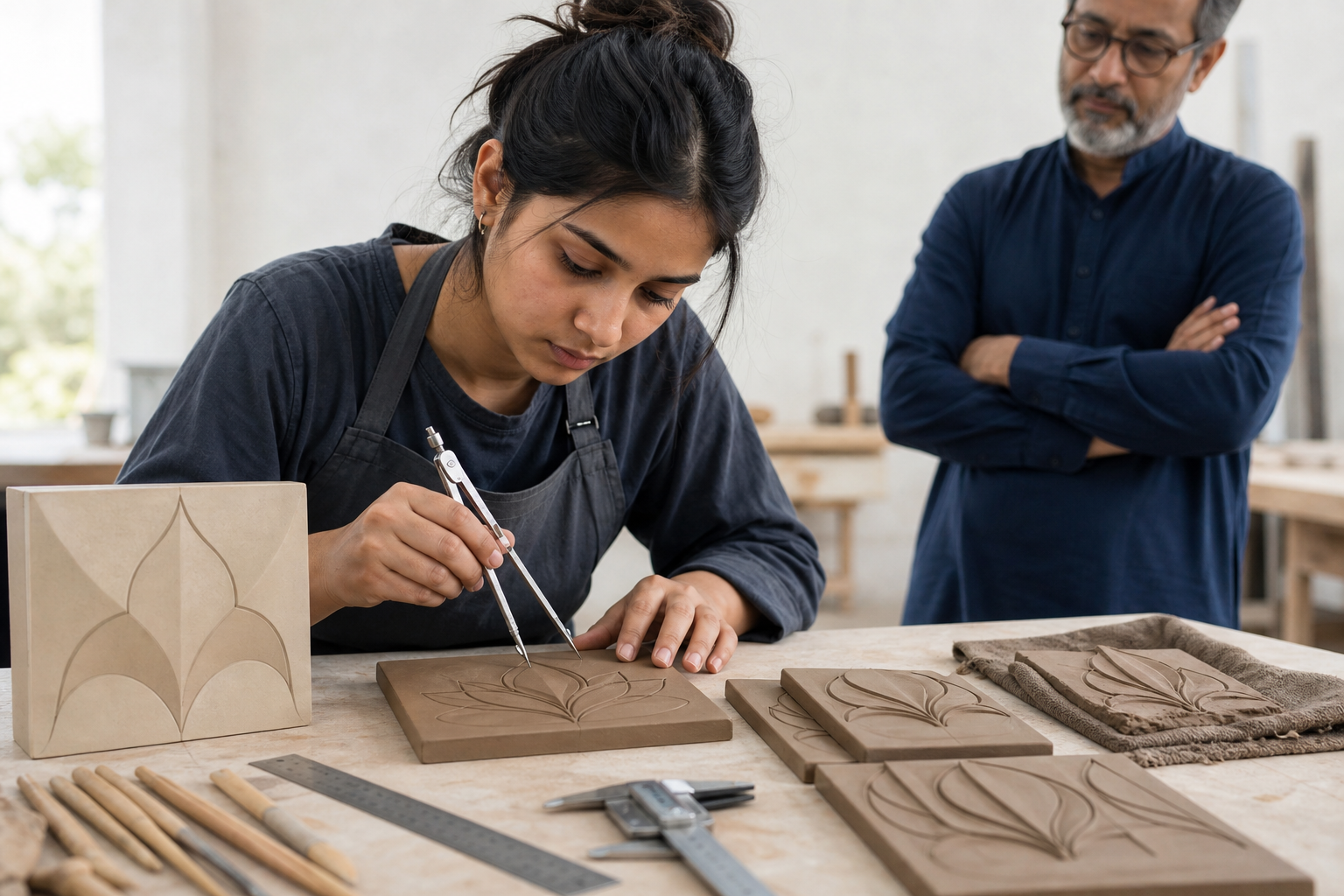
You do not need previous mastery to enter this field. You do need evidence that you can observe carefully, accept correction and sustain manual concentration. Run the following test before choosing a course or relocating for study.
- Choose a local temple where the custodians permit sketching. Work outside active ritual areas and follow every instruction given on site.
- Draw one temple profile and one pillar, bracket or motif from direct observation. Do not trace a photograph.
- With permission, make a measured drawing of an accessible architectural element. Record what you could not measure instead of filling gaps by guesswork.
- Redraw the element after checking alignment, symmetry and repeated proportions. Mark the corrections rather than hiding them.
- Model a simple lotus or geometric motif in clay. Concentrate on mass, axes and repetition before surface detail.
- Write a short note explaining where the form sits in the temple and what you still need to learn about it.
Now assess the process, not merely the result. Did correction make you curious or impatient? Could you repeat a form without becoming careless? Did measuring sharpen your observation? Were you willing to stop when permission, knowledge or safety was uncertain? Those reactions tell you more about your fit for apprenticeship-led education than raw drawing talent alone.
Keep the drawings, corrections and model photographs. A simple portfolio can include freehand sketches, measured studies and earlier work in clay, wood or soft stone. Do not describe it as an official admission requirement unless the current notification says so. Its immediate value is that it shows you—and a teacher—how you observe and respond to mistakes.
Build an application file that can survive verification
For the 2026–2027 TTD intake, the application period ran from May 4 through June 20, with Class 10 or SSC pass as the stated educational eligibility. That calendar is useful historical guidance, not a promise that a later intake will use the same dates. Work only from the official TTD notification for the cycle in which you apply.
- Save the applicable notification and copy its programme name, eligibility rule, deadline and submission method onto one page.
- Prepare the SSC certificate, identity proof and any category documentation that applies to you. Follow the notification on whether copies must be scanned, attested or supplied in another form.
- Check whether selection involves only record scrutiny or also an aptitude-oriented interaction. Do not assume a portfolio replaces any prescribed document or test.
- Verify reservation provisions, the language used in instruction and the process for document verification. Technical learning may combine regional-language usage with Sanskrit and English terminology.
- Submit early enough to correct a missing or rejected document. Keep a copy of everything submitted and retain proof of submission.
Selected students in that intake were offered free accommodation subject to TTD norms. Treat those last words seriously. Before planning your finances, confirm eligibility, allotment, duration and exactly what the accommodation provision includes. Do not build a budget on an assumed benefit that has not been confirmed for your cycle.
If you applied for the 2026–2027 cycle, use the period after submission to strengthen drawing, geometry and technical vocabulary rather than attempting advanced carving alone. If you missed the deadline, do not send an unofficial late application or presume that next year’s window will match it. Prepare the document file now and monitor TTD’s official admissions communication for the next valid opportunity.
Plan for a craft career, not a romantic idea of one
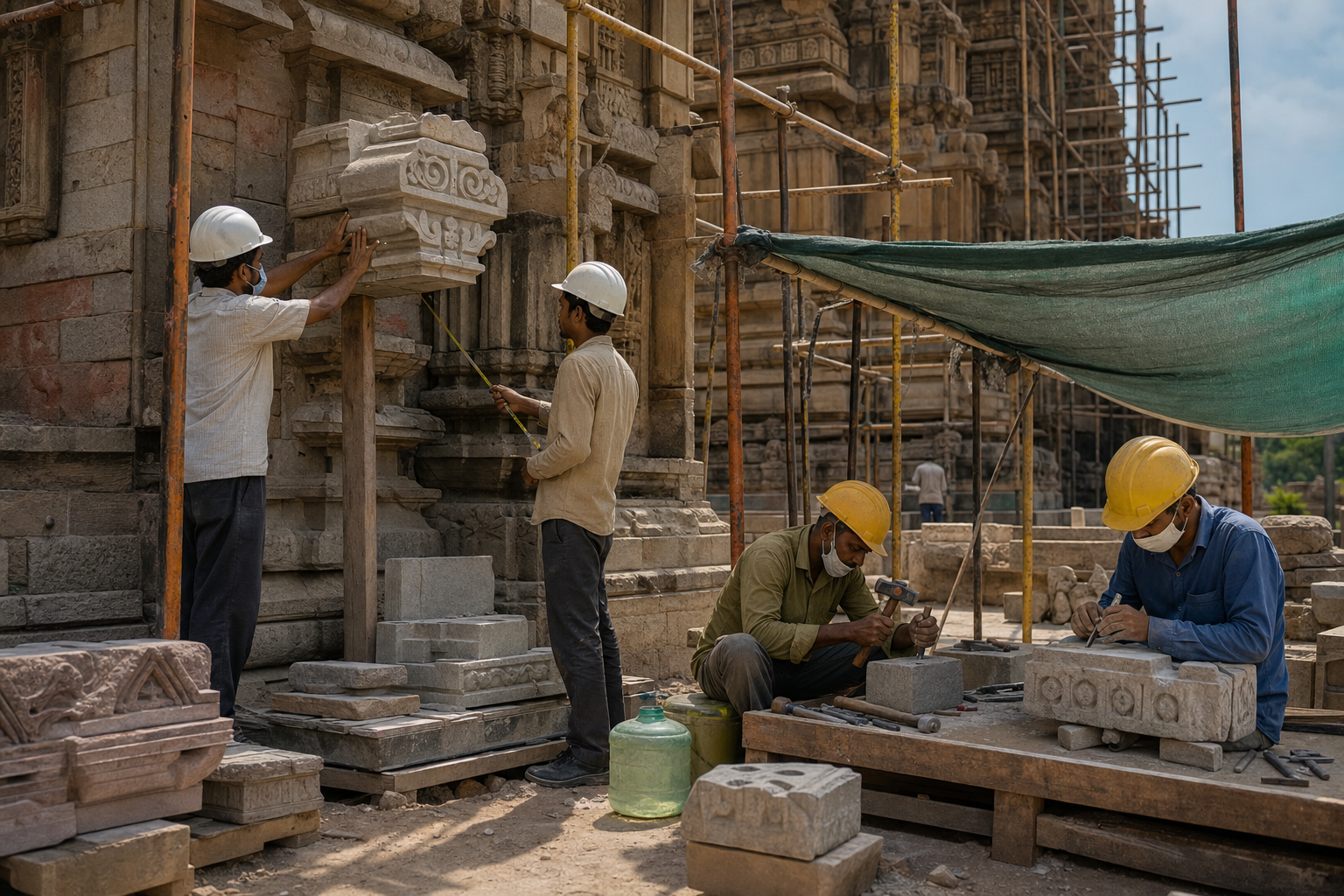
The visible result may be a vimana, murti or carved ceiling, but a beginner’s work is more likely to involve measured drawings, models, material preparation, repeated exercises and assistance under supervision. If those foundations feel beneath you, this is probably the wrong education. Sacred work depends on reliability long before it displays individual distinction.
Possible routes include junior work with a sthapati or sculptor, site craft for a temple or endowment body, conservation assistance, architectural draughting and model-making, or eventually an independent workshop serving temple communities. The combination of drawing, stone, wood, lime and sacred geometry is what creates those options; the credential alone cannot replace a demonstrable portfolio and supervised experience.
Before enrolling, ask the college for concrete answers about workshop access, supervised tool use, field observation, measured-survey practice, assessment and the kind of work graduates normally undertake at entry level. Also identify costs not covered by accommodation, including any personal tools, materials, travel or daily expenses specified for your intake. A vocation can be meaningful and still require a realistic household plan.
The underlying skills can also support shared Dharmic heritage. Documentation and compatible material practice may be useful in Hindu temples, Jain basadis, Buddhist viharas and stupas, and appropriate parts of Sikh gurdwara precincts. That does not make their ritual and iconographic requirements interchangeable. Serve each place under the guidance of its own custodians and learned practitioners.
Key takeaways
- The four-year Diploma is the stronger fit for broad, sustained preparation; the two-year Certificate is a focused foundation.
- Class 10 eligibility opens the door, but patience, drawing, geometry, hand skills and comfort with supervised physical work determine whether you can progress.
- Test yourself through observation, measured drawing and clay modelling before committing years to the field.
- Use a portfolio to show your process and corrections, but verify whether the current admission rules formally require one.
- Document historic fabric before proposing any intervention, and leave diagnostics and unsupervised repairs to qualified specialists.
- Confirm every date, document, benefit and selection condition in the official notification for your own intake.
Your next step can be small and serious. Open a sketchbook, obtain permission at a nearby temple and draw one architectural element carefully enough to discover what you have not yet learned. At the same time, assemble your SSC and identity records and set a reminder to check the next official TTD notification. If disciplined observation deepens your interest rather than exhausting it, traditional temple education deserves consideration as a real vocation—not merely an expression of reverence.