

You may not be wondering whether money is evil. More likely, you are deciding how hard to pursue the next promotion, business milestone, home or investment without making your peace depend on it. The difficulty is that ‘enough’ often moves as soon as an improvement becomes normal.
A Dharmic life does not force you to choose between household responsibility and spiritual integrity. It gives wealth a proper role: earn it honestly, use it well, enjoy it without shame, share it, and refuse to let it define you. The practical task is to place artha under dharma while training the mind to find fulfilment before the next result arrives.
Wealth is a servant: place artha under dharma

The four purusharthas give material prosperity a legitimate but limited place. They are not four unrelated ambitions competing for your attention. They form a structure for a complete human life:
- Dharma asks whether your conduct is truthful, responsible and ordered toward the good.
- Artha supplies the material capacity to maintain a household, meet obligations and support worthwhile institutions.
- Kama allows affection, beauty, pleasure and celebration without turning them into the purpose of existence.
- Moksha keeps freedom in view, so possessions and achievements do not become your identity.
This ordering corrects two common mistakes. The first is treating wealth as proof that you have succeeded as a person. The second is treating poverty, disorganisation or neglect of dependants as signs of spiritual seriousness. Neither follows Dharma. Artha is necessary for the householder, but it becomes dangerous when it escapes ethical limits or claims to provide what only inner freedom can provide.
Your useful question is therefore not, ‘How little am I allowed to own?’ Ask instead: ‘What is this wealth for, what duties does it help me fulfil, and what will I refuse to do in order to obtain it?’ Those questions make prosperity accountable without making it shameful.
Aspiration is not entitlement to an outcome
You can pursue an ambitious goal without demanding that reality deliver it on your preferred schedule. Modest expectations mean reality-aligned expectations, not defeatism. Aspiration chooses a direction and commits effort. Entitlement silently turns the desired result into a debt that life supposedly owes you.
Bhagavad Gita 2.47 places action within your responsibility while denying ownership of its fruits. Gita 2.38 adds steadiness in success and failure. Together, they describe a disciplined division of attention:
- Within your responsibility: preparation, skill, courage, honesty, persistence and the quality of your decisions.
- Not within your control: a guaranteed promotion, a particular market result, another person’s approval or the exact timing of success.
Before an important effort, write two sentences. In the first, state your sankalpa: the action and standard you will uphold. In the second, name the result you prefer and explicitly release your claim to certainty. For example: ‘I will prepare carefully, speak truthfully and negotiate fairly. I prefer this opportunity, but I will not trade my character or peace for a guarantee.’ This is karma-yoga applied to a decision, not merely admired as a concept.
Use four gates for any important money decision

A salary, business, purchase or investment is not Dharmic merely because it is profitable, legal or followed by a donation. The means, motive, consequences and use of the surplus all matter. Run consequential choices through these four gates in order:
| Gate | Question to ask | Red flag | What to do next |
|---|---|---|---|
| Dharma and ahimsa | Does earning or using this money require deception, exploitation or avoidable harm? | You are relying on distance, complexity or industry custom to avoid naming the harm. | Decline the choice or redesign the work before considering its return. |
| Motive and mental quality | Does this serve a real function, a duty or a worthy enjoyment, or is it driven mainly by fear, comparison and display? | You can explain how the choice will look to others more easily than how it will improve life. | Pause until you can state its purpose without referring to status. |
| Sufficiency and resilience | Have you considered the full burden, including maintenance, time, debt and reduced freedom? | The choice makes essential duties fragile or assumes an uncertain result is guaranteed. | Review the actual obligations and downside before committing. |
| Stewardship and circulation | Who benefits, who bears the cost, and how will any surplus support more than private display? | Workers, customers, community or environment absorb costs that your accounting ignores. | Improve terms, repair the harm, share the gain or choose a sounder alternative. |
The first gate prevents a convenient moral error: trying to purify adharmic earnings after the fact. Generosity is good, but it does not erase deliberate deception or exploitation. Buddhist Right Livelihood, Sikh Kirat Karo and the wider principle of ahimsa all direct attention to how income is produced, not only to what happens after it reaches your account.
The second gate exposes rajas when it masquerades as healthy ambition. Rajasic desire is agitated and comparative: it needs the next object or recognition to settle an insecurity, but the settlement does not last. Sattvic aspiration is clearer. It can work intensely, accept feedback and enjoy success without treating either victory or defeat as a verdict on the self. Tamas appears differently: it avoids necessary effort and calls the avoidance contentment.
The third gate matters especially when debt, investing or contractual commitments are involved. If a choice could jeopardise housing, food, care for dependants or legal and tax obligations, spiritual reflection alone cannot establish whether it is financially suitable. Pause and obtain advice from an appropriately qualified financial or legal professional before making an irreversible commitment.
The fourth gate turns private prosperity toward lokasangraha, the sustaining welfare of society. For an employer, that includes honest products, fair treatment and worker dignity. For a household, it includes giving, repair, responsible consumption and support for community life. For a professional, it can mean refusing manipulative practices even when those practices would improve a narrow performance metric.
Make contentment visible in your household system
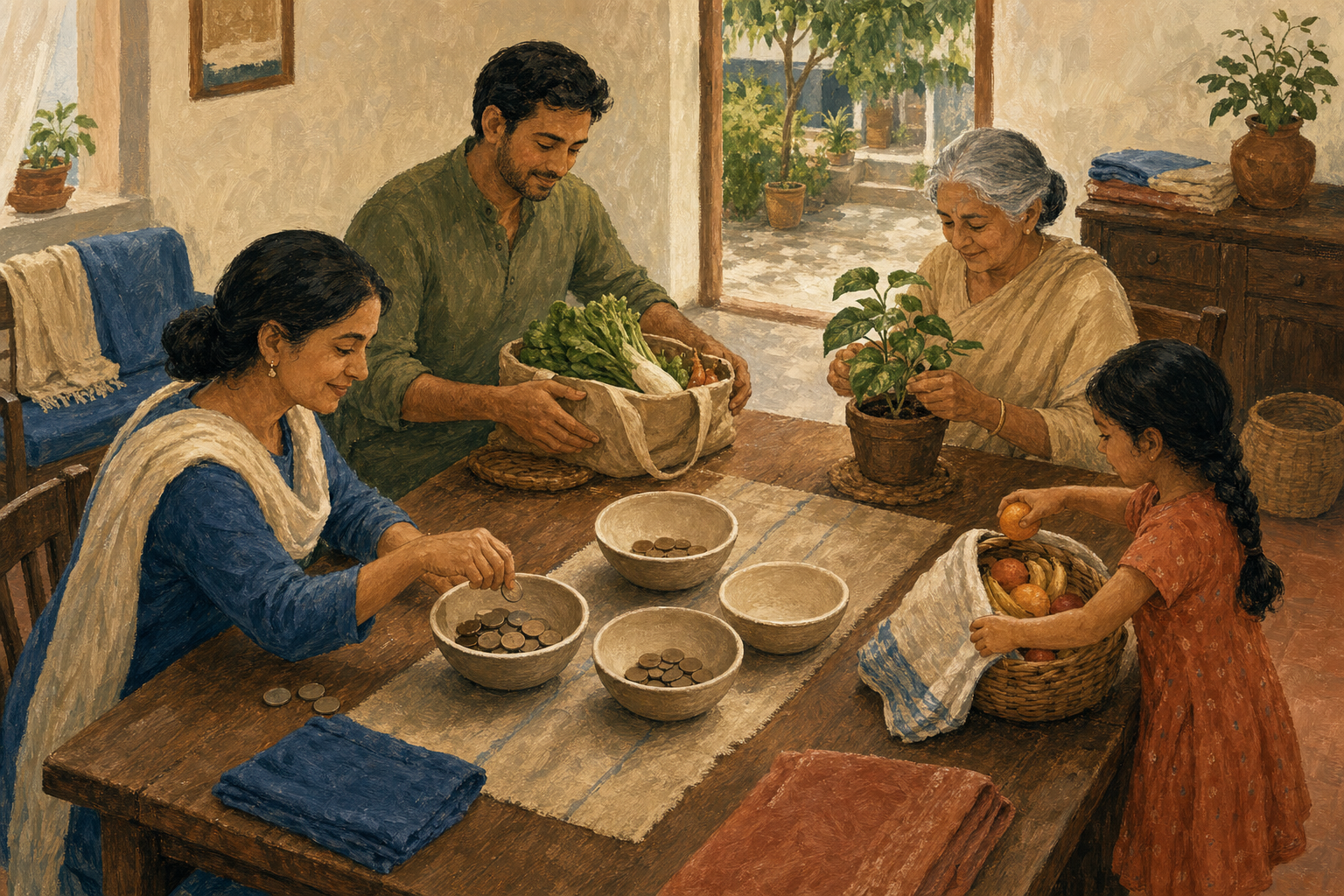
Santosha cannot govern money if it appears only during prayer or meditation. It has to become visible in the order of your budget, the rules around purchases and the way your household defines enough.
A Dharma-first budget does not require one universal ratio. A family with dependants, a person with irregular income and a renunciant do not carry the same material duties. What matters is the order in which claims are recognised:
- Meet duties first. Protect necessities, honest obligations and the care of people who properly depend on you.
- Preserve the capacity to earn ethically. Fund the tools, education, health and reasonable margin needed to keep livelihood stable.
- Choose kama consciously. Allow forms of enjoyment that genuinely nourish relationships, beauty and rest instead of treating every pleasure as a moral failure.
- Give by rule, not only by mood. Set aside a fixed amount or proportion for dana, seva or vand chhakna that remains compatible with essential duties.
- Support spiritual practice. Reserve time and, where appropriate, resources for worship, study, pilgrimage, community and silence.
This order avoids performative austerity. Giving that causes neglected responsibilities is not automatically noble. Enjoyment funded by deception or unmanageable debt is not genuine abundance. The aim is a household in which duty, delight, generosity and freedom can coexist.
Give aparigraha practical rules
Aparigraha is often translated as non-hoarding or non-possessiveness. It does not require you to despise objects. It asks you to end the reflex by which acquisition becomes the default response to discomfort. Yoga Sutra 2.39 associates steadiness in aparigraha with clearer insight into the causes and course of one’s life.
Use three questions before discretionary spending: Is it necessary or genuinely life-giving? Does it accord with Dharma? Will it strengthen sattva, or add agitation and clutter? Then turn the answers into household rules:
- Repair a useful possession when repair is reasonable before treating replacement as automatic.
- Release or donate unused possessions before adding more of the same kind.
- Count maintenance, storage, attention and lost flexibility as part of an object’s cost.
- Discuss major purchases in terms of use and duty before discussing brand, prestige or comparison.
- Schedule bounded use of comparison-heavy digital media rather than carrying it into every idle moment.
Digital restraint belongs in a money practice because comparison changes the felt baseline of sufficiency. When curated displays of success fill every pause, yesterday’s comfort begins to feel inadequate. Protecting attention is therefore part of protecting contentment.
Hold a Dharma-first money meeting
At each pay cycle, review money before new desires claim the surplus. Keep the agenda concrete:
- Confirm that essential duties and known obligations are covered.
- Apply the household’s giving rule before discussing discretionary upgrades.
- Identify a recurring expense that no longer serves its stated purpose.
- Name any concern about how income is being earned, including pressure to deceive, manipulate or externalise harm.
- Complete this sentence: ‘For this season, enough means meeting these duties, allowing these chosen joys and preserving this freedom.’
The final sentence matters because enough is contextual. It can change with genuine responsibility. It should not expand automatically whenever income or social comparison expands.
Train fulfilment before the next milestone arrives

If fulfilment is postponed until the next financial result, every achievement becomes a waiting room. Santosha reverses that arrangement. You still build, negotiate, save and improve, but you stop asking an uncertain future to grant permission for present steadiness.
A repeatable rhythm makes this trainable:
- Before work: use japa, Naam Simran, breath-centred meditation or another practice from your tradition to remember what the day’s effort serves.
- Before a consequential choice: slow the breath or practise nadi shodhana, then use the four gates. The purpose is to create a pause in which discernment can return.
- After disappointment: separate the failed result from the quality of your conduct. Correct weak effort where necessary without converting the event into a judgement on your worth.
- At the end of the day: keep a three-line expectation record: what you expected, what occurred and how you responded.
- Regularly: perform seva in a form that places you in a real relationship of responsibility rather than using generosity only as an abstract ideal.
The expectation record reveals patterns that memory tends to blur. You may notice that a purchase urge followed comparison, that irritation followed an imagined guarantee, or that a setback became manageable once you returned to right effort. This is svadhyaya directed at the mechanics of craving.
Let each Dharmic tradition retain its distinct contribution
Hindu, Buddhist, Jain and Sikh paths should not be flattened into interchangeable vocabulary. Their metaphysics and disciplines differ. Yet each provides a practical lens through which you can examine wealth and attachment:
- Hindu Dharma: karma-yoga joins committed action with non-attachment; santosha and aparigraha discipline consumption; the purusharthas place artha and kama within Dharma and the horizon of moksha.
- Buddhist Dharma: the diagnosis of tanha shows how craving sustains dukkha; anicca exposes the instability of possessions and status; Right Livelihood and dana connect insight with economic conduct.
- Jain Dharma: aparigraha makes limits explicit, while household-scale anuvratas allow discipline appropriate to lay life. Anitya-bhavana, among the 12 bhavana, contemplates impermanence, and anekantavada encourages attention to consequences from more than one standpoint.
- Sikh Dharma: Naam Japo, Kirat Karo and Vand Chhako unite remembrance, honest labour and sharing. Santokh under hukam does not cancel work; seva, langar and dasvandh give contentment a communal and economic expression.
You do not need to assemble every practice into a personal mixture. Begin coherently within your own path. The shared ethical grammar is simple enough to remember: earn without exploitation, consume without compulsion, give without display and loosen possessiveness inwardly.
Check whether contentment has become an excuse
Counterfeit contentment is passive. It invokes karma, fate or acceptance to avoid planning, difficult conversations, disciplined work or resistance to wrongdoing. Genuine santosha coexists with tapas, the heat of disciplined effort, and svadhyaya, honest self-examination. It can accept an outcome without approving injustice or abandoning agency.
Watch the direction of change. A sound practice should gradually support clearer decisions, steadier conduct, less impulsive acquisition, less compulsive comparison and more reliable generosity. It should make you more capable of fulfilling duties, not less. Easier sleep onset or a calmer mood may be useful personal observations, but they are not medical measures.
If spending, gambling, debt or financial anxiety feels compulsive, is disrupting sleep or work, or is placing essential needs at risk, do not rely on spiritual discipline as a substitute for care. Seek an appropriately qualified mental-health professional for the compulsive or anxiety-related behaviour and a qualified financial professional for the practical exposure.
Key takeaways for your next pay cycle
- Define what your wealth is for before deciding how much more to pursue.
- Write both a committed action and a released outcome for your next major goal.
- Test consequential choices for harm, motive, sufficiency and stewardship, in that order.
- Meet real duties first, then apply a consistent giving rule before lifestyle upgrades consume the surplus.
- Use aparigraha as a household system: repair, release clutter, count hidden burdens and limit comparison triggers.
- Measure progress by ethical consistency, freedom from compulsion and steadiness across success and failure, not by possessions alone.
At your next income or spending decision, do not ask only whether you can afford more. Ask what the choice serves, what it costs beyond money, who else carries its consequences and whether you could remain inwardly free without it. That pause is where ethical wealth and contentment begin to support each other.
References
- DharmaRenaissance Blog – Beyond Abundance: Why Modest Expectations Foster Lasting Happiness in Dharmic Wisdom
- DharmaRenaissance Blog – Beyond Maya: Dharmic Wisdom on Materialism, Ethical Wealth, and Lasting Fulfilment