
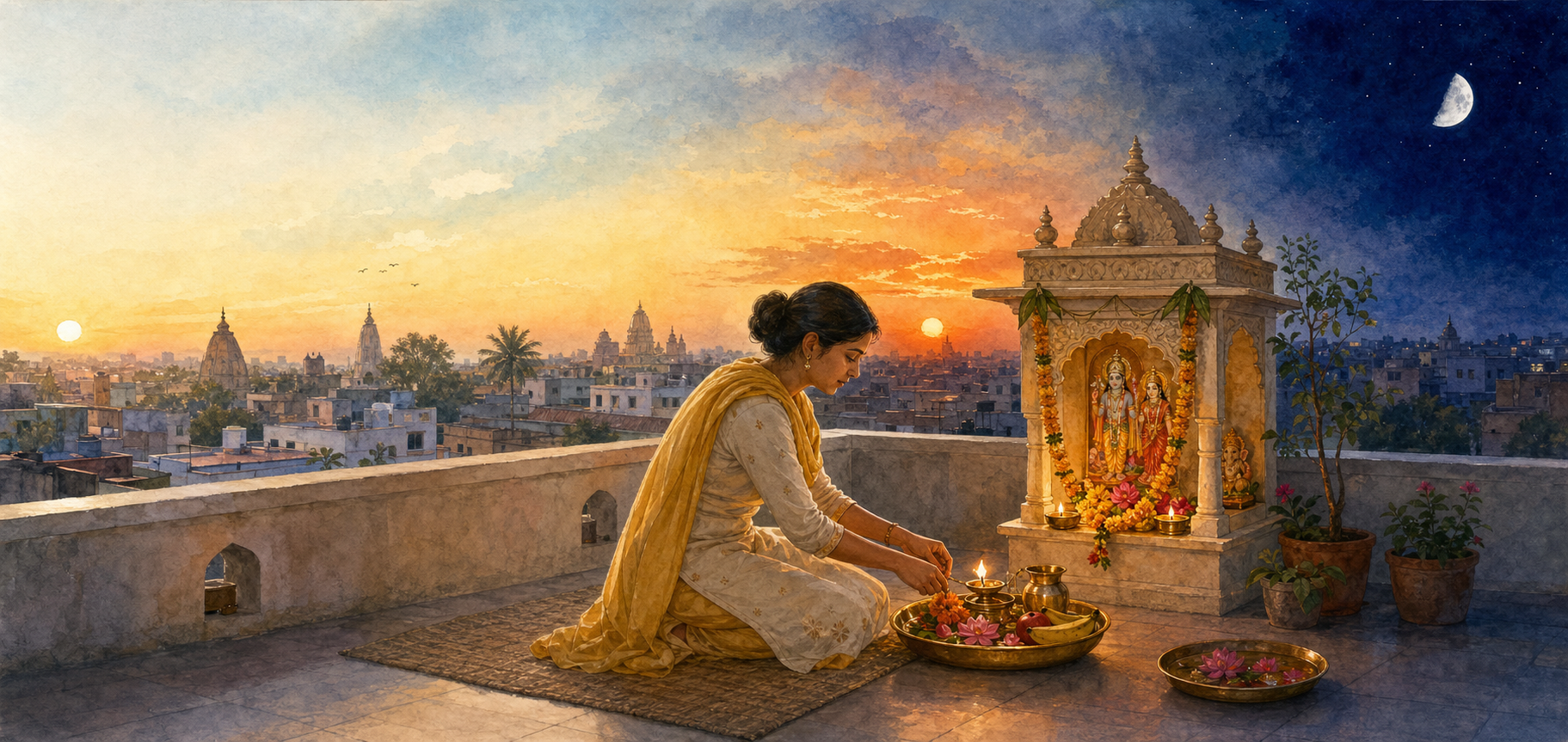
You have an Ashtami vrata in mind, but one Panchang marks one civil date while another seems to point to the next. Do not begin by asking which date is Ashtami. Ask which date holds Ashtami at the moment your observance requires, in the place where you will worship.
That distinction resolves most calendar confusion. It tells you whether sunrise, the daytime puja period, dusk, or a night interval governs your observance. It also prevents a muhurta printed for one city from being copied into a schedule where it does not belong.
A civil date contains the tithi; it does not define it

A civil date changes at midnight. A tithi changes when the angular relationship between the Sun and Moon reaches its next boundary. Each tithi covers a 12-degree interval of solar-lunar separation, but the Moon does not move at a perfectly uniform rate. A tithi can therefore begin or end at almost any clock time instead of staying neatly inside one date.
This is why the word Ashtami printed beside a date is not enough to plan a vrata. You need its start and end times. On 10 May 2026, Krishna Paksha Ashtami continues until 10:06 AM in the cited Indian timing; Krishna Paksha Navami takes over after that boundary. Early-morning worship and late-evening worship on that civil date therefore occur under different tithis.
Before committing to a date, copy these details from a location-specific Panchang:
- Your city, not merely your country or time zone.
- The time zone and daylight-saving setting used by the calendar.
- The local sunrise and, if the ritual involves dusk or night, the local sunset.
- The paksha and exact start and end times of Ashtami.
- The moment your family, temple, or sampradaya uses to assign the observance.
If two calendars still appear to disagree, check what kind of disagreement you are seeing. The Amanta system ends the lunar month at Amavasya, while the Purnimanta system ends it at Purnima. The same tithi can consequently carry different month labels without being a different lunar event. Nakshatra and rashi calculations may also reflect settings such as ayanamsha; many Indian almanacs use Lahiri ayanamsha. Compare configuration details before deciding that one set of clock times must be wrong.
Let the ritual’s governing moment choose the date
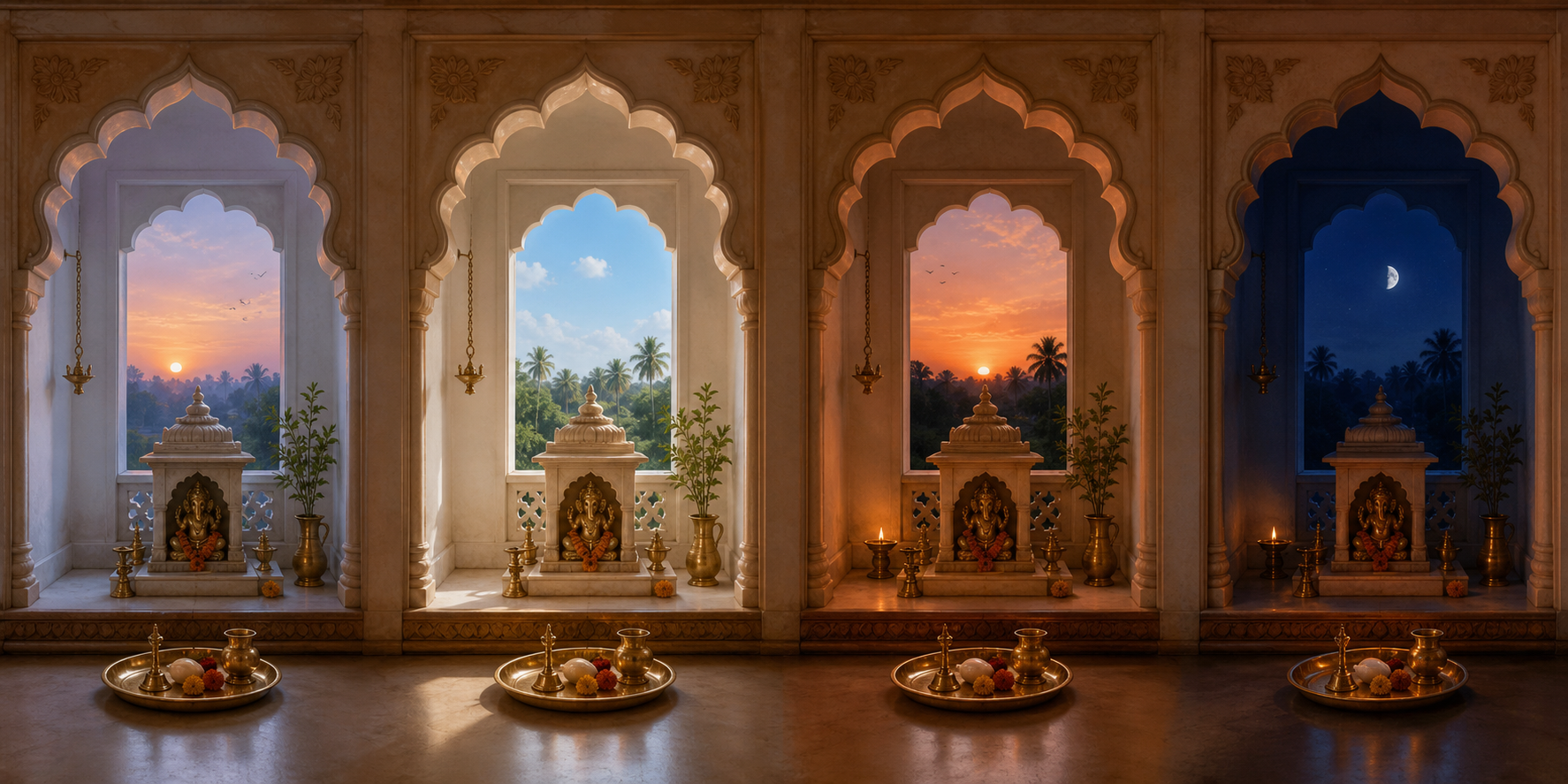
Different Ashtami observances do not all use one universal date-selection rule. The decisive question is whether Ashtami must be present at sunrise, during the main puja, or during a specified part of the night.
- Sunrise-based observance: The civil day on which Ashtami prevails at local sunrise commonly receives the vrata or festival. Household and temple observances of Shukla Devi Puja often use this rule. If Ashtami is absent at sunrise, many lineages place the full puja on the date when it is present.
- Operative-tithi worship: The puja must occur while Ashtami is actually running. An early-ending Ashtami may leave only a morning window, even though the civil date continues for many more hours.
- Night-based observance: A vrata connected with a night interval, including a nishita-based Kala Ashtami rule, requires Ashtami during that interval. Presence at sunrise alone does not answer the question.
Use the rule inherited through your family or sampradaya. If it is not known, ask the temple or acharya whose vidhi you intend to follow. A calendar can calculate the lunar boundary, but it cannot decide which lineage rule belongs to your vrata.
A reliable decision sequence is:
- Name the observance precisely: Krishna Kala Ashtami, a Shukla Devi vrata, a family Ashtami puja, or another lineage-specific practice.
- Identify its governing moment: sunrise, daytime, dusk, or a specified night interval.
- Open a Panchang calculated for the city where the worship will occur.
- Choose the civil date on which Ashtami overlaps that governing moment.
- Only then select a suitable muhurta within the available Ashtami period.
This order matters. Abhijit Muhurta cannot turn Navami back into Ashtami, and avoiding Rahu Kalam cannot repair a date chosen under the wrong tithi rule. Tithi establishes whether the ritual belongs there; muhurta refines the timing after that decision has been made.
The distinction becomes concrete with Jyeshta Shukla Ashtami on 22 June 2026. That date supports Shukla Devi Puja across most Indian locations, but a practitioner elsewhere should still verify whether Ashtami prevails at local sunrise and during the intended puja. The festival name remains meaningful; the local lunar clock decides where it falls on your civil calendar.
Shukla and Krishna Ashtami call for different forms of worship
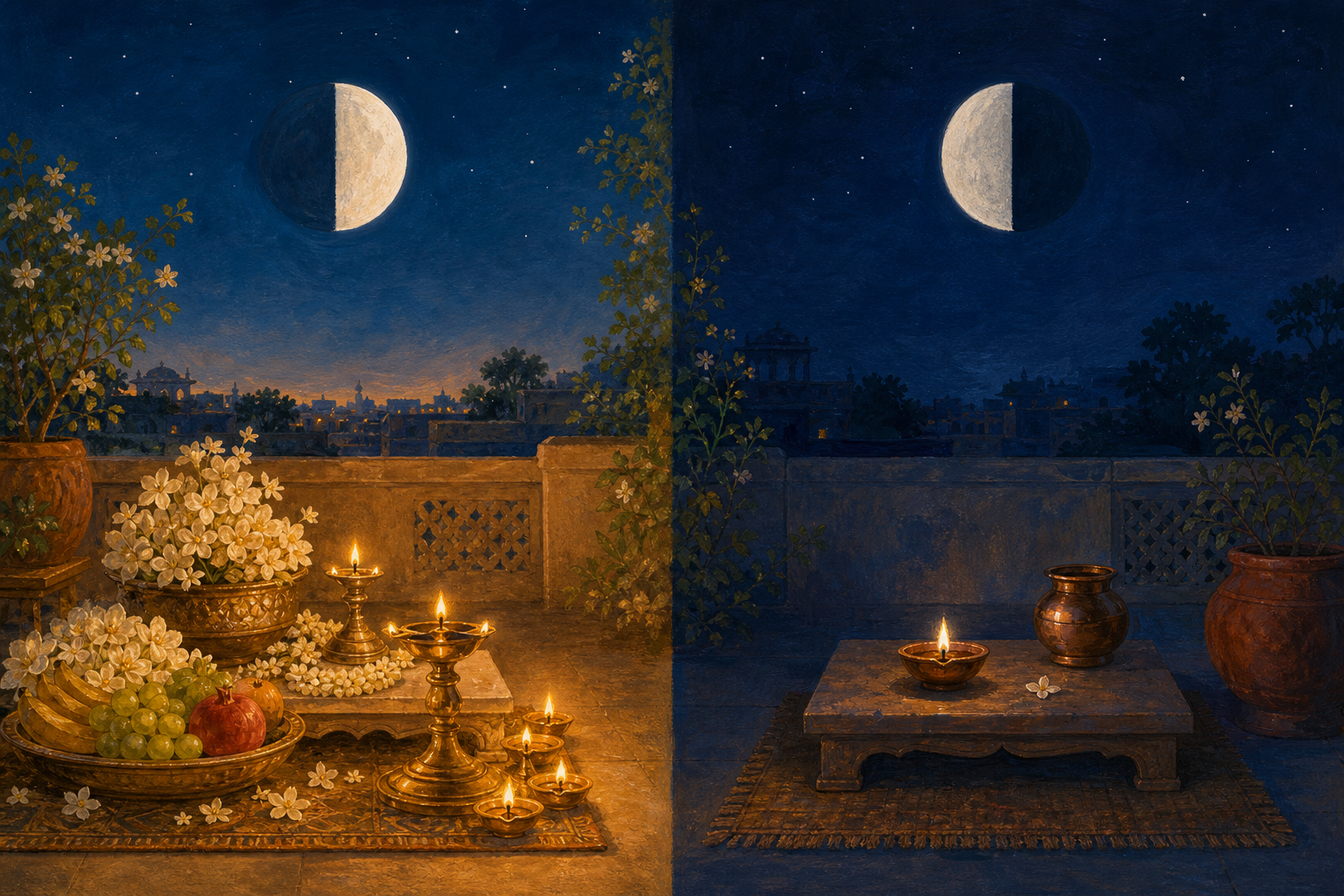
Ashtami tells you that it is the eighth tithi. Paksha tells you whether the lunar cycle is waxing or waning. The name of the vrata, its deity, and its lineage then tell you what to do. Treating every Ashtami as the same observance loses the very distinctions the Panchang is meant to preserve.
For Krishna Paksha and Kala Ashtami: The waning fortnight lends itself to restraint, introspection, mantra-japa, and steady sadhana. Kala Ashtami is associated in many traditions with reverence for Bhairava. A modest household observance may include upavasa, names or hymns of Shiva and Bhairava, a deepa, and compassionate care for or feeding of a dog, which is traditionally associated with Bhairava’s vahana. The point is disciplined remembrance, not ritual display.
If Krishna Ashtami ends in the morning, complete acts that explicitly require the operative tithi before the boundary. Do not automatically assume that an evening or night practice still belongs to Ashtami. Where the observance requires Ashtami at nishita or another night segment, inspect the neighboring civil dates in your local Panchang and follow the lineage rule.
For Shukla Paksha and Devi worship: The bright fortnight supports a luminous, sattvika orientation. In Shukla Devi Aradhana, shukla points to the Goddess’s bright and clarifying mode, not necessarily to a separate sectarian deity. A household may worship the locally received form of Devi, including Durga, Parvati, Saraswati, or Lakshmi, according to its sampradaya.
White flowers, white cloth, and milk-rice kheer express that luminous emphasis. In Kashmir, the Jyeshta Shukla Ashtami observance is closely connected with the Khir Bhavani Mela at Tulmul and the worship of Ragnya Bhagwati. A family participating through its home altar can retain the same devotional center without trying to reproduce every temple custom.
A practical home sequence for Shukla Devi Puja is:
- Purify yourself and the worship space through the customary achamana, pranayama, and quiet preparation.
- State a sankalpa using the tithi and month name shown by your local, lineage-compatible Panchang.
- Invoke Ganesha, Guru, and Kula Devata before the principal Devi worship.
- Perform murti-puja or kalasha-sthapana according to the panchopachara or shodashopachara form you know.
- Offer sandal, akshata, flowers, dhoopa, deepa, and sattvika naivedya such as kheer and fruit.
- Use a received recitation such as Sri Suktam, Durga Suktam, or an appropriate portion of Devi Mahatmya rather than collecting unfamiliar mantras for one day.
- Conclude with arati, quiet japa, pushpanjali, prasada, and a practical act of seva.
Vrata intensity can vary without emptying the observance of meaning. Some practitioners fast from sunrise to sunset, some take fruit and water, and others abstain from grains, onion, and garlic. If fasting conflicts with a medical condition, prescribed treatment, pregnancy, age-related needs, or prior medical guidance, do not equate severity with devotion. Follow medical advice and take a suitable light sattvika diet. Ahimsa applies to your own body as well as to others.
The eighth lunar day also carries contemplative resonances beyond Hindu practice: Buddhist Uposatha cycles may include the eighth day for intensified mindfulness, while Jain observances may emphasize tapas, svadhyaya, and dana. Sikh practice generally centers sabad and seva rather than astrological determinism. These are distinct paths, not interchangeable versions of one ritual. Their convergence lies in disciplined attention, compassion, self-restraint, and service.
Build a split-tithi schedule without mixing the rules
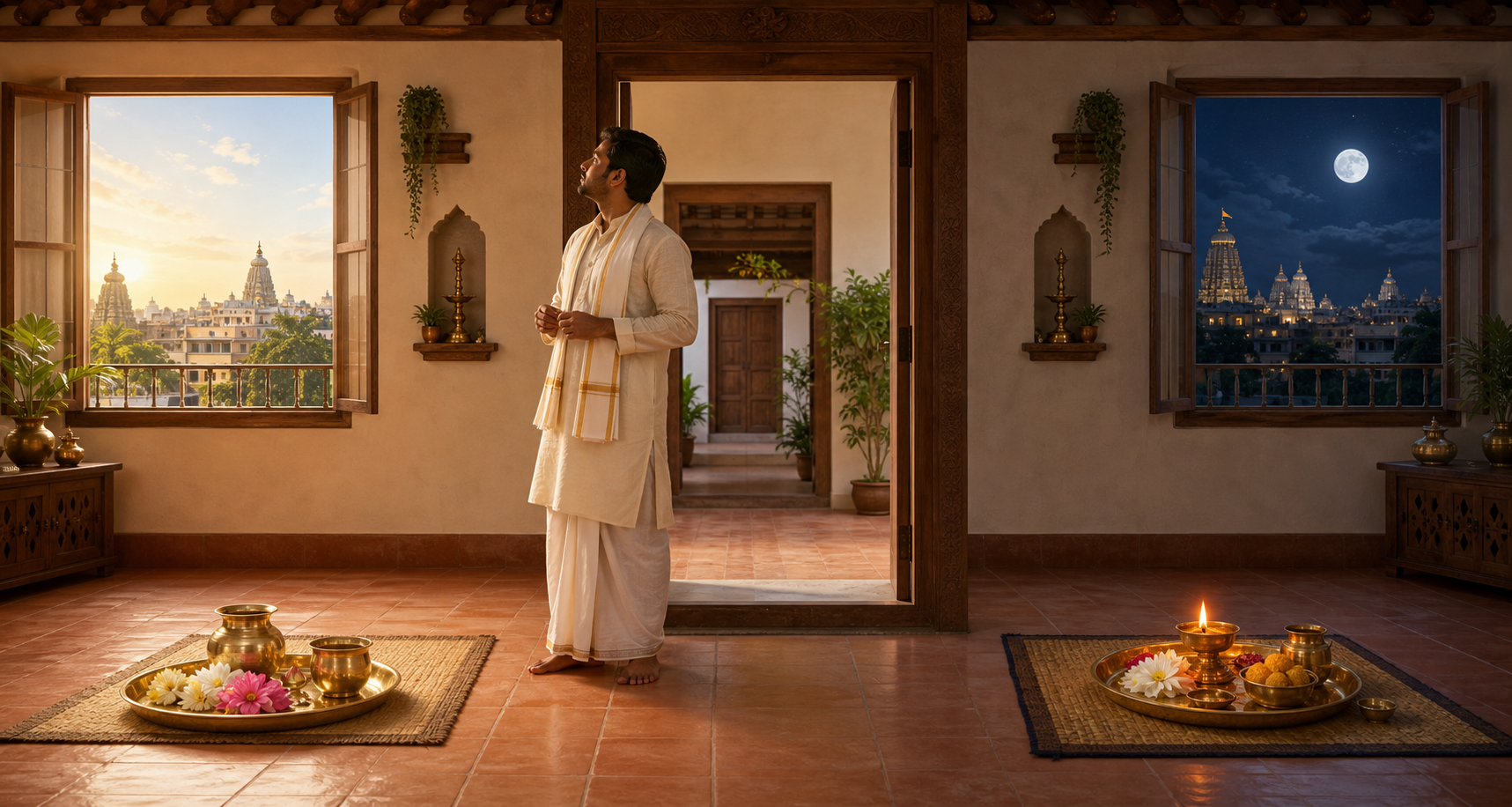
An early-ending Ashtami is where mistakes become visible. Consider the Indian timing for Sunday, 10 May 2026: Krishna Paksha Ashtami remains until 10:06 AM, and Navami follows. If your rule accepts the date because Ashtami prevails at sunrise, the day can be organized as follows:
- At dawn: Confirm that the Panchang is set to your actual location. Take the Ashtami sankalpa and begin the tithi-dependent japa or puja.
- Before 10:06 AM in the cited Indian timing: Complete commitments that must occur while Ashtami is operative. Do not wait until evening merely because the calendar page is still dated 10 May.
- After the boundary: Recognize Navami in any new sankalpa. Quiet recitation, household seva, study, and ordinary devotional duties may continue without pretending that the earlier tithi remains.
- For a night-based Kala Ashtami rule: Do not use this sunrise schedule as proof that the same civil date qualifies. Check which local date actually carries Ashtami during the required night interval.
The 10:06 AM boundary is an example, not a reusable annual timetable. If you are outside the reference location, copy neither the clock time nor the Indian civil date without checking local ephemerides. Longitude, latitude, sunrise, time-zone settings, and daylight-saving status all affect how the observance appears on your local calendar.
The five limbs of the Panchang help you separate the date-setting question from the finer timing questions:
| Panchang limb | What it describes | How to use it for Ashtami |
|---|---|---|
| Tithi | The changing angular relationship of the Sun and Moon | Determine whether Ashtami is operative at the ritual’s required moment. |
| Vara | The weekday | Use weekday-dependent conventions only after the tithi date is settled. |
| Nakshatra | The Moon’s position among 27 sidereal sectors of 13 degrees 20 minutes each | Refine mantra, travel, or ritual choices when your tradition requires it. |
| Yoga | A quality derived from the combined solar and lunar longitudes | Use it as an additional qualitative factor, not as a substitute for Ashtami. |
| Karana | A half-tithi segment | Apply it where a detailed karmakanda or sankalpa procedure specifies one. |
Rahu Kalam, Yamaganda, and Gulika Kalam are likewise secondary filters. Their daily windows are calculated by dividing the interval from local sunrise across the day into eight equal parts, so a generic Sunday timetable will drift with season and latitude. Abhijit Muhurta sits around the middle of local daylight and may be useful for a key sankalpa or undertaking, but it must still fall inside the tithi window required by the observance. Tara-bala and Chandra-bala can add personal refinement where the family tradition uses them.
Your planning hierarchy should therefore remain simple: first identify the vrata rule, then find the local Ashtami overlap, and only then filter that interval through muhurta considerations. This keeps astronomical calculation in service of dharma instead of allowing a long list of calendar terms to obscure the actual decision.
Key takeaways
- The correct civil date is the date on which local Ashtami overlaps the moment required by your specific observance.
- Sunrise can govern one vrata while daytime presence, dusk, or nishita governs another. Use your lineage’s rule rather than a universal shortcut.
- Shukla Ashtami and Krishna Ashtami are not interchangeable: paksha, deity, and sampradaya determine the devotional form.
- Tithi comes before muhurta. Abhijit Muhurta or avoidance of Rahu Kalam cannot compensate for the absence of Ashtami.
- Amanta and Purnimanta calendars can give the same tithi different month labels; that alone does not prove a timing conflict.
- Fasting is adaptable. Truthfulness, ahimsa, remembrance, self-restraint, and seva remain central when health needs require a lighter discipline.
Before your next Ashtami, save one dependable local Panchang and write four things at the top of your plan: the required ritual moment, the Ashtami start and end times, local sunrise or night interval, and your chosen puja window. That short record is more reliable than a forwarded festival-date card. Once the timing is settled, stop recalculating and give your attention to the worship itself.
References
- DharmaRenaissance Blog – May 10, 2026 Panchang: Definitive Guide to Tithi Shift, Shubh Muhurat, Nakshatra & Rashi
- DharmaRenaissance Blog – Shukla Devi Puja 2026 on Jyeshta Shukla Ashtami: Sacred Timings, Kheer Bhavani, Complete Vidhi