
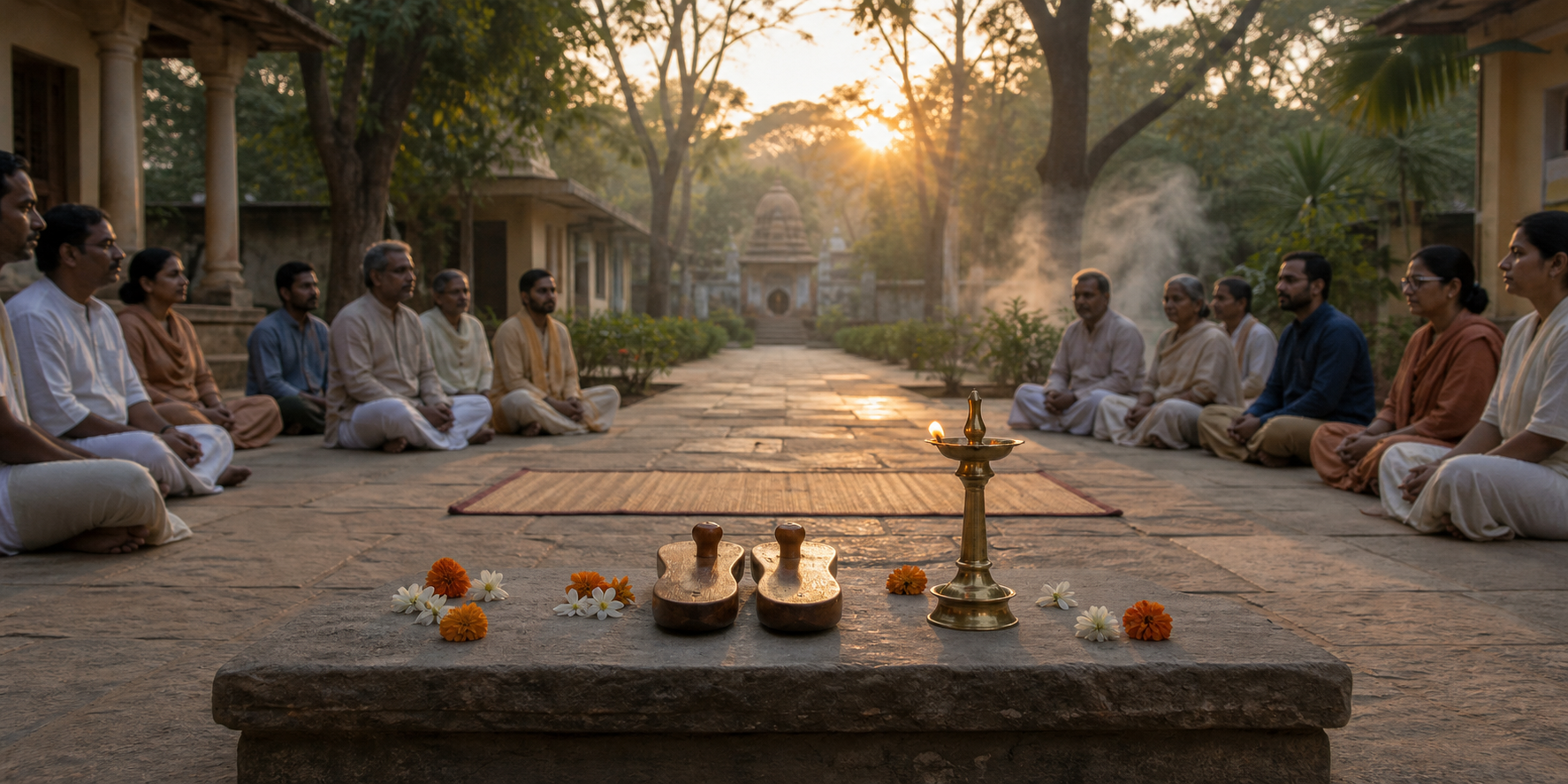
When you hear that a guru or Mahant has “attained samadhi,” grief may arrive with practical questions. Are you being asked to accept a claim about realization? What should you do with the guru’s padukas, teachings, and daily instructions? Who, if anyone, now speaks for the lineage?
You do not have to choose between devotion and discernment. A Dharmic response can honor mahasamadhi, preserve the practice you actually received, and examine succession by the duties of a parampara rather than by emotion, spectacle, or institutional pressure.
Read “samadhi” in its context before interpreting it
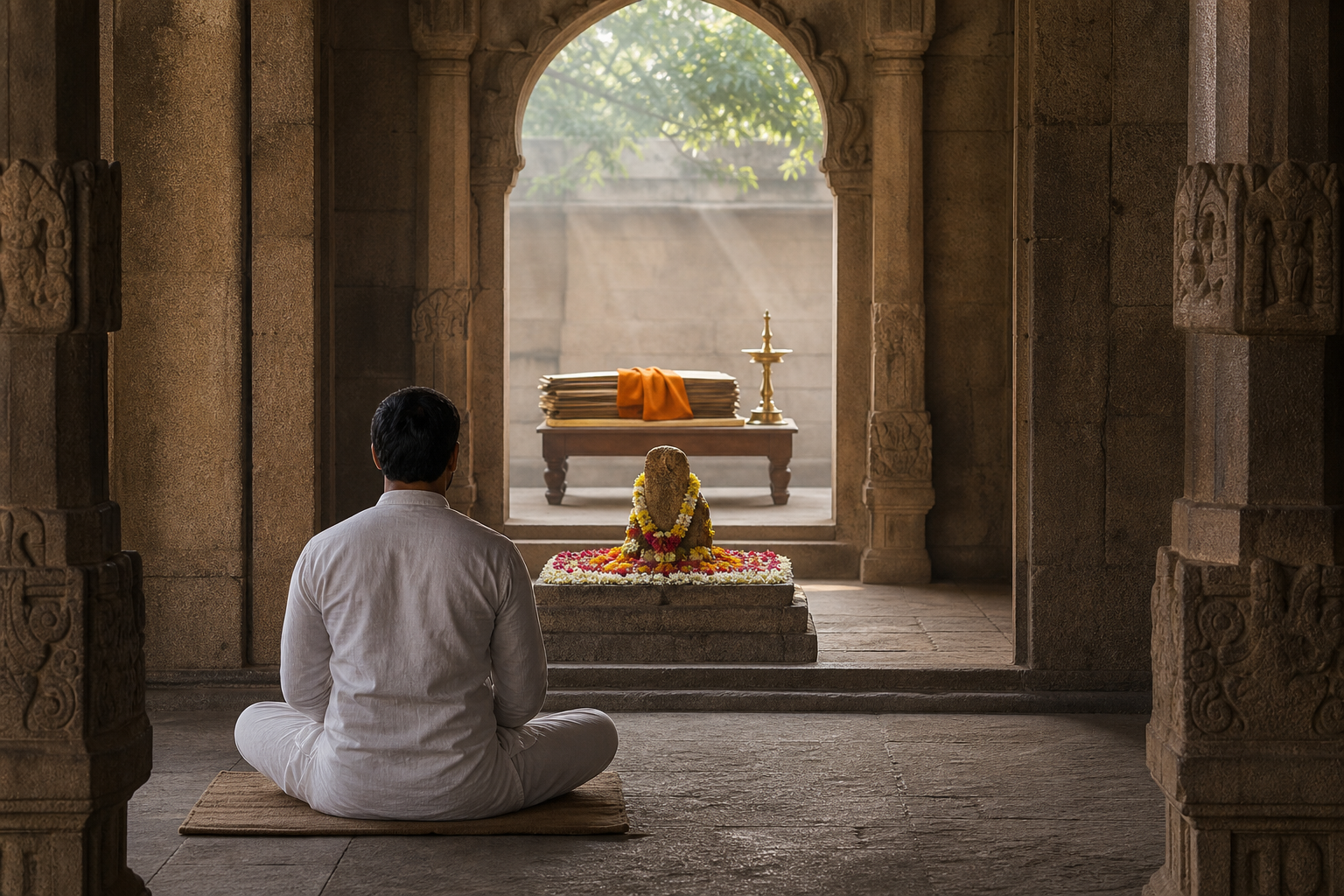
The word samadhi can name a meditative attainment, the final departure of a realized practitioner, or a sanctified place associated with that practitioner. Confusing these meanings creates unnecessary arguments. Start with the sentence in which the word appears.
| Where you meet the word | What it is naming | What you should do |
|---|---|---|
| A teaching on Yoga | A consummate state of meditative absorption; the precise classification depends on the school | Identify the teacher’s philosophical vocabulary before comparing it with another system |
| A death announcement | In many Hindu sampradayas, mahasamadhi: a sacred understanding of a realized practitioner’s conscious final departure | Respect the lineage’s usage without inventing biographical details, supernatural events, or certainty you do not possess |
| The name of a pilgrimage place | A sanctified memorial or resting place maintained according to sampradaya norms | Follow the site’s rules for darshan, worship, photography, offerings, and annual observances |
In the Yoga framework, dharana, dhyana, and samadhi form the triad called samyama. Dharana gathers attention around a chosen focus. Dhyana sustains that attention as an unbroken flow. Samadhi brings absorption to its consummation. This progression belongs within a larger discipline that includes ethical restraint, observance, posture, breath regulation, and withdrawal of the senses. Samadhi is therefore not a dramatic mood or an isolated technique.
The vocabulary becomes more exact within particular schools. The Yoga Sutra tradition distinguishes samprajnata samadhi, in which increasingly subtle cognition remains, from asamprajnata samadhi, in which even subtle objectification falls away. Advaita and Yoga teachers may also discuss savikalpa and nirvikalpa. These terms should not be stacked into a universal ranking system. Ask which school is speaking, how that school defines the terms, and what disciplines it requires.
A death announcement is doing different work. In many Hindu lineages, saying that a saint attained samadhi or mahasamadhi recognizes spiritual completion rather than merely substituting a decorative word for death. Receive that language as the sampradaya’s sacred judgment. It need not become a demand that outsiders certify another person’s interior state. When public biographical information is limited, speak about known service and teaching; do not fill the silence with miracles, secret initiations, or titles that no responsible custodian has confirmed.
The wider Dharmic family also uses a language of deep absorption, but not as one undifferentiated doctrine. Buddhism places samadhi within the Noble Eightfold Path, Jain practice relates meditative equipoise to right knowledge and right conduct, and Sikh remembrance points toward sahaj, a natural spiritual poise. These resonances make respectful conversation possible. They do not erase the distinct aims, authorities, or methods of each tradition. When speaking across traditions, name the particular tradition instead of implying that one definition governs everyone.
Revere the guru principle without making a personality absolute
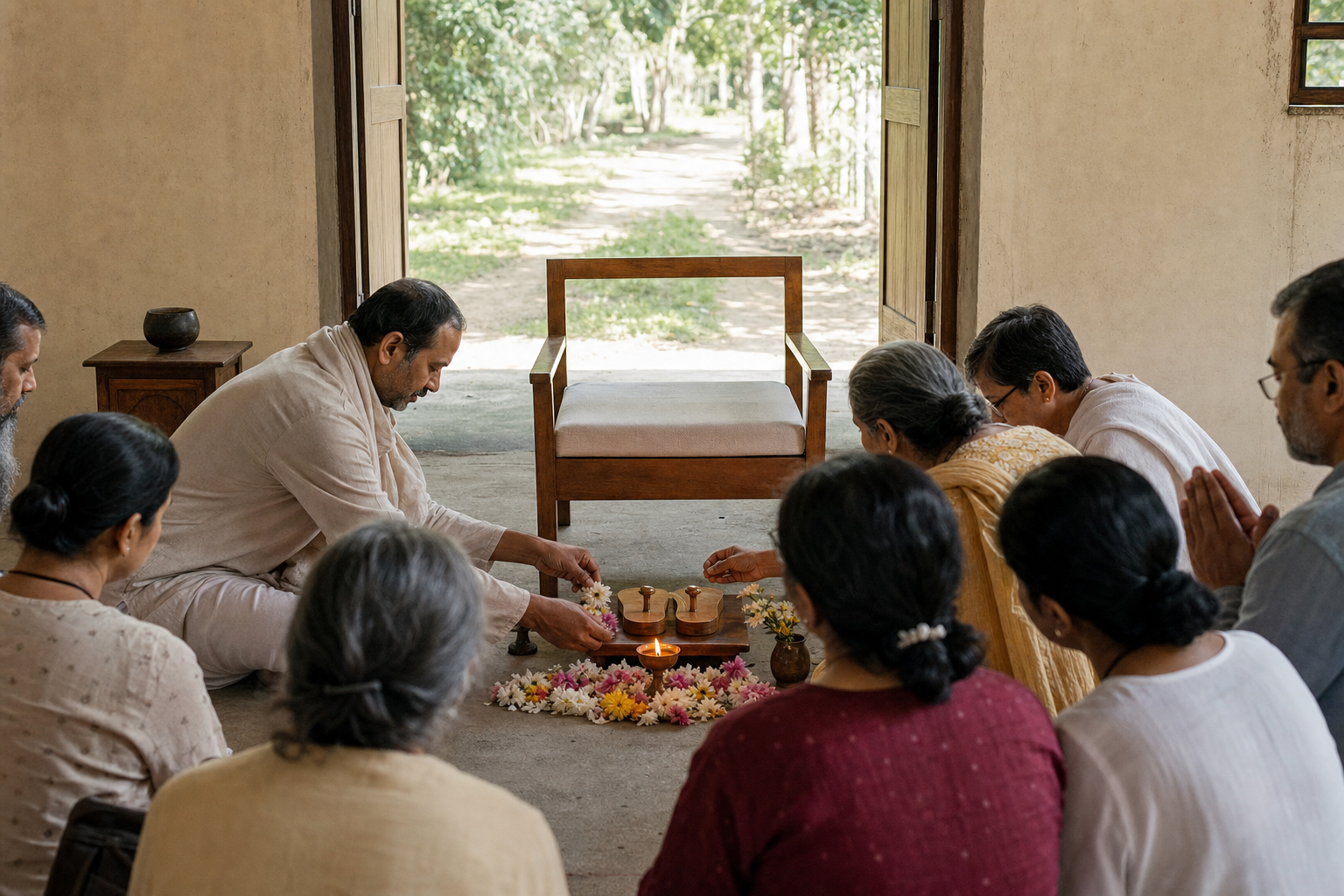
Guru reverence is meant to make you more receptive to truth and more accountable to Dharma. It is not meant to suspend conscience. The physical grammar of Paada Puja makes this visible: you lower yourself, attend carefully, and honor the feet as the foundation upon which the teacher stands and walks.
Paada Puja brings together hospitality, humility, devotion, and concrete service. Water, flowers, fragrant substances, lamps, and offerings turn gratitude into an embodied act. The point is not that one human body becomes entitled to domination. The rite trains the devotee to place ego beneath wisdom and action beneath Dharma.
The padukas are especially meaningful after physical absence. Bharata’s enthronement of Rama’s padukas expressed rule under Rama’s authority while Rama was away. In guru traditions, padukas likewise represent the path and teaching carried by the guru. That symbolism gives you a useful boundary: honoring the padukas should deepen fidelity to righteous guidance; possession of a paduka, photograph, seat, or other relic does not by itself make someone a successor.
A restrained paduka observance at home
If your sampradaya already prescribes a sequence, follow that sequence. If it does not, call what you are doing a personal observance rather than presenting it as an authorized initiation or formal rite. Simplicity is more truthful than an improvised ceremony advertised as ancient.
- Confirm the representation. Ask whether the guru’s padukas, an established symbolic pair, or another authorized representation should be used. Also ask whether the object may be washed. If water could damage it, offer flowers and light without pouring anything over it.
- Prepare a clean, quiet place. Arrange an asana or low platform, a tray, water at a comfortable temperature, a soft cloth, sandalwood paste, flowers, incense or a lamp, and naivedya. Use kumkum or other substances only where they belong to your custom.
- State the purpose plainly. Make a short sankalpa centered on gratitude, purification, and renewed discipline. Do not use the moment to announce visions, confer titles, or make promises on behalf of other devotees.
- Make the offerings with restraint. If permitted, pour a small amount of water over the padukas, dry them carefully, apply the customary anointment, offer flowers, and perform arati. Attention matters more than quantity or display.
- Complete the rite in conduct. Offer pranam. Give dakshina only where appropriate and through a legitimate channel. Then name one received practice or act of seva that you will actually maintain.
If charanamrita forms part of your lineage’s practice, receive or distribute it only in the recognized manner. Do not copy the custom from another sect simply because it appears devotional. The same rule applies to mantras, mudras, dress, and ritual ingredients: fidelity means doing what was transmitted, not assembling an attractive mixture from unrelated traditions.
Paada Puja is voluntary, contextual, and governed by consent and propriety. If a living teacher or elder does not want physical contact, you stop. If a leader treats bodily access, secrecy, money, or unconditional obedience as something owed because of a title, the ritual’s ethical direction has been reversed. You may bow deeply and still ask who authorized an instruction, how an offering will be used, or whether a demand agrees with Dharma.
A lineage survives through duties, not a throne or surname
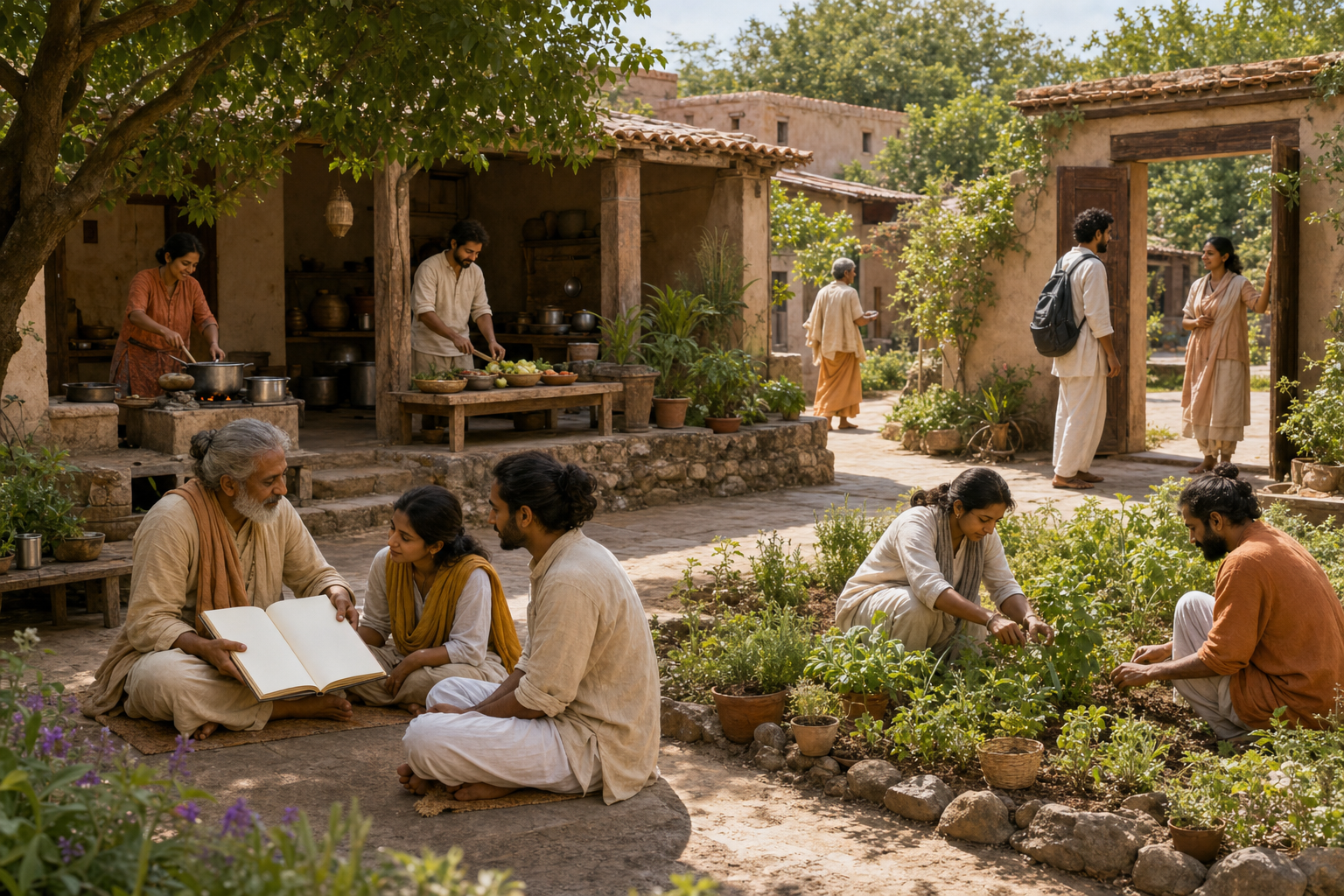
Honorifics can tell you what kind of responsibility a person has carried. They cannot settle every question of realization or succession. A Mahant is ordinarily the custodian of a math, peeth, temple, or monastic establishment, with responsibilities that can include ritual continuity, teaching, care for pilgrims, and community guidance. Yati signals renunciation. Saraswati can identify affiliation with the Dashanami Sannyasa tradition, often traced to Adi Shankaracharya.
These titles should sharpen your questions rather than end them. A Mahant’s work is not exhausted by sitting on a ceremonial seat. Daily worship must continue. Scriptures and teachings must be transmitted faithfully. Festivals, vows, satsangs, pilgrim care, and seva require attention. Sacred objects and institutional resources need stewardship. Householders and renunciants need responsible counsel. A claimed successor should therefore be evaluated by the office’s actual duties and by the lineage’s method of recognition.
Questions to ask during a succession
- What is the formal sampradaya? Ask for its full name and the authority under which the math, peeth, or temple operates. A generic appeal to “Sanatan Dharma” does not answer a specific lineage question.
- How does this lineage recognize a successor? The relevant process may involve a prior designation, a monastic council, senior disciples, institutional trustees, or another established authority. Do not assume that every lineage follows the same method.
- What office is being transferred? Spiritual instruction, ritual leadership, administration, custody of a shrine, and control of an institution are not automatically identical roles. Ask which one is under discussion.
- Is the appointment final, interim, or disputed? Use the accurate term. Do not turn a provisional arrangement into a settled spiritual fact merely by repeating it.
- Which instructions are authenticated? Distinguish teachings recorded or witnessed in a clear setting from private recollections that appeared only after the guru’s death. A sincere memory can still be incomplete.
- Who maintains the living work? Look for continuity in puja, study, japa, festivals, satsang, pilgrim care, and seva. Ceremonial visibility without these duties is not enough.
- How are offerings, archives, and sacred objects safeguarded? Reverence does not make ordinary stewardship unnecessary. A responsible institution should be able to identify the people and procedures accountable for them.
- Where can a disciple raise a concern? A living parampara needs a Dharmic way to correct error and hear disagreement without branding every question as betrayal.
If clear answers are not yet available, you can continue the japa, dhyana, study, and ethical discipline you genuinely received while withholding judgment about a new claimant. You do not have to denounce someone in order to wait. During an unclear succession, pause new vows, unusually large dakshina, transfers of property, and declarations of exclusive allegiance until the relevant authority has been established.
Also distinguish spiritual continuity from administrative completion. A disciple may be respected as a teacher without controlling a temple. A trustee may lawfully manage property without becoming a guru. A ritual custodian may maintain worship without inheriting every teaching role. Naming these distinctions early prevents devotion from being recruited into a dispute it cannot resolve.
Turn remembrance into a rule of practice
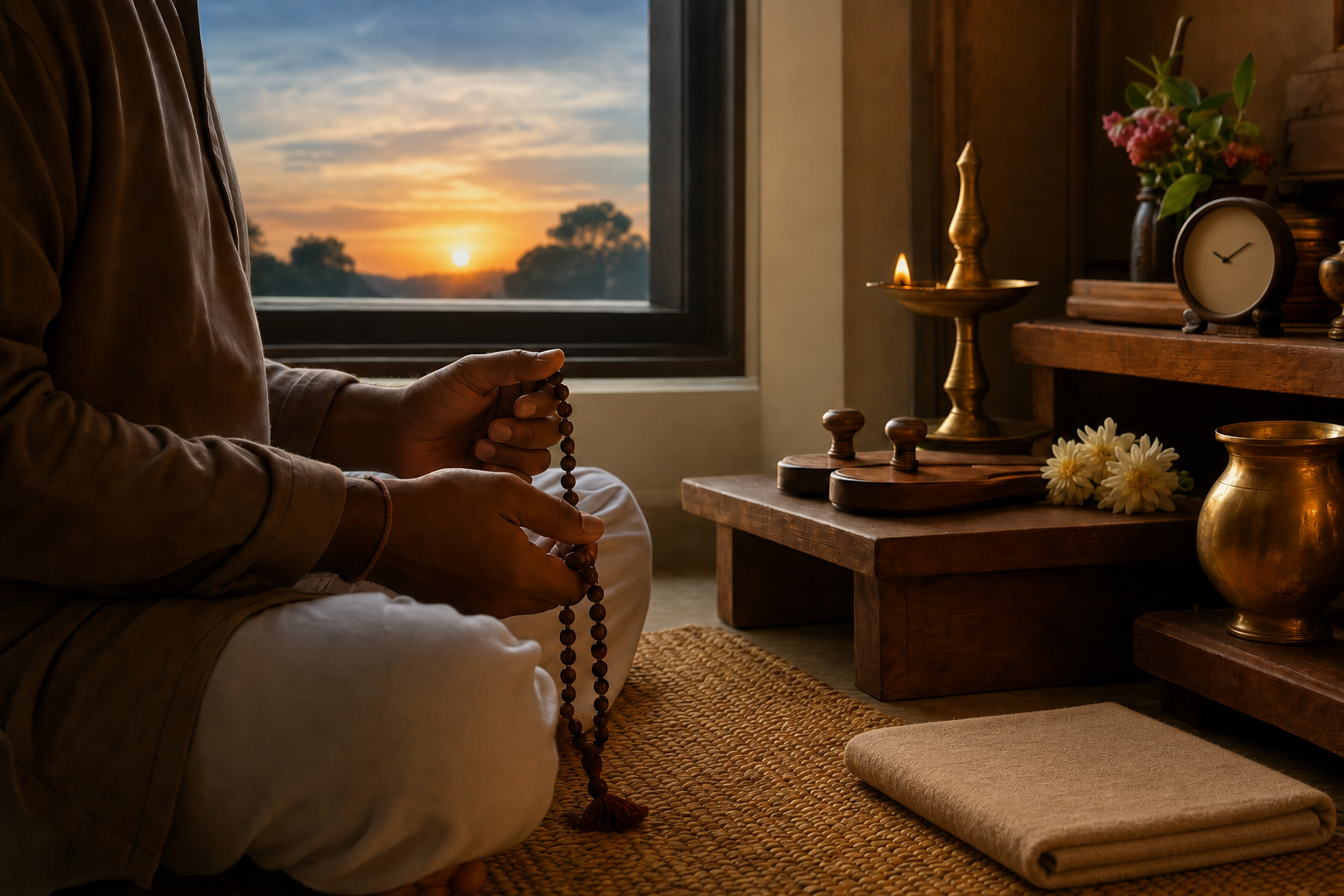
After the first intensity of mourning passes, a lineage is carried by repeatable conduct. An annual gathering can be moving, but the guru’s work is better preserved when remembrance governs the ordinary days between observances.
Key takeaways
- Keep one daily discipline intact. Continue a japa, dhyana, reading, or observance that you actually received. Preserve its form unless an authorized teacher within the lineage changes it.
- Choose one recurring act of seva. Help maintain a temple routine, assist pilgrims, support scriptural study, or meet a real community need. Choose a duty you can repeat, not a dramatic gesture that ends with the memorial event.
- Preserve teachings responsibly. Record where and when you heard an instruction and who else was present. Mark paraphrases as paraphrases. Do not turn a personal recollection into a universal command from the guru.
- Observe the annual remembrance accurately. Many sampradayas honor a saint through aradhana or punyatithi centered on recitation, meditation, worship, and seva. Confirm the calendar, liturgy, and site customs with the responsible lineage authority.
- Protect the community from rumor. During transition, repeat only what can be attributed clearly. Carry legitimate concerns through the appropriate channel, and refuse attempts to turn grief into factions.
You can test your remembrance without making claims about mystical experiences. Is your practice becoming steadier? Is your conduct more aligned with restraint, truthfulness, discipline, and compassion? Is your seva more dependable? Are you helping the community remain principled when personalities compete? If the answer is no, adding more ceremony will not repair the missing foundation.
Before the next observance, write down one authentic instruction from the guru, one daily practice you will maintain, one concrete service you will perform, and the recognized person or institution that can answer lineage questions. Confirm what needs confirmation, place the observance on your calendar, and begin quietly. Reverence becomes parampara when Dharma is carried forward in disciplined lives, including yours.
References
- Hindu Jagruti Samiti – Mahant Yati Maa Chetananand Saraswati attains samadhi
- Hindupad – Paada Puja significance and importance