
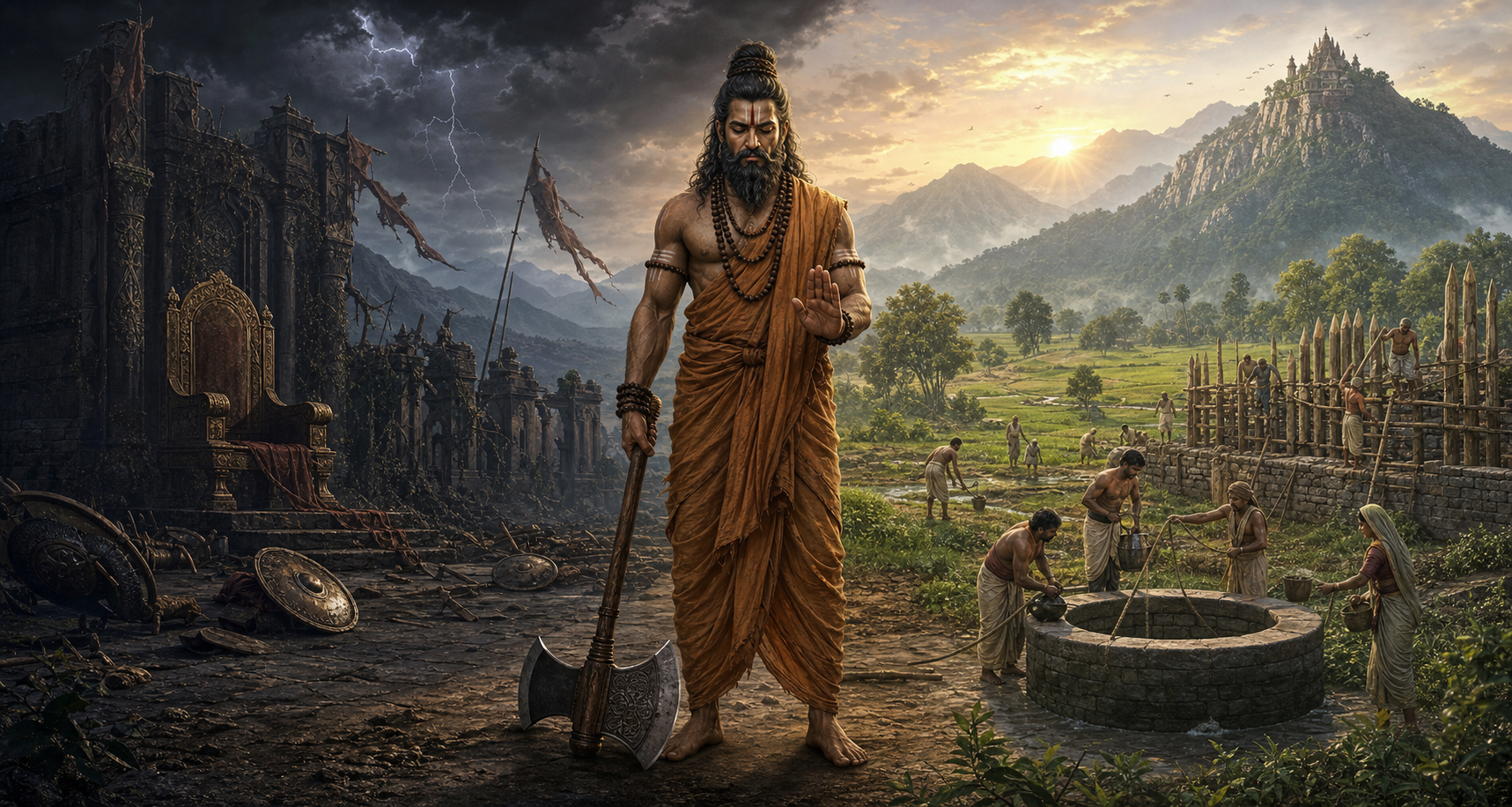
If Parashurama leaves you uneasy, that is a sound place to begin. An ascetic bearing an axe and undertaking twenty-one campaigns can look like sanctified rage when the story is separated from its central question: what must happen when the power entrusted with protection becomes predatory?
Your practical question is not whether anger can borrow the language of righteousness. It often does. The harder question is how dharma distinguishes protective strength from vengeance. Parashurama answers by placing tapas before force, restoration after victory, and renunciation where a conqueror would normally claim possession.
The failure being corrected is corrupted protection
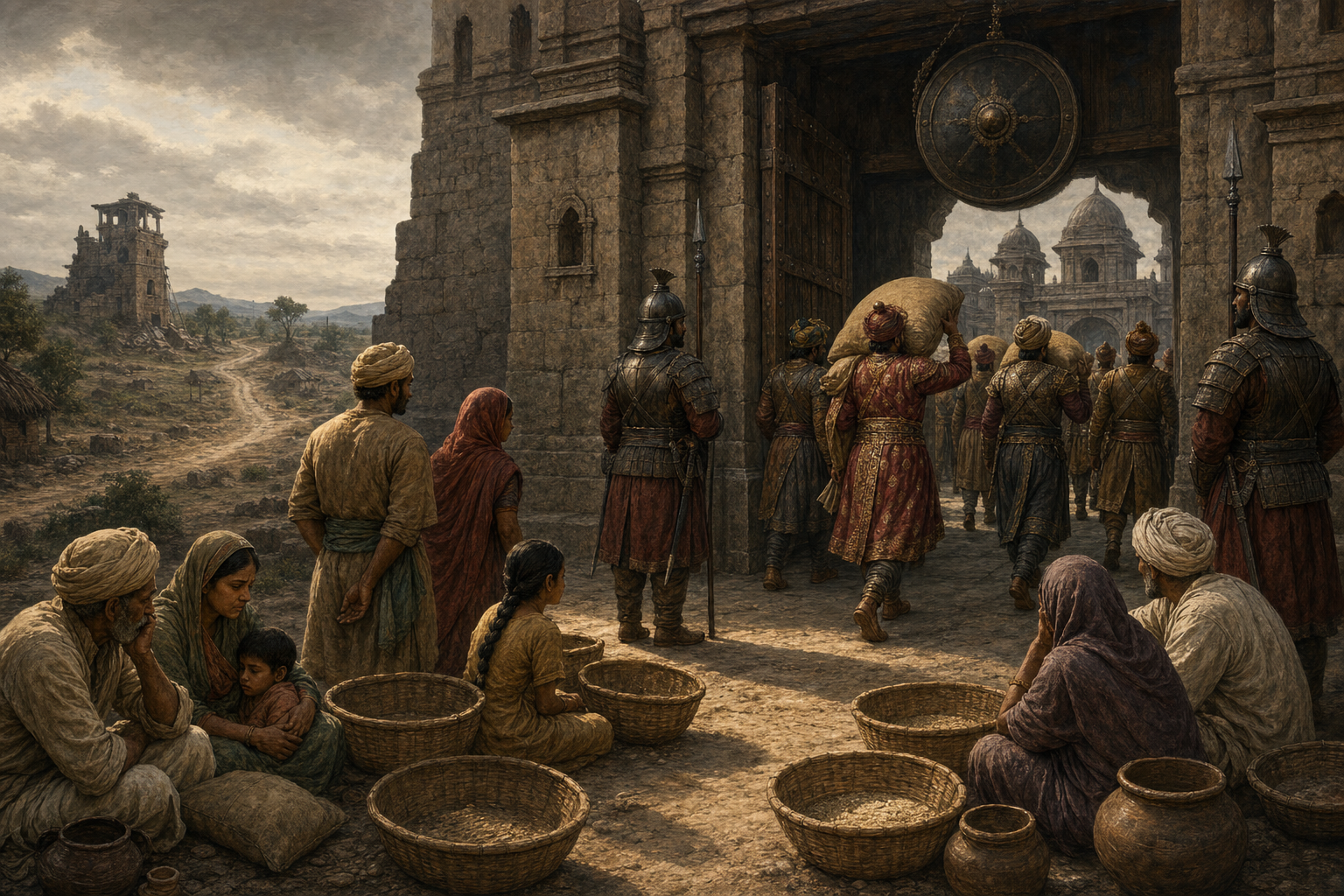
Kshatra Dharma is not a permission slip for the strongest person in the room. It is the discipline governing royal and martial power: the capacity to protect people, restrain disorder, and uphold a just boundary. Parashurama does not appear because strength itself is impure. He appears because strength has become detached from service.
That distinction is visible in his own identity. The son of Jamadagni and Renuka, formed in the Bhargava lineage, Parashurama is revered as Vishnu’s sixth avatar and as a devoted bhakta of Shiva. His martial authority does not stand outside spiritual discipline. The axe comes through tapas and Shiva’s grace; the preservative task belongs to Vishnu’s avatara. Shaiva fierceness and Vaishnava preservation meet in a single vocation.
His iconography makes the same argument without words. Matted locks and the sacred thread accompany the axe, bow, and arrows. He looks like an ascetic entrusted with weapons, not an emperor displaying trophies. The weapon is therefore not self-validating. It remains answerable to the consciousness of the person holding it.
The political crisis begins around the hermitage of Jamadagni and the Haihaya king Kartavirya Arjuna, also called Sahasrarjuna. An abuse of royal power leads to Parashurama’s slaying of the king. Jamadagni is subsequently murdered, and the son’s response expands into a vow against Kshatriya excess. A private wound is the immediate trigger, but the moral object of the campaigns is an office that has abandoned its protective purpose.
This prevents a dangerous misreading. The story cannot responsibly be turned into a warrant for caste hostility, collective punishment, or modern vigilantism. Birth does not supply the ethical diagnosis. Conduct does. Whenever you apply this teaching, begin by naming the duty that was betrayed, not the identity of the person you oppose.
Parashurama also clarifies the place of ahimsa in a world where vulnerable people can be harmed. Restraint is not the same as passivity, but neither is courage the same as aggression. Buddhist self-mastery, Jain non-possessiveness, and the Sikh saint-soldier ideal are not identical doctrines, yet each asks what discipline governs strength. If you invoke warrior dharma, you should be able to identify the restraint governing you before describing the force available to you.
The reform follows four movements, not one burst of anger
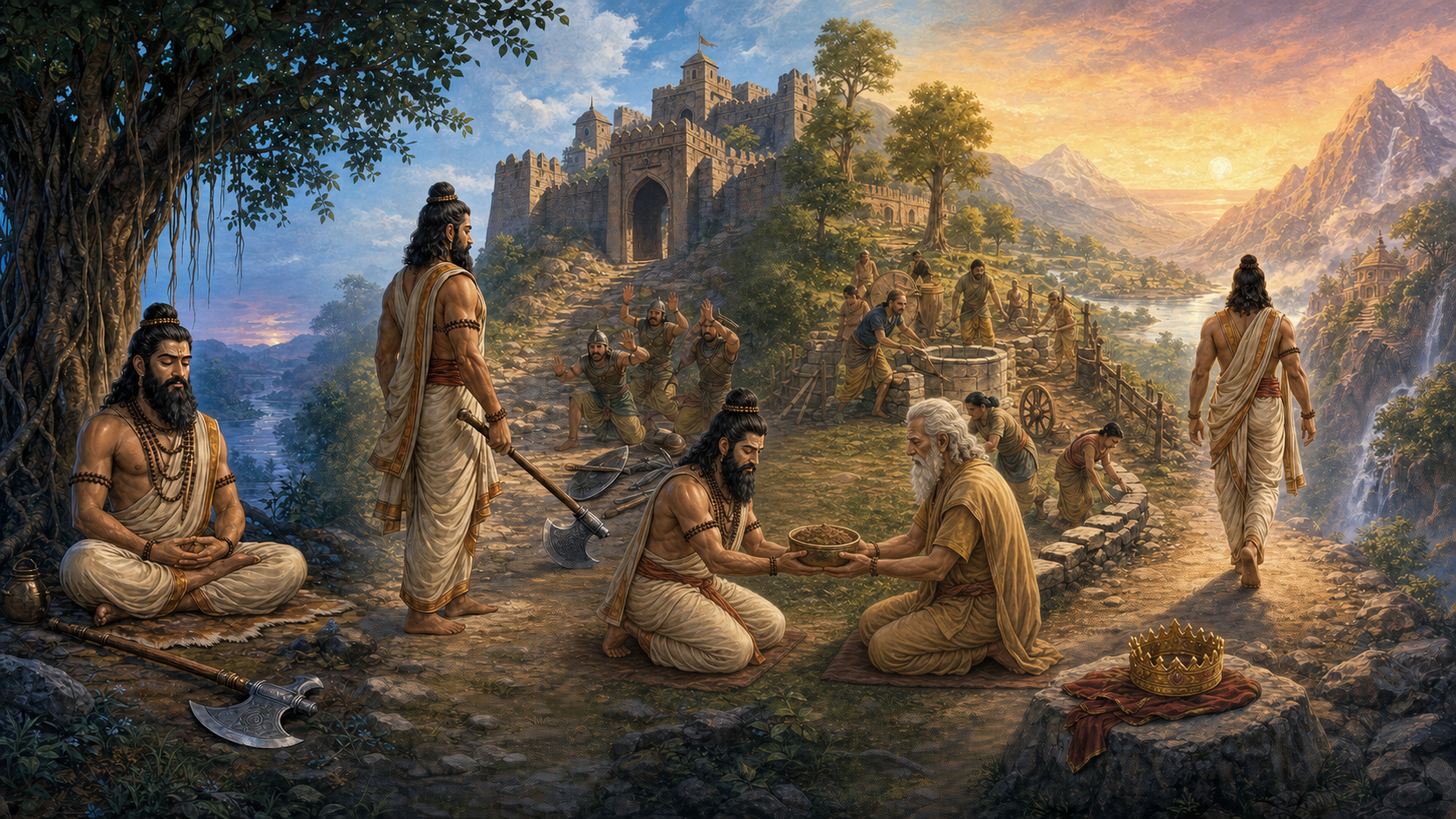
Parashurama’s mission becomes intelligible when you follow its complete movement. Stopping an offender is only one part. Reform must discipline the reformer, interrupt the abuse, repair the order, and prevent corrective authority from becoming a new possession.
- Discipline comes before coercion. Parashurama receives the parashu through tapas and devotion. His anger does not ordain itself. In a modern conflict, write down the duty, the verified violation, and the threshold for intervention before imposing a penalty. If you cannot do that calmly, seek review from someone who is not invested in your victory.
- Correction must reach the real pattern. The vow is remembered as twenty-one campaigns against Kshatriya excess. The epic scale conveys comprehensive correction rather than a momentary outburst. In your setting, do not remove one visible offender while preserving the incentives, secrecy, or unchecked discretion that made the abuse easy.
- Victory must become restitution. At Samantapanchaka in Kurukshetra, the earth is said to be ritually purified and relinquished to sages and householders. The endpoint is a restored social order, not a defeated enemy. Ask what access, security, standing, opportunity, or stewardship must be restored after the immediate harm stops.
- The reformer must relinquish exceptional power. Having completed his mandate, Parashurama withdraws to the Mahendra mountains rather than converting correction into a personal kingdom. Every extraordinary intervention needs an exit condition, a handoff, and an authority capable of reviewing the reformer.
This sequence separates reform from conquest. Punishment without restoration can leave the community frightened and damaged. Restoration without correction can invite repetition. Correction and restoration without withdrawal can install the reformer as the next unaccountable ruler.
Use that test whenever a proposed solution would increase your authority. What objective condition will end the additional power? Who receives control afterward? What personal benefit will you refuse? A campaign that leaves its champion permanently richer, less accountable, or harder to replace has failed an essential Parashurama test, even when the original grievance was real.
Rama and Karna reveal the limits of martial excellence
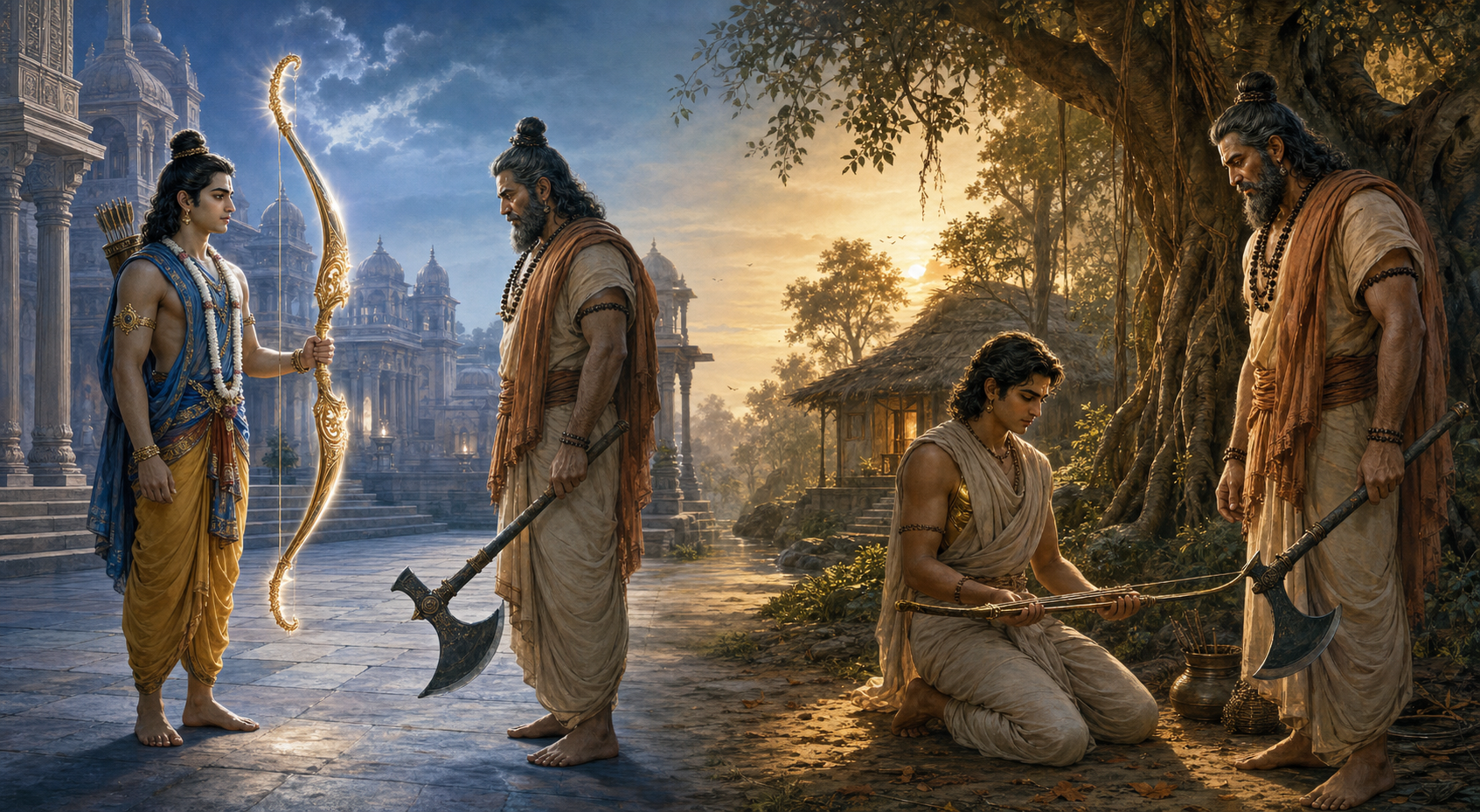
Parashurama’s reform of Kshatra Dharma does not end with corrupt kings. His encounters in the Ramayana and Mahabharata examine two quieter dangers: the veteran who cannot yield and the gifted pupil who separates skill from truth.
Sri Rama tests whether the reformer can step aside
After Sri Rama of Ayodhya breaks Shiva’s bow, Parashurama confronts him at a threshold between two expressions of dharma. The elder warrior eventually recognizes the rising mandate of maryada and withdraws. This is not weakness after a life of strength. It is mastery over the impulse to treat one’s former necessity as a permanent entitlement.
For a parent, founder, commander, teacher, or public official, succession is a moral test. Can the next responsible person exercise authority without first performing personal loyalty to you? Can you acknowledge that a method suited to one crisis may be wrong for the next stage? If every successor must remain subordinate to your identity, you have transferred tasks but not power.
Karna tests whether knowledge can survive falsehood
The Mahabharata remembers Parashurama as a teacher associated with Bhishma, Drona, and Karna. Karna receives instruction while Parashurama believes him to be a Brahmin. The resulting chain of vow and curse culminates in crucial knowledge failing Karna when he most needs it. The episode binds vidya to satya: technical brilliance cannot make the conditions under which it was acquired irrelevant.
This should not be reduced to a clever trap or a modern slogan about social identity. Its useful warning is sharper. A person who conceals a material fact from a teacher, team, institution, or public may still acquire impressive capability, but the concealed breach remains inside the relationship. It tends to surface under pressure, precisely when trust is needed to carry skill through uncertainty.
Parashurama’s continuing identity as an acharya completes the picture. Certain Purana traditions remember the Chiranjivi as a future instructor of Kalki. The durable role is mentorship, not occupation of the throne. Reform succeeds when it produces truthful and disciplined protectors who can act without the reformer’s permanent command.
- Ask whether you can recognize a rightful successor and yield without manufacturing a final rivalry.
- Disclose facts that would materially change a teacher’s, colleague’s, or institution’s decision to trust you.
- Teach the standard behind your decision, not merely the technique used to enforce it.
- Judge success by whether others can uphold the boundary after your exceptional role ends.
Use the inner parashu without mistaking anger for dharma

An avatar narrative is not a private enforcement code. You are not authorized to label another person an adharmic ruler and act outside lawful process. The inner parashu is first the power of clean discrimination: separating evidence from suspicion, protection from humiliation, and necessary firmness from the desire to make someone suffer.
Before a difficult intervention, pause long enough to answer six questions in writing. Anger may alert you to a violated boundary, but it cannot certify its own judgment.
- What duty was entrusted? Complete the sentence: The role required this, but the conduct did that. If you can describe only the person’s character, affiliation, or presumed motive, your diagnosis is incomplete.
- What is verified? Separate observed acts, dates, records, and direct testimony from interpretation. Do not turn confidence into evidence.
- Who needs protection now? Name the person, community, institution, or shared good at risk. A plan centered only on vindicating your pride is not protective action.
- What is the least coercive measure likely to stop the harm? Depending on your responsibility, this may be a clear boundary, removal of access, formal reporting, independent investigation, or a proportionate sanction. Choose the measure for its protective effect, not its dramatic appearance.
- What must be repaired? Stopping misconduct does not automatically restore safety, trust, opportunity, stewardship, or reputation. Identify the repair separately from the penalty.
- Who reviews the decision, and when does extra authority end? Name the reviewer, the exit condition, and the person or institution receiving the handoff. Do this before victory makes relinquishment inconvenient.
If there is an immediate physical threat, do not conduct an extended moral inquiry at the scene. Create distance where possible, protect those at risk, and contact the appropriate emergency services or competent authorities. Nothing in Parashurama’s sacred vocation licenses private vengeance or illegal violence.
At home, protection cannot mean domination
The difficult Renuka episode includes an unbearable command followed by Parashurama’s compassionate request for restoration. It can be approached as a drama of attachment, obedience, and healing; it must not be converted into permission for a parent, spouse, or guru to demand harmful compliance. The household application is to set a boundary that stops harm while preserving the possibility of truthful repair, not to prove supremacy through fear.
At work, correct the system as well as the offender
Describe a workplace conflict as a breach of responsibility, preserve the relevant evidence, and allow fair review. If one person misused access, remove the access necessary to stop the harm, but also examine why approval, oversight, or reporting failed. If you investigate the problem or recommend a sanction, disclose any personal benefit you could receive and hand the final decision to a disinterested authority where possible.
In civic life, demand an end point for corrective power
Support the protective function of institutions rather than granting moral immunity to personalities. A leader’s declared enemy does not prove the leader’s dharma. Ask whether action is grounded in a public duty, subject to review, directed toward restoration, and limited by a clear end point. Emergency authority that cannot explain how it will conclude is already drifting away from Parashurama’s pattern of withdrawal.
Key takeaways for reforming power
- Parashurama reforms warrior power; he does not abolish the duty to protect.
- Tapas comes before the axe because strength must be governed before it is exercised.
- The twenty-one campaigns express the thorough correction of predatory authority, not a warrant for caste hatred, collective guilt, or vigilantism.
- Samantapanchaka and the withdrawal to Mahendra show that reform requires restitution and relinquishment, not merely victory.
- The encounter with Sri Rama tests whether a powerful guardian can recognize succession and step aside.
- The instruction of Karna warns that vidya separated from truth may fail at the moment of greatest pressure.
- A modern intervention should identify the duty, evidence, protected person, measured response, necessary repair, independent review, and exit condition.
If you observe Parashurama Jayanti on Vaishakha Shukla Tritiya, often alongside Akshaya Tritiya, let vrata, recitation, and dana become an audit of power. Practise one restraint before speaking, establish one boundary you have avoided, and make one act of giving or restoration that costs you something real.
Take one live conflict and answer the six questions before your next move. If your plan cannot name the person protected, the evidence relied upon, the repair owed, the reviewer, and the point at which your control ends, it is not ready to be called dharmic. The first cut must pass through self-exemption.