
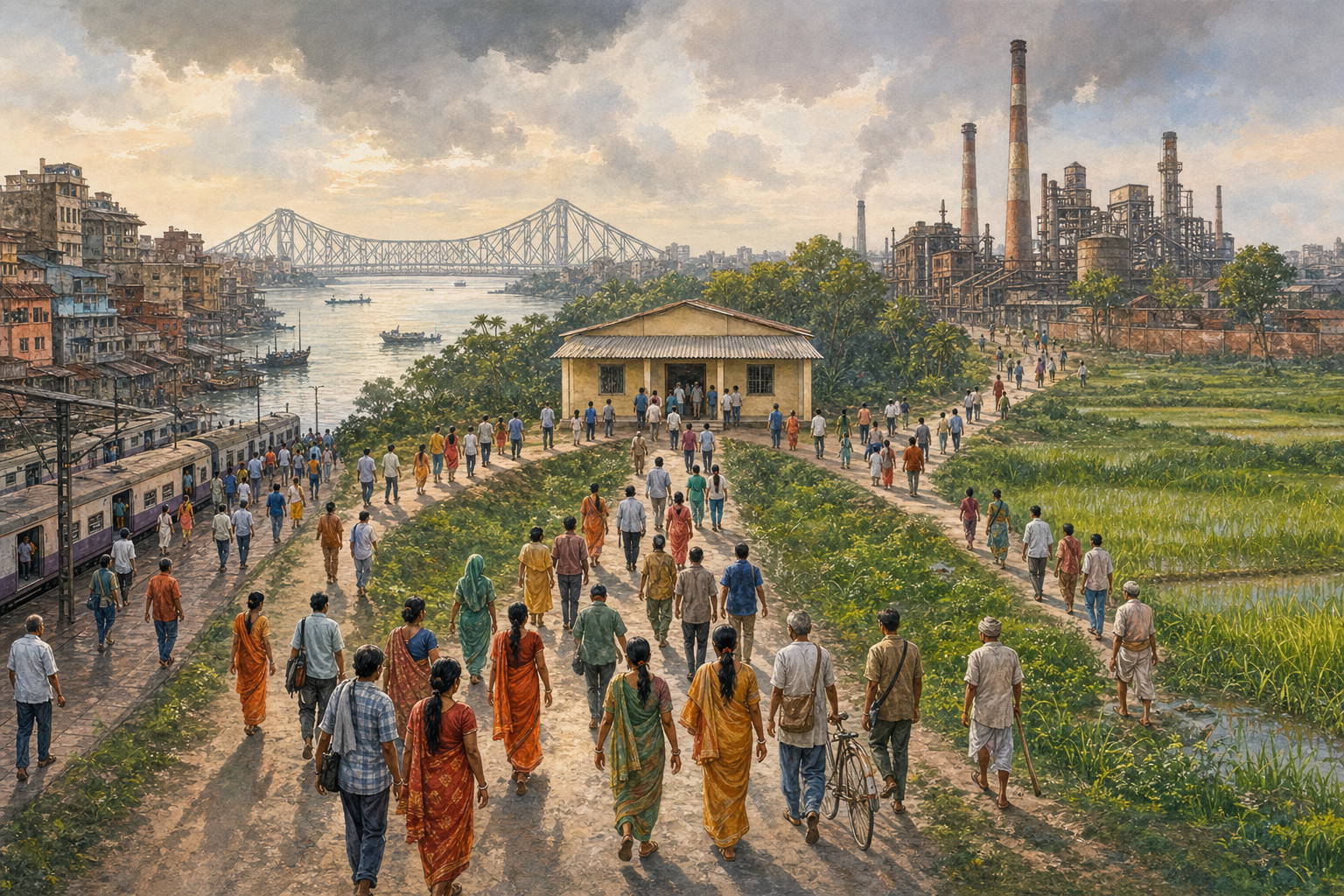
You may be trying to resolve a deceptively simple question: did West Bengal vote for Hindutva, against the Trinamool Congress, or for better government? Treating these as rival explanations obscures what happened. The BJP’s decisive 2026 victory after fifteen years of TMC rule became possible because cultural security, impartial administration and economic opportunity began to look like parts of the same choice.
That distinction matters now. A coalition can unite around dissatisfaction, yet remain together only through delivery. If you want to know whether Bengal has undergone a durable political realignment rather than a one-election transfer of power, watch four bargains made with voters: cultural dignity, public security, administrative fairness and economic mobility.
The verdict joined identity, security and delivery
Incumbency fatigue created an opening, but it does not explain the breadth of the result by itself. The TMC’s personalized leadership and welfare architecture had held in the 2021 Assembly election. By 2026, however, cumulative dissatisfaction over alleged irregularities, access to services and public safety had combined with a stronger BJP organization. Hindu consolidation supplied the coalition’s cultural center, while youth, women, first-time voters and aspirational households connected the election to jobs, safety and dependable services.
- The cultural bargain: Hindu voters could affirm civilizational confidence without being asked to abandon constitutional government or respect for other Dharmic traditions.
- The security bargain: stronger policing and border management were presented as ways to protect ordinary movement, markets, schools and public spaces, not merely as national-security abstractions.
- The fairness bargain: merit-based recruitment, impartial policing and rule-bound access to services offered an alternative to alleged local rent-seeking and political patronage.
- The opportunity bargain: salaried workers, small entrepreneurs, gig workers, traders and students were offered lower administrative friction, infrastructure and clearer routes into employment.
These bargains reinforced one another. A parent who doubts the integrity of a recruitment process sees more than a jobs problem; the family sees a state that may not reward merit. A woman who cannot move confidently through a public space encounters more than a policing problem; her education, work and independence are constrained. A trader repeatedly delayed at a municipal counter does not experience governance as an academic debate; the delay becomes a cost embedded in every transaction.
Do not make the opposite mistake and assume every BJP voter embraced every part of this program. Electoral coalitions work because different people reach the same choice by different routes. Hindu identity may have been decisive for one household, recruitment fairness for another and local security for a third. The realignment occurred when the BJP became the common vehicle for all three.
A single victory does not by itself prove that these voters have permanently changed allegiance. A durable realignment requires the public to keep associating the winning party with the issues that moved them. The 2026 mandate created that possibility. Performance will determine whether it becomes a new equilibrium.
Hindu consolidation carries a constitutional test

The strongest pro-Hindu reading of the verdict begins with a distinction between consolidation and domination. Hindu consolidation can validate cultural self-respect, institutional fairness and the right to worship without fear. It cannot validate selective policing, collective suspicion or political discrimination. If Hindu civilizational confidence is presented as the foundation of a just order, that order must be visibly just.
The winning language placed Hindu, Buddhist, Jain and Sikh traditions within a shared Dharmic and pluralist civilizational framework. The responsible inference is that this framework helped cultural identity speak in the civic vocabulary of equal law, freedom of worship and social peace. It is not proof that every Buddhist, Jain or Sikh voter moved in the same direction; that would require community-level electoral evidence not supplied by the statewide result.
You can test the constitutional substance of this Dharmic claim through concrete questions:
- Does a victim receive the same police response regardless of community or political affiliation?
- Are temples, shrines and religious gatherings protected through predictable rules rather than partisan discretion?
- When targeted violence occurs, are offenders pursued promptly and affected families rehabilitated without political conditions?
- Are citizenship and demographic-documentation procedures transparent, reviewable and humane?
- Can every eligible household obtain welfare and public services without passing through a party intermediary?
Border anxieties require the same discipline. Smuggling, trafficking and unlawful cross-border movement are legitimate security concerns. Households in border districts and urban peripheries connected them to the safety of streets, commerce and schools, helping the promise of stronger inter-agency coordination and technology-assisted policing gain political force. But effective enforcement must identify unlawful conduct through evidence and procedure. Treating an entire population as suspect would violate both constitutional order and the dignity-centered case made to voters.
The same caution applies to prominent social constituencies. Matua and Namashudra communities, along with Rajbanshi constituencies in northern Bengal, were associated with questions of dignity, documentation and access to public goods. Their prominence does not establish a uniform bloc shift. Until granular booth-level evidence is available, claims about their exact movement should remain claims, not settled arithmetic.
The middle-class shift began at ordinary counters
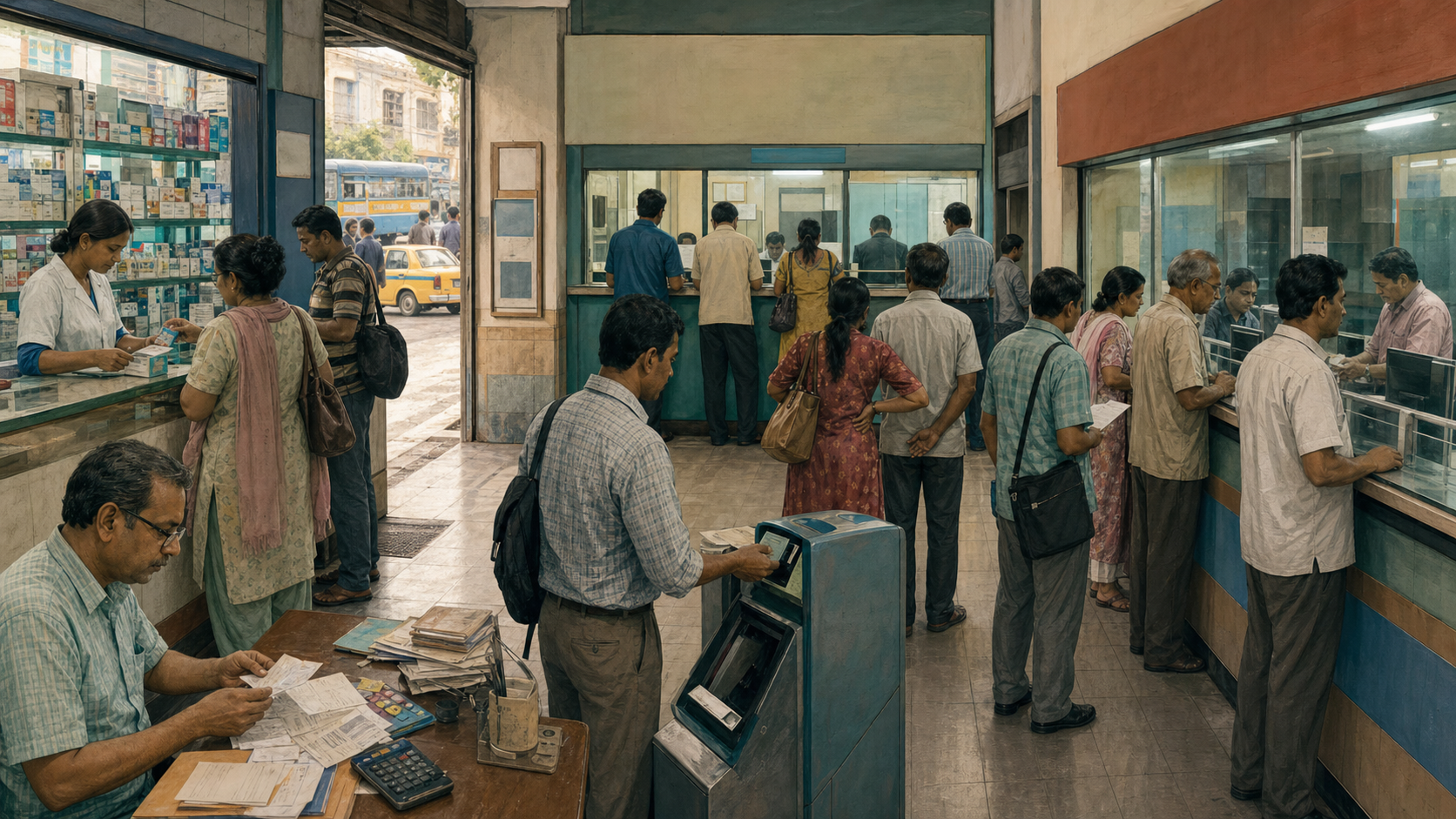
Bengal’s middle-class realignment was not driven only by large investment promises. It grew at recruitment offices, municipal counters, police stations, schools and licensing desks. Public controversy over alleged recruitment irregularities and local rent-seeking made exam integrity, transparent appointments and fair access to services household questions. Administrative probity became personal because families had invested time, savings and hope in education and competitive selection.
This helps explain why anti-incumbency and aspiration merged. Salaried professionals wanted predictable public administration. Small entrepreneurs and self-employed traders wanted permits and taxes that did not carry hidden transaction costs. Students wanted visible paths from universities and polytechnics into manufacturing, logistics and technology-enabled services. Households managing food, transport and school expenses wanted both relief from price pressure and a credible route to higher income.
Welfare therefore did not disappear from Bengal’s politics. It was recast as dignity-preserving infrastructure. Direct transfers, housing support, sanitation and clean cooking fuel could remain important while becoming more portable, auditable and resistant to political coercion. This is a crucial correction to the claim that growth-oriented voters necessarily reject welfare. The operative demand was welfare without leakage or partisan dependence, alongside opportunity that reduces long-term dependence.
The proposed economic geography was also more concrete than a generic promise of development. Port connectivity, freight-corridor linkages and upgraded industrial estates addressed larger investment. Agro-processing, cold chains and logistics offered smaller towns a connection between local production and wider markets. Handlooms, crafts, heritage and tourism gave Bengal’s cultural economy a place in the jobs program rather than treating culture as ceremonial decoration.
Organization converted these motives into votes. Booth management, page committees, neighborhood outreach, volunteer logistics and polling assistance raised contact intensity in contested areas. Candidate profiles emphasizing administrative competence, local roots, integrity, women and historically marginalized groups then gave the statewide message a constituency-level face. A popular theme without last-mile organization can remain a mood; the BJP’s ground operation helped turn mood into turnout.
Use a delivery scorecard, not campaign memory

The mandate’s implied program is concrete enough to audit. You do not need to wait for the next campaign, nor should you judge performance by announcements alone. Track the administrative output first, the household outcome second and equal treatment throughout.
| Mandate | First proof to seek | Household-level test | Warning sign |
|---|---|---|---|
| Impartial justice and public safety | Professional policing, accessible complaint registration, modern forensics, community policing and faster case handling | Can an ordinary resident report an offence and receive a predictable response without political sponsorship? | Selective enforcement, factional interference or public-safety claims unsupported by transparent records |
| Clean recruitment and administration | Published rules, merit-based selection, digital processes and time-bound grievance handling | Can an applicant understand the process, verify the result and challenge an error without finding an intermediary? | Unexplained delays, opaque changes or informal gatekeepers returning under a new banner |
| Jobs and investment | Operational industrial estates, functioning infrastructure, expanded apprenticeships and industry-linked training | Do students and workers reach actual training, placement or business opportunities near where they live? | Repeated announcements that produce neither operating activity nor identifiable employment pathways |
| Dignity-centered welfare | Portable benefits, direct transfers, auditable eligibility and clear grievance channels | Can an eligible family receive support without declaring loyalty to a party or local faction? | Middlemen, political discrimination or benefits that exist on paper but cannot be accessed |
| Lawful border management | Coordination among agencies, stronger policing capacity and focused surveillance of high-risk corridors | Are trafficking, smuggling and unlawful movement addressed while lawful residents retain due process? | Indiscriminate action, opaque documentation procedures or security language used to excuse harassment |
| Federal-state coordination | Timely clearances, infrastructure cooperation and predictable investment rules | Do stalled projects and business approvals begin moving through identifiable administrative stages? | Permanent blame-shifting with no published account of where a decision is blocked |
Turn this into a constituency ledger rather than an argument conducted from memory:
- Select the promises that touch your district. A border constituency, an industrial town and a Kolkata neighborhood should not be judged through an identical local checklist.
- Record the starting condition. Note how recruitment, complaint handling, permits, welfare access or local infrastructure functioned before the promised change. Without a baseline, every side can redefine success later.
- Separate authorization from implementation. A policy announcement or budget allocation shows intent. A staffed office, functioning system or completed facility shows output.
- Separate output from outcome. A new training program matters when eligible people can enter it and move into work. Cameras and police equipment matter when reporting and response improve.
- Check distribution. Statewide progress can conceal local exclusion. Ask whether outcomes reach remote areas, marginalized communities and people unaffiliated with the ruling party.
- Update the ledger when verifiable information appears. Preserve notifications, eligibility rules and implementation records so that later political claims can be compared with what was actually promised.
This method also protects a pro-Dharma analysis from becoming partisan apologetics. Supporting a civilizational correction does not require lowering the standard applied to the government that benefited from it. On the contrary, a mandate sought in the name of cultural dignity and constitutional order deserves a higher standard of institutional conduct.
Key takeaways
- The 2026 result is best understood as a convergence of Hindu consolidation, security concerns, anti-incumbency, administrative fairness and economic aspiration.
- Hindu identity broadened its electoral reach when expressed through equal law, civilizational confidence and respect for Dharmic plurality.
- The constitutional credibility of that appeal depends on impartial policing, humane documentation procedures and equal access to public goods.
- Middle-class realignment grew from ordinary experiences with recruitment, permits, policing, prices and services, not only from ideological messaging.
- Welfare remains part of the coalition, but voters were offered a model based on direct, auditable and politically neutral delivery.
- The shift becomes durable only if organization and narrative are followed by measurable improvements in justice, jobs, recruitment and service access.
From here, stop asking only whether Bengal experienced a wave. Keep a local record instead. Was the complaint registered? Was recruitment visibly merit-based? Did the permit become easier to obtain? Did the eligible family receive its benefit without a party broker? Did training lead toward actual work? If those answers improve across communities, the 2026 verdict can mature into a durable realignment. If they do not, it may remain a transfer of power carrying promises that outlived their delivery.