

You may have come to the Nrisimha Tapaniya Upanishad looking for a powerful mantra and a reliable way to practise it. The first khanda asks you to pause before counting repetitions. Sound, metre, meaning, divine form and conduct must work together; otherwise japa becomes either mechanical recitation or an exercise in spiritual imagination.
The practical way into this teaching is to read its cosmogony as part of the discipline itself. Creation, preservation and dissolution are not distant events. They become patterns you can hear in the arising of a mantra, its ordered duration and its return to silence. Once you see that pattern, the first khanda gives you a clear method: establish the words carefully, preserve their metrical body, contemplate Nrisimha’s protective force and judge the practice by what it does to your conduct.
Key takeaways
- Read the first khanda’s cosmogony as the setting for practice, not as a modern scientific chronology. Om grounds the movement of emergence, order and return.
- The anustubh metre has four padas of eight syllables each, giving the Sanskrit mantra a 32-syllable architecture. A translation may carry meaning, but it does not automatically preserve that metre.
- Phonetic accuracy, metrical cadence and contemplated meaning are three parts of one discipline. Do not perfect one while neglecting the other two.
- Do not assemble a practice from unrelated seed syllables, kavacas or nyasa instructions. Use the wording and ritual procedure preserved by the recension or lineage you actually follow.
- Choose a repetition count that lets you remain accurate and attentive. Increasing the count while pronunciation or awareness deteriorates defeats the method.
- Test the practice outside the seat: fear should become discernment, anger should become protective responsibility, and strength should remain governed by ahimsa.
Creation is the frame of the mantra, not background mythology

The Nrisimha Tapaniya is traditionally associated with the Atharvavedic stream and transmitted in two broad parts, the Purva Tapaniya and Uttara Tapaniya. The opening khanda of the Purva section places cosmogony and mantra instruction inside the same contemplative movement. That arrangement matters. You are not first given a theory of the universe and then handed an unrelated devotional technique. The account of reality tells you what the mantra is meant to disclose.
Om, the pranava, stands beneath the cycle expressed as srishti-sthiti-laya: emergence, ordered continuance and return. For practice, do not turn this into a dispute about physical cosmology. Ask the question the teaching places in front of consciousness: What makes manifestation possible, what holds it in intelligible order, and into what does it resolve?
You can notice the same threefold pattern during japa. A recitation arises from quiet. Its sounds remain intelligible because they unfold in a definite sequence and rhythm. The completed mantra then resolves into silence. The silence is not an embarrassing gap to be filled as quickly as possible. It completes the movement. If you rush immediately into the next repetition, you hear production but miss return.
- Before the first repetition, notice the quiet from which sound is about to arise. Do not manufacture a special experience; simply become attentive.
- During the mantra, let order govern power. Preserve every syllable and every pada rather than pushing for speed or emotional intensity.
- After the final repetition, remain still long enough to notice that the sound has ended while awareness remains.
Nrisimha gives this cosmic pattern a form that is simultaneously formidable and protective. His leonine aspect can be contemplated as the force that breaks the enclosure of ignorance and confronts adharma. His human aspect can be contemplated as discernment, ethical agency and responsibility toward other beings. These are contemplative readings, not a reason to reduce the deity to a psychological symbol. The form remains the focus of devotion while also teaching you how power should be carried.
This is why fierceness and auspiciousness are not contradictions here. Fierceness without care becomes domination. Care without the courage to confront harm becomes passivity. Nrisimha holds the two together: force is directed against adharma, while the vulnerable remain under protection. Before japa, identify the quality you actually need. It may be courage to speak truth, restraint when anger is rising, steadiness under pressure or compassion that does not surrender discernment.
The name Tapaniya reinforces this demand. Traditional explanations connect it with tempering or refining, with internalization through tapas, and with the concentrated heat that burns away ignorance. Tapas in this setting should not be confused with strain. The relevant test is refinement. If repeated practice makes your speech harsher, your judgement more self-righteous or your treatment of others less careful, more intensity is not the answer. Return to meaning and ethical purpose.
Anustubh gives sacred sound a disciplined body

The mantra foregrounded in the first khanda is set in anustubh, the familiar metre that also pervades the Mahabharata and Ramayana. Its structure is precise: four padas, each containing eight syllables, for a total of 32. Familiarity can make this metre feel effortless, but its accessibility is part of its discipline. The balanced quarters help memory, regulate cadence and give the mind a stable form to inhabit.
The 32-syllable statement applies to the Sanskrit mantra, not to an English rendering and not to the number of written letters. A translation can be indispensable for understanding artha, but you cannot count its words and claim to have reproduced the chandas. If you intend to perform metrical japa, work from a verified Sanskrit text and learn how its syllables are actually pronounced.
| Dimension | What it governs | What can go wrong | Practical correction |
|---|---|---|---|
| Shiksha | Clear production and hearing of the sounds | Vowels are shortened, consonants blur, or transliteration is guessed | Learn one verified wording, listen closely and correct pronunciation before increasing speed |
| Chandas | The four-part, 32-syllable metrical body | Pada boundaries disappear or breathing distorts the sequence | Mark all four padas and rehearse them accurately before joining the complete mantra |
| Artha | Meaning, deity and devotional intention | Repetition continues while the mind treats the sounds as an automatic device | Review the meaning before japa and carry one divine quality into conduct afterward |
These three dimensions correct one another. Meaning prevents phonetic discipline from becoming a recital performance. Phonetics prevents devotion from replacing the received mantra with whatever sounds approximately right. Metre prevents both sound and meaning from dissolving into an unstructured stream.
Breath should support this structure without becoming a contest. Sit so the spine can remain naturally upright, allow the breath to settle, and keep it smooth rather than forced. Do not sacrifice a syllable merely to finish a pada on one breath. Nor should you assume that every quarter must be tied to a particular breathing pattern unless that method has been taught within your practice tradition. The first obligation is integrity of the mantra.
The four padas have also invited contemplative correspondences with the quarters of space, stages of life, states of consciousness and phases of a cosmic cycle. Such mappings can help reflection, but they should not be presented as one compulsory secret code. If a commentary or lineage gives you a particular correspondence, follow it consistently. Otherwise, retain the simpler structural lesson: realization is not partial. All four quarters must be preserved for the metrical body to be whole.
The broader Nrisimha mantra tradition may add a bija, protective kavaca, kara-nyasa or anga-nyasa. Kara-nyasa installs the mantra on the hands; anga-nyasa extends the installation to the limbs. The point is embodiment: the practitioner is not merely saying something about divine power but aligning action, perception and the body with it. Yet exact nyasa formulas and seed-syllable arrangements are not interchangeable accessories. Later practice manuals elaborate procedures that should be learned as complete systems, not reconstructed from fragments found in different places.
If your lineage reserves a bija or nyasa for direct instruction, honour that boundary. You can still study the Upanishadic cosmogony, understand the anustubh architecture, establish a stable seat and clarify your ethical intention. Preparation is part of practice; guessing is not.
Build a daily practice around accuracy, reflection and silence
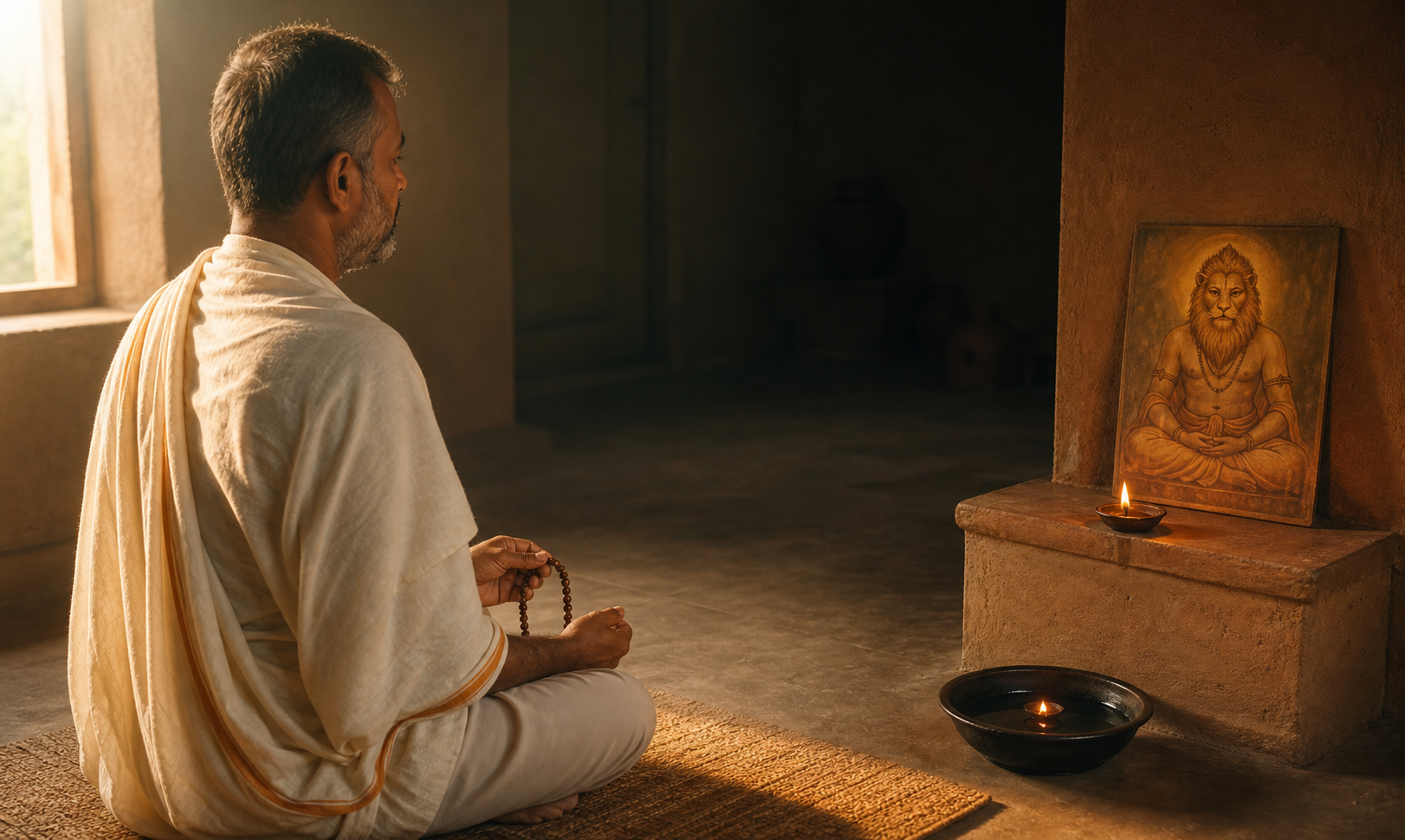
A dependable session does not require theatrical complexity. It requires an order you can repeat without negotiating with yourself each day. Scale the number of repetitions to your capacity, but keep the sequence of preparation, japa, reflection and assimilation intact.
Secure the wording before you begin counting
Minor variations occur among manuscript recensions. That makes textual consistency more important, not less. Select the version used by your teacher, lineage or trusted edition. Do not alternate among transliterations because one looks easier on a particular day. Mark the four padas visibly, note the words whose meaning you need to learn, and resolve uncertain pronunciation before making the recitation faster or quieter.
If you possess only a translation or a paraphrase, use it for study rather than pretending it supplies the missing Sanskrit mantra. You can contemplate the relationship among Om, manifestation and Nrisimha, but metrical japa begins only when the actual sound-form is available.
Use the same sequence for each session
- Prepare a clean, quiet place. Choose a stable seat that allows natural spinal alignment without unnecessary tension.
- Let the breath settle. Do not add retention, force or an elaborate breathing ratio merely to make the practice feel advanced.
- Recall the contemplative frame: sound will arise, remain in ordered form and return to silence. Bring Nrisimha to mind as radiant, all-pervading awareness whose strength protects dharma.
- Recite at the pace required for complete articulation. During learning, clarity is more valuable than fluency.
- Maintain all four padas and use a repetition count you can complete without losing pronunciation, cadence or attention. If those begin to break down, correct the execution before increasing the count.
- Listen while reciting. This is the practical beginning of shravanam: the mantra must be heard attentively, even when it is already familiar.
- After the last repetition, examine one part of its meaning. This is mananam: reflection that asks what Nrisimha’s union of power and protection demands in your present circumstances.
- Allow reflection to settle into silence. This is the movement toward nididhyasanam, in which the teaching is assimilated rather than merely discussed.
- Close with one concrete ethical resolve. It might be to tell the truth without humiliating someone, restrain retaliatory speech, protect a person being treated unjustly or perform a needed act of service.
Shravanam, mananam and nididhyasanam should not be treated as three unrelated courses. They form a single movement. You hear accurately so that you have something definite to contemplate. You contemplate so that the mantra’s worldview becomes intelligible. You enter silence so that understanding can move from an idea you possess to a disposition that shapes you.
Work with fear without feeding hostility
Nrisimha practice is often approached because fear or anger has become difficult to carry. Do not use the visualization to rehearse revenge against a person. That turns a dharmic protector into an image of private aggression. Direct the leonine force toward confusion, cowardice, cruelty and the impulse to abandon right action. Direct the human discernment toward proportion, responsibility and care for consequences.
A useful question after japa is: What would protection require here if anger were not making the decision? Sometimes the answer will be firm speech or a clear boundary. Sometimes it will be patience, withdrawal from a needless quarrel or help offered to someone exposed to harm. Fearlessness is not one outward behaviour. It is freedom to choose the dharmic response instead of obeying fear automatically.
Judge mantra power by the conduct it produces
The first khanda’s promise of fearlessness should not be confused with emotional numbness, recklessness or the thrill of feeling invulnerable. Abhaya is better tested as clarity under pressure. Fear may still arise, but it no longer has unquestioned authority over perception, speech and action.
Use the following questions as a periodic audit. They are more revealing than chasing unusual sensations during recitation.
- Accuracy: Are you becoming more careful with the mantra, or using familiarity as permission to become casual?
- Steadiness: Can you maintain the practice without repeatedly inflating the count and then abandoning it?
- Speech: Does recitation leave you better able to speak firmly without adding avoidable cruelty?
- Power: When you feel stronger, does that strength protect others, or does it demand submission and recognition?
- Discernment: Can you identify adharma without reducing every disagreement to a battle between good and evil?
- Responsibility: Does your devotional life produce a concrete act of truthfulness, generosity, restraint or service?
Truthfulness, non-harming, moderation, generosity and reverence for learning are not optional decorations around mantra. They are the ground on which mantra becomes transformative. A practice that amplifies confidence while weakening restraint has separated Nrisimha’s force from Nrisimha’s guardianship. The correction is not to discard strength but to reunite it with care.
This union also explains why the practice can resonate across the wider dharmic family without losing its Vaishnava identity. Careful sound has parallels in Buddhist esoteric recitation. The ethical discipline required of the practitioner has kinship with Jain commitments. The identity-shaping role of sacred utterance recalls the Sikh Mul Mantar. These are resonances, not claims that the traditions teach identical theology. Comparison is useful when it sharpens three shared questions: Is the sound treated with care? Is intention governed by ethics? Does inner discipline increase responsibility toward others?
Nrisimha should therefore be neither reduced to a generic energy nor used as a sectarian badge. His distinctive form presents a demanding vision of divine power: overwhelming toward adharma, protective toward beings and inseparable from luminous discernment. That is the standard your japa must gradually bring into ordinary life.
Begin with one modest commitment. Verify the Sanskrit wording you will use, mark its four padas, choose a sustainable count, and leave room for silence after the final repetition. Then carry one quality from the practice into the next difficult exchange you face. When exact sound and ethical action begin to support each other, cosmogony is no longer distant speculation. It has become a way of hearing, choosing and standing within dharma.