

You are sitting in a seminar when a sweeping claim about Hindu Dharma appears on the screen. It may concern caste, women, ritual, history, or social power. You know the claim leaves something important out, but a broad objection such as “That is offensive” is unlikely to change the syllabus.
Your strongest response is neither silence nor a demand for deference. It is a disciplined challenge: identify the exact claim, determine what kind of evidence could support it, introduce the Hindu perspectives it excludes, and ask for the same academic standards that would be applied to any other living tradition.
Ask to participate in the method, not escape scrutiny
Hindu representation becomes meaningful before anyone reaches the final panel or classroom discussion. It begins with who defines the question, chooses the categories, selects the evidence, interprets disagreement, and decides whether a correction is warranted. Inviting a Hindu speaker after all those decisions have been made may add a voice without sharing any intellectual authority.
Ask where Hindu participation exists in the actual process:
- Agenda: Were Hindu students or practitioners consulted while the question was being framed, or only after the framing had hardened?
- Evidence: Can participants inspect the passages, translations, historical records, and contemporary data on which the argument depends?
- Interpretation: Does the discussion include more than one Hindu school, community, or scholarly reading where genuine disagreement exists?
- Correction: Is there a clear way to challenge an error and receive a substantive answer after the event or class?
Lived experience has real evidentiary value, but its value must be stated precisely. A practitioner can explain how a teaching is understood, transmitted, or embodied within a community. A student can describe the effect of a classroom portrayal. Neither testimony automatically settles what a particular text meant in an earlier period or how every Hindu community behaves. Those questions may also require philology, history, sociology, or other relevant methods.
The reverse limitation matters just as much. An academic credential does not grant exclusive ownership of a living tradition’s self-description. A scholar may know a textual archive exceptionally well while misunderstanding how a concept functions in worship, family life, or a particular sampradaya. Good inquiry puts forms of knowledge into conversation and states what each can establish.
This gives you a fair principle to defend: Hindu identity should not make a claim immune to examination, and distance from Hindu life should not be treated as automatic neutrality. Everyone must show the chain from evidence to conclusion.
Build a claim file before you challenge a narrative

Most unsuccessful objections begin at the level of the whole tradition. They try to answer “Hinduism is oppressive” or “Hinduism teaches equality” in one move. Neither formulation gives a serious discussion enough information. Before responding, classify the proposition in front of you.
| Type of claim | Evidence you should request or collect | Question that tests its scope |
|---|---|---|
| Textual | The exact passage, edition or translation, surrounding context, and interpretive method | Does the conclusion depend on one translation or a selectively isolated passage? |
| Historical | A defined period and place, records from that setting, and relevant competing explanations | Is evidence from one institution or era being projected onto all Hindu history? |
| Contemporary empirical | The population studied, location, period, definitions, and method used to gather evidence | Does the evidence support a claim about the measured group or about all Hindus? |
| Ethical or philosophical | The moral premise, the interpretation being evaluated, and the standard of judgment | Is the same standard applied consistently to comparable traditions and institutions? |
| Institutional bias | Exact words or conduct, dates, context, comparators, policies, and any repeated pattern | Is this a difficult disagreement, a correctable error, or unequal treatment tied to Hindu identity? |
| Lived experience | A clear account of what happened, who was involved, and corroboration where available | What does this experience demonstrate, and what broader conclusion would require more evidence? |
Turn that classification into a short response brief. Keep it focused enough that a lecturer, department chair, or event organizer can answer it directly:
- Copy the disputed sentence accurately and record where it appeared.
- State whether it is textual, historical, empirical, ethical, or institutional.
- Identify the evidence offered for it rather than assuming what the speaker meant.
- Present the strongest relevant counterevidence or alternative interpretation, including material that complicates your preferred position.
- Request a specific remedy: clarification, a corrected citation, an additional reading, a response from another qualified perspective, or review of an institutional practice.
A useful classroom question sounds like this: “Is this a claim about this passage, this historical community, or Hindu Dharma as a whole? The evidence presented appears to establish the first. What supports the broader conclusion?” That question is difficult to dismiss because it targets inference rather than motive.
Your record also helps you decide when not to escalate. If a lecturer narrows an overstatement, supplies the missing evidence, or corrects a mistake, the academic process has worked. If the same unsupported generalization persists, your written record shows that the concern is substantive rather than a reaction to criticism.
Treat difficult subjects as tests of academic seriousness
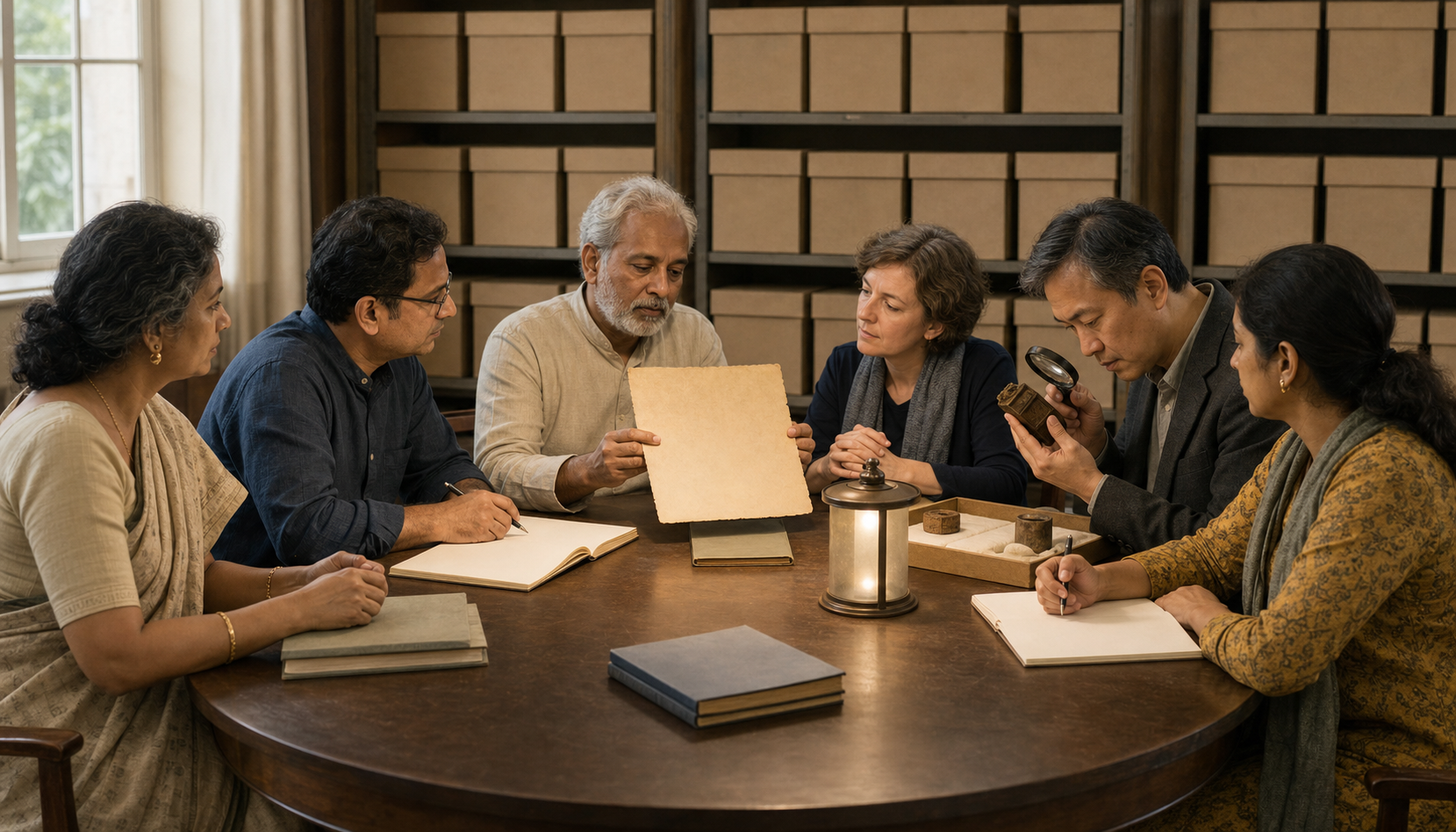
A pro-Hindu academic voice earns credibility by facing the tradition’s difficult questions directly. Caste, misogyny, exclusion, and contested customs cannot be answered by saying that Hinduism is diverse and stopping there. Diversity is the beginning of the inquiry: it tells you to identify which text, community, period, institution, or practice is actually under examination.
Read Hindu women as characters with agency and context
Sweeping accounts of Hindu women often move too quickly from a selective episode to a total theory of womanhood. A recent campus discussion tested that tendency through figures including Savitri, Urvashi, Ganga, Satyavati, Kunti, and Draupadi. The useful lesson is methodological: do not reduce a character to a label before examining her choices, constraints, speech, relationships, and consequences within the narrative.
Defending these figures with the generic claim that Hinduism reveres women creates a different kind of flattening. It bypasses the actual character and cannot answer a close textual criticism. Work at the level of a named figure and episode. Ask what she does, what alternatives the narrative makes available, who interprets her action, and whether the assigned reading has mistaken a later label for the whole character.
A stronger response template is: “The lecture described this figure as [label]. In the passage under discussion, she makes [decision or argument]. How does the proposed interpretation account for that agency, and which textual evidence supports setting it aside?” You are not declaring the criticism illegitimate. You are requiring it to interpret the complete evidence.
Distinguish resemblance, influence, adaptation, and borrowing
Claims about Bharat’s influence on Western culture need the same care. George Harrison, J.D. Salinger, M*A*S*H, and Star Wars have all been used as points of inquiry into the movement of Dharmic ideas through Western culture. Placing two works beside each other can reveal a meaningful resemblance, but resemblance alone does not prove a path of transmission or direct borrowing.
Use language that matches the strength of the evidence. “Resonates with” identifies a comparison. “Was influenced by” requires a plausible channel through which the idea travelled. “Adapted” or “borrowed” requires stronger evidence connecting the creator or work to the Dharmic material. Cultural pride becomes more persuasive, not less, when it refuses to claim more than the record can bear.
Define Hinduphobia through conduct and evidence
Hinduphobia is a consequential and disputed term. Use it carefully enough that a listener can tell what would confirm or disprove the allegation. Criticism of a doctrine, text, institution, or social practice is not automatically prejudice against Hindus. Even forceful criticism can belong in academic life when its claims are defined, evidenced, consistently judged, and open to response.
Possible evidence of bias looks different: treating inherited caricatures as uncontested facts; describing Hindu students as suspect merely because they defend their tradition; excluding adherents on the ground that proximity makes them uniquely unreliable; applying a harsher evidentiary rule to Hindu claims than to comparable claims; or allowing contempt for Hindu people to substitute for analysis of an idea.
Do not try to prove an institutional pattern from one ambiguous exchange. Record the exchange, ask for clarification, and compare it with the treatment of relevant peers or traditions. At the same time, do not let a repeated pattern be dismissed as ordinary disagreement merely because each incident can be isolated. Dates, exact wording, course materials, responses to correction, and consistent comparators turn an impression into an assessable case.
Match your response to the problem. Take an interpretive disagreement to office hours or a seminar response. Address a factual error with the lecturer and supporting material. Raise a recurring curriculum problem with the appropriate academic lead. Use the university’s designated policy channel when the concern is discriminatory conduct rather than scholarly disagreement. This sequence preserves the difference between being challenged and being treated unequally.
Build forums that continue after the auditorium empties

A public event can open academic space, but durable representation is usually built beforehand. At Rutgers on April 30, 2026, more than 75 students, scholars, educators, and community members attended a Hinduism seminar organized with student groups and the university’s Hindu Chaplaincy. The CYAN and Hindu Students Council teams had worked for more than a year to create the setting. That preparation matters more than the appearance of a single successful evening.
The coalition also shows why different participants should have different jobs. Students can identify the claims affecting campus life. Practitioners can explain lived meanings and internal vocabulary. Scholars can test textual and historical propositions. Educators can translate a concern into a workable syllabus or classroom change. Chaplaincy and community bodies can support participation without deciding the academic conclusions in advance.
Because an organizer supplied the publicly available event record, its attendance and program details illuminate the forum’s intended structure; they do not independently validate every substantive claim made from the stage. Preserve that distinction in your own work. An event proves that a discussion occurred. It does not prove every argument presented there.
Use this structure when you want to create a campus forum rather than merely register a complaint:
- Frame a narrow question. Replace “Is academia anti-Hindu?” with a question about a defined curriculum, interpretive habit, institutional practice, or field of scholarship.
- Assign complementary roles. Invite participants for the evidence they can contribute, not simply to produce an apparent balance of identities.
- Circulate an evidence packet. Include the disputed claims, relevant passages, definitions of contested terms, and competing interpretations early enough for meaningful preparation.
- Use an active moderator. The moderator should ask whether a statement is textual, historical, empirical, ethical, or personal and stop participants from sliding between categories.
- Make room for internal questions. A credible Hindu forum must allow substantive inquiry into matters such as caste, atheism, pluralism, misogyny, and menstruation, alongside external stereotypes and institutional bias.
- Create a correction path. Record disputed propositions, unanswered questions, promised materials, and the person or group responsible for the next academic step.
Avoid turning the forum into a loyalty test. Hindu participants should be free to disagree with each other. Faculty members whose work is challenged should receive the actual criticism and a meaningful chance to answer it. Questions from sceptical students should be heard when they address evidence rather than demean identity. Agreement is not the measure of success; clearer propositions and better-supported disagreement are.
Key takeaways
- Ask for Hindu participation in agenda-setting, evidence selection, interpretation, and correction, not only a speaking slot at the end.
- Classify a disputed claim before answering it. Textual, historical, empirical, ethical, and institutional claims require different evidence.
- Use lived experience to establish what it can genuinely show, without treating identity as conclusive proof or academic distance as automatic neutrality.
- Answer hard questions at the level of a named text, period, community, character, or practice. Hindu plurality should sharpen a claim’s scope, not shield it from examination.
- Reserve allegations of Hinduphobia for evidence of stereotyping, exclusion, contempt, or unequal standards; do not confuse criticism with prejudice.
- Judge a campus forum by the quality of its follow-through: corrections, additional materials, unresolved questions, and durable participation.
Start with the next sentence in a lecture or reading that troubles you. Copy it accurately, identify the kind of claim it makes, and write the narrowest question that exposes its unsupported step. Take that question to the lecturer before turning it into a general accusation. If the problem proves broader, you will already have the evidence needed to organize others and ask for a serious institutional response.