

Your government invokes dharma, promises firm rule, or celebrates civilizational confidence. How do you tell whether its conduct is actually dharmic rather than merely forceful?
Dandaniti gives you a demanding test. It asks whether public power is capable enough to protect people, disciplined enough to administer justice, and restrained enough not to become another source of fear. That makes it useful not as a slogan from the past, but as a way to examine a law, security operation, tax, welfare programme, diplomatic choice, or public institution before you support it.
Danda is justified by protection, not by the ruler’s anger

Danda is the state’s coercive authority: the power behind courts, policing, penalties, defence, and the enforcement of lawful decisions. Niti is prudent policy, disciplined method, and judgment about how that power should be used. Dandaniti therefore does not mean that punishment is the essence of government. It means that coercive power must be placed inside an ethical and institutional order.
The problem it addresses is real in every political age. When the state cannot enforce a just order, wealth, influence, private violence, and organized intimidation begin to decide who receives protection. This is matsya nyaya, the condition in which the stronger consume the weaker. Yet an undisciplined state can reproduce the same injustice under official authority. A ruler who punishes selectively, confiscates unpredictably, or treats personal preference as law behaves like the powerful fish from which the public needed protection.
Rajadharma resolves this tension by treating rule as a trust. The raja holds authority in order to protect praja, secure nyaya, preserve social order, and support prosperity. Authority is not self-validating. Its legitimacy depends on the public duty for which it is exercised.
This corrects three common mistakes:
- Weakness is not compassion. Refusing to restrain predation leaves vulnerable people at the mercy of those who already possess power.
- Severity is not strength. Spectacular punishment cannot compensate for poor evidence, selective enforcement, or an incapable administration.
- Religious language is not rajadharma. A government does not become dharmic by using sacred vocabulary. Its treatment of the weak, its procedures, and its stewardship of public resources provide the harder evidence.
When you assess a government action, begin with two questions: What concrete harm is the state preventing, and whose safety or rights will improve? If the answer is merely that the ruler must display resolve, the case for danda has not yet been made.
Dandaniti is also a tradition of political reasoning developed across the Arthasastra, Dharmasastra literature, Vidura-niti, and later manuals such as the Nitisara. It is not one frozen legal code. Its durable value lies in the relationship it establishes among duty, capacity, procedure, and restraint. Ancient penalties or monarchical arrangements should not be transplanted mechanically into a modern state; the principles must be applied through lawful institutions suited to the political order in which you actually live.
Judge the whole state, not the charisma of its leader
Political debate often concentrates on the ruler. Dandaniti requires a wider field of vision. The saptanga model treats the state as seven interdependent limbs: swamin, amatya, janapada, durga, kosa, danda, and mitra. These are not exact equivalents of modern departments. They are a diagnostic map showing that political will succeeds only when institutions, resources, territory, security, and relationships can carry it.
| Limb | What it includes | The question you should ask | A warning sign |
|---|---|---|---|
| Swamin | The ruler or directing authority | Does leadership treat office as a duty governed by law and counsel? | Personal loyalty replaces public responsibility. |
| Amatya | Ministers, advisers, and officials | Are capable people selected, supervised, and held accountable? | Decisions depend on favourites, secrecy without oversight, or unqualified appointees. |
| Janapada | People, productive territory, and settled social life | Will the policy improve security and livelihood beyond the capital or governing elite? | The population is treated mainly as a source of revenue, labour, or political spectacle. |
| Durga | Fortification and protective infrastructure | Can essential systems withstand attack, disruption, or disaster? | Visible projects receive attention while maintenance and resilience are neglected. |
| Kosa | The treasury | Is the commitment funded through stable revenue and disciplined expenditure? | Promises outrun resources, or extraction weakens the productive base. |
| Danda | Military, policing, and enforcement capacity | Is force competent, lawful, proportionate, and answerable for misconduct? | Enforcement is selective, politicized, poorly trained, or used to conceal administrative failure. |
| Mitra | Allies and dependable external relationships | Are partners reliable, reciprocal, and compatible with long-term security? | Temporary convenience is mistaken for durable alignment. |
The value of this map appears when one limb seems strong and the others are neglected. A large army without a sound treasury is not durable power. Revenue without productive janapada becomes extraction. A determined leader without trustworthy ministers receives distorted information. Fortifications without allies may leave a realm isolated, while alliances without domestic capacity make it dependent.
You can use the seven limbs to test any major promise. Mark each limb as strong, strained, or failing, and write down the public evidence for your judgment. Do not average the result into one flattering score. Identify the weakest limb that could cause the policy to fail. A border strategy may depend on logistics and allies; famine relief may depend on records, treasury, roads, and local administration; market regulation may fail because inspectors can be bribed even when the law itself is sensible.
This method changes the political question. Instead of asking whether a leader sounds decisive, ask whether the state can convert a legitimate decision into a predictable public result without arbitrary shortcuts.
Walk the response ladder before reaching for force

The four upayas provide a graduated repertoire of state action: sama, or conciliation; dana, or a concession that makes settlement possible; bheda, or division within an opposing alignment; and danda, or coercive force. The sequence expresses an important presumption: counsel, settlement, and persuasion ordinarily come before punishment.
This is not a mechanical timetable. An immediate attack may require immediate restraint. A court need not bargain indefinitely with a repeat offender, and a state need not reward aggression merely to show that it considered dana. The disciplined question is whether a less coercive tool can remove the danger without imposing an unacceptable cost on the innocent.
Use each upaya for the problem it can actually solve
- Sama: Clarify the dispute, communicate consequences, correct misinformation, and seek voluntary compliance. It is appropriate when interests can be reconciled or wrongdoing may stop once rules become clear.
- Dana: Offer a lawful concession, incentive, compensation, or face-saving path when it can secure peace without sacrificing justice. Dana becomes corruption when a private favour replaces a public rule.
- Bheda: Separate hardened wrongdoers from followers, weaken a hostile coalition, or expose conflicting interests within it. This instrument requires special caution because legitimate differentiation can slide into deceit, social fragmentation, or collective suspicion.
- Danda: Restrain, penalize, or defeat conduct that lesser measures cannot stop. Its justification rests on necessity and public protection, not vengeance.
Once danda is contemplated, the principle of danda-parimana requires proportion. The response should fit the conduct, circumstances, harm, and public danger. Certainty matters more than theatrical harshness: a predictable penalty after a fair process deters more justly than an extreme penalty applied to a convenient few.
Vyavahara, the practical administration of law, gives this restraint institutional form. A dispute requires a clear claim, a reply, defined issues, evidence, and a reasoned judgment. Documents, witnesses, and surrounding circumstances have to be tested for consistency. That sequence matters because even a morally attractive objective can produce adharma when accusation is treated as proof.
Before supporting a coercive measure, check for all of the following:
- A defined public harm rather than a vague demand for obedience.
- Authority granted to an identifiable institution, not improvised around a powerful personality.
- Evidence that can be examined and challenged.
- A meaningful opportunity for the affected person to answer, unless an immediate threat temporarily makes prior hearing impossible.
- A penalty proportionate to the actual offence and risk.
- Rules known in advance and applied consistently.
- Review, appeal, or correction when officials make an error.
- A path to restitution, rehabilitation, or social reintegration where continued exclusion is unnecessary.
The last point is easy to miss. Nigraha means restraining wrongdoing, but legitimate order also seeks prasada, public confidence. A system that can punish but cannot correct its own errors eventually teaches citizens to fear authority rather than trust justice. Prayaschitta adds a complementary idea: correction should leave room for moral repair when repair is possible.
This is why copying an ancient schedule of fines or bodily penalties would miss the deeper lesson. The useful inheritance is not the literal penalty. It is the insistence that coercion be justified, measured, procedurally grounded, and directed toward restored order.
Administrative competence is part of rajadharma

A state can profess noble ends and still harm people through incompetence. Dandaniti treats capacity as an ethical concern because badly maintained records, corrupt revenue collection, unreliable measures, and neglected infrastructure transfer costs to ordinary people. Good intention does not irrigate a field, reconcile an account, or deliver relief to a village cut off by disaster.
Royal capacity can be examined through three forms of shakti. Mantra-shakti is the power of counsel and informed deliberation. Prabhava-shakti is the power of resources, influence, and material position. Utsaha-shakti is initiative and determined action. Each becomes dangerous or futile without the others. Initiative without counsel becomes impulsiveness. Resources without initiative decay unused or are captured. Counsel without resources produces plans that cannot protect anyone.
Counsel must be informed, confidential, and accountable
Mantra is more than receiving agreement from advisers. It requires competent ministers, specialized knowledge, iterative deliberation, and information that has been checked. Confidentiality can protect a genuine decision process, especially in security and diplomacy. It cannot excuse missing records, undisclosed conflicts, or immunity from later review.
The administrative tradition surrounding dandaniti paid close attention to the ordinary mechanisms of integrity: selecting officials carefully, testing their conduct, rotating duties where capture was a danger, conducting surprise inspections, keeping parallel records, and cross-verifying accounts. The same machinery also had to distinguish corruption from a false accusation against an honest official. Accountability fails if nobody is investigated, but it also fails if accusation itself becomes a weapon.
When you hear an anti-corruption promise, look past the arrests. Ask whether revenue and expenditure records can be reconciled, whether inspectors are independent of the activity they inspect, whether duties are divided so that one person cannot authorize and conceal the same transaction, and whether findings lead to reasoned decisions. These institutional details reveal more than the number of dramatic cases announced.
A treasury is held for security and public welfare
Kosa is not simply money accumulated by the state. It connects taxation, expenditure, resilience, and productive life. Stable and predictable assessments allow households, cultivators, traders, and guilds to plan. Excessive extraction weakens the base on which future revenue depends; inadequate revenue leaves the state unable to maintain justice, defence, infrastructure, or disaster relief.
This produces a practical fiscal test. A dharmic tax should have a public purpose, a comprehensible basis, and a burden that does not cripple the activity being taxed. Expenditure should be traceable to capacities the population genuinely needs: irrigation, roads, protective works, granaries, market integrity, and relief during famine, flood, or fire. Oversight of weights and measures also belongs here. Market fraud is not outside justice merely because no sword is drawn; false measures allow the strong to take from the weak through information and position.
Do not judge a budget only by how much it spends or how little it taxes. Ask whether revenue is predictable, whether expenditure strengthens long-term resilience, whether maintenance has been funded, and whether benefits reach the janapada rather than remaining concentrated around the centre of power.
Local authority needs both room and limits
Village bodies and occupational guilds could handle boundary questions, water sharing, communal works, quality rules, apprenticeships, and local disputes. This reduced the burden on royal institutions and allowed decisions to use knowledge held by the affected community. Records and consent mattered, while higher authority remained available when local resolution failed.
The transferable rule is to place a function at the closest level competent to perform it. A distant authority should not micromanage a water arrangement that villagers can administer fairly. But local custom is not beyond dharma. When a practice injures public welfare, entrenches predation, or denies meaningful justice to a vulnerable party, higher oversight becomes necessary.
For any decentralization proposal, ask two questions together: Does the local body have the information, resources, and legitimacy to decide? What remedy remains for a person whom that body treats unfairly? Autonomy without capacity creates neglect; autonomy without appeal can protect local dominance rather than local freedom.
Use a dharmic scorecard before endorsing a policy
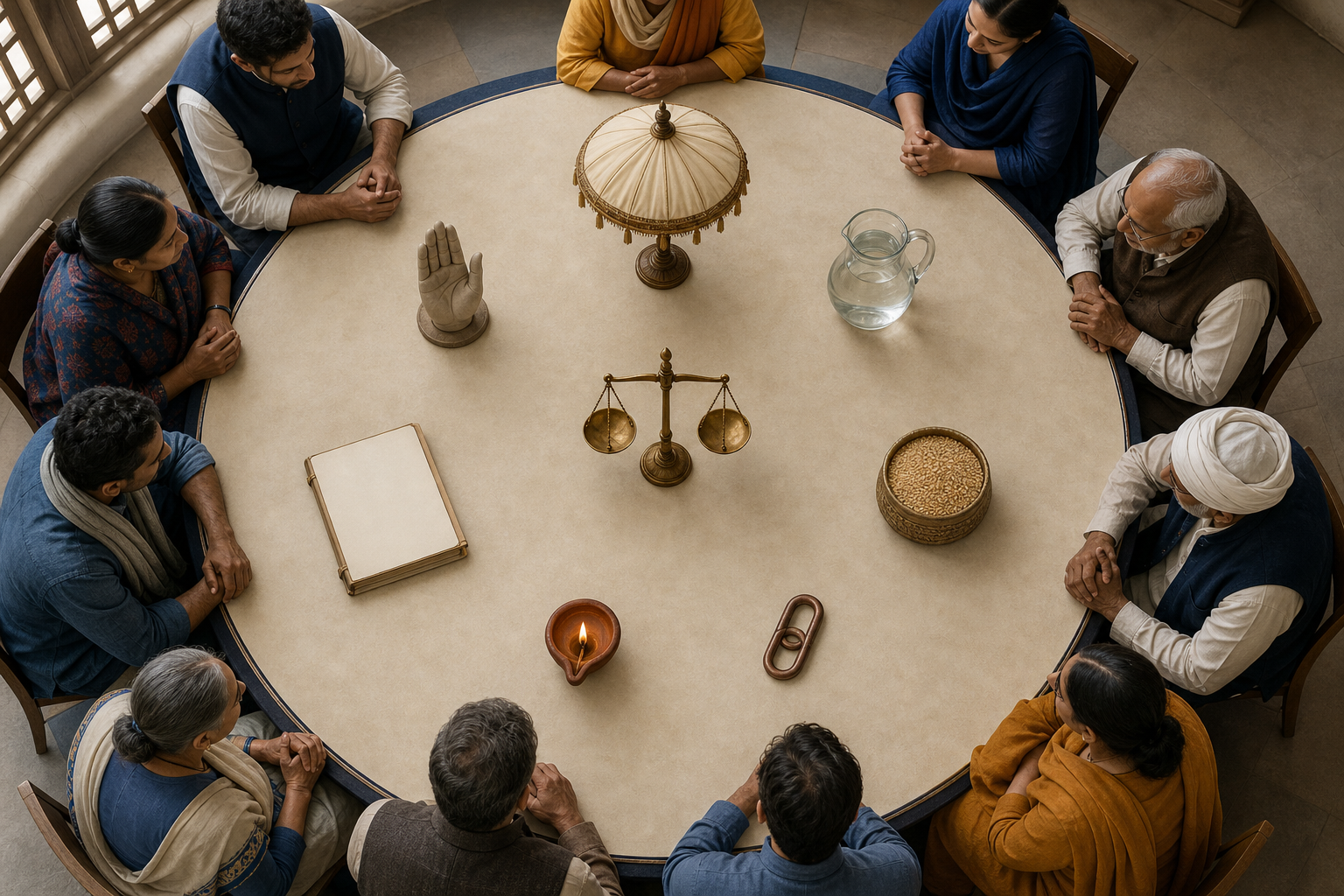
Dandaniti belongs to a Hindu vocabulary of statecraft, but its central restraint resonates across dharmic traditions without making those traditions interchangeable. Buddhist kingship places moral education, welfare, patience, and persuasion before punishment. Jain ahimsa intensifies the demand for minimal necessary harm, while anekantavada reminds a judge that one account may not exhaust the truth. Sikh Miri-Piri and the sant-sipahi ideal join spiritual discipline to the duty to protect the innocent, permitting force under necessity while binding it to justice.
These emphases give you complementary stress tests. Ask whether authority is capable and lawful; whether persuasion and welfare could remove the cause of disorder; whether competing accounts have been heard with humility; and whether force genuinely protects the innocent rather than the reputation of power. The shared horizon is disciplined authority in the service of compassion, truth, restraint, and justice, not the erasure of real doctrinal differences.
Key takeaways
- Name the protected good. Identify the life, liberty, property, livelihood, public trust, or social peace that the policy is meant to secure.
- Identify the lawful custodian. Determine which institution has authority, what limits bind it, and who can review its conduct.
- Demand a factual process. Look for a clear allegation, a reply, tested evidence, and a reasoned decision rather than punishment by public mood.
- Test the upayas. Ask whether sama, a legitimate form of dana, or careful separation through bheda could remove the danger before danda is used. Treat an immediate threat as an explicit exception, not a permanent excuse.
- Apply danda-parimana. The coercive response should be necessary, predictable, and proportionate to the conduct and danger.
- Inspect all seven limbs. Leadership, officials, people and territory, infrastructure, treasury, enforcement, and allies must support the policy as a functioning whole.
- Follow the money and records. A noble announcement without funding, maintenance, accurate accounts, and integrity controls is not capable governance.
- Preserve correction and repair. Leave room for appeal, restitution, rehabilitation, and the correction of official error wherever public safety permits.
Choose one public decision you are being asked to support and answer those eight tests in writing. Where you cannot find evidence, do not fill the gap with partisan trust or civilizational sentiment. Ask for the missing authority, procedure, funding, safeguard, or measure of necessity.
A dharmic state is not the one that speaks most often about dharma. It is the one whose power is capable enough to stop predation, ordered enough to deliver public goods, and bounded enough not to become a predator itself. That is the standard worth carrying into your next judgment about governance.