

When your mind is crowded, silence can feel less like peace and more like an empty room in which every worry becomes louder. Sound gives you another way in: one steady sensation to follow while your breathing settles and your thoughts lose some of their grip.
The practical goal is not to manufacture a blank mind. It is to become better at returning after agitation, interruption, or emotional strain. You can begin that training at home in 10-15 minutes, without buying a gong, bowl, or subscription.
A resilient mind returns; it does not remain undisturbed
Mental resilience is sometimes mistaken for permanent calm. That standard turns an ordinary stress response into a personal failure. A more workable test is whether you can notice activation, reduce unnecessary resistance, and recover enough clarity to choose your next action.
Sound can support that return in three connected ways:
- It gives attention a low-demand anchor. A sustained tone, soft hum, or measured recitation is easier to follow than a complicated instruction. When attention wanders into a thought loop, the sound remains available.
- It works naturally with the exhale. Humming and chanting extend vocalized exhalation without requiring you to hold the breath. Laryngeal and pharyngeal vibration may also support vagal activity and a shift toward parasympathetic regulation.
- It brings awareness back into the body. Feeling vibration in the face, throat, chest, or abdomen can interrupt purely verbal rumination. You are no longer dealing only with a story in the mind; you are noticing what the body is doing now.
The evidence base is promising but not conclusive. Clinical and observational findings associate sound baths and related contemplative practices with lower perceived stress and anxiety, pain relief, and better sleep, but larger randomized trials are still needed. Treat sound as a supportive practice whose value you assess in your own routine, not as a proven cure.
Rich overtones and slow changes in amplitude may encourage relaxed patterns of attention associated with alpha rhythms at 8-12 Hz and theta rhythms at 4-7 Hz. That is a proposed mechanism, not a promise that a particular instrument will force the brain into a special state. A bowl’s marketing claim matters less than whether the sound feels tolerable, holds your attention gently, and leaves you more functional afterward.
A 10-15 minute sound practice you can repeat at home
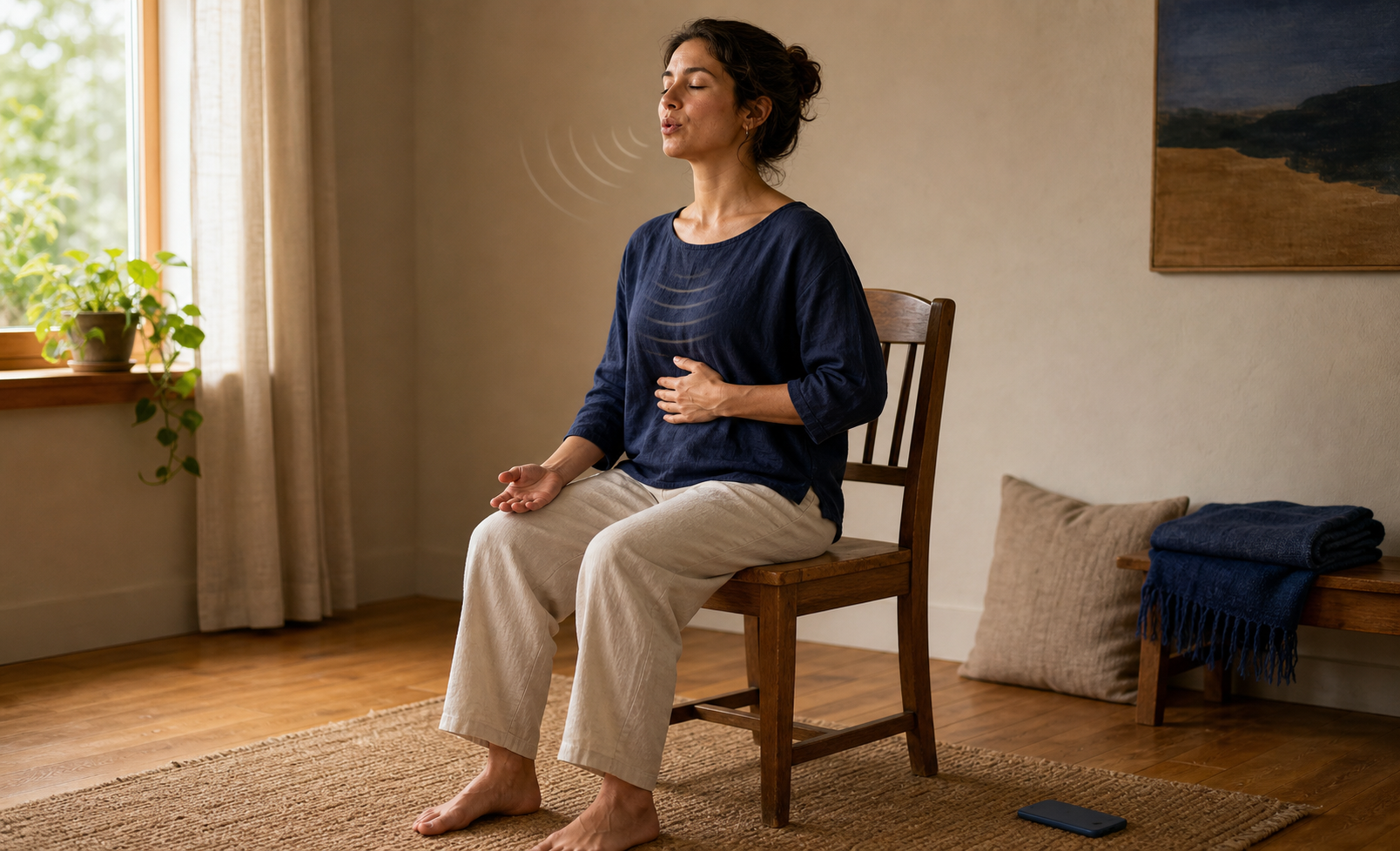
Consistency is more useful than intensity. Use the following sequence on most days if it suits you. Keep the first sessions modest enough that you can notice your response instead of trying to produce a dramatic experience.
- Name one gentle intention. Choose something observable, such as “listen without judgment” or “let the body settle.” Avoid demanding that the session eliminate every thought or difficult emotion.
- Arrange the body for ease. Sit or recline with support under the head, neck, or knees as needed. The posture should reduce avoidable effort without making you feel trapped or excessively drowsy.
- Lengthen the exhale without strain. Inhale naturally. If counting helps, try four counts in and six counts out. Four in and eight out is another option only when it remains comfortable. Return to ordinary breathing if counting creates air hunger, tension, or urgency.
- Introduce one sound. Hum softly, recite a familiar mantra, play a bowl slowly with generous pauses, or attend to a steady environmental sound such as a quiet fan. Use most of the session for listening rather than continually changing sounds.
- Include the whole soundscape. Let the chosen sound remain your anchor, but do not fight traffic, footsteps, a closing door, or another ordinary noise. Notice each sound and then return. The return is the exercise.
- Close before interpreting. Let the sound stop and remain in silence for one to three minutes. Notice breath, muscle tone, mood, and mental pace. Stretch gently, drink water, and avoid rushing immediately into conversation or a stream of notifications.
A brief written note can help turn a pleasant state into practical learning. You do not need a detailed spiritual diary. Answer one or two questions:
- What changed in my breathing, muscle tension, or mood?
- Which sound helped, and which sound demanded too much attention?
- What thought became less gripping without being argued away?
- Which quality is present now: release, peace, spaciousness, ease, clarity, calmness, or gratitude?
- What is one small action that would express that quality today?
The last question matters. Resilience is not proved by how serene you feel while lying down. It becomes visible in the next conversation, decision, boundary, or act of care.
Choose a sound that fits both your nervous system and your tradition
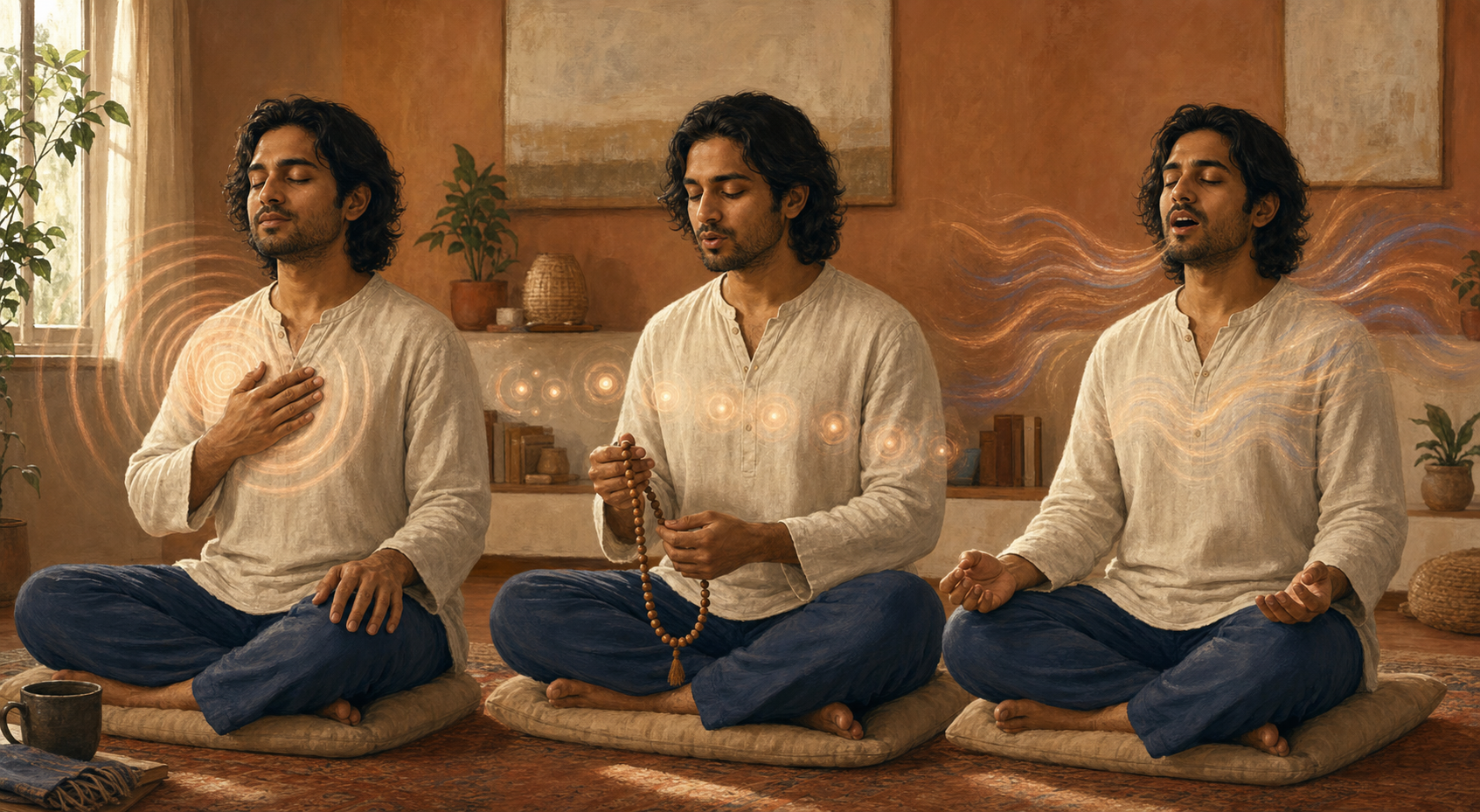
There is no universally superior sound. Your best starting point depends on whether you need a bodily anchor, a meaningful verbal focus, or a spacious field of listening. Sacred practices also carry contexts that should not be flattened into interchangeable relaxation techniques.
Use humming when thoughts are too busy for words
On each comfortable exhale, make a quiet, even hum. Feel the vibration rather than judging the musical quality. If bhramari, or bee breath, is already part of your yoga practice, use its familiar form gently. The point is not maximum volume or the longest possible exhale. It is the joining of breath, vibration, and attention.
Humming is especially practical when a new mantra would create more mental work. It requires no instrument, carries through minor background noise, and gives you an immediate bodily sensation to follow.
Use mantra or sacred song when meaning helps you return
Choose a mantra, chant, or sacred composition you already understand and can approach respectfully. Let pronunciation, rhythm, meaning, and remembrance work together. If you belong to a living practice community, its established method is a better starting point than collecting unfamiliar sacred syllables solely for their supposed acoustic effects.
Dharmic traditions use sound in distinct ways. Nada yoga within Hindu traditions cultivates attentive immersion in sound as a path toward stillness. Buddhist chanting and singing bowls can support mindfulness and compassion. Measured mantra recitation within Jain samayik helps stabilize attention alongside ethical reflection. Sikh shabad kirtan places sacred sound within remembrance, or simran, and alignment with the Guru’s wisdom. Their shared attention to sound, breath, and mind does not erase their different teachings or purposes.
If you do not know the context of a sacred form, begin with a neutral hum or ambient sound. That gives you the regulatory practice without pretending that every chant is merely a wellness tool.
Use bowls, chimes, or ambient sound when you need spacious listening
A singing bowl or chime works best here when played slowly. Strike or circle it once, listen through the decay, and allow a pause before repeating. Filling every second with sound can turn a receptive practice into another source of stimulation.
You can also use a recording or an ordinary steady sound. Keep the volume low enough that you do not brace against it. Notice whether the sound softens your breathing and muscles or makes you vigilant. Your body’s response is more useful than the price, size, material, or mystical description of the instrument.
Let interruptions train recovery, then check whether it helps

An interruption does not ruin the session. It reveals the exact skill you are trying to build. The useful inner instruction is “No judgment – just new sounds.” That does not mean every noise must be pleasant. It means you can hear dissonance before adding a story about why it should not be happening.
When an unexpected sound appears, rehearse this sequence:
- Hear the raw event. Notice qualities such as near or far, brief or sustained, soft or sharp.
- Locate the reaction. Check whether the jaw, shoulders, chest, or abdomen tightened.
- Drop the extra argument. You do not need to decide that the noise is welcome. Set aside the claim that calm is now impossible.
- Return gently. Come back to the hum, mantra, bowl, breath, or wider field of sound.
This same movement applies outside formal practice. A difficult email, a child’s interruption, or a painful memory may still affect you. Resilience lies in noticing the activation without letting the first reaction write the entire next chapter.
Track recovery rather than chasing an impressive experience
Before each session, record one relevant measure in a consistent way: perceived stress, pain, or the quality of the previous night’s sleep. Record the same measure afterward, along with one bodily observation. Over several weeks, look for patterns rather than treating one unusually peaceful or restless session as a verdict.
If you already use a wearable, heart rate variability can serve as an optional proxy for changes in parasympathetic tone. It is not required, and a single reading should not outrank your actual functioning. The more important questions are whether you recover from agitation more readily, sleep more steadily, and approach demanding moments with greater choice.
A realistic cadence is 10-15 minutes on most days, with a longer session once a week if that remains supportive. If you repeatedly feel worse afterward, do not assume that discomfort proves the practice is working. Adjust the sound, volume, posture, duration, or method.
Use sound within clear safety limits
Sound is not automatically gentle merely because it appears in a contemplative setting. Use these safeguards at the point of practice:
- If you have hearing sensitivity, tinnitus, migraine susceptibility, or sensory-processing differences, begin at a lower volume with softer timbres. Stop if the sound aggravates your symptoms.
- If closing your eyes or reclining makes you feel unsafe, keep your eyes open and remain seated. In a facilitated session, choose someone who explains what will happen, seeks consent, and lets you change position or leave.
- Forcefully played gongs and other intense low-frequency instruments can be overwhelming. If you are in late-stage pregnancy or have a cardiac condition, seek guidance from an appropriate clinician before joining a high-intensity session.
- If the practice increases fear, dissociation, or persistent distress, stop and seek appropriate mental-health support rather than escalating the intensity.
Sound-based practice can complement self-care, medical care, or psychological treatment. It should not replace professional assessment or treatment for ongoing anxiety, sleep disturbance, pain, trauma symptoms, or another health concern.
Key takeaways
- The goal is not a thought-free state. Train the ability to notice activation and return.
- Begin with 10-15 minutes, use one sound, and reserve one to three minutes of silence at the end.
- Humming provides a bodily anchor; a familiar mantra adds meaning; bowls, chimes, and ambient sounds support spacious listening.
- Treat ordinary noises as part of the field. Notice the sound, check the body’s reaction, release the argument, and return.
- Judge the practice by patterns in stress, sleep, pain, and everyday functioning over time, not by one dramatic session.
- Lower the volume or stop when sound increases symptoms. Sound practice is supportive care, not a substitute for medical or psychological treatment.
For your next session, choose the simplest sound available and one quality you want to carry into the rest of the day. Practice the return for 10-15 minutes, sit quietly afterward, and let your next action show you whether the practice was useful.
References
- Tiny Buddha – Quieting an Overwhelmed Mind: Science of Sound Baths and Dharmic Wisdom for Resilience