
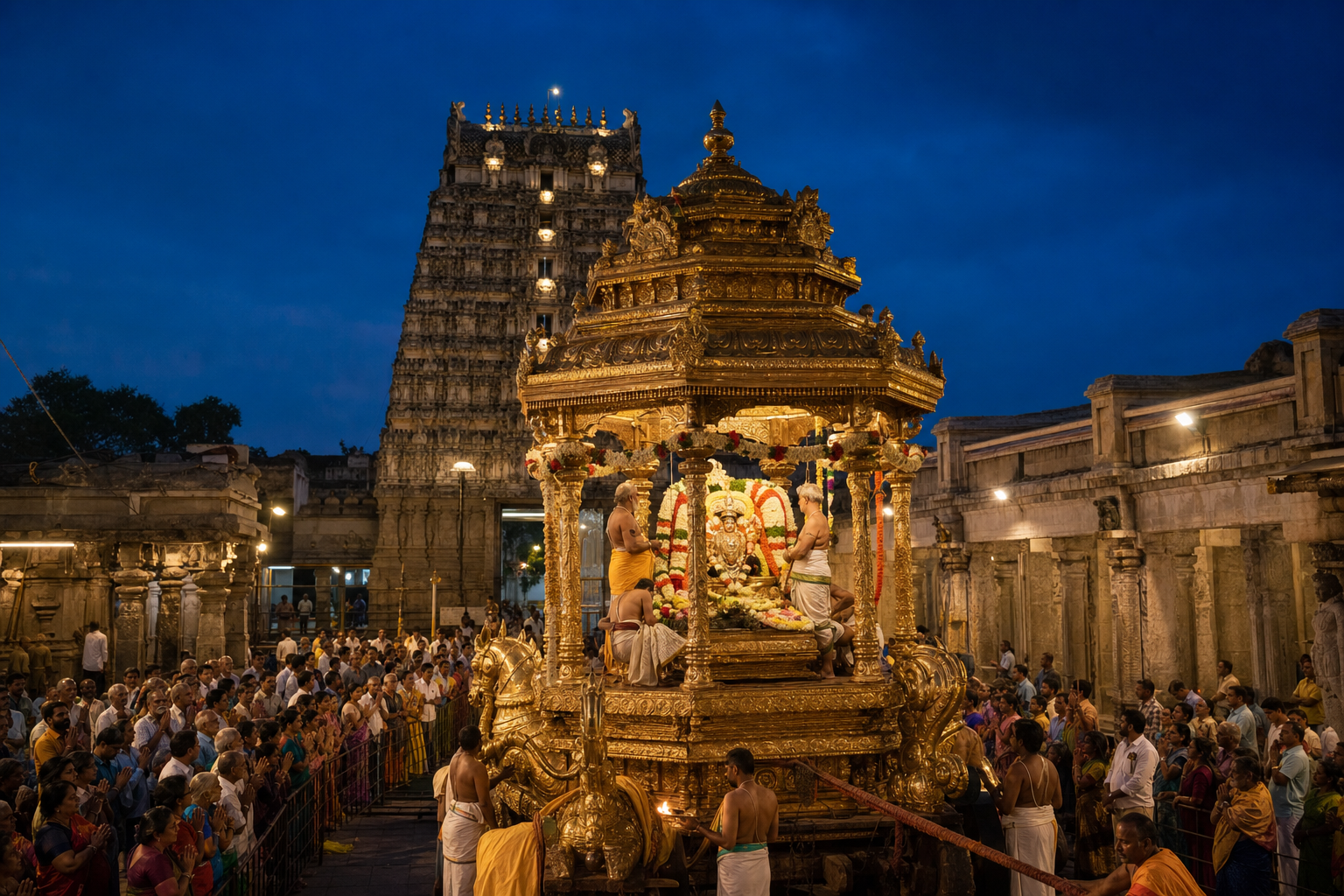
If the Golden Chariot is the reason you are travelling to Srinivasa Mangapuram, protect the evening of 8 May. If your purpose is the wider Vasanthotsavam experience, you have three festival days to work with, each carrying the central rhythm of abhisheka, Unjal Seva and processional worship.
The useful distinction is between the dates and special event already announced, and the operational details that Tirumala Tirupati Devasthanam (TTD) may still update. Build your pilgrimage around the firmest points, leave room for local queue and route instructions, and you can approach the festival as worship rather than a race against an overpacked itinerary.
The three-day schedule at a glance
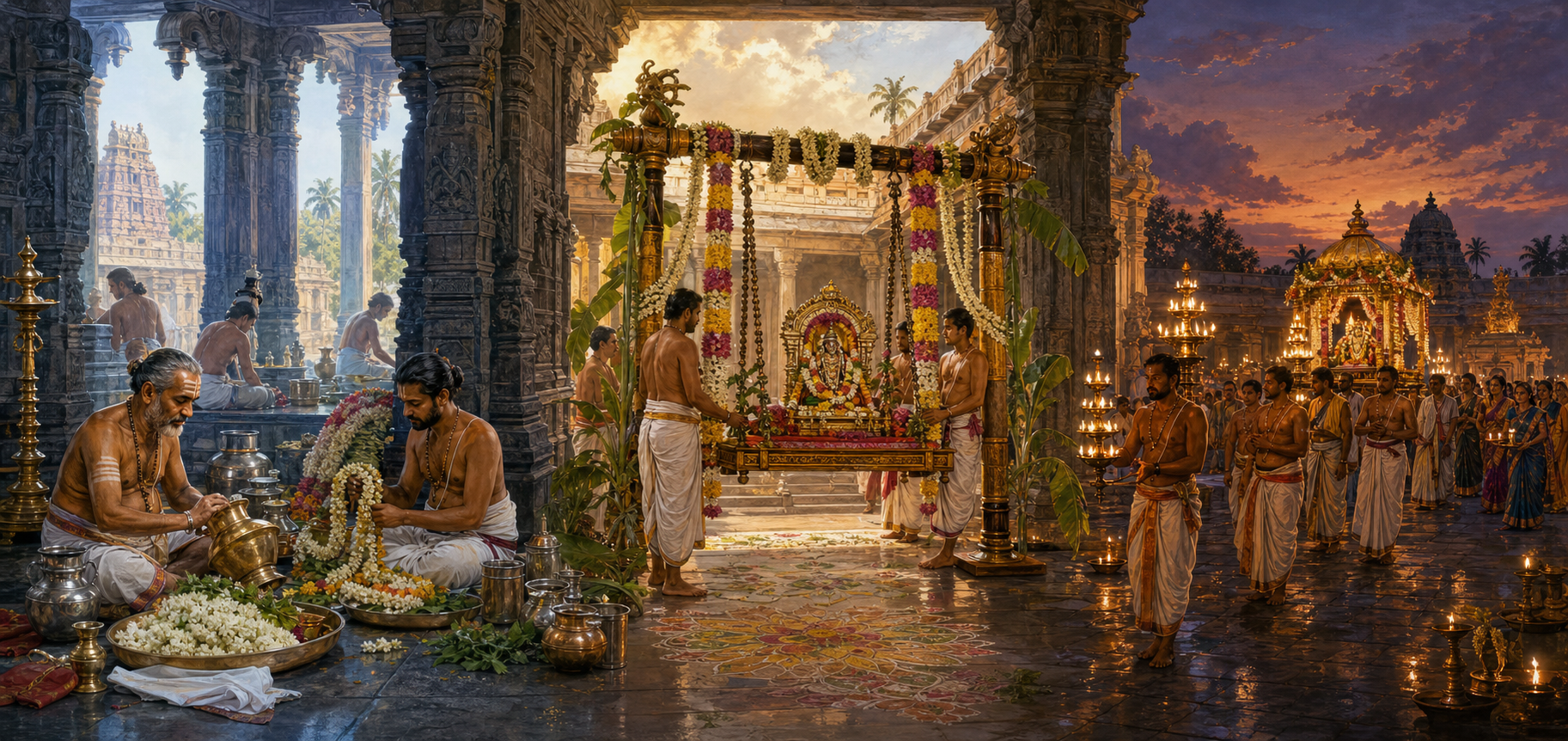
Srinivasa Mangapuram Vasanthotsavams will run from 7 to 9 May 2026 at Sri Kalyana Venkateswara Swamy Temple in Srinivasamangapuram, near Tirupati. Snapana Tirumanjanam, Unjal Seva and a ceremonial procession form the daily programme.
| Date | Core observances | Special planning point |
|---|---|---|
| 7 May 2026 | Snapana Tirumanjanam, Unjal Seva and ceremonial procession | First day of the three-day festival |
| 8 May 2026 | Snapana Tirumanjanam, Unjal Seva and ceremonial procession | Swarna Ratham procession with the Lord, Sridevi and Bhudevi from 6:00 pm to 7:00 pm |
| 9 May 2026 | Snapana Tirumanjanam, Unjal Seva and ceremonial procession | Final day of the festival |
The 8 May chariot hour is the clearest fixed time in the programme. Precise daily hours for the other observances should be checked again closer to your visit. That matters because a broad expectation such as “morning” is useful for choosing a travel day, but it is not a substitute for the final TTD schedule.
Choose the day that matches your purpose
You do not need the same plan as every other pilgrim. Decide first which darshan would make the journey meaningful for you, then arrange transport and accommodation around that choice.
- If the Swarna Ratham is your priority, attend on 8 May. Sri Kalyana Venkateswara Swamy will come in procession with Sridevi and Bhudevi between 6:00 pm and 7:00 pm.
- If Snapana Tirumanjanam or Unjal Seva is your central interest, all three dates belong in your decision. The core observances are planned daily, so you need not force a one-day journey onto the busiest special-event window.
- If you want to experience the festival as a complete arc, plan for 7 through 9 May and reserve your stay before the first day. This removes the pressure to fit every form of seva into a single visit.
- If you are travelling with children or senior family members, choose the schedule they can sustain. A shorter, attentive visit is more valuable than keeping the family in a crowded area simply to complete an ambitious checklist.
Crowd density is generally expected to peak around the Golden Chariot period on 8 May. Arrive well before the procession begins, enter only through designated queues and follow the movement directions given by temple volunteers. Do not treat 6:00 pm as an arrival time; it is the scheduled beginning of the event you came to witness.
The temple-street procession brings the utsava murtis into shared public space, but that does not guarantee an unobstructed position for every devotee. Let the queue system determine where you stand, and do not block a procession route while searching for a preferred view. Darshan depends as much on orderly collective conduct as on physical proximity.
Read the sevas as one ritual sequence
Vasanthotsavam is not a collection of unrelated attractions. Its ritual language moves from seasonal bathing and adornment to repose, music and public procession. Knowing that sequence changes what you notice when the temple is crowded and individual moments pass quickly.
Snapana Tirumanjanam: cooling the season through seva
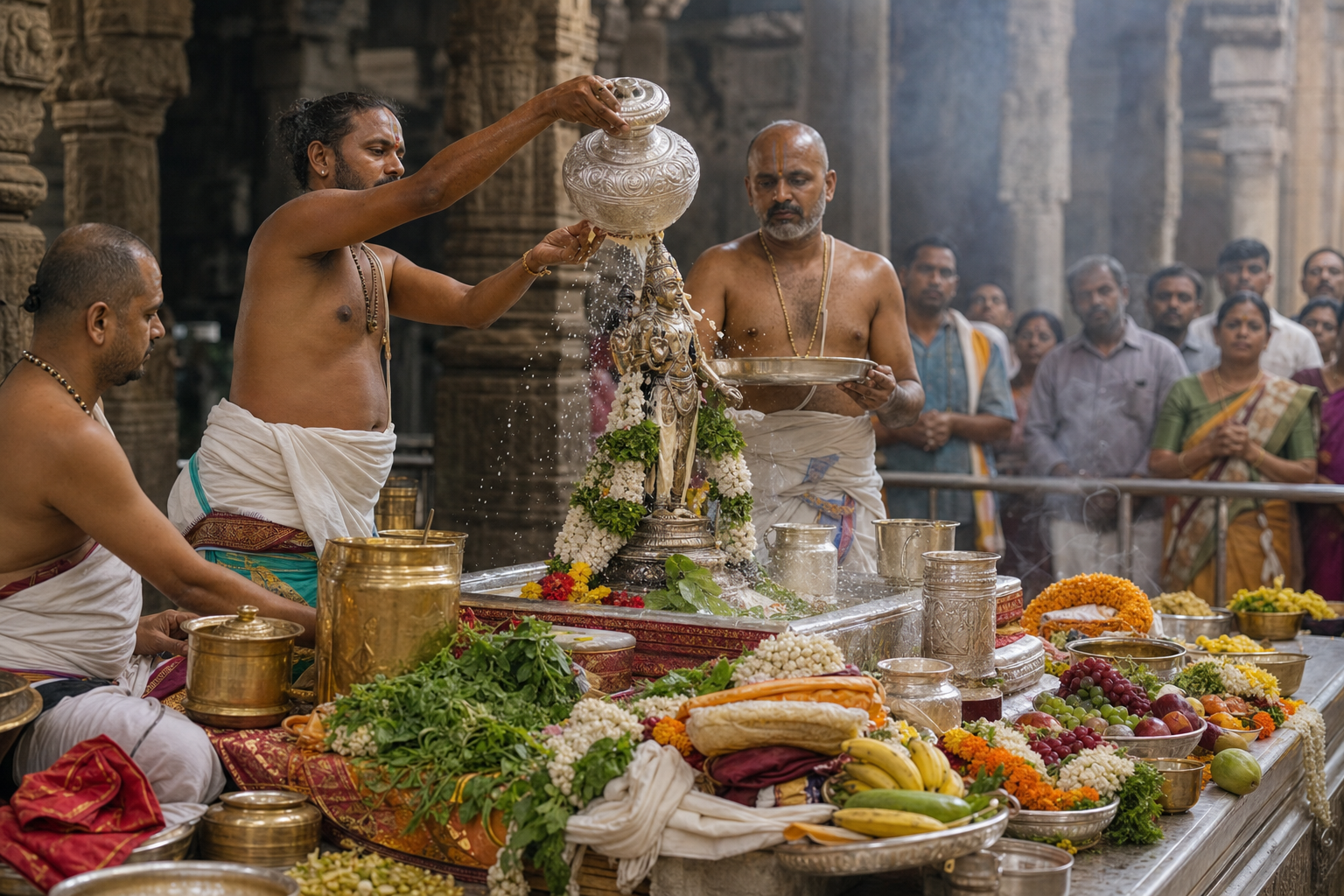
Snapana Tirumanjanam is an elaborate abhisheka. Its ritual materials include substances traditionally valued for their cooling and fragrant qualities, such as sandal paste, tulasi and aromatic waters. Panchamrita brings together milk, curd, ghee, honey and sugar.
The bathing is both seasonal and theological. The materials respond to Vasantha through coolness and fragrance, while the act of offering expresses care for the deity and invokes auspiciousness, health and prosperity for the community. When you attend, notice the disciplined order of the offerings rather than seeing the rite merely as a display of abundance. Each substance enters a larger grammar of purification, hospitality and devotion.
Unjal Seva: devotion carried by rhythm
During the evening Unjal Seva, the utsava murtis are placed on a gently moving swing or pallaki. Veda parayanam, Divya Prabandham recitation and Annamacharya sankeerthanas accompany the seva, joining Sanskrit revelation, Sri Vaishnava Tamil hymnody and Telugu bhakti music in one worship setting.
You do not need to understand every recited word to enter the discipline of the moment. Follow the cadence, allow your breathing to settle and keep conversation to a minimum. The measured swing gives visible form to balance; the sound keeps attention gathered around the deity rather than dispersed through the crowd.
Swarna Ratham: divine sovereignty in the temple streets
The second-day procession is the festival’s most visually distinctive moment. Sri Kalyana Venkateswara Swamy appears in regal splendour with Sridevi and Bhudevi, surrounded by the radiance of the golden chariot, floral alankaram, music and percussion.
Sridevi and Bhudevi are not incidental additions to the scene. Their presence places divine grace, the sustaining earth, abundance and dharmic order within the same image. The chariot carries that image beyond the immediate sanctum and turns the veedhis into corridors of worship. Watch the relationship among the three deities, the ratham and the assembled community; that relationship is the theological heart of the procession.
The liturgy remains distinctly Vaishnava, even while its language of renewal and seva is intelligible across the Dharmic family. A Buddhist, Jain or Sikh visitor can recognise disciplined service and communal sacred space without flattening the differences among traditions. Respecting the festival’s own Vaishnava form is the soundest basis for finding that wider resonance.
Build a practical Tirupati-to-temple plan
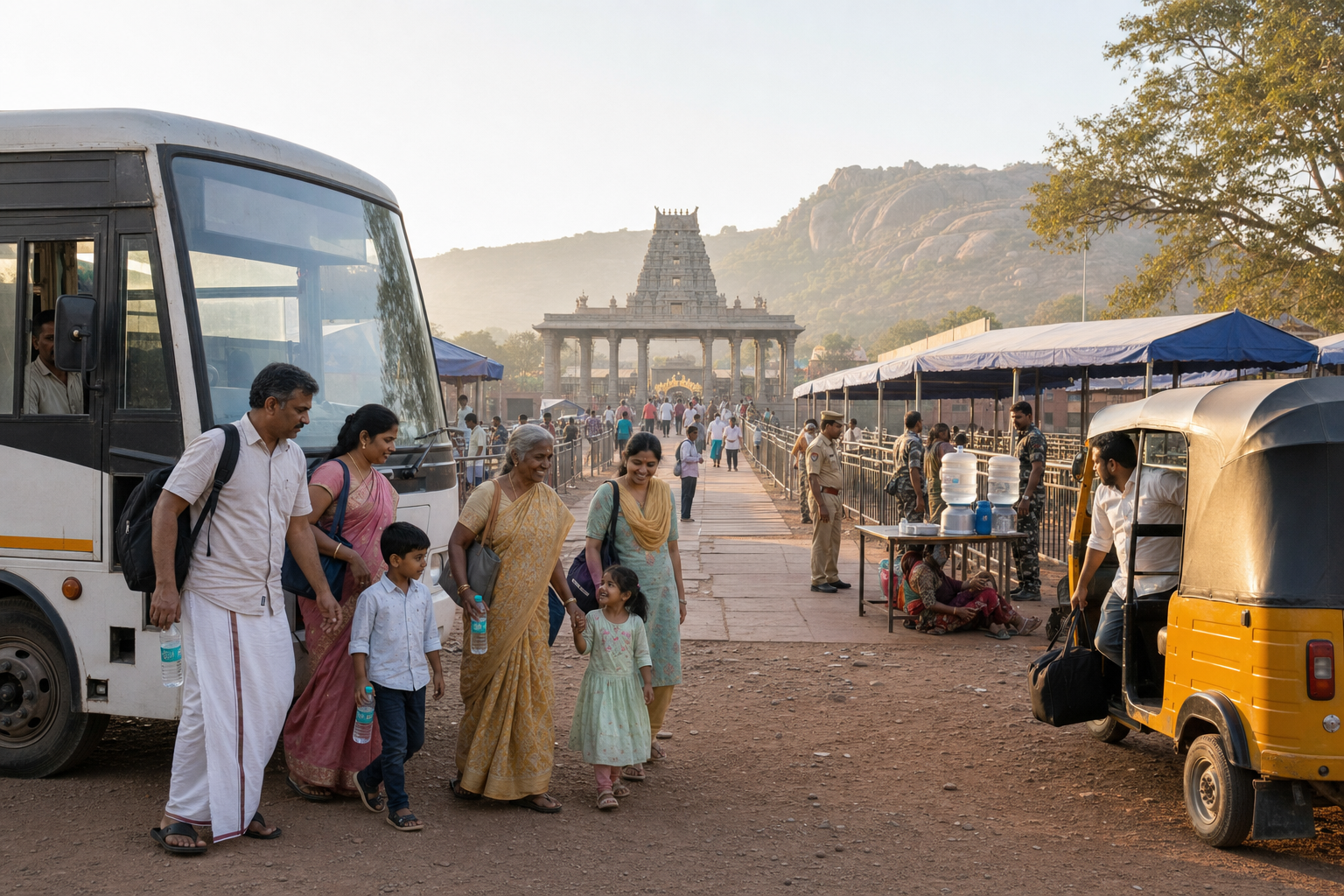
- Choose your base before choosing every activity. Srinivasa Mangapuram is approximately 12 km southwest of Tirupati, so accommodation in Tirupati or a nearby town can support a day visit. Reserve in advance rather than assuming festival-period availability.
- Select transport that suits your group. APSRTC buses, taxis and private vehicles can be used to reach Srinivasamangapuram. If you drive, verify parking and vehicle-movement instructions separately because procession-day access and routes may change.
- Anchor 8 May around the 6:00-7:00 pm chariot window. Keep the surrounding hours flexible so security screening, queues and local movement controls do not turn a tight connection into a missed procession.
- Wear modest temple-appropriate clothing and expect security screening. Observe photography restrictions within sanctified precincts. A procession in a public-facing temple street does not cancel the rules applied inside the sacred complex.
- On arrival, identify the correct queue, water points and the volunteers giving movement instructions. This is especially useful when your group includes children, senior citizens or someone visiting the temple for the first time.
- Keep your group coordinated. Agree on a simple meeting point before entering a dense queue, and ensure each person knows which date and event you are attending. That small step is more dependable than trying to communicate across a moving procession crowd.
The most important practical habit is to separate an announced festival highlight from a guaranteed access arrangement. The Swarna Ratham time gives you an itinerary anchor. Queue locations, movement routes, seva access and local restrictions remain matters for the final TTD notifications and on-site directions.
Pilgrim FAQ
Are exact times available for every daily seva?
The present planning pattern places Snapana Tirumanjanam in the morning and Unjal Seva and processions in the evening. The specific time stated for 2026 is the 8 May Swarna Ratham procession from 6:00 pm to 7:00 pm. Recheck TTD updates for the final daily timetable, routes and access arrangements before leaving for the temple.
What support can families and senior citizens expect?
Festival arrangements at TTD-managed temples typically include signage, water points and organised queues intended to support families, senior citizens and first-time visitors. Treat these as on-site support, not as a promise of a dedicated or priority darshan route. Ask a temple volunteer which queue applies to your group before joining it.
Should you rely on annadanam for a fixed meal plan?
Annadanam facilities in and around Tirupati express the festival’s wider spirit of seva, but the festival details do not fix a particular serving place or time. Confirm arrangements locally and do not make an unverified annadanam schedule your only meal plan, especially when travelling with children or older relatives.
Choose your festival day now, reserve your Tirupati-area stay if needed, and make one final TTD schedule check shortly before travel. Then arrive with enough time to follow the temple’s rhythm: receive the darshan available to you, make room for other devotees and let seva, rather than schedule anxiety, define the visit.