
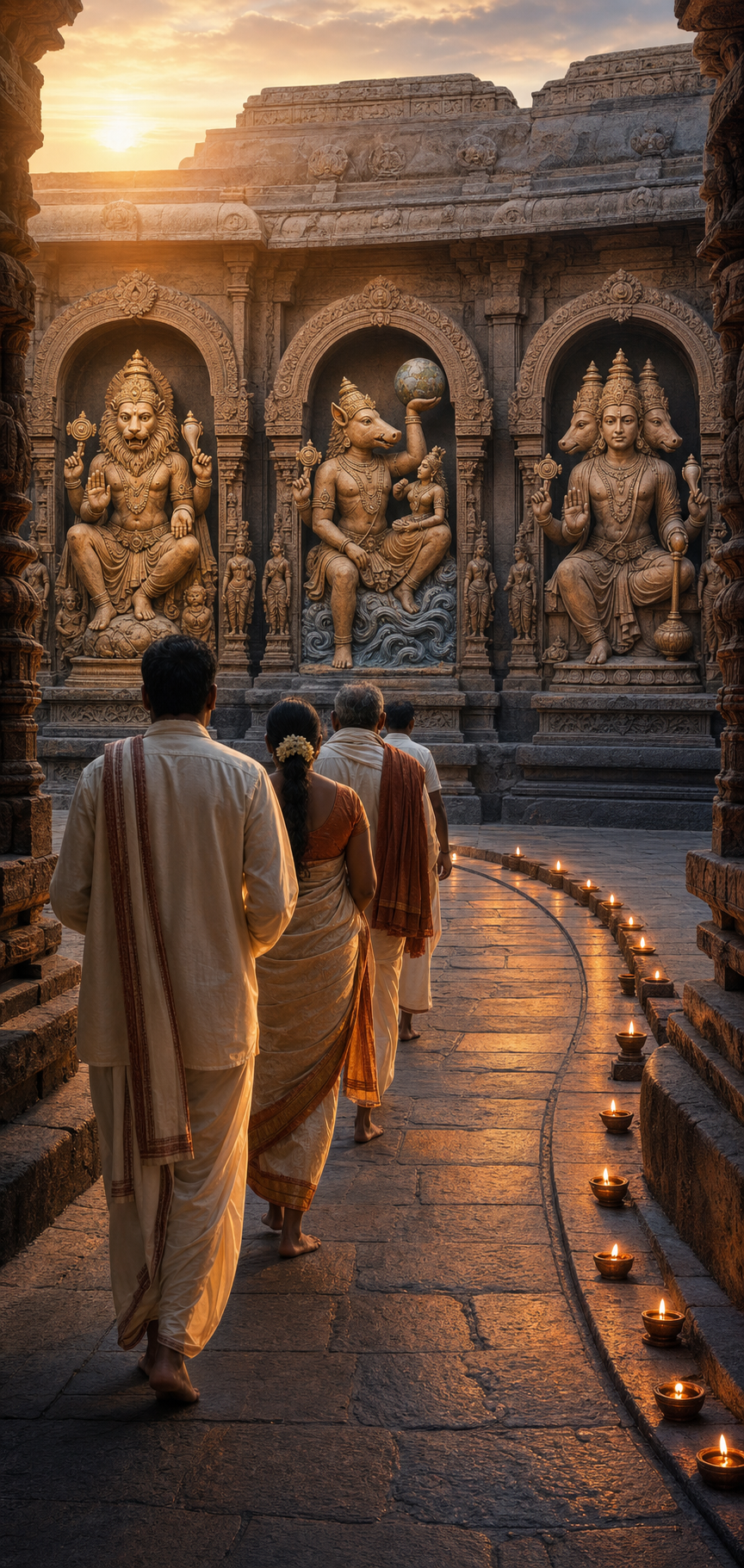
You may reach a temple knowing that the deity is Vishnu but still wonder why the murti has a lion’s face, a boar’s head, several faces, or the posture of a restrained yogi. Do not stop at asking which avatara you are seeing. Ask what kind of disorder the form confronts, what it preserves or restores, and how the temple asks you to approach it.
That shift turns iconography into a practical part of pilgrimage. Narasimha, Varaha, and Vaikuntha Chaturmukha do not offer three interchangeable pictures of divine safety. They reveal protection as the defense of dharma, the recovery of a damaged world, and the power to guard a whole field of life without losing its unifying center.
Three forms answer three different kinds of danger
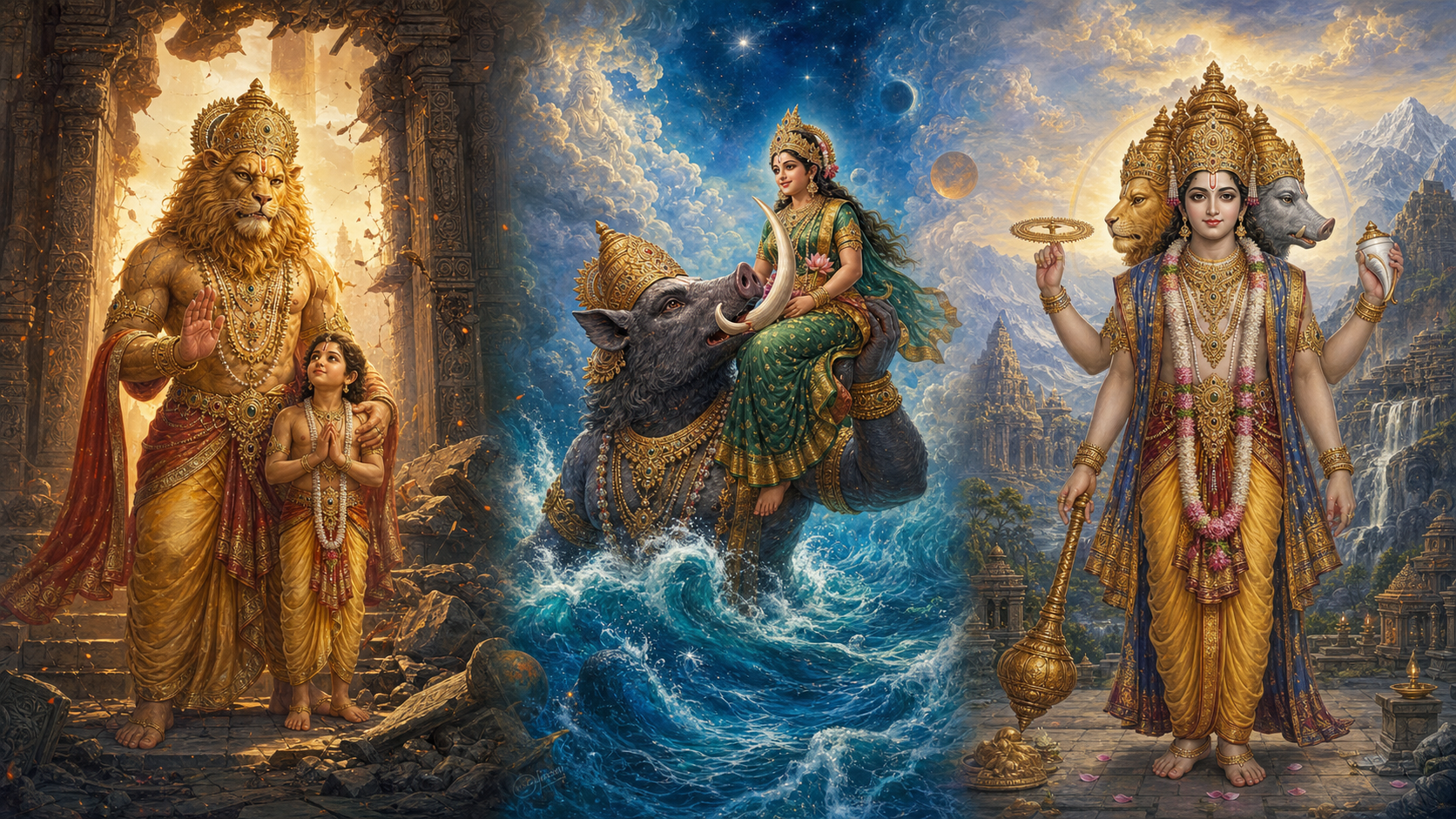
Vishnu’s protection is larger than the idea of being shielded from an unpleasant event. In these forms, protection may be decisive resistance to adharma, patient restoration after upheaval, or the integration of several powers into one sustaining presence. If you recognize which mode is before you, your prayer can become more precise.
Narasimha: protection that confronts adharma
Narasimha’s leonine form communicates that dharma is not defenseless. Yet the lion face does not always mean explosive movement. At the Padalathri Narasimhar Temple at Singaperumal Koil, the presiding form is revered as Yoga Narasimha: the upper hands carry the Vaishnava signs of shankha and chakra, while the lower hands and yogapatta establish a controlled, contemplative posture.
This combination corrects a common misreading. Sacred strength is not the same as uncontrolled aggression. The leonine head declares the capacity to stop adharma; the yogic body shows mastery over that capacity. Ahobilavalli Thayar’s presence adds Sri’s compassion and auspiciousness to the temple’s visual teaching. When you pray here, ask for courage governed by discernment, not merely victory over an opponent.
Varaha: protection that retrieves and re-establishes
Varaha meets a different crisis. The Earth has been displaced into cosmic submergence, so preservation requires recovery and re-grounding. The anthropomorphic murti usually joins a boar’s head to a human body and may include Bhudevi. Shankha and chakra identify Vishnu’s sovereignty, while Bhudevi makes clear what is being protected: not an abstraction, but the living Earth.
At Tirumala, this meaning shapes the pilgrimage itself. The hill is remembered as Adi Varaha Kshetra, and Sri Varahaswami receives ritual precedence before Sri Venkateswara. You are not merely looking at the avatara who restored Bhudevi; by beginning with Varaha, you acknowledge that aspiration rests upon a world already sustained for you.
Make that recognition concrete. Treat the tank, pathways, queues, food, water, and waste as parts of your worship. Careless conduct around sacred land contradicts the very protection you have come to honor.
Vaikuntha Chaturmukha: protection from every direction
Vaikuntha Chaturmukha gathers several protective powers into one body. The form became especially prominent in Kashmir from the seventh century CE onward and received a canonical framework in the Vishnudharmottara Purana. Its human, leonine, boar, and rear fierce faces create an image that sees and guards beyond a single line of sight.
The frontal human face provides composure and accessibility. Narasimha contributes the power to resist a threat to dharma. Varaha contributes the strength to recover what has fallen into disorder. The rear face, often inaccessible to ordinary frontal viewing, preserves an element of awe and unknowability. Protection here is neither passivity nor force alone. It is a complete field of awareness containing clarity, resistance, restoration, and mystery.
The form can recall the Vaishnava idea of the caturvyuha, in which differentiated powers remain rooted in one source, but you should not assign each face to a member of the caturvyuha as though the two schemes were a strict one-to-one code. The useful principle is unity without flattening plurality.
Read the whole murti before naming it
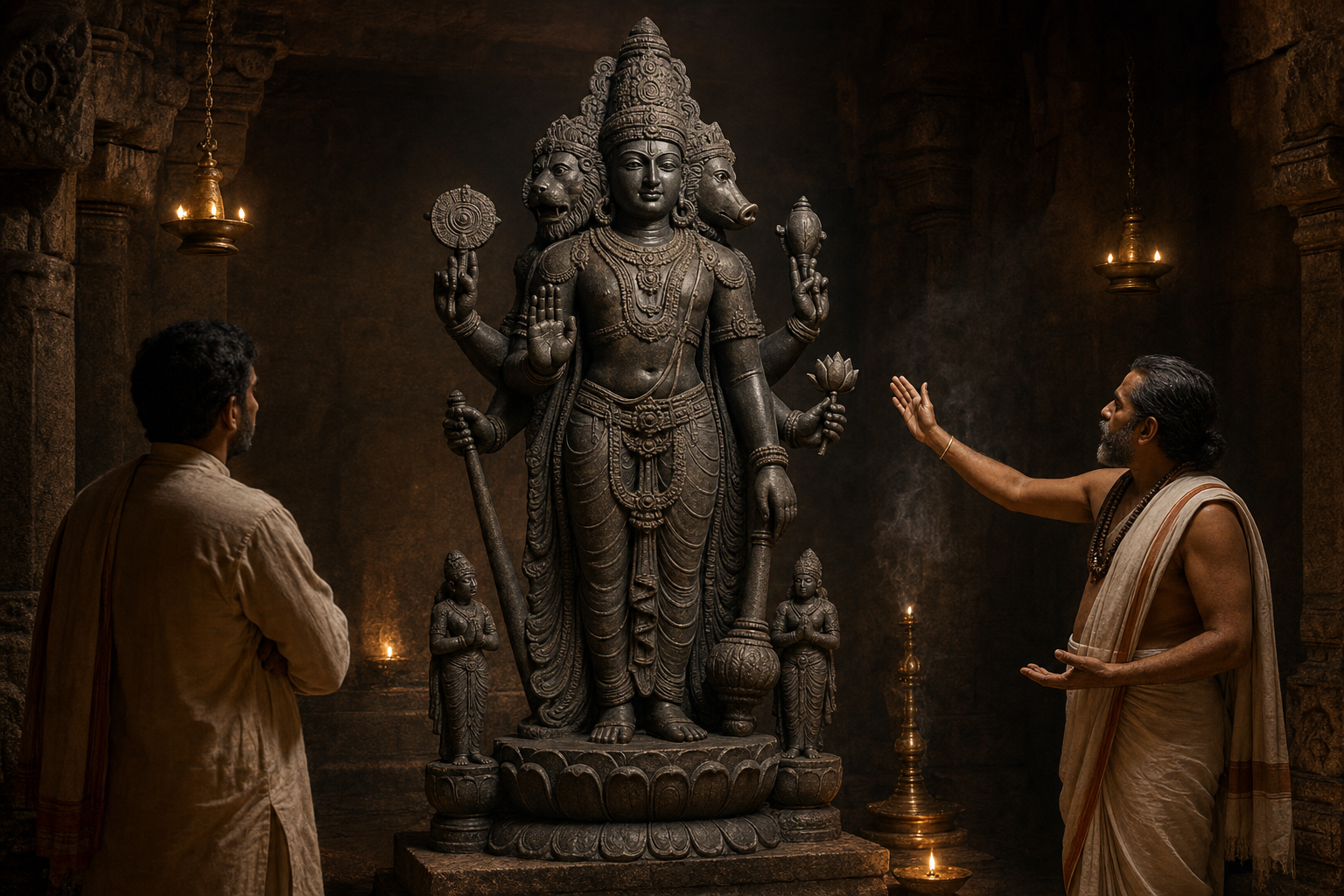
A head, weapon, or gesture can provide a clue, but iconographic identification becomes reliable only when several clues agree. Use this order when you encounter an unfamiliar Vishnu murti:
- Count the faces and check the viewpoint. A lion face points toward Narasimha and a boar face toward Varaha. In a typical Vaikuntha Chaturmukha arrangement, the calm human face is frontal, Narasimha is on the deity’s right, Varaha is on the deity’s left, and a fierce face is behind. When you stand before the murti, the deity’s right appears on your left. Do not assume a multi-faced image is damaged because a rear face cannot be seen from the central line of darshan.
- Read posture before judging mood. A leonine face combined with yogic stillness communicates controlled power differently from an actively combative composition. At Padalathri, the yogapatta and settled lower hands are essential to understanding Yoga Narasimha. The face identifies the power; the body shows how that power is being held.
- Use the hands to confirm, not to guess. Shankha and chakra strongly establish Vaishnava identity, but they appear across several Vishnu forms and cannot identify the avatara by themselves. Gada and padma may complete the familiar group of attributes. Abhaya offers reassurance, varada grants a boon, and a teaching gesture may direct attention toward divine instruction rather than combat.
- Look for the relationship around the deity. Bhudevi clarifies Varaha’s work of restoring Earth. Lakshmi or a locally named form of Thayar frames protective power through grace. Garuda, guardians, or personified weapons such as Shankhapurusha and Chakrapurusha can establish the wider Vaishnava setting. These figures are part of the theological sentence, not ornamental leftovers.
- Separate regional style from theological identity. Kashmiri Vaikuntha images may display a tall tiered crown, sharply modeled jewelry, layered garments, or even fitted boots. These features can help you recognize a Himalayan artistic vocabulary, but they do not create a separate deity. First identify the protective form; then ask how a particular region chose to embody it.
Multi-directional imagery also belongs to a wider dharmic visual conversation. Jain chaturmukha sanctuaries make sacred availability face several directions; Buddhist multi-faced bodhisattvas can express far-reaching compassion; and Sadashiva presents differentiated aspects within Shaiva theology. These are meaningful comparisons of visual grammar, not permission to erase doctrinal differences. Compare how plurality is organized around unity while allowing each tradition to speak in its own terms.
Let the pilgrimage route complete the icon’s meaning
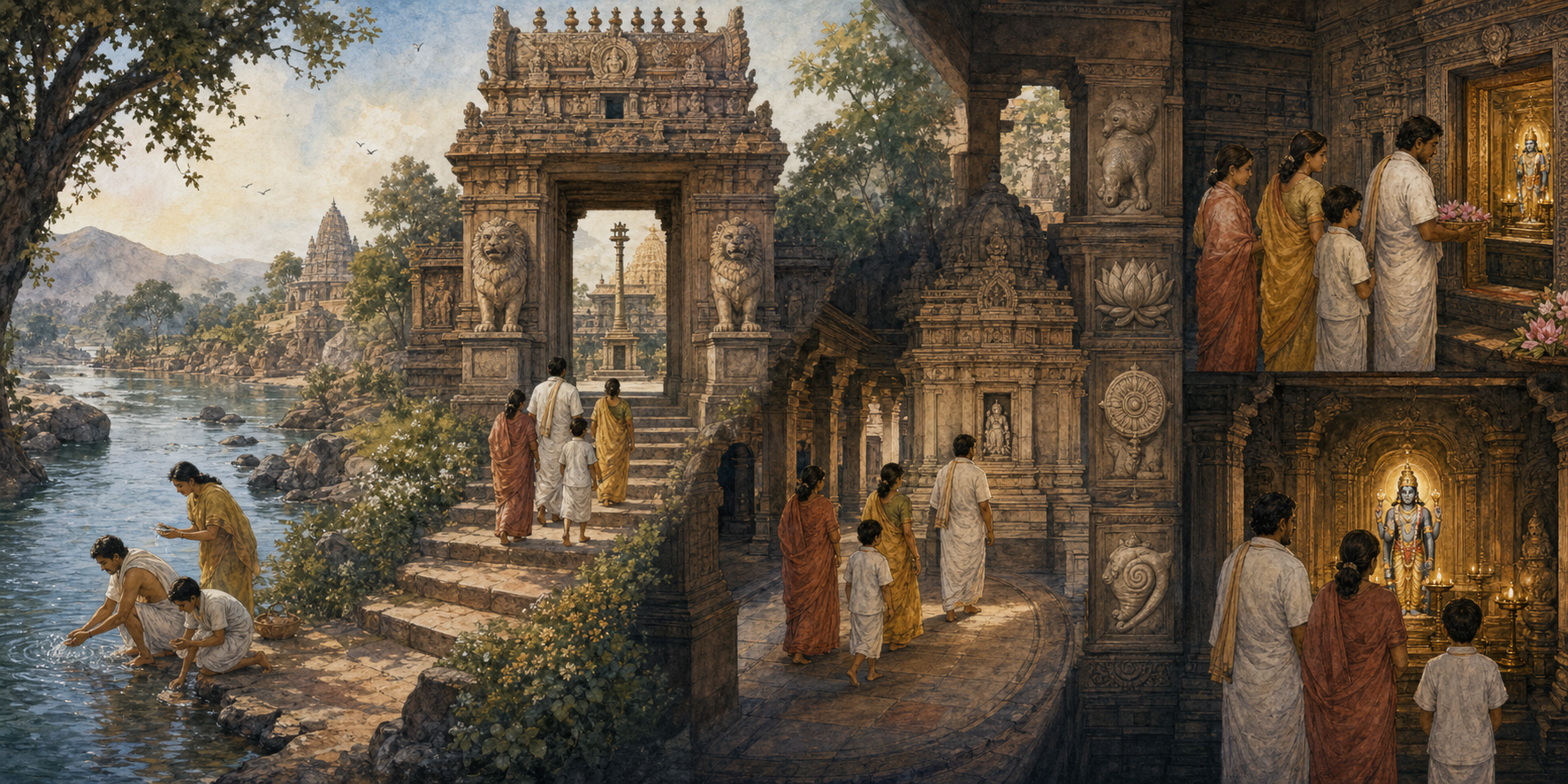
A museum encounter asks you to study an object from permitted angles. A living temple adds thresholds, water, ascent, waiting, offerings, companion shrines, and circumambulation. Those actions are not logistical clutter around the icon. They can disclose what the icon means.
At Tirumala, allow restoration to precede grace
Sri Varahaswami Temple stands on the northern bank of Swami Pushkarini, close to the Sri Venkateswara Temple. A traditional sequence begins near the tank, continues with Varaha darshan, and then proceeds to Venkateswara. The order enacts the remembered covenant in which Varaha grants Srinivasa a place on the hill while retaining first worship and a share of offerings.
If conditions permit, approach the sequence deliberately. Pause near Pushkarini without treating the water body as a backdrop for noise or waste. Receive Varaha darshan as acknowledgment of the ground, Earth, and kshetra that make the rest of the pilgrimage possible. Then enter the larger Venkateswara pilgrimage with gratitude rather than beginning only with a request.
Access arrangements, darshan timings, security rules, and festival crowd controls can change. Confirm current instructions from Tirumala Tirupati Devasthanam before fixing your route, and follow on-site directions if the ideal sequence is temporarily unavailable. Ritual meaning does not authorize you to obstruct a queue or cross a restricted boundary.
At Padalathri, notice how fierceness enters stillness
Padalathri Narasimhar Temple is traditionally dated to the eighth century CE and belongs to the Pallava rock-cut idiom. The sanctum is hewn into a red hill, with later structural additions extending the temple around it. The approach therefore moves from road and settlement, up stone steps, and into the concentrated enclosure of a cave-cut garbhagriha.
Use the ascent to settle your attention before you inspect details. At the sanctum, hold two features together: the leonine visage and the yogic restraint. Then receive Ahobilavalli Thayar’s darshan without treating it as secondary decoration to Narasimha’s power. The pairing teaches that the defense of dharma is completed by compassion, auspiciousness, and care.
On crowded days, the practical order of Thayar and Narasimha darshan may depend on queue movement. Follow temple guidance. The purpose is not to force a privately designed sequence onto a living shrine, but to remain attentive to the relationship the shrine has already established.
Before a multi-faced murti, let movement become interpretation
When a Vaikuntha Chaturmukha image is installed so that circumambulation is permitted, different faces become legible as you move. Begin with the frontal human serenity. Notice Narasimha’s flank as the demand for courage, Varaha’s flank as the duty to restore and uphold, and the rear as a reminder that divine reality exceeds the portion available to frontal sight.
Never step behind a sanctum icon, enter a prohibited area, or disrupt worship merely to complete an art-historical inspection. If only the front and side profiles are available, let the unseen rear face do its theological work precisely as unseen. Knowledge of the full scheme can deepen darshan without turning darshan into trespass.
Key takeaways
- Narasimha protects through decisive strength. Posture tells you whether a particular murti emphasizes active intervention, yogic restraint, or another local devotional mode.
- Varaha protects by restoring the ground of life. A boar-headed Vishnu with Bhudevi directs attention toward Earth, stability, recovery, and responsible care for the kshetra.
- Vaikuntha Chaturmukha protects as an integrated presence. The human, lion, boar, and rear fierce faces should be read as powers united in one Vishnu, not as unrelated beings assembled together.
- Weapons confirm identity but rarely finish the interpretation. Read shankha and chakra alongside face, posture, gesture, companions, and placement.
- The route is part of the teaching. First worship at Tirumala, ascent at Padalathri, and permitted circumambulation around a multi-faced image each turn theology into embodied practice.
- Temple discipline outranks private curiosity. Local ritual order, access rules, queue instructions, and sanctum boundaries remain binding even when another viewing angle would help your study.
Carry one protective discipline home
Protective iconography becomes useful beyond the temple when you translate darshan into conduct. Narasimha asks where fear has made you tolerate adharma and whether you can respond without becoming reckless. Varaha asks what damaged part of your material world you are prepared to lift, clean, repair, or support. Vaikuntha asks whether you can hold several necessary perspectives together without abandoning a dharmic center.
After darshan, write down three questions: What must be confronted? What must be restored? What must be held together? Choose one answer that is actually within your responsibility and take the first step within a day. That is a more faithful response to Vishnu’s protection than leaving the temple with only a photograph or a vague wish to feel safer.
References
- DharmaRenaissance Blog – Vaikuntha Chaturmukha Vishnu Revealed: The Majestic Four-Faced Theophany of Kashmir
- DharmaRenaissance Blog – Sri Varahaswami Temple, Tirumala: Timeless Legends, Sacred Routes, and Ritual Significance
- DharmaRenaissance Blog – Awe-Inspiring Padalathri Narasimhar Temple: Pallava Rock-Cut Sanctum at Singaperumal Koil